
TRW & Co · Employment
Unfair dismissal compensation calculator

Unfair dismissal compensation has two parts: a basic award fixed by age, service and capped weekly pay (£751 a week from 6 April 2026), and a compensatory award for your actual financial loss. Until 31 December 2026 the compensatory award is capped at £123,543 or 52 weeks' gross pay; for terminations from 1 January 2027 there is no cap.
Key pointThe effective date of termination decides the qualifying period, the time limit and whether the compensatory award cap applies, so a dismissal on notice in late 2026 can fall under the 2027 rules.
At a glance
Basic award
Redundancy-style formula on gross pay capped at £751, maximum £22,530.
Compensatory award
Net financial loss caused by the dismissal, less mitigation and reductions.
Adjustments
Polkey, up to 25% either way for the ACAS Code, and contributory fault.
Cap until 2027
Lower of £123,543 and 52 weeks' gross pay for EDTs to 31 December 2026.
From 1 Jan 2027
No cap and a six-month qualifying period (Employment Rights Act 2025).
Time limit
Six months from the effective date of termination (from 1 October 2026).
Swipe or scroll →
Unfair dismissal compensation calculator: the short answer
This unfair dismissal compensation calculator estimates the two awards an employment tribunal normally makes when it finds a dismissal unfair: a basic award, worked out by a fixed formula like statutory redundancy pay, and a compensatory award for the financial loss the dismissal caused. The tribunal then adjusts the compensatory figure for mitigation, the chance of a fair dismissal anyway, any breach of the ACAS Code and your own conduct.
Two dates change the arithmetic. For an effective date of termination from 6 April 2026, the basic award uses a week's pay capped at £751 and the compensatory award cap is the lower of £123,543 and 52 weeks' gross pay. For an effective date of termination on or after 1 January 2027, the cap disappears: section 25 of the Employment Rights Act 2025 repeals it, and the commencement regulations bring that into force on that date.
We have written this for employees weighing up a claim or a settlement offer, and for employers who need a realistic view of exposure. It explains each input in the tool and the law behind it. For the wider claim, see our guide to unfair dismissal, and for representation, our employment tribunal solicitors in London.
Use the unfair dismissal compensation calculator
Start with the effective date of termination, because it decides which limits apply. Then enter your age and service for the basic award, and your pay, benefits and expected period of loss for the compensatory award. The percentage fields let you test the deductions a tribunal might make. Defaults show a hypothetical employee aged 40 with six years' service on £900 a week gross.
Interactive tool
Unfair dismissal compensation calculator (2026 and 2027 rules)
Estimates the basic award and compensatory award under sections 119 to 124A of the Employment Rights Act 1996, applying the cap only where it still applies. It cannot tell you whether the dismissal was unfair.
Without JavaScript: the basic award is 0.5, 1 or 1.5 weeks' gross pay (capped at £751) per complete year of service, by age, up to 20 years. The compensatory award is your net lost pay and benefits plus expenses, less new earnings, then reduced for the chance of a fair dismissal and your own conduct, and adjusted by up to 25% for ACAS Code breaches. Before 1 January 2027 it is capped at the lower of £123,543 and 52 weeks' gross pay.
With the defaults, the basic award is six weeks at the capped £751, so £4,506. The compensatory award is 26 weeks of net pay and pension contributions (£18,850), plus £500 of other losses, less £4,000 of new earnings, giving £15,350; a 10% uplift for an unreasonable failure to follow the ACAS Code takes it to £16,885. The 52-week limb of the cap (£46,800) is not reached, so the total is £21,391. Change the termination date to January 2027 and the cap line changes to "no statutory cap".
Tribunals compensate loss, not hurt feelings. Unless the dismissal was also discriminatory, there is no award for injury to feelings in an ordinary unfair dismissal claim, so the strength of the evidence about future earnings usually matters more than anything else in the schedule of loss.
Can you claim? Qualifying period and time limits
To bring an ordinary unfair dismissal claim you must be an employee and have the qualifying period of continuous employment at the effective date of termination. For terminations before 1 January 2027 that period is two years. For terminations on or after that date, section 25 of the 2025 Act reduces it to six months. Under the transitional rule in regulation 4, the new rules apply wherever the effective date of termination falls on or after 1 January 2027, even if notice was given earlier.
No qualifying period applies to automatically unfair dismissals, such as dismissal for whistleblowing, for asserting a statutory right, for pregnancy or family leave, or for health and safety reasons. ACAS explains the main categories. The statutory minimum notice period can also extend the effective date of termination for counting service, which can take an employee over the threshold.
Time limits changed on 1 October 2026. Under section 111 as amended, a claim must be presented within six months beginning with the effective date of termination; before then the limit was three months. The commencement regulations apply the longer period only where the effective date of termination is on or after 1 October 2026, as the government's guidance confirms. You must contact ACAS for early conciliation before you can issue, and doing so pauses the clock. For more detail, see our guide to employment tribunal time limits.
How the basic award is calculated
The basic award is mechanical. Section 119 uses the same formula as statutory redundancy pay: count complete years of continuous employment backwards from the effective date of termination, up to 20, and allow one and a half weeks' pay for each year in which you were 41 or over, one week for each year aged 22 to 40, and half a week for each earlier year. The basic award does not depend on what you have lost, and it is payable even if you found a better job the next day.
A week's pay for the basic award is gross and capped by section 227. The Employment Rights (Increase of Limits) Order 2026 set the cap at £751 for effective dates of termination on or after 6 April 2026 (previously £719), so the maximum basic award is £22,530. The repeal of the compensatory award cap in 2027 does not touch this limit.
| Rule | Effect | Source |
|---|---|---|
| Age multipliers | 0.5, 1 or 1.5 weeks per year by age band | s.119(2) ERA 1996 |
| Service counted | Latest 20 complete years only | s.119(3) |
| Week's pay | Gross, capped at £751 (EDT from 6 April 2026) | s.227; SI 2026/310 |
| Minimum basic award | £9,157 for health and safety, employee representative, trade union and certain other reasons | s.120 ERA; s.156 TULRCA; SI 2026/310 |
| Conduct reduction | May be reduced for conduct before dismissal | s.122(2) |
| Redundancy payment | Deducted in full from the basic award | s.122(4) |
Two reductions are common. If you received a redundancy payment, it is deducted from the basic award under section 122(4), which often reduces it to nil in redundancy cases; any excess reduces the compensatory award under section 123(7). And the tribunal can reduce the basic award for your conduct before dismissal if it is just and equitable, even where that conduct did not cause the dismissal. For redundancy pay itself, our statutory redundancy pay calculator applies the same age bands.
The compensatory award: what counts as loss
Under section 123, the compensatory award is the amount the tribunal considers just and equitable having regard to the loss you sustained because of the dismissal, so far as attributable to the employer's action. It is built from net figures, because the aim is to put you in the position you would have been in, not to give you a gross salary you would have paid tax on.
Past loss of earnings
Net pay from the end of employment (or the end of any notice paid) to the hearing, less what you earned in the meantime.
Future loss
Net pay until you are likely to find equivalent work. The tribunal estimates this on evidence about the job market and your efforts.
Pension and benefits
Employer pension contributions, car, health cover and other benefits you would reasonably have received.
Loss of statutory rights
A conventional sum because you must work again before regaining unfair dismissal protection. It is not fixed by statute.
Expenses
Reasonable costs of looking for work, such as travel to interviews or retraining.
Contractual redundancy excess
Loss of an enhanced redundancy payment, to the extent it exceeds the basic award (s.123(3)).
You must mitigate your loss by looking for suitable work. The tribunal applies the ordinary common law rule (section 123(4)): the employer must show you acted unreasonably, but a tribunal will expect evidence of applications. Earnings from new work reduce the award; if you start a job paying the same or more, future loss usually stops at that point.

Reductions and uplifts
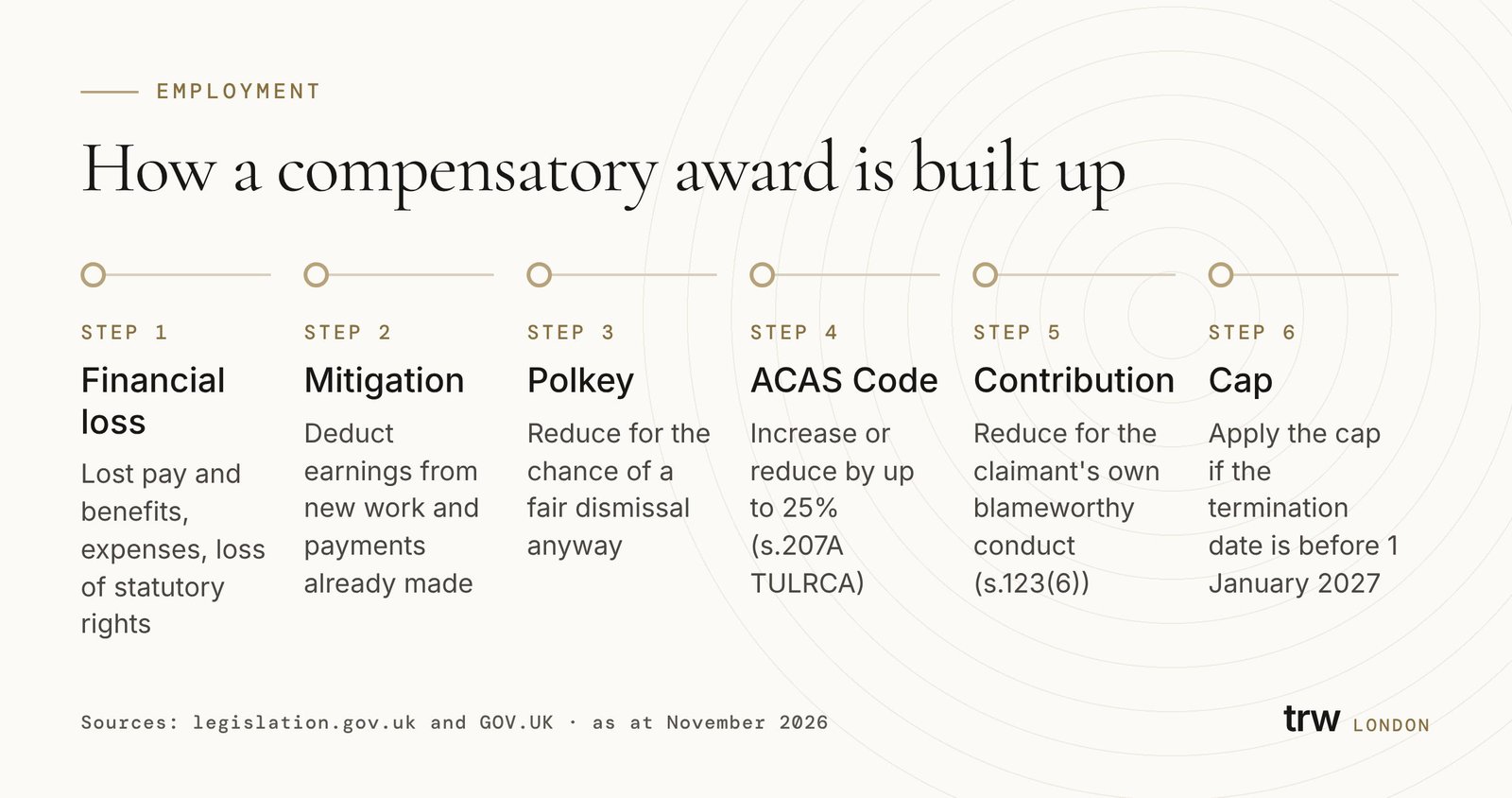
Three adjustments can move the compensatory award substantially. The tool lets you test each one, but in a real case they are fought over on the evidence.
- Polkey reduction. If a fair procedure would or might have led to dismissal anyway, the tribunal reduces compensation to reflect that chance. The name comes from the House of Lords decision in Polkey v A E Dayton Services Ltd (1987). A procedural failing with an inevitable outcome can leave little more than a few weeks' pay.
- ACAS Code adjustment. Under section 207A of the Trade Union and Labour Relations (Consolidation) Act 1992, the tribunal may increase the award by up to 25% where the employer unreasonably failed to follow the ACAS Code of Practice on disciplinary and grievance procedures, or reduce it by up to 25% where the employee did.
- Contributory fault. Where your own conduct caused or contributed to the dismissal, section 123(6) requires a just and equitable reduction. In misconduct cases the reduction can be substantial, and it can also reduce the basic award.
The order matters. Section 124A requires the ACAS adjustment to be applied immediately before the contributory fault reduction, and section 124(5) applies the cap only after all reductions. The calculator follows that sequence. Applying the cap first, as some rough estimates do, can understate an award considerably.
The compensatory award cap and its removal in 2027
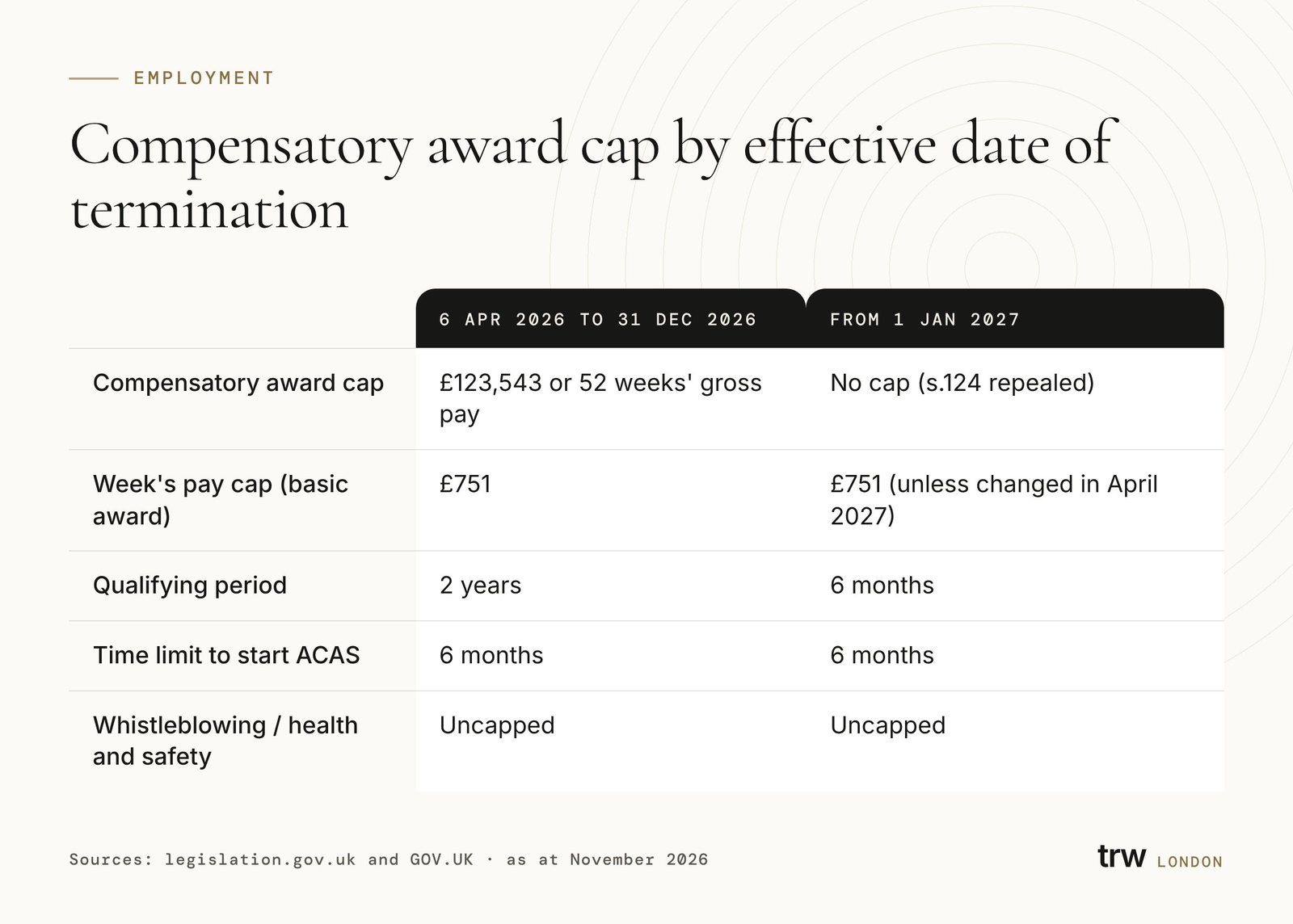
Under section 124, the compensatory award cap is the lower of a fixed sum and 52 weeks' pay. From 6 April 2026 the fixed sum is £123,543 (it was £118,223 for the previous year). The 52-week limb uses actual gross pay, not the capped £751, so for most employees earning under about £123,500 a year the 52 weeks' pay figure is the real ceiling.
The compensatory award cap does not apply where the dismissal is automatically unfair for whistleblowing or for certain health and safety reasons (section 124(1A)). Our guide to whistleblowing protection explains those claims. Discrimination claims brought alongside an unfair dismissal claim are not subject to a statutory cap.
Section 25(3) of the Employment Rights Act 2025 omits section 124 altogether. The Commencement No. 4 Regulations bring this into force on 1 January 2027, and regulation 4 applies it wherever the effective date of termination is on or after that date, even if the employee was dismissed earlier. The government factsheet describes the change as removing the cap on compensatory awards. A dismissal on notice given in late 2026 may therefore be uncapped.
For employers, the practical consequence is that exposure for senior or highly paid staff is no longer limited to a year's pay. For employees, it raises the value of a claim where loss will run for a long time, for example a specialist in a narrow market. Either way, the arithmetic now turns more heavily on evidence about future loss.
Reinstatement, re-engagement and the additional award
A tribunal must first consider whether to order reinstatement (getting your old job back) or re-engagement (a comparable job) if you ask for it. These orders are uncommon, partly because trust has usually broken down. If an order is made and the employer does not comply, section 117 requires compensation and, unless compliance was not practicable, an additional award of between 26 and 52 weeks' pay, with a week's pay capped at £751.
Interest can be added to awards that remain unpaid after the tribunal's decision, and costs orders are possible where a party behaves unreasonably, but they are not the norm. For the overall process from claim form to hearing, see our employment tribunal process guide.
Tax and recoupment of benefits
Compensation for unfair dismissal is a termination payment. Under section 403 of the Income Tax (Earnings and Pensions) Act 2003 it is taxable only to the extent that, with other termination payments, it exceeds the £30,000 threshold. Where a large compensatory award will be taxed, tribunals often "gross up" the award so that you receive the intended net sum; settlement negotiations should do the same.
If you claimed certain state benefits after dismissal, the tribunal's award may be subject to recoupment, meaning part of it is paid to the Department for Work and Pensions instead of to you. Recoupment does not apply to settlements reached through ACAS or under a settlement agreement, which is one reason settlement figures can look lower than a tribunal estimate but be worth a similar amount in cash.
A good settlement is measured against what you would actually receive, after reductions, tax and recoupment, not against the headline cap.
Worked example
Example (hypothetical): a 47-year-old sales director at a London software company, with 11 years' service, is dismissed for alleged poor performance after one meeting and no warning. Gross pay is £2,200 a week, net £1,450, and the employer pension contribution is £180 a week. The effective date of termination is 15 January 2027.
Basic award: six years aged 41 or over at 1.5 weeks and five years aged 36 to 40 at one week gives 14 weeks; at the £751 cap, £10,514. Compensatory award: she expects 40 weeks out of work, so net pay and pension lost is £65,200, plus £600 of expenses, less £8,000 earned from consultancy, giving £57,800. The tribunal finds a 20% chance she would have been dismissed fairly after a proper process (£46,240), adds 15% for ignoring the ACAS Code (£53,176), and makes no contribution reduction.
Because the effective date of termination is after 1 January 2027, there is no compensatory award cap; had it fallen earlier, the 52-week limb (£114,400) would not have reduced the award either. The estimated total is £63,690, before tax and grossing up. Enter these figures in the unfair dismissal compensation calculator to see the steps.
Common pitfalls
Using gross pay for the compensatory award
The basic award uses gross pay; the compensatory award uses net loss. Mixing them up can inflate a claim by a third or more, and a tribunal or the other side will notice.
Assuming the cap is £123,543
For most employees the 52 weeks' gross pay limb is lower, and from 1 January 2027 there is no cap at all for ordinary claims. Check which applies by the effective date of termination.
Ignoring the redundancy payment
A redundancy payment wipes out the basic award up to its value, and any excess comes off the compensatory award. Do not count it twice.
Weak evidence of job hunting
Without a record of applications and responses, a tribunal may cut future loss short. Keep a dated log from the week after dismissal.
Missing the ACAS step
You cannot issue a claim without an early conciliation certificate. Start conciliation well before the six-month deadline; leaving it to the last week risks errors in the dates.
Settlement agreement compensation
How offers compare with a tribunal award.
Read the guideReformEmployment Rights Act 2025
What has changed and what is still to come.
Read the guideProcessDisciplinary and grievance
Following the ACAS Code in practice.
Read the guideDeadlinesTribunal time limits
The six-month rule and early conciliation.
Read the guideNext steps
If you have been dismissed, write down the effective date of termination and diarise the ACAS deadline now. Gather payslips, pension statements and your contract, and start a job-search log. Use the unfair dismissal compensation calculator to frame a realistic range, then take advice on the merits: the figure means little if the dismissal is likely to be found fair.
If you are an employer facing a claim, model the basic award, the likely period of loss and the cap position before responding to ACAS. We usually start by testing the process against the ACAS Code, because that drives both liability and the uplift. Our settlement agreements team can document an exit, and you can book a consultation with our employment lawyers.

Frequently asked questions
01What is the maximum unfair dismissal compensation in 2026?
For an effective date of termination between 6 April 2026 and 31 December 2026, the basic award is capped at £22,530 and the compensatory award at the lower of £123,543 and 52 weeks' gross pay. For terminations on or after 1 January 2027, the compensatory award has no statutory cap.
02Does the removal of the cap apply to dismissals that happened in 2026?
It depends on the effective date of termination, not when notice was given. Under regulation 4 of SI 2026/559 the repeal applies where the effective date of termination is on or after 1 January 2027, even if the employee was dismissed before that date.
03Is the basic award reduced if I get a new job quickly?
No. The basic award is a fixed sum based on age, service and capped weekly pay. Only the compensatory award is reduced by new earnings.
04Can I get compensation for stress or hurt feelings?
Not in an ordinary unfair dismissal claim. Injury to feelings is available for discrimination, and some detriment claims, but the unfair dismissal compensatory award covers financial loss only.
05Do I need two years of service to claim?
For an effective date of termination before 1 January 2027, yes, unless the dismissal is automatically unfair. From 1 January 2027 the qualifying period is six months, under section 25 of the Employment Rights Act 2025.
06How long do I have to claim?
For an effective date of termination on or after 1 October 2026, six months beginning with that date, extended by the time spent in ACAS early conciliation. Earlier terminations kept the three-month limit.
07Is unfair dismissal compensation taxed?
It is tax-free up to the £30,000 termination payment threshold, counting other termination payments; amounts above that are taxable, and tribunals may gross up the award to reflect this.
08Does the compensatory award cap apply to whistleblowers?
No. Section 124(1A) disapplies it where the dismissal is automatically unfair because of a protected disclosure, and for certain health and safety dismissals.
Sources and official materials
- Employment Rights Act 1996, section 124 — Compensatory award cap (£123,543 or 52 weeks' pay) and exceptions
- Employment Rights (Increase of Limits) Order 2026 (SI 2026/310) — Week's pay cap, minimum basic award and cap from 6 April 2026
- Employment Rights Act 2025, section 25 (as enacted) — Six-month qualifying period and repeal of section 124
- Employment Rights Act 2025 (Commencement No. 4 and Transitional and Saving Provisions) Regulations 2026 — 1 January 2027 commencement and EDT transitional rule
- Employment Rights Act 2025 (Commencement No. 5 and Transitional Provisions) (Amendment) Regulations 2026 — Six-month tribunal time limits from 1 October 2026
- Employment Rights Act 1996, sections 119 and 123 — Basic and compensatory award rules
- Trade Union and Labour Relations (Consolidation) Act 1992, section 207A — ACAS Code adjustment of up to 25%
- ACAS: Early conciliation — Mandatory step before issuing a claim
- Business.gov.uk: Employment tribunal time limits — Government confirmation of the October 2026 change
General information only, current as at 23 November 2026. It is not legal advice and does not create a solicitor–client relationship. It reflects the law of England and Wales unless stated otherwise; Scotland and Northern Ireland have separate legal systems, and the law changes frequently. Check current official sources and take advice on the facts of your matter.