TRW & Co · Asylum, deportation and detention
Asylum solicitors in London

An asylum claim asks the UK to recognise you as a refugee or, failing that, to grant humanitarian protection. Claims made from 2 March 2026 lead to 30 months' permission rather than 5 years. The outcome usually turns on the first statement, the interview and the evidence, so early advice matters.
Key pointThe strongest asylum claims are prepared before the interview: a complete, dated witness statement that explains gaps and delays answers most credibility points before they arise.
At a glance
Legal test
Refugee Convention fear of persecution, then real risk of serious harm for humanitarian protection.
Standard of proof
Balance of probabilities for facts, then reasonable likelihood of persecution (claims from 28 June 2022).
Grant length
30 months for claims from 2 March 2026; 5 years for earlier claims and for UASC.
Appeal
14 days from a refusal in the UK, unless the claim is certified.
Reform
A single "core protection" status is in the Immigration and Asylum Bill, not yet law.
Swipe or scroll →
Asylum solicitors in London: who we act for
Asylum solicitors represent people asking the UK for international protection because they cannot safely return to their country. The Home Office decides every asylum claim first as a claim for refugee status under the 1951 Refugee Convention and, if that fails, as a claim for humanitarian protection. Both outcomes now carry shorter permission than they did before March 2026.
We act for adults claiming in the UK, families with children, people whose claims have been refused and who are preparing an appeal, and people who already hold refugee status or humanitarian protection and need to renew it, settle or bring family. We also advise friends, sponsors and community organisations helping someone take the first step.
This page sets out the legal test, the gateways that can stop a claim before its merits are considered, how the process runs, what a grant gives you as at November 2026, and how our London asylum solicitors work.
How our asylum solicitors help
Before the claim is registered
Advice on whether to claim, how and where, and on the risks of delay, including the effect of section 8 of the 2004 Act on credibility.
Statement and evidence
A detailed witness statement taken over several sessions, with documents, country evidence and, where appropriate, medical or expert reports.
The asylum interview
Preparation for the substantive interview and, where funding allows, attendance with you, followed by written representations on anything left unclear.
Refusals and appeals
Appeals to the First-tier Tribunal, onward appeals, fresh claims and judicial review of certification or inadmissibility decisions.
We usually start by listening to the account in full before any document is filed. Asylum cases are lost on gaps and inconsistencies that could have been explained early, so the first meetings are about understanding what happened, in what order, and what proof exists or can be obtained.
The legal test: refugee status and humanitarian protection
Paragraph 334 of Part 11 of the Immigration Rules grants refugee status where the person is in the UK, meets the Refugee Convention definition, is not a danger to national security or, after conviction for a particularly serious crime, to the community, and would be returned in breach of the Convention to a country where they would be persecuted for one of five reasons: race, religion, nationality, political opinion or membership of a particular social group.
For claims made since 28 June 2022, section 32 of the Nationality and Borders Act 2022 sets a two-stage standard of proof. The decision-maker first decides, on the balance of probabilities, whether the person has a protected characteristic (or has one attributed to them) and actually fears persecution because of it. Only then does it ask whether there is a "reasonable likelihood" of persecution on return and an absence of state protection.
Persecution can come from the state, from parties controlling territory, or from non-state actors where the state cannot or will not protect (section 31). Under section 35 a person is not a refugee if they could reasonably relocate to a safe part of their country.
| Refugee status | Humanitarian protection | |
|---|---|---|
| Legal source | Refugee Convention; para 334 | Para 339C and 339CA |
| Core question | Well-founded fear of persecution for a Convention reason | Substantial grounds for a real risk of serious harm |
| Serious harm includes | n/a | Death penalty, unlawful killing, torture or inhuman treatment, indiscriminate violence in armed conflict |
| Permission (claims from 2 March 2026) | Minimum 30 months | Minimum 30 months |
| Permission (claims by 1 March 2026) | Minimum 5 years | Minimum 5 years |
Claims based on events after leaving, and exclusion
A claim can rest on events since the person left home, or on activities in the UK, such as political activity or a religious conversion. Paragraph 339P accepts these "sur place" claims, particularly where the activity continues convictions held before leaving, but paragraph 339J(iv) also asks whether activities were undertaken mainly to create a claim. Evidence of the genuineness and visibility of the activity is therefore central.
Some people are excluded from protection even if they face risk, including those for whom there are serious reasons for considering they committed war crimes or serious non-political crimes abroad, or who are a danger to national security. Exclusion cases need specialist handling from the outset.
Humanitarian protection is considered only if refugee status is refused. Our separate guide to humanitarian protection covers it in more depth, and refugee status in the UK explains what a grant means in practice.
Gateways that can stop an asylum claim early
Several rules decide whether the merits of an asylum claim are examined at all. Paragraph 327AB records a claim as valid only if it is made in person at a designated place, by someone who is not a British citizen, and, for adults, is particularised. A claim is not valid while it falls to be treated as further submissions under paragraph 353.
Claims can be treated as inadmissible under sections 80A and 80B of the 2002 Act, for example where the person travelled through or has a connection with a safe third country. Paragraph 345D of Part 11 provides that an inadmissible claim is admitted to the UK process if removal to a safe third country is unlikely within a reasonable time. Our asylum inadmissibility guide covers this.
Separately, section 94 of the 2002 Act allows the Home Office to certify a protection claim as clearly unfounded, removing the in-country appeal. Since HC 259, nationals of EEA states and Switzerland have been added to the list of claimants who need not be given a personal interview, and a "merged registration" interview can combine registration, screening and basis of claim for claims the Home Office considers clearly unfounded.

From registration to decision
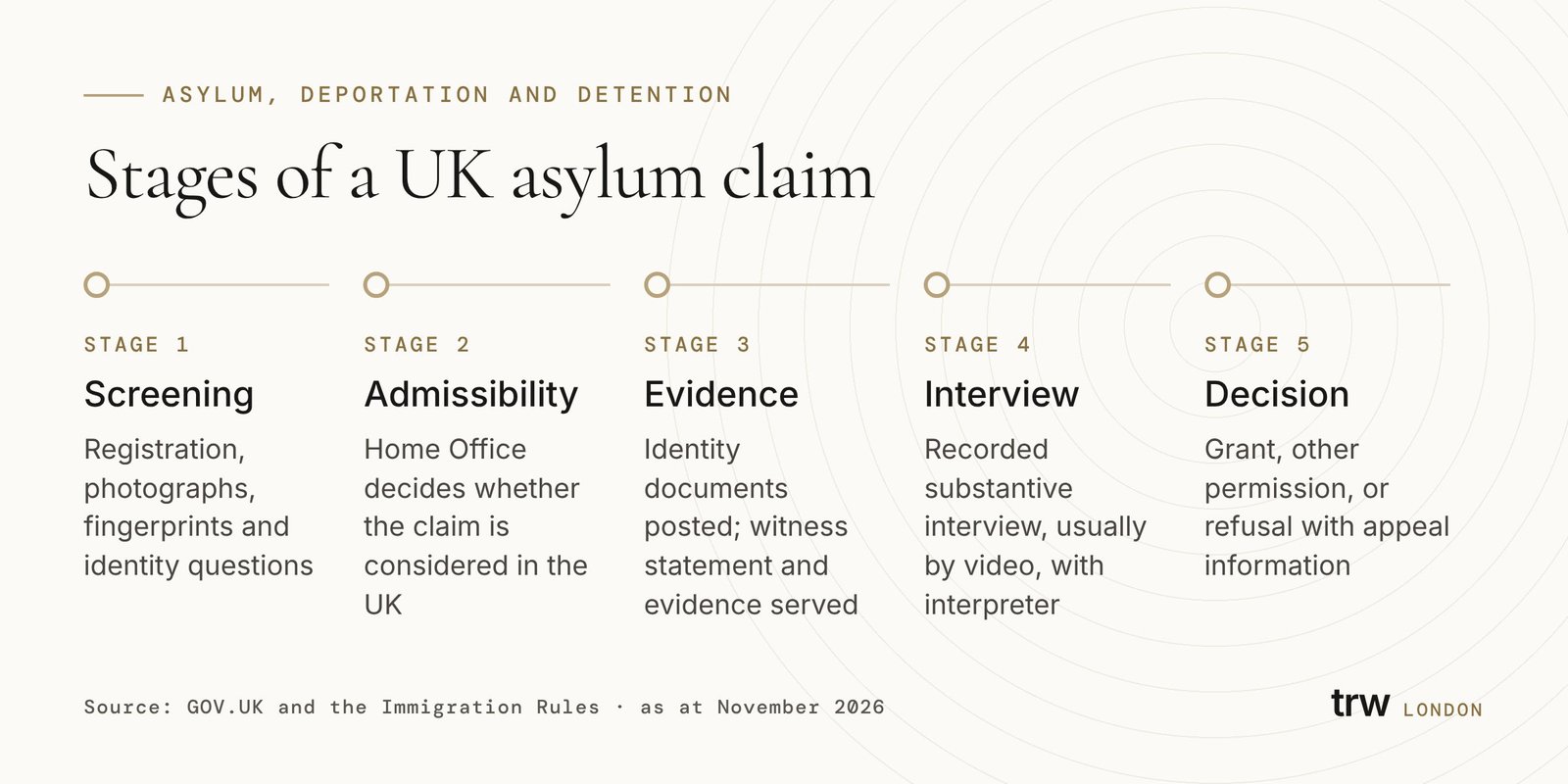
GOV.UK's asylum guidance sets out the official sequence. The stages below are not fixed in length: the Home Office does not commit to a decision date, and paragraph 333A only requires it to tell an applicant, on written request, when a decision is expected if none has been made within six months.
- Registration
Screening
Photographs, fingerprints and an identity interview at the border or at an asylum intake unit by appointment. You are asked briefly why you are claiming.
- After screening
Admissibility and documents
The Home Office decides whether the claim can be considered in the UK. An asylum registration card (ARC) and sometimes a questionnaire follow.
- Before interview
Evidence and statement
Original identity documents are posted to UKVI; evidence of persecution can be emailed. This is when a full witness statement should be served.
- Interview
Substantive interview
Usually by video call, recorded, with an interpreter. You receive a copy of the interview record.
- After interview
Further evidence
Any agreed further evidence is sent within the deadline recorded at the end of the interview.
- Decision
Grant or refusal
A grant of refugee status or humanitarian protection, other permission, or a refusal with reasons and appeal information.
Children claiming on their own
Unaccompanied children follow a different path. Children not in local authority care can use the walk-in service at the asylum intake unit, ideally with the adult responsible for them. Paragraph 352ZA requires the Home Office to ensure an unaccompanied child has a representative as soon as possible after the claim, and paragraph 352ZB requires the decision to be taken by someone trained to deal with children's claims. If granted, unaccompanied children receive 5 years' permission, not 30 months.
Missing the interview without a reason outside your control, failing to attend reporting events, or not returning a questionnaire can lead to the claim being treated as withdrawn under paragraph 333C. Our step-by-step guide to the asylum claim process and our guide to the asylum substantive interview go further.
Building the evidence
Paragraph 339I places the burden on the claimant to submit all material factors as soon as possible: a statement of reasons, documents about identity, nationality, background and travel route, and identity and travel documents. Paragraph 339L allows unsupported parts of an account to be accepted without confirmation if the claimant has made a genuine effort, explained gaps, given a coherent and plausible account, claimed at the earliest possible time (or has a good reason for not doing so), and is generally credible.
The Home Office credibility guidance says statements can be accepted if they are sufficiently detailed and specific, internally consistent, consistent with country information and other evidence, and plausible. It also says that demeanour must not be used to assess credibility and that trauma can affect memory and disclosure.
Under section 8 of the Asylum and Immigration (Treatment of Claimants, etc.) Act 2004, behaviour such as failing without reasonable explanation to produce an identity document, destroying travel documents, or failing to claim in a safe country on the way can be treated as damaging credibility. These points should be addressed in the statement, not left for the interviewer to raise.
Example: turning an account into evidence
Example (hypothetical): a journalist arrives in London and claims asylum at screening, saying she was detained after publishing articles critical of her government. Before her interview we would take a statement covering each arrest in order, identify the articles and where they can still be found online, ask a former editor for a letter, and obtain country evidence on the treatment of journalists. We would also deal directly with why she travelled through two other countries before claiming, because section 8 makes that point unavoidable.
Most refusals that we see on appeal turn on credibility findings that a fuller first statement could have answered.
What a grant gives you as at November 2026
For asylum claims or further submissions made on or after 2 March 2026, a grant of refugee status or humanitarian protection now gives permission to stay for a minimum of 30 months, renewable within the last 28 days if protection is still needed. Unaccompanied asylum-seeking children still receive 5 years. Claims made by 1 March 2026 still lead to 5 years and the existing settlement route after 5 years.
The grant figures come from the Home Office core protection factsheet. Partners and children included as dependants usually receive permission for the same period, but they do not receive refugee status themselves unless they make their own claim. Adults granted protection, and their adult dependants, can also apply for an interest-free refugee integration loan.
After the grant: renewal, settlement and family
People granted 30 months must apply for further permission within the last 28 days of their current permission, and the Home Office will ask whether protection is still needed. Those whose claims were made by 1 March 2026 can apply for settlement after 5 years under Appendix Settlement Protection; GOV.UK lists no fee for protection holders, but a "safe return review" is carried out unless the Home Secretary directs otherwise.
Bringing family is harder than it was. Refugee family reunion under Appendix FRP has been closed to new applications since 3pm on 4 September 2025, so partners and children must now use Appendix FM, with its fee and financial requirements. Our guide to refugee family reunion explains the current position.
Costs, legal aid and support
GOV.UK's asylum guidance does not list an application fee for registering an asylum claim. The main costs are evidence, translation and expert reports, and legal representation. Civil legal aid is available in scope for Refugee Convention claims and Article 2 or 3 claims under paragraph 30 of Schedule 1 to LASPO 2012, subject to means and merits, but the statute excludes attendance at a Home Office interview unless regulations provide otherwise.
Destitute applicants can apply for asylum support. As at November 2026 the cash allowance is £49.18 per person per week, or £9.95 where meals are provided (GOV.UK asylum support rates). Appeal fees of £82 or £144 do not apply to appellants receiving asylum support. Our asylum support guide explains eligibility.
Where we act privately, we agree the scope and the fee in writing before work starts, and we tell you if a case appears to qualify for legal aid so you can consider a legal aid provider.
Common problems in asylum cases
Delaying the claim
Gov.uk warns that a claim is more likely to be refused if you wait. Delay is not fatal on its own (paragraph 339MA says claims cannot be rejected solely for not being made as soon as possible), but it has to be explained.
Working without permission
Asylum seekers cannot usually work. Permission to work can be sought where a claim has been outstanding for more than 12 months through no fault of the claimant, and is limited to jobs at RQF 6 or above in Appendix Skilled Occupations. See our guide to asylum seekers' right to work.
Inconsistent dates and names
Small discrepancies between screening, questionnaire, statement and interview are a common basis for refusal. A chronology prepared early and checked against every document reduces them.
Not adding family members correctly
A partner or child is not a dependant on the claim until they have been registered at a screening appointment. If they are not registered, they may not receive permission if the claim succeeds.
Leaving the UK or losing contact
Leaving the UK without authorisation, or failing to keep the Home Office updated with an address, can lead to the claim being treated as withdrawn.
Reforms: what is law and what is not
In force
- 30-month protection permission for claims from 2 March 2026 (HC 1691).
- Most of the Illegal Migration Act 2023 repealed by section 41 of the 2025 Act on 2 December 2025.
- Refugee family reunion under Appendix FRP suspended since 4 September 2025.
- Asylum seekers' permitted work limited to RQF 6+ occupations (HC 1691).
- 24-week tribunal target for appeals by asylum-supported appellants since 12 August 2026.
Bill or announced policy only
- A single "core protection" status replacing refugee status and humanitarian protection, ending upgrade appeals (Immigration and Asylum Bill).
- An Independent Immigration Appeals Authority with a single appeal (Bill).
- Recovery of asylum support costs by flat charge (Bill).
- 20 years to settlement on core protection and a Protection Work and Study route (policy statement; earned settlement policy).
- No commencement dates have been published for these measures.
The Bill passed its Commons Third Reading on 17 November 2026 and had its first reading in the Lords on 18 November 2026. Until it receives Royal Assent and is commenced, the current Part 11 rules and the 2002 Act appeal rights apply.

Next steps with our asylum solicitors
If you have not yet claimed, speak to an adviser before your screening appointment if you can. If you have a screening record, questionnaire or interview invitation, bring it to the first meeting. If you have been refused, check the date on the decision now: the tribunal deadline is 14 days from receiving the decision for appeals brought in the UK (tribunal guidance).
Related services: immigration appeals, immigration detention and deportation.
To speak to our asylum solicitors in confidence, book a consultation.
Frequently asked questions
01Do I need a solicitor to claim asylum?
No. You can register a claim yourself. Paragraph 333B of the Immigration Rules gives applicants an effective opportunity to consult a regulated adviser, and representation usually improves the quality of the statement and evidence.
02Can my solicitor come to my asylum interview?
Yes. GOV.UK says you can bring a legal representative, but the interview will go ahead if they are not there and you cannot ask for more time to find one. Legal aid rules restrict public funding for attending interviews, so check funding early.
03What is the difference between refugee status and humanitarian protection now?
They have different legal tests but, for claims made from 2 March 2026, the same minimum 30-month permission. The Immigration and Asylum Bill would merge them into a single protection status; that is not yet law.
04Will the Home Office contact my country's authorities?
Paragraph 339IA prohibits disclosing information about a claim to the alleged persecutors, or obtaining information in a way that would alert them. GOV.UK also says interview information will not be shared with the authorities of your country.
05Can I travel abroad while my asylum claim is pending?
Leaving the UK without authorisation before the claim is decided can lead to it being treated as withdrawn under paragraph 333C. Do not travel without advice.
06What if I am detained?
GOV.UK says some people are detained while a claim is decided, but children, families with children, pregnant women and some vulnerable adults will not usually be detained. See our immigration bail page for release options.
07Can a refused claim be reopened?
After appeal rights are exhausted, new material can be lodged as further submissions in person at a Service and Support Centre. They succeed only if they amount to a fresh claim under paragraph 353.
Sources and official materials
- Claim asylum in the UK (GOV.UK) — Official process, documents and decision outcomes.
- Immigration Rules Part 11: asylum — Paras 327AB, 333C, 334, 339C, 339I, 339L, 339NA, 339QAA.
- Nationality and Borders Act 2022, section 32 — Two-stage standard of proof.
- Asylum and Immigration (Treatment of Claimants, etc.) Act 2004, section 8 — Behaviour damaging credibility.
- Assessing credibility and refugee status (Home Office guidance) — Credibility indicators applied by caseworkers.
- LASPO 2012, Schedule 1 paragraph 30 — Legal aid scope for asylum.
- Immigration and Asylum Bill: core protection factsheet — Proposed single protection status and grant statistics.
- Restoring Order and Control policy statement — Announced asylum policy (November 2025).
General information only, current as at 19 November 2026. It is not legal advice and does not create a solicitor–client relationship. It reflects the law of England and Wales unless stated otherwise; Scotland and Northern Ireland have separate legal systems, and the law changes frequently. Check current official sources and take advice on the facts of your matter.