TRW & Co · Visits and travel
Visit visa for medical treatment in the UK

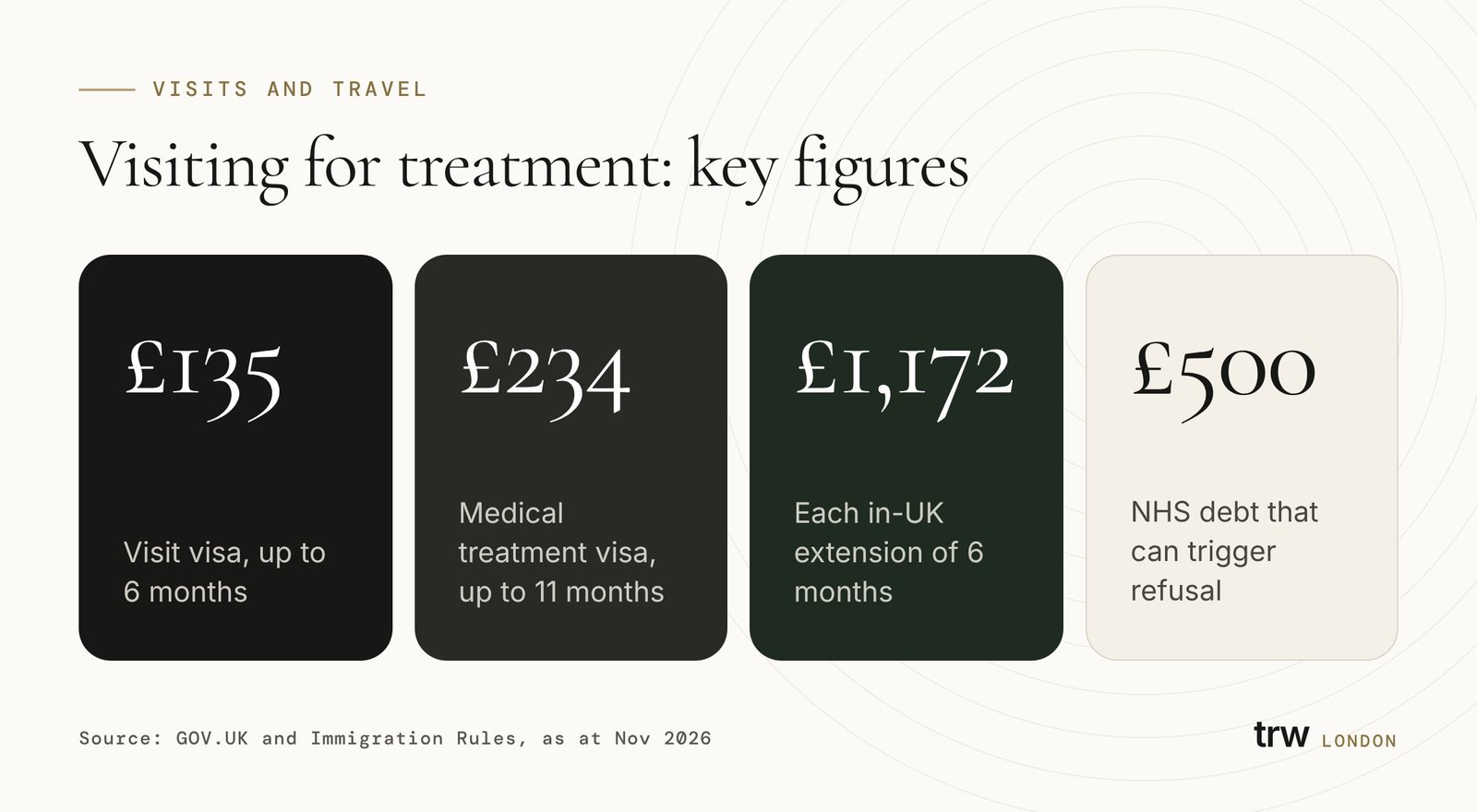
Patients can visit the UK for private medical treatment, or NHS treatment paid by their own government under a reciprocal arrangement. As at November 2026 a standard visit visa costs £135 for up to 6 months, an 11-month medical visa £234, and each 6-month extension in the UK £1,172. Treatment must be arranged, finite and fully funded.
Key pointThe consultant's letter does most of the work: it must state the condition, the cost, a finite duration and where treatment will happen.
At a glance
Who it suits
Patients paying privately, or funded by their government under a reciprocal arrangement.
Length
Up to 6 months, or up to 11 months with medical evidence.
Extensions
6 months at a time, no limit, £1,172 each.
Companions
Visit in their own right; no extension beyond 6 months.
NHS
Visitors are charged; unpaid bills of £500+ can lead to refusal.
Swipe or scroll →
Visit visa medical treatment: the short answer
The visit visa medical treatment rules let a person come to the UK as a Standard Visitor to receive private medical treatment, or NHS treatment paid for by their own government under a reciprocal healthcare arrangement. A standard visit visa costs £135 for up to 6 months; a dedicated visa of up to 11 months costs £234; and patients already in the UK can extend for further 6-month periods at £1,172 each time. All figures are as at November 2026.
The route has three hard edges. The treatment must be arranged before travel and of finite duration. The patient must be able to pay for it in full. And the visit remains a visit: the patient must intend to leave when treatment ends. Visitors are not entitled to free NHS hospital treatment, and the route cannot be used to obtain it.
This guide covers the requirements, the evidence caseworkers expect, longer stays and extensions, family members who want to come too, and the separate rules for organ donors.
The legal framework for private medical treatment
The starting point is paragraph V 4.4(c) of Appendix V: Visitor: a visitor must not intend to access medical treatment other than private medical treatment or organ donation, and for either of those must meet extra requirements. Paragraph PA 16.1 of Appendix Visitor: Permitted Activities then lists private medical treatment as a permitted activity, and PA 16.2 does the same for organ donation.
The additional requirements for private medical treatment are in V 7.1 to V 7.3, those for extensions in V 15.1, and the periods of grant in V 17.2 and V 17.3. The Home Office's Visit caseworker guidance, version 18.0 published on 8 October 2026, explains how officials apply them. Visitors visiting for treatment must also meet the general visitor rules: they must be genuine visitors with enough money for all reasonable costs of the visit, including the cost of the treatment itself.
Visa nationals must apply before travel. Non-visa nationals coming for 6 months or less can usually rely on an ETA, but anyone seeking to come for medical treatment for more than 6 months needs a visa, whatever their nationality. GOV.UK states that all visits for medical treatment lasting longer than 6 months require a Standard Visitor visa.
Private treatment, the NHS and reciprocal arrangements
The caseworker guidance states that visitors are not eligible for free NHS treatment unless an exemption from charging applies in law, and may be billed for any NHS treatment they receive. The Department of Health and Social Care publishes guidance on the overseas visitor charging regulations. GOV.UK's NHS entitlements guide notes that some services, such as A&E treatment and treatment of certain infectious diseases, are free to everyone, but these exemptions do not apply to people who travel to the UK for the purpose of seeking that treatment.
Private medical treatment is therefore the core of the route. It can take place at a private hospital or clinic, or in a private patient unit, provided the patient pays.
The one route to planned NHS treatment is a reciprocal healthcare arrangement. If the patient's own government authorises and pays for the treatment, the patient provides that government's authorisation form. The guidance explains that planned treatment under the arrangements with Ireland and the EU, reimbursed by those countries' health authorities, is treated as private medical treatment for the visitor rules. Applicants under the EU arrangement should also read GOV.UK's guidance for S2 Healthcare Visitors.
Unpaid NHS bills follow you. Under paragraph SUI 16.1 of Part Suitability, any future application may be refused where the NHS has notified the Home Office of unpaid charges totalling £500 or more. Settle any NHS invoice before you leave.
Visit visa medical treatment requirements
The table below sets out what a patient visiting for treatment must show, with the source of each requirement.
| Requirement | What it means in practice | Rule |
|---|---|---|
| Genuine visitor | Will leave at the end of treatment or when permission expires | V 4.2 |
| Treatment arranged before travel | Consultations or treatment booked with a named UK doctor or hospital | V 7.2 |
| Finite duration | An end point can be estimated; open-ended treatment is refused | V 7.2(a)(ii) |
| Funds | Enough money for treatment, travel, accommodation and living costs | V 4.2(e) |
| Public health | Anyone with a communicable disease must satisfy the medical inspector they are not a danger to public health | V 7.1 |
| 11-month visa only | Evidence that treatment is likely to exceed 6 but not 11 months; TB certificate where required | V 7.3 |
At the border, the guidance says anyone who states they are receiving or intend to receive medical treatment must be referred to the port medical inspector, and entry can be refused on the inspector's advice. Under paragraph SUI 19.1 of Part Suitability, entry clearance or permission to enter must be refused where a medical inspector advises that it is undesirable for medical reasons, unless there are strong compassionate reasons. Declaring the purpose honestly is essential: the guidance confirms a visitor may have private treatment during a visit, but if treatment is the main reason for coming, it must be disclosed.
Funding private medical treatment
Money is where many applications for private medical treatment fall down. The caseworker must be satisfied that the patient can meet all reasonable costs of the visit, which here includes the treatment itself, accommodation near the hospital, local travel, living costs and the journey home. There is no fixed amount; the estimate in the consultant's letter sets the benchmark, and the funds shown should comfortably exceed it.
Where an employer, government body or family member is paying, the evidence should come from them and say what they will cover. A recent large deposit without explanation invites further checks. Any visit visa medical treatment application that relies on money still to be raised, or on the patient working in the UK, will fail.
The test is not whether the patient is ill, but whether the treatment is arranged, finite, paid for and followed by departure.
The consultant's letter
The single most important document when visiting for treatment is the letter from the UK doctor or consultant. Paragraph V 7.2(a) requires it to set out the medical condition requiring consultation or treatment, the estimated costs and likely duration of the treatment, and where it will take place. GOV.UK's medical visit page repeats these points, and the Home Office's guide to supporting documents lists the same contents.
- Written by the UK doctor or consultant who will provide the treatment, on headed paper
- Names the condition requiring consultation or treatment
- Gives an estimated cost, ideally broken down by stage
- Gives a likely duration, with an end point (it must be finite)
- States the hospital or clinic where treatment will take place
- For an 11-month visa, explains why treatment is likely to exceed 6 months
- Dated recently and consistent with the application form
Caseworkers check. The guidance tells them to search the General Medical Council register to confirm the doctor is registered, to contact the hospital if the consultant is not listed, and to contact the consultant or hospital if they doubt the costs or arrangements. They may seek the applicant's consent to obtain an estimate of treatment length from the treating consultant.
Funding evidence should match the estimate. Bank statements showing the source of funds, letters from any sponsor or employer meeting the costs, and confirmation of any deposit already paid to the hospital all help. If a family member or third party is paying, V 4.3 requires a genuine relationship, lawful status in the UK if they are here, and the ability and intention to pay for the whole stay.

How long you can stay
There are two entry options. A standard visit of up to 6 months suits most patients, and the guidance says most visitors seeking private medical treatment would be expected to stay for 6 months or less. Where the treating doctor expects treatment to last more than 6 months but not more than 11, the patient can apply before travel for a visa of up to 11 months, at £234 as at November 2026.
The 11-month visa has an extra evidential step: the consultant must confirm the likely length, and where Appendix Tuberculosis applies, the patient must provide a certificate showing they are free from active pulmonary tuberculosis. Check whether you need a TB test early, because only approved clinics can do it.
Choosing between the two is a medical question first and an immigration question second. If the consultant genuinely cannot say whether treatment will exceed 6 months, the safer course is often a standard visit followed, if needed, by an extension from inside the UK, rather than an 11-month application unsupported by the evidence the rules require. Either way, the visit visa medical treatment decision is about the plan in front of the caseworker on the day.
Extending a stay for treatment
Treatment does not always run to plan. A patient in the UK for private medical treatment can apply to extend for a further 6 months, and GOV.UK says there is no limit on the number of extensions, at £1,172 each time. The application must be made from inside the UK, on form FLR(IR), before current permission expires. Super priority is available for an extra £1,000; the standard decision time is 8 weeks.
- Pay for treatment already received. V 15.1(a) requires the decision maker to be satisfied that the costs of treatment so far have been met. Keep paid invoices.
- Get a new medical letter. From a registered medical practitioner who holds an NHS consultant post or is on the GMC Specialist Register, detailing the condition that needs further treatment.
- Show you can pay for what comes next. If funds come from abroad, the guidance says proof that they can be transferred may be requested; a third-party sponsor must reconfirm their support.
- Apply before your permission expires. Then attend a UKVCAS appointment for biometrics and upload evidence.
- Stay in the Common Travel Area until the decision. GOV.UK warns the application will be withdrawn if you travel outside the UK, Ireland, the Channel Islands or the Isle of Man.
Where an extension for NHS treatment under a reciprocal arrangement is refused (other than for an NHS debtor), the guidance says the refusal letter should explain that a fresh application can be made if the patient is prepared to pay privately. If an application is refused, see our guide to visitor visa refusals. If permission has already expired, read our guide on what it means to be an overstayer before taking any step.
Planning ahead when visiting for treatment
Patients visiting for treatment over a long period should diarise their permission end date as soon as they arrive. An extension needs paid invoices, a fresh consultant's letter and evidence of funds, which can take weeks to assemble while treatment is under way. Starting the process a month before expiry is a sensible minimum.
Family members and carers
There is no dependant category for the family of someone visiting for treatment. The caseworker guidance says a family member, friend or nurse should not accompany a visitor solely to act as an escort. They can, however, apply as visitors in their own right for another permitted activity, such as visiting family, if they meet the visitor rules.
Companions face a firm limit on length. The guidance says there is no provision for people accompanying a patient to extend beyond 6 months. Where there are compelling, compassionate or exceptional circumstances, officials may refer the case for consideration of leave outside the rules, but that is discretionary and should not be planned on.
Patient
Private medical treatment visitor: up to 6 or 11 months, with 6-month extensions.
Spouse or adult child
Standard Visitor in their own right; up to 6 months; no extension beyond 6 months.
Private nurse or friend
Cannot come solely as an escort; must qualify through another permitted visitor activity.
Children of a donor
Only where no care is available at home and arrangements in the UK are adequate.
Parents coming to support a son or daughter through treatment in the UK should read our guide to the visit visa for parents, which covers sponsor letters and evidence of ties.
Visiting as an organ donor
A person can visit to donate an organ, or to be assessed as a potential donor, to an identified recipient in the UK with whom they have a genetic or close personal relationship. Paragraphs V 8.1 to V 8.4 require written confirmation of tests showing a match, or that further tests are under way, and a letter dated no more than 3 months before arrival. It must come from the lead nurse or coordinator of the NHS Trust's Living Donor Kidney Transplant team, or from a registered practitioner who holds an NHS consultant post or is on the GMC Specialist Register. The recipient must be lawfully in the UK.
The guidance adds that genetic relationships mean blood relatives, close personal relationships typically mean a spouse, partner or close friend, and relationships established through social media campaigns do not count. Paying for an organ is an offence, and suspected payment is referred to Immigration Enforcement. Donors to NHS patients can be reimbursed for expenses directly attributable to donation, such as travel and loss of earnings, usually by the NHS after treatment.
What the route does not cover
Open-ended treatment
Where treatment has no foreseeable end, the guidance says the application will be refused. Fertility treatment is given as an example of treatment that can continue for years, so the consultant's estimate of duration is crucial.
Free NHS treatment
Visitors cannot use the route to obtain NHS treatment, except where their own government pays under a reciprocal arrangement. NHS treatment received during a visit will normally be charged.
Surrogacy
The guidance states there is no provision in the rules for a woman to come to the UK to act as a surrogate, and that admission for private medical treatment is not appropriate because she would not have a medical condition. Such applications are normally refused; exceptional cases may be referred.
Clinical trials
The guidance tells caseworkers to seek policy advice where someone applies to take part in a clinical trial. Expect closer scrutiny and allow extra time.
Paired or pooled organ donation
If a donor is not a suitable match and joins a paired or pooled scheme, the application falls outside the rules and must be referred for consideration outside the rules.
If the treatment plan does not fit any of these routes, it is better to find out before travelling. Applying for a visit visa medical treatment grant on a basis the rules do not cover usually leads to refusal, and the refusal must be disclosed in later applications.

Worked example
Example (hypothetical): Mr A, a 58-year-old visa national, has been advised by a London orthopaedic surgeon to have a hip replacement privately, with surgery and rehabilitation expected to take 10 weeks. The surgeon's letter names the condition, the hospital, an estimated cost and a likely duration. Mr A applies for a 6-month Standard Visitor visa at £135, with bank statements showing funds to cover the estimate, his travel and his stay, and evidence of his business and family at home. His wife applies separately as a Standard Visitor to visit with him.
After surgery, a complication means rehabilitation will take another four months, beyond his 6-month permission. Before it expires, Mr A pays all invoices to date, obtains a new letter from his consultant, who is on the GMC Specialist Register, and applies to extend for 6 months at £1,172. His wife cannot extend beyond her 6 months as a companion, so she plans to return home and come back on a fresh visit.

Visit visa solicitors
Help with complex medical visit applications and extensions.
Read the guideVisitsPriority visa service
When paying for a faster decision makes sense.
Read the guideFamilyAdult dependent relative visa
For relatives who need long-term care from family in the UK.
Read the guideNext steps
Start any plan for private medical treatment with the treating consultant. Ask for a letter that meets V 7.2, with a clear estimate of cost and duration, and decide between a 6-month visit and an 11-month visa on that basis. Then gather funding evidence that matches the estimate, check whether a TB test is needed, and apply in good time. If treatment overruns, apply to extend before permission expires, with all invoices paid.
We advise patients, families and private hospitals on visiting for treatment, including extensions and refusals. To discuss your situation, book a consultation with our team.
Frequently asked questions
01Can I come to the UK for treatment on an ETA?
For private treatment lasting 6 months or less, a non-visa national can usually travel with an ETA, but must declare the purpose at the border. Any medical visit over 6 months needs a visa.
02Will the NHS treat me for free as a visitor?
Generally no. Visitors are charged for most NHS hospital treatment unless an exemption applies or their government pays under a reciprocal arrangement.
03Does my UK doctor need to be on the GMC register?
The caseworker guidance tells officials to check the GMC register and to contact the hospital if the doctor is not listed. For extensions, the letter must come from an NHS consultant or a doctor on the GMC Specialist Register.
04Can my family member stay with me throughout a long treatment?
Not automatically. Companions are visitors in their own right and cannot extend beyond 6 months; exceptional cases may be considered outside the rules.
05What if I cannot pay a hospital bill?
Unpaid NHS charges of £500 or more can lead to refusal of later applications under SUI 16.1. Our visit visa team can advise on the consequences.
06Can I travel abroad while my extension is pending?
No. GOV.UK says an extension application is withdrawn if you travel outside the UK, Ireland, the Channel Islands or the Isle of Man before the decision.
07Is a visa for medical treatment faster on priority?
Priority services may be available for visit visas from outside the UK, and super priority for in-UK extensions. See our guide to the priority visa service.
Sources and official materials
- Immigration Rules Appendix V: Visitor — V 4.4(c), V 7, V 8, V 15 and V 17
- Immigration Rules Appendix Visitor: Permitted Activities — PA 16.1 and PA 16.2
- Visit the UK as a Standard Visitor: medical reasons — Evidence, 11-month visa and fees
- Visit the UK as a Standard Visitor: extend your stay — Extensions for treatment
- Visit caseworker guidance (version 18.0) — Assessment of treatment, companions and donors
- Immigration Rules Part Suitability — NHS debt (SUI 16.1) and medical grounds (SUI 19.1)
- Guidance on overseas visitors hospital charging regulations — NHS charging for overseas visitors
General information only, current as at 19 November 2026. It is not legal advice and does not create a solicitor–client relationship. It reflects the law of England and Wales unless stated otherwise; Scotland and Northern Ireland have separate legal systems, and the law changes frequently. Check current official sources and take advice on the facts of your matter.