TRW & Co · Settlement and citizenship
Earned settlement solicitors in London

The Home Office published its final earned settlement policy on 2 November 2026, moving the default route to settlement from five years to ten. It is not yet law: no Immigration Rules have been laid and no start date set. We help individuals, families and employers work out where they stand and whether to apply under the current rules first.
Key pointSettlement is decided under the rules in force at the date of decision, so anyone close to qualifying should establish their earliest valid application date now rather than wait.
At a glance
Status
Announced policy in CP 1707 (2 November 2026); not in the Immigration Rules as at November 2026.
Default
10 years, with 3 and 5-year paths for high earners, public service and British connections.
Longer path
20 years after specified public funds use or an adult immigration breach.
Minimums
No criminal record, no government debt, B2 English and Life in the UK for everyone.
Long Residence
Still open today but announced to close; temporary-route time to stop counting.
Swipe or scroll →
Earned settlement solicitors in London: the short answer
Our earned settlement solicitors advise individuals, families and employers on the Home Office's new framework for indefinite leave to remain. On 2 November 2026 the government published its final policy, A Fairer Pathway to Settlement: Government response to the consultation (CP 1707). It moves the default qualifying period for settlement from five years to ten, with faster and slower paths depending on earnings, public service, family ties and immigration history.
The most important point is about status. As at November 2026, earned settlement is announced policy, not law. No Statement of Changes to the Immigration Rules implementing it has been laid, and no start date has been published. People who qualify for settlement today still apply under the current rules. What has changed is the planning horizon: anyone close to five years on a work or family route now has a strong reason to understand their position precisely.
We act for skilled workers and their families, founders and senior executives, NHS and education staff, care workers, partners of British citizens, and the HR and mobility teams who manage sponsored workforces in London and across the UK.
Where the settlement reforms stand in November 2026
The settlement reforms have moved in three stages. The Immigration White Paper of May 2025 committed to increasing the standard qualifying period from five to ten years. A consultation followed from 20 November 2025 to 12 February 2026 and drew 204,667 responses. The government's response, CP 1707, was published on 2 November 2026 and sets out the final design.
CP 1707 is a Command Paper. Earned settlement binds nobody until its content is written into the Immigration Rules through a Statement of Changes laid before Parliament. The most recent statement on the GOV.UK collection of Statements of Changes is HC 584 of 3 September 2026, which does not implement earned settlement. The paper itself says further technical guidance will be published before implementation, and that a full impact assessment will accompany it.
Two statements from the government matter for planning. First, the Home Secretary told Parliament that "the rules around settlement are determined when a settlement decision is made. Not at the point when someone arrives" (Home Secretary's statement). There is no general grandfathering for people already in the UK, beyond the specific cohorts described below. Second, the accompanying Home Office news release states that settled status "will never be removed from anyone who already holds it".
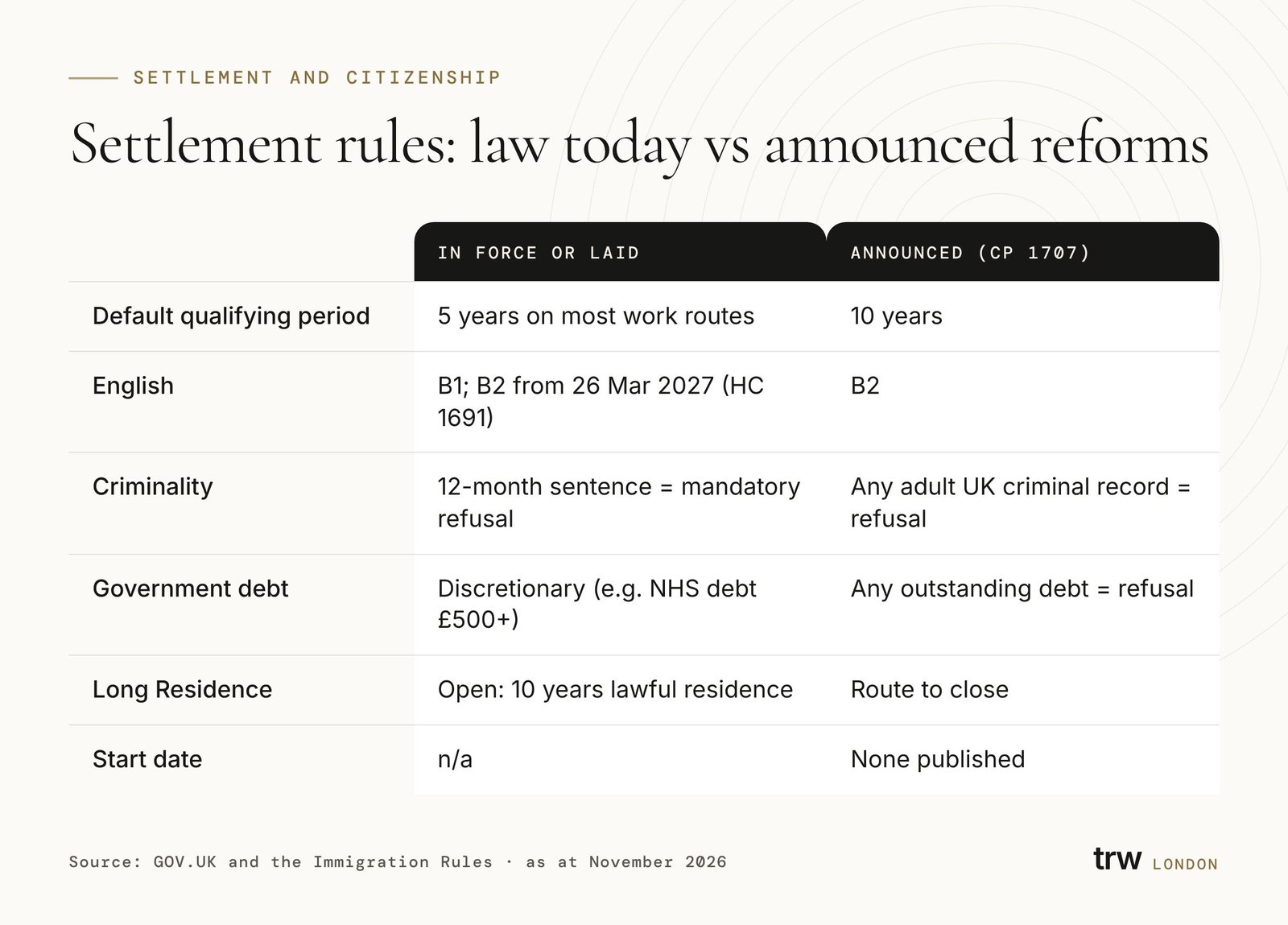
Separately from earned settlement, a change that is already in the Immigration Rules takes effect on 26 March 2027: settlement applications on Skilled Worker, Global Talent, Innovator Founder, Long Residence, Settlement Family Life and several other routes will need English at B2 rather than B1. It was laid in HC 1691 in March 2026 (explanatory memorandum) and applies to people already on those routes.
How our earned settlement solicitors help
Most of our work on the settlement reforms is diagnostic. Clients want to know which pathway they are likely to fall into, what could move them onto a longer one, and whether there is anything to gain by applying under the current rules first. We usually start by reconstructing the full immigration history, then test it against both regimes side by side.
Individuals close to five years
We confirm the date you first qualify under today's rules, check absences, salary and English, and prepare the application so it can be lodged on the earliest valid date.
Employers and HR teams
We map a sponsored workforce by settlement date and route, flag workers at risk of a longer path, and advise on how pay and role changes interact with the announced earnings thresholds.
NHS, education and care staff
We assess whether a role is on a national pay scale and whether the one-off transitional arrangements for care, health and education workers who arrived before May 2025 are likely to apply.
Families
We plan settlement for partners and children together, including young adults aged 18 to 24 and those approaching 25, where the announced rules change the position.
People with a complicated history
Overstaying, condition breaches, past refusals, cautions or debts can move someone onto a 20-year path or block settlement. We assess the record and the evidence before any application is made.
Founders and high earners
For Global Talent, Innovator Founder and senior Skilled Worker clients we review whether the announced 3-year or 5-year pathways may be available and how earnings will need to be evidenced.

The 3, 5, 10 and 20-year pathways
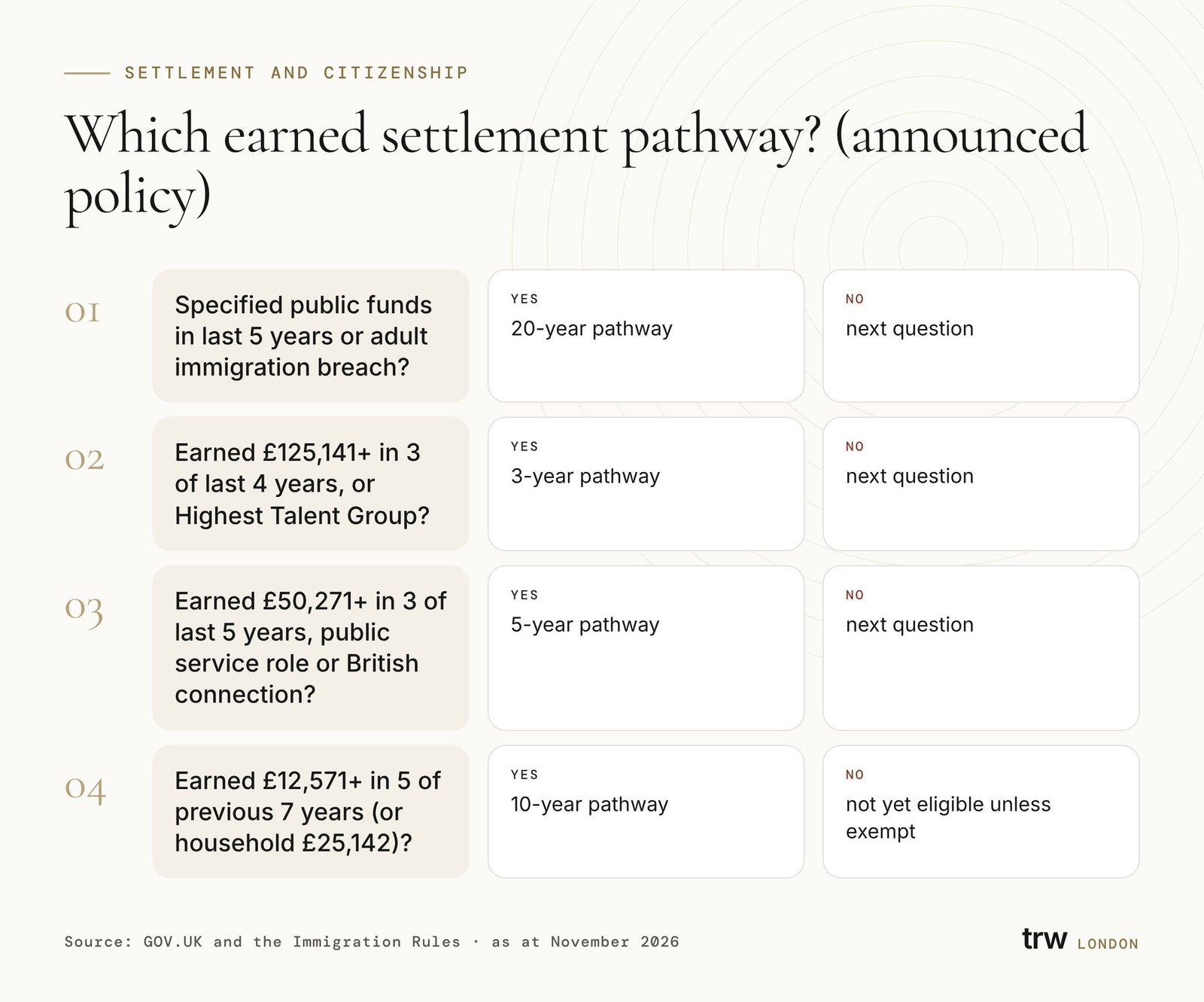
Earned settlement sorts applicants onto four pathways, each with its own qualifying period. The earnings thresholds are tied to income tax bands and will move with them. The table summarises Table 1 of the response; all of it is announced policy as at November 2026.
| Pathway | Who it is for | Main contribution test |
|---|---|---|
| 3 years | Exceptional economic contributors and the "Highest Talent Group" (Global Talent and Innovator Founder, subject to review pending a MAC report) | Earnings of at least £125,141 in 3 of the last 4 years, or qualifying talent route |
| 5 years | Higher earners; eligible public service workers; people with a British connection | £50,271 in 3 of the last 5 years; or 5 years in an Annex C health or education occupation; or partner, parent or child of a British citizen, or UK Ancestry |
| 10 years | The default for anyone meeting the mandatory requirements | £12,571 in 5 of the previous 7 years (couples may combine to £25,142) |
| 20 years | Anyone who has accessed specified public funds in the 5 years before applying, or committed a specified immigration breach as an adult | Still £12,571 in 5 of the previous 7 years, plus all mandatory requirements |
The look-back structure in the paper is designed to absorb gaps in the qualifying period. A year on parental leave or a period of ill health does not automatically push someone onto a slower path, because only the required number of qualifying years within the look-back window must clear the threshold. Exemptions from the earnings test are announced for children, people aged 65 and over, and those unable to work because of a physical or mental condition.
Not every route can use every pathway. The paper states that permission under the Family and Private Life routes will not qualify for the 3 or 5-year pathways, and that applicants on those routes would instead use the 10 or 20-year pathway. Partners of British citizens are treated differently because the British connection is itself a 5-year qualifying basis.
Mandatory requirements for everyone
Underneath the earned settlement pathways sits a set of minimum standards that apply on every route into the framework. The paper is explicit that these cannot be offset by higher earnings or public service.
- No criminal record for adult applicants in the UK, including suspended sentences, cautions, conditional discharges, court fines and community sentences. Overseas convictions also count where the conduct would be an offence in the UK, with some discretion.
- No outstanding government debt, including NHS charges, tax and National Insurance, and litigation costs owed to the Home Office.
- English at B2, with the existing exemptions for children, people aged 65 and over, and people with a relevant condition.
- A pass in the Life in the UK test, which the government is also reviewing.
- Sustained contribution, normally through the earnings tests above.
This is one of the most significant settlement reforms. Under Part Suitability of the current Rules, a custodial or suspended sentence of 12 months or more leads to mandatory refusal, but shorter sentences, non-custodial sentences and out-of-court disposals give the Home Office discretion. Under the announced policy, any adult criminal record in the UK would lead to refusal. Debt moves the same way: today an NHS debt of at least £500 is a discretionary refusal ground; the paper proposes that any outstanding government debt becomes a bar.
Under the announced framework, a caution that is a minor footnote in today's application could block settlement altogether.
Which time counts towards the qualifying period
Residence remains part of the test, but the settlement reforms link it to the purpose of the route. Time on "core permission" routes (Skilled Worker, Global Talent, Scale-up, Innovator Founder, UK Ancestry, International Sportsperson, Minister of Religion, family partner and parent routes and statelessness) will count. So will Family and Private Life, protection routes and safe and legal routes, each on its own pathway.
Time on temporary routes will not. The paper lists Visit, Student, Global Business Mobility, Temporary Worker routes, Youth Mobility, Seasonal Worker, Overseas Domestic Worker, Graduate, High Potential Individual, the Ukraine schemes and leave outside the Rules.
Current Immigration Rules (in force)
- Most work routes: settlement after 5 years on a qualifying route
- Long Residence: settlement after 10 years' continuous lawful residence, which can include Student and Graduate time (Appendix Long Residence)
- Time on different routes can sometimes be combined through Long Residence
- English at B1 for settlement until 26 March 2027
Earned settlement (announced, not law)
- Default 10 years, with 3 and 5-year paths for qualifying contribution
- The Long Residence route will close
- Temporary-route time stops counting; protection or Article 8 time cannot be combined with work or family time
- B2 English, no criminal record and no government debt for everyone
For graduates who moved from a Student visa to the Graduate route and then into sponsored work, this is the most consequential change. Today their study years can count towards long residence indefinite leave to remain. Under the announced framework they would not. Until the Rules change, the current Long Residence route remains open.
Transitional and protected groups
The government describes its transitional arrangements as one-off and targeted, not a wider exemption for everyone already living here. Our detailed guide to earned settlement transitional arrangements explains each cohort; in summary, the announced position is as follows.
Care workers who entered or switched into the care route before the White Paper was published in May 2025 keep the 5-year qualifying period if they meet the £25,000 salary, sponsorship and employment requirements and the new minimum standards. Those who do not meet them can apply for a further five-year Health and Care visa restricted to genuine work in the sector, not tied to their former employer. From 1 February 2027, care workers whose sponsor's licence is revoked are to have 120 days to secure a job offer and a further 60 days to resolve their status.
Health and education workers below RQF 6 on national pay scales who arrived before May 2025 keep a five-year route. The pre-April 2024 Skilled Worker cohort is to be able to extend on current salary terms until 2035. Several groups stay outside the framework entirely, including BN(O) visa holders, Afghan schemes, HM Armed Forces, bereaved partners, victims of domestic abuse, children in care and the EU Settlement Scheme, although most of them will still need to meet the criminality and B2 standards.
Families and dependants under the announced framework
Family unity was one of the main themes of the earned settlement consultation, and the final design moved away from a fully individual model. A partner who arrives with the main applicant may settle at the same time; a partner who joins later must complete the same qualifying period under the settlement reforms. Couples can combine earnings to meet a household threshold of £25,142.
Children under 18 settle with their parents and are exempt from the income, debt, English and Life in the UK requirements, though suitability still applies. Young adults aged 18 to 24 who keep child-dependant status settle with the family without an earnings test but must meet the adult minimums. From 25, a dependant must qualify independently. For families on longer paths, a teenager today could pass that age before the household is eligible, so the order and timing of applications matters.
What to do before the rules change
Because no implementation date for earned settlement has been announced, planning should assume that the current Rules apply until a Statement of Changes says otherwise, but that the window could close with relatively short notice once rules are laid. Statements of Changes normally take effect at least 21 days after laying.
- Now
Audit the immigration history
List every grant, gap, absence and route. Identify the earliest date you qualify under current rules.
- Now
Check suitability risks
Obtain police and court records, clear NHS or tax debts, and resolve any Home Office litigation costs.
- Before 26 March 2027
Plan for B2 English
B2 applies to settlement applications from that date under HC 1691, regardless of earned settlement.
- As soon as eligible
Apply under current rules
Skilled Workers can apply up to 28 days before completing five years; do not let the visa expire first.
- Throughout
Keep earnings evidence
Retain P60s, payslips and tax returns: earnings years may matter under the announced tests.
- When Rules are laid
Re-assess immediately
Check commencement and transitional provisions in the Statement of Changes itself.
For Skilled Workers, the current GOV.UK settlement guidance allows an application up to 28 days before completing five years and warns that earlier applications may be refused. Our guide to ILR for Skilled Workers covers that route in detail, and our guide to ILR absences explains the 180-day test that most refusals turn on.
Common problems we see
"I arrived before May 2025, so I am protected"
Not as a general rule. The arrival-date protections in CP 1707 cover specific cohorts: care workers, sub-RQF 6 health and education staff on national pay scales, and the pre-April 2024 Skilled Worker cohort for salary purposes. Other people already in the UK are expected to qualify under whatever rules apply when their settlement decision is made.
Relying on Student and Graduate years
Long Residence is still open today, but the paper says it will close and that temporary-route time will stop counting. Anyone counting on study years to reach ten years should take advice now on timing and on whether another route fits better.
A minor caution or fixed penalty in the past
Under current rules most minor matters are discretionary. Under the announced policy, a criminal record of any kind would bar adult settlement in the UK. Disclosure rules are strict, and non-disclosure itself can lead to refusal for deception.
Gaps between visas
Short gaps that are disregarded today under the overstaying exceptions may still count as an immigration breach for earned settlement purposes once the new rules define "qualifying breaches". We check every transition between grants.
Public funds received by a family member
The paper proposes that accessing specified public funds in the five years before applying moves someone to the 20-year pathway, with detail on safeguards still to come. Families should know exactly what support has been received and on whose claim.
Costs and Home Office fees
No fees have been announced for applications under earned settlement, and none will apply until the settlement reforms are in the Rules. The current figures for settlement under existing routes, as at November 2026, are set out below; always check the Home Office fee table before applying.
The priority service costs £500 and settlement decisions usually take 30 working days; super priority costs £1,000 for a decision usually by the end of the next working day. The Life in the UK test costs £50. Our fees for advice and applications are agreed in writing at the outset, usually as a fixed fee for a defined scope.
Working with us
We begin with a settlement review: a written assessment of your immigration history, the date you qualify under current rules, the risks that could affect that application, and our view of where you would likely sit under the announced settlement reforms. For employers we prepare the same analysis at workforce level.
Where an application is ready, we prepare and submit it, deal with any Home Office requests, and advise on next steps towards British citizenship. If something goes wrong, our ILR refusal guide sets out the remedies. For broader settlement work see our indefinite leave to remain solicitors page.

To discuss your position with one of our earned settlement solicitors, book a consultation. Please bring your passports, previous decision letters and a list of absences if you have one.
Frequently asked questions
01When will earned settlement start?
No date has been published. The changes need a Statement of Changes to the Immigration Rules, and none implementing them had been laid as at November 2026. Treat any article that gives a specific start date with caution.
02If I already have ILR, can it be taken away under the reforms?
The Home Office has said settled status "will never be removed from anyone who already holds it". The reforms are about how new settlement is earned. ILR can still lapse after more than two years continuously outside the UK under the existing rules.
03Will my earnings be judged on salary or total income?
CP 1707 refers to earnings thresholds aligned with income tax bands and assessed over a look-back period. The detailed evidential rules have not been published; keep P60s, payslips and tax returns for every year.
04Does the new B2 English rule depend on earned settlement?
No. B2 for most settlement routes is already in the Immigration Rules through HC 1691 and applies to applications made on or after 26 March 2027. Earned settlement would keep B2 as the standard.
05Are partners of British citizens affected?
The announced policy keeps a five-year path for partners, parents and children of British citizens and for UK Ancestry, subject to the mandatory requirements. Partners of non-British sponsors would move to longer paths. See our spouse visa solicitors page.
06Can an employer do anything to help a sponsored worker?
Employers cannot change the rules, but accurate payroll records, timely salary reviews and careful management of absences and role changes all affect a worker's settlement evidence. Sponsors also remain bound by their reporting duties.
07Does earned settlement change the route to British citizenship?
CP 1707 does not deal with citizenship. The 2025 White Paper said citizenship reforms would be aligned with earned settlement, but no specific proposal had been published as at November 2026.
Sources and official materials
- A Fairer Pathway to Settlement: Government response (CP 1707) — Final earned settlement policy, 2 November 2026
- Home Secretary's earned settlement statement — Statement to Parliament on timing of settlement decisions
- Home Office news release on new settlement rules — Assurance that existing settled status will not be removed
- Immigration Rules: Statements of Changes — Confirms no implementing statement laid as at November 2026
- HC 1691 explanatory memorandum — B2 English for settlement from 26 March 2027
- Immigration Rules Appendix Long Residence — Current 10-year route
- Immigration Rules Part Suitability — Current criminality and debt grounds
- Home Office immigration and nationality fees (October 2026) — Current application fees
General information only, current as at 19 November 2026. It is not legal advice and does not create a solicitor–client relationship. It reflects the law of England and Wales unless stated otherwise; Scotland and Northern Ireland have separate legal systems, and the law changes frequently. Check current official sources and take advice on the facts of your matter.