TRW & Co · Settlement and citizenship
ILR absences and the 180-day rule

For most ILR routes you must not spend more than 180 days outside the UK in any rolling 12-month period during your qualifying period. Some absences, such as for a close relative's life-threatening illness, are disregarded if evidenced. Only whole days count, and the period can be measured from the most favourable of several dates.
Key pointThe 180-day test is rolling, not by calendar year: check every 12-month window, and gather evidence for any absence you say should be excused at the time it happens.
At a glance
Main rule
No more than 180 days abroad in any 12-month period (CR 3.1).
Older permission
Pre-11 January 2018 grants use consecutive 12-month periods.
Excused absences
Serious illness or bereavement, travel disruption, crisis work, approved research.
Whole days
Part days under 24 hours are not counted.
After ILR
Status lapses after more than 2 continuous years abroad.
Swipe or scroll →
ILR absences: the short answer
For most routes to indefinite leave to remain, ILR absences are tested by one rule: you must not have been outside the UK for more than 180 days in any 12-month period during your qualifying period. The rule is in Appendix Continuous Residence of the Immigration Rules (CR 3.1), and for permission granted since 11 January 2018 it is applied on a rolling basis, not by calendar or visa year.
Some absences are disregarded altogether, such as time abroad because of a close relative's life-threatening illness or travel disruption caused by a pandemic or conflict. Others are counted even though people do not expect them to be, including the days between getting a visa abroad and arriving in the UK. This guide explains how the Home Office counts, which absences are excused, and what to do if you are close to the limit.
Which ILR absence rule applies to you
Appendix Continuous Residence applies only to the routes it lists, including Skilled Worker, Global Talent, Innovator Founder, Scale-up, UK Ancestry, Settlement Family Life, Private Life settlement, Hong Kong BN(O) and Long Residence. Within those routes, the test differs according to when your permission was granted and which route you are on.
| Situation | Test | Source |
|---|---|---|
| Permission granted on or after 11 January 2018 (most current applicants) | No more than 180 days outside the UK in any rolling 12-month period | CR 3.1 |
| Permission granted before 11 January 2018 | 180 days in consecutive 12-month periods ending on the anniversary of the application date | CR 3.2 |
| Long Residence, absences that began before 11 April 2024 | No single absence over 184 days; no more than 548 days in total reached before that date | CR 3.3 |
| Settlement Family Life | 180-day rule, but absences for work, study or supporting family overseas may be disregarded if family life and permanent residence stayed in the UK | CR 3.4(g) |
| Naturalisation as a British citizen (after ILR) | Different test: 450 days in 5 years and 90 days in the last 12 months | GOV.UK naturalisation guidance |
The routes not covered by the appendix, and the EU Settlement Scheme, have their own continuous residence rules. If your route is not on the list, do not assume the 180-day rule is the right test.
How the 180-day rule is counted
The Home Office continuous residence caseworker guidance (version 10.0, published 8 October 2026) explains that for permission granted on or after 11 January 2018, absences are "considered in any 12-month period they may fall within". In practice that means testing every possible 12-month window across your qualifying period, not just each year of your visa.
A pattern that looks safe year by year can fail the rolling test. Someone who spends 100 days abroad from September to December and another 100 days from January to April has 200 days inside a single 12-month window, even though no calendar year exceeds 180.
Which date the period is counted back from
CR 1.1 lets the qualifying period be counted back from whichever of these is most beneficial: the date of application, any date up to 28 days after it, or the date of decision. That flexibility can move an old absence out of the window. It sits alongside the rule in the GOV.UK Skilled Worker settlement guide that Skilled Workers can apply up to 28 days before completing five years.
Counting days
Only whole days count towards ILR absences. The guidance says part-day absences of less than 24 hours are not counted, so the days you leave and return are not normally absences. Its example: a person who began the journey home on day 180 but arrived on day 181 has not exceeded 180 days.
Some periods count as absences even though you held a visa. Time between the grant of entry clearance and your first arrival counts towards absences. So does time working offshore beyond the UK's 12-mile territorial waters, for example on a ship or oil rig.

Absences that do not count towards the limit
CR 3.4 lists absences that are left out of the calculation entirely. The applicant must give the reason and evidence; the guidance says there is no prescribed form of evidence, but sets out what caseworkers normally expect.
Compelling and compassionate circumstances
For example the applicant's own life-threatening illness, or the life-threatening illness or death of a close family member (including a parent, partner, child, grandparent, sibling, step-parent, uncle, aunt or grandchild). Medical records and death or birth certificates are typical evidence.
Travel disruption
Disruption caused by a natural disaster, military conflict or pandemic. Expect to show how your own travel was affected, such as cancelled flights or closed borders.
Humanitarian or environmental crisis
Assisting with a national or international crisis overseas. Sponsored workers also need their sponsor's agreement, usually in a letter giving the dates.
Approved research
Research approved by the sponsor for Skilled Workers in specified research occupation codes, and research by Global Talent holders endorsed by named bodies or qualifying through a listed prize.
Family Life routes
Under Settlement Family Life, absences for work, study or supporting family overseas, provided family life was kept up in the UK and the UK stayed the permanent home.
Crown service
Accompanying a partner abroad on Crown service as a member of HM Armed Forces, a UK or devolved government employee, or a permanent member of the British Council.
The guidance tells caseworkers that compelling and compassionate circumstances are not limited to illness and that each case is judged on its merits, considering whether the reason is credible and evidenced, whether it was in the applicant's control, and whether the absence was planned. A long holiday that happened to coincide with a relative's illness is unlikely to be excused without evidence of the role you played.
An excused absence is only excused if you can prove the reason: collect the medical letters and cancelled tickets at the time.
Events that break continuous residence
ILR absences are not the only way continuous residence can be broken. Under CR 4.1, residence is broken if any of the following applies during the qualifying period:
- a conviction with a sentence of imprisonment (not a suspended sentence) or detention in an institution other than a prison, with different treatment for Settlement Family Life and Private Life settlement
- a deportation order, exclusion order or exclusion direction
- removal directions under section 10 of the Immigration and Asylum Act 1999 (for Long Residence, actual removal)
- a period without permission, unless one of the overstaying exceptions applies
- absences over the permitted limits, where no exception applies
- removal or deportation from the UK
- leaving voluntarily after a refusal, once any permission held has expired
A gap without permission that is excused does not break continuity, but on most routes the gap itself does not count towards the qualifying period (CR 4.2). For more on those gaps, see our guide to long residence indefinite leave and to section 3C leave.
Partners and children
Dependants are tested on their own ILR absences under the 180-day rule. CR 5.1 adds that where a partner or child was abroad for one of the permitted reasons while accompanying the person they depend on, that time does not count towards their 180 days either. For permission granted before 11 January 2018, CR 5.2 also disregards a dependant's absences where the main applicant was absent on certain routes, including Tier 1, Tier 2 and Global Talent.
For Skilled Worker families, GOV.UK says a partner must have lived in the UK with the main applicant as a dependant for at least five continuous years. A partner who spent long periods abroad, for example looking after a relative, can therefore fall behind the main applicant even though the family applies together.
Building your record of ILR absences
The application form asks you to list ILR absences, and caseworkers compare the list with passport stamps and other Home Office records. Entry through eGates or from Ireland may leave no stamp, so the guidance tells staff to use other systems and to ask for boarding passes, bank statements or employer letters where the dates are unclear. The applicant bears the burden of proof, on the balance of probabilities.
- Collect every source. Passports (old and new), airline and train bookings, boarding passes, email confirmations, employer travel and leave records, and card statements showing spending abroad.
- Build one chronology. Record departure and return dates for each trip. Mark whole days only.
- Run the rolling test. For each departure date, total the whole days abroad in the 12 months that follow it; then check the 12 months ending on each return date.
- Tag permitted absences. Identify trips that fall within CR 3.4 and gather evidence for the reason and the dates.
- Explain any uncertainty. If dates cannot be confirmed, say so in the application and explain how you reconstructed them, rather than waiting to be asked.
The family and private life application forms ask only about absences of 150 days or more in a 12-month period, but the guidance is clear that the 180-day limit is still the test. Being accurate matters more than being brief: an undeclared absence that later appears in Home Office records can raise a deception issue under Part Suitability.

When old and new counting methods overlap
Applicants who first came to the UK some years ago may have permission granted on both sides of 11 January 2018. The caseworker guidance deals with this by splitting the qualifying period. Its illustration is a person with permission from 1 July 2015 to 28 July 2018 who applies for settlement on 30 June 2020. Absences during the first grant are tested in consecutive 12-month periods ending on 30 June each year; absences during the later grant are tested on the rolling basis.
The split matters because the older method can be more forgiving. Under consecutive periods, two long trips that straddle the 30 June boundary fall into different periods and are tested separately. Under the rolling method, the same two trips could sit in one window. When we calculate ILR absences for long-standing clients, we run both methods for the relevant parts of the history rather than applying the rolling 180-day rule throughout.
Settlement Family Life: a wider exception
Partners and parents settling under Settlement Family Life have the broadest exception in the appendix. Under CR 3.4(g), time abroad for work, study or supporting family overseas is disregarded if the family maintained family life in the UK throughout and the UK remained their permanent home. The guidance treats a single family member working abroad while the others stay in the UK differently from the whole family relocating, so the facts need careful presentation.
There is also a transitional rule for that route: absences before 20 June 2022 are not counted if the applicant was later granted permission as a partner or parent under Appendix FM or certain private life provisions after those absences (CR 3.6). Families moving from the 10-year partner route should check whether it helps them.
Worked example
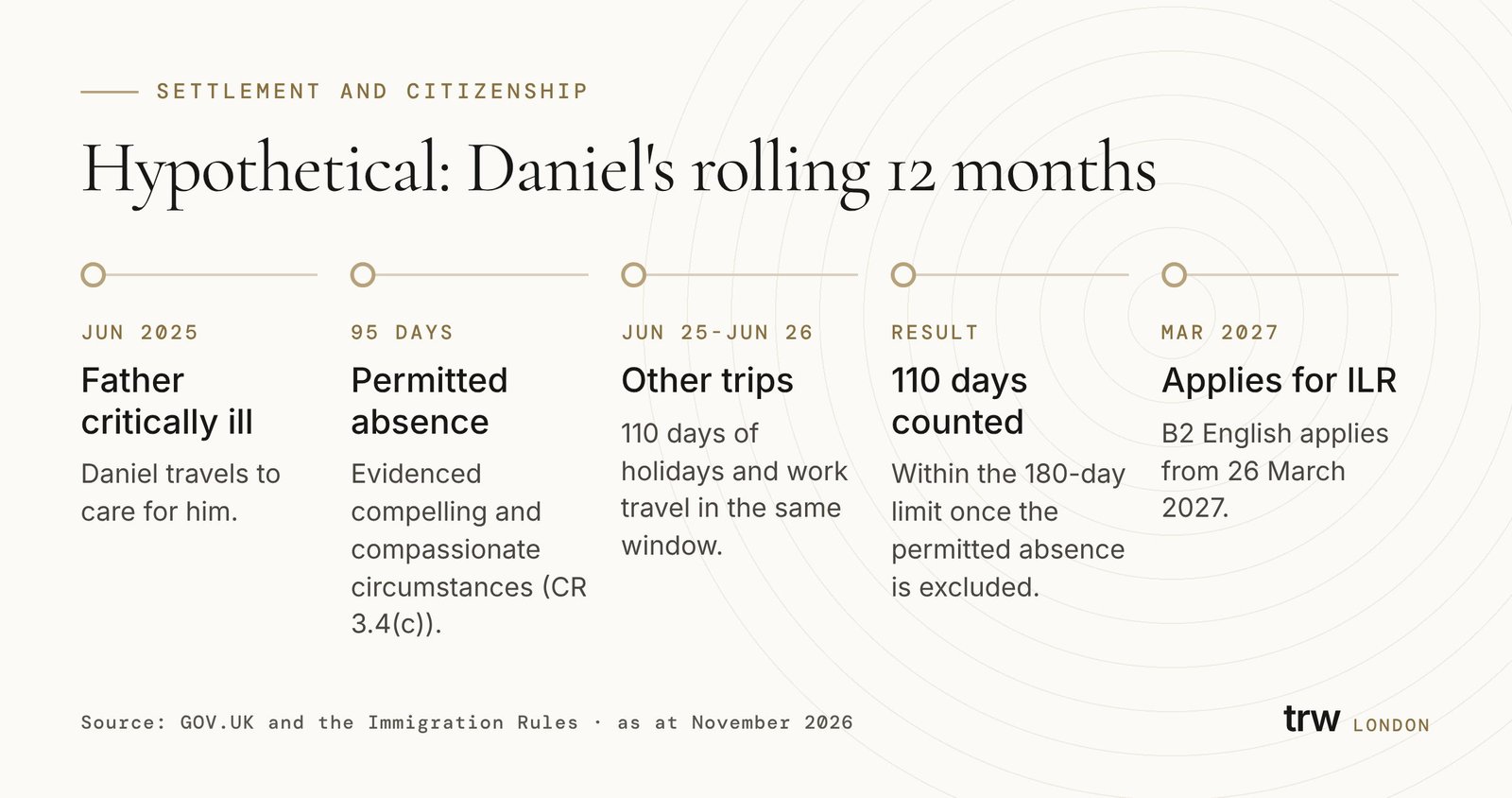
Example (hypothetical): Daniel is a Skilled Worker in London who plans to apply for ILR in March 2027. In the five years he has taken short holidays totalling about 40 days a year. In June 2025 his father became critically ill abroad; Daniel stayed with him for 95 days until his father's death, then returned. In the 12 months from June 2025 he also spent 110 days on holidays and work trips.
Counted plainly, Daniel has 205 days abroad in one rolling window and would fail CR 3.1. But the 95 days caring for his father fall within CR 3.4(c), compelling and compassionate circumstances, if he can evidence them. With hospital letters, the death certificate and his travel bookings, those days are disregarded and he has 110 days in that window. He also needs B2 English if he applies on or after 26 March 2027, so the timing of his application matters for that reason too.
Pitfalls
Testing calendar years instead of rolling windows
For post-2018 permission the test is any 12-month period. Two long trips either side of New Year can breach it even if each year looks fine.
Counting from your visa start date
If you got entry clearance weeks before you travelled, the days before arrival are absences. Check the vignette or eVisa grant date against your arrival date.
Relying on "I was working for my sponsor"
Business travel counts like any other absence. Only the specific research exceptions for listed occupation codes, and sponsor-agreed humanitarian work, are excused.
Assuming COVID-era absences are automatically excused
Travel disruption due to a pandemic is a permitted reason, but you still need to show that your own travel was disrupted. Choosing to stay abroad is different from being unable to return.
Forgetting the partner's own travel
Each applicant's absences are tested separately. A partner's long stay abroad can delay their settlement even if the main applicant qualifies.
Absences after you get ILR
Once you have indefinite leave to remain, the 180-day rule and the continuous residence test no longer apply to keep your status, but two other limits matter.
Keeping ILR
- ILR lapses if you are outside the UK for more than 2 continuous years (GOV.UK returning resident guidance)
- EUSS settled status lapses after more than 5 continuous years (4 for Swiss citizens and their family members)
- After lapse, you need a Returning Resident visa (fee £726) showing strong ties to the UK
Qualifying for citizenship
- No more than 450 days outside the UK in the 5 years before applying (GOV.UK naturalisation guidance)
- No more than 90 days in the last 12 months
- Physically present in the UK exactly 5 years before the Home Office receives the application
People who travel heavily while on ILR can keep their status yet still fall outside the naturalisation limits, which are tighter over the five years. The Home Office has discretion on excess absences for citizenship, but it should not be assumed. Our British citizenship solicitors page covers that stage, and you should keep your eVisa details up to date before travelling.

Earned settlement and the continuous residence rules
The government's earned settlement response (CP 1707, 2 November 2026) keeps lawful, continuous residence as part of settlement but does not publish new absence limits. It records that consultation respondents raised concerns about rigid residence rules and short absences. As at November 2026 the 180-day rule in Appendix Continuous Residence remains the law, and no Statement of Changes implementing earned settlement has been laid.
Employers should note that absences also matter for sponsor compliance, separately from settlement. Our guide to sponsored worker absence covers reporting duties for unpaid leave and long absences.
Next steps
If you are within a few weeks of the 180-day limit in any window, or relying on a permitted absence, get your chronology checked before you apply. A refusal on continuous residence grounds costs the application fee and can leave you with limited time to regularise your stay; our ILR refusal guide explains the remedies.
We usually start by building the rolling calculation from your documents and testing it against each possible counting date. For a review, book a consultation, or read more on our indefinite leave to remain solicitors page.
Frequently asked questions
01Do the days I leave and return count as absences?
Normally not. The caseworker guidance says only whole days of absence are counted, and a part day of less than 24 hours is not.
02Is the 180-day rule per visa year or per calendar year?
Neither, for permission granted on or after 11 January 2018. Absences are tested in any 12-month period in which they fall. Only absences during permission granted before that date are tested in consecutive 12-month periods ending on the application date anniversary.
03Can I apply for ILR if I exceeded 180 days once, years ago?
If the excess falls within your qualifying period and no exception applies, continuous residence is broken and the qualifying period restarts after that point. If it fell before your qualifying period started, it does not matter.
04Do absences during my visa application count?
Yes. The guidance says time abroad while an entry clearance or permission application is under consideration counts towards the absence limit.
05What if the Home Office records show trips I forgot?
Caseworkers are told to give applicants a chance to explain inconsistencies. Correct the record promptly and explain the omission. Deliberately false information can lead to refusal under Part Suitability.
06Do absences affect the English or salary requirements?
They are separate requirements. Sponsors do, however, have their own reporting duties for some absences; see our sponsored worker absence guide.
Sources and official materials
- Immigration Rules Appendix Continuous Residence — The 180-day rule, exceptions and events breaking residence
- Continuous residence caseworker guidance (v10.0) — Rolling periods, whole days and evidence
- GOV.UK: ILR for Skilled Workers — 180-day rule and 28-day early application
- GOV.UK: Long residence — Pre-11 April 2024 absence limits
- GOV.UK: Returning Resident visa — Lapse of ILR after 2 years abroad
- GOV.UK: Citizenship with ILR — 450 and 90-day limits for naturalisation
- A Fairer Pathway to Settlement (CP 1707) — Earned settlement residence principles
General information only, current as at 19 November 2026. It is not legal advice and does not create a solicitor–client relationship. It reflects the law of England and Wales unless stated otherwise; Scotland and Northern Ireland have separate legal systems, and the law changes frequently. Check current official sources and take advice on the facts of your matter.