TRW & Co · Refusals, appeals and challenges
Section 3C leave explained

If you apply to extend or switch before your permission expires and no decision arrives in time, section 3C of the Immigration Act 1971 extends your existing permission, on the same conditions, until the application is decided or withdrawn and through any in-country appeal or administrative review. It ends if you leave the UK, and it never starts if the application was late or invalid.
Key pointSection 3C depends entirely on a valid, in-time application: get the form, fee, identity document and biometrics right before your permission expires.
At a glance
Source
Section 3C of the Immigration Act 1971, applied through Home Office guidance version 12.0.
Trigger
A valid application to vary leave made before the leave expires.
Conditions
Existing work, study and public funds conditions continue unchanged.
Travel
Leaving the UK ends the extension and usually withdraws the application.
Cancellation
Possible only for breach of conditions or deception, under s.3C(3A).
Swipe or scroll →
Section 3C leave in one paragraph
Section 3C leave is the automatic extension of your existing UK permission while an application you made in time is still waiting for a decision. If you apply to extend or switch before your visa expires, and the Home Office has not decided by the expiry date, your permission continues on the same conditions until the application is decided or withdrawn, and then through any appeal or administrative review you are entitled to bring from inside the UK.
Nothing is issued to confirm it. There is no new vignette, eVisa entry or letter, which is why employers, landlords and even applicants are often unsure whether it applies. This guide reads the statute line by line, explains when the protection begins and ends, and covers the pitfalls that turn a lawful wait into a period of overstaying.
What section 3C says, provision by provision
Section 3C of the Immigration Act 1971 was inserted in 2003 and has been amended several times since, most recently to cover administrative review and EU citizens' rights appeals. Its structure is compact, and each subsection answers a different practical question. The table below translates it into plain terms.
| Provision | What it does | Practical effect |
|---|---|---|
| s.3C(1) | Applies where a person with limited leave applies to vary it before it expires, and the leave expires undecided | Only in-time applications by people who still hold leave qualify |
| s.3C(2)(a) | Extends leave while the application is neither decided nor withdrawn | Covers the waiting period, however long the Home Office takes |
| s.3C(2)(b)–(c) | Extends leave while an in-country appeal under s.82 of the 2002 Act could be brought or is pending | Protection continues through the appeal window and the appeal itself |
| s.3C(2)(d) | Extends leave while an administrative review could be sought or is pending | Covers the 14-day window to seek review and the review itself |
| s.3C(3) | Leave lapses if the applicant leaves the UK | Travelling abroad ends the extension |
| s.3C(3A) | Leave may be cancelled for breach of conditions or deception | Added from 1 December 2016 by the Immigration Act 2016 |
| s.3C(4)–(5) | No new application while on 3C leave, but the pending application may be varied | You can change what you applied for, not start a second application |
The Home Office explains how it applies these provisions in its caseworker guidance 3C and 3D leave (version 12.0). The guidance states the purpose directly: to prevent a person who makes an in-time application from becoming an overstayer while awaiting a decision and while any appeal or review they are entitled to is pending.
When 3C leave starts, and when it never starts
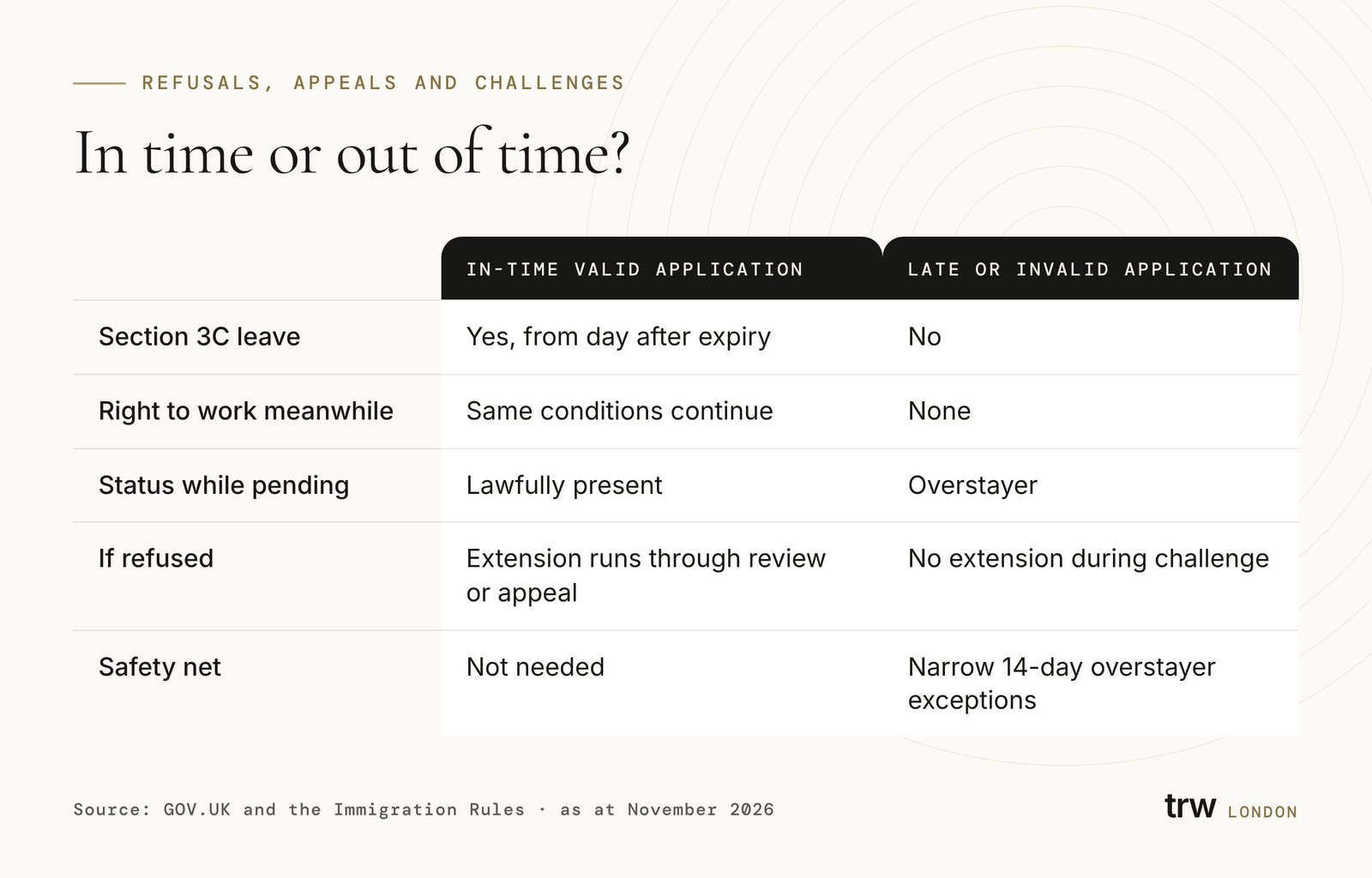
The extension begins at the end of the last day of your existing permission, but only if three things were true on the day you applied: you held limited leave, you were in the UK, and the application was valid. The validity point is where most problems arise. Under paragraph 34 of Part 1 of the Immigration Rules, an application must be made on the specified form, with the fee and Immigration Health Surcharge paid (or a fee waiver granted), proof of identity provided and biometrics enrolled as required.
Section 3C applies
- Valid online application submitted on or before the expiry date
- Application initially invalid but corrected within the single opportunity the Home Office gives under paragraph 34B, so it is treated as valid from the original date
- A variation of a pending in-time application, which takes the date of the original application (paragraph 34GB)
Section 3C does not apply
- Application submitted the day after permission expired, even by a few hours
- Application rejected as invalid and never corrected, even if made in time
- An application for a document that is not an application to vary leave, such as an old EEA residence card
- A person who was already without leave when they applied
The courts have confirmed that an invalid application does not engage section 3C at all; the Home Office guidance cites the Supreme Court's decision in Mirza [2016] UKSC 63 for that proposition. Where an application becomes invalid because biometrics were not enrolled, the guidance records that section 3C leave ends when the notice of invalidity is served, not on the original expiry date. A missed biometrics appointment can therefore end the extension part-way through.
One practical safeguard: if you are applying close to the deadline, submit and pay online the same day, keep the submission confirmation, and book the earliest biometrics appointment available. Section 3C cannot rescue an application that was never validly made.
How long the extension lasts
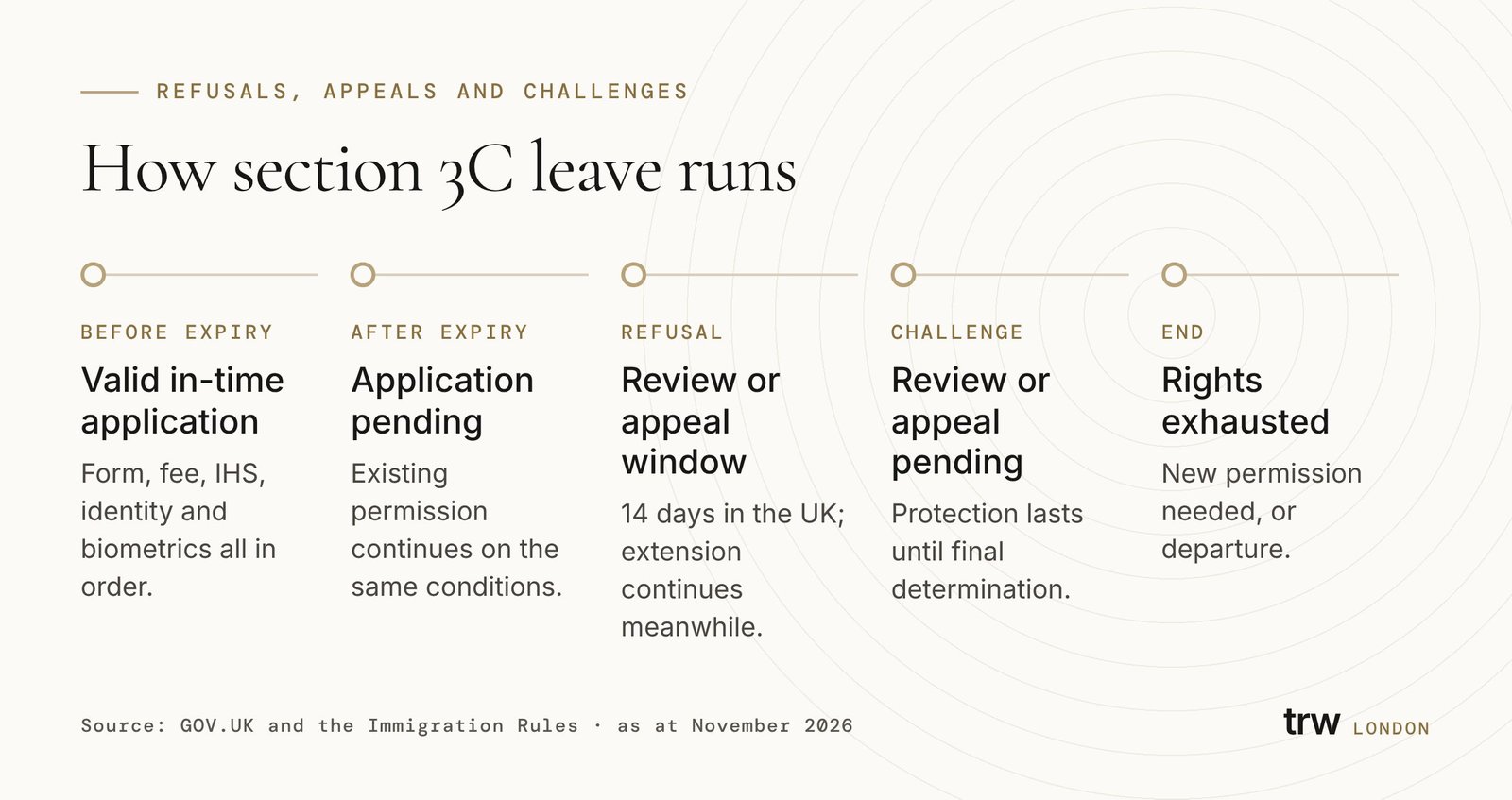
There is no fixed duration. Section 3C leave lasts for as long as the statutory conditions are met, which can be weeks or, in a contested case, years. The stages run consecutively, and the protection moves from one to the next without a gap only if each step is taken in time.
- Stage 1
Application pending
From the day after your permission expires until the Home Office decides the application or you withdraw it.
- Stage 2a
Administrative review window
For refusals that attract review, 14 days to apply (7 if detained) under the GOV.UK administrative review rules.
- Stage 2b
Appeal window
For refusals of human rights or protection claims, 14 days to appeal to the First-tier Tribunal from inside the UK.
- Stage 3
Review or appeal pending
Until the review is decided, or the appeal is finally determined, withdrawn or abandoned.
- Stage 4
Onward appeals
Continues while permission to appeal to the Upper Tribunal or the Court of Appeal can be sought in time, or is pending.
- End
Protection stops
When the last in-time step is exhausted, the person must leave or hold new permission.
Two limits are worth knowing. The Home Office guidance states that an appeal to the Supreme Court does not extend section 3C leave, and that a judicial review of the Upper Tribunal's refusal of permission to appeal does not do so either, unless the refusal is later quashed. And where a decision is withdrawn by the Home Office, the extension "resurrects" from the date of withdrawal, so there can be a break between the original decision and its withdrawal.
Six ways section 3C leave comes to an end
The application is granted
The new permission replaces the extension from the date of grant. If an appeal was pending, it is treated as abandoned on the grant (save for asylum or humanitarian protection grounds the appellant wishes to pursue), but section 3C leave ends anyway.
The application is refused and no in-time challenge follows
If you do not seek administrative review or appeal within the time limit, the extension ends at the end of the last day on which you could have done so. An out-of-time appeal does not revive it unless the tribunal later extends time, in which case the guidance says it resurrects from the date the appeal was lodged.
You withdraw the application or the appeal
Withdrawal ends the extension. For a First-tier Tribunal appeal, the guidance treats the leave as ending at the beginning of the day the appeal is withdrawn, so a new application made that same day will not attract section 3C protection.
You leave the UK
Section 3C(3) is blunt: the extended leave lapses on departure. Separately, paragraph 34K of the Immigration Rules treats an undecided application as withdrawn if you travel outside the Common Travel Area.
A fresh application ends a pending review
Under Appendix Administrative Review, a pending review stops being pending the day before a new valid application is made, so section 3C leave ends then. The new application does not carry the extension forward.
The Home Office cancels it
Under section 3C(3A) and paragraph SUI 9.2 or SUI 11.8 of Part Suitability, the extension can be cancelled for deception or for breach of conditions. Cancellation takes effect immediately.
Your rights while on 3C leave: work, study and travel
The extension preserves your existing permission on its existing conditions. That is both its strength and its limit: you keep exactly what you had, no more. The Home Office guidance gives the example of a student whose 20-hour term-time work limit continues to apply while an extension application is pending, and a worker whose no-recourse-to-public-funds condition continues to bind.
- Work continues on the same terms, including any restriction to a particular employer, job or number of hours.
- Study continues on the same terms, including any ATAS or course restrictions attached to your permission.
- Your right to rent and NHS entitlement continue, because you still hold leave.
- Conditions such as no recourse to public funds continue to apply and can be enforced.
- Travel outside the UK ends the extension and, for most routes, withdraws the pending application.
- Time on section 3C leave is lawful residence, which matters for settlement and long-residence calculations.
A worker on section 3C leave cannot generate a fresh share code showing new permission, because none has been granted. GOV.UK directs employers to the Employer Checking Service where an employee has an outstanding application, appeal or review. Use it to maintain a statutory excuse against the civil penalty once the original permission has expired, and diarise any follow-up check.

Changing a pending application without losing protection
Section 3C(4) bars a second, free-standing application while you are on extended leave, but section 3C(5) allows you to vary the pending application. Paragraph 34BB of the Immigration Rules sets out the mechanics: any further application is treated as a variation, only the most recent is considered, and the new application takes the date of the original one. The variation must itself be valid, so any higher fee must be paid. Variation is possible only while the original application is undecided; once a decision is made, the only way to change course is to withdraw the appeal or let the review end, which brings the extension to a close.
- Confirm the original application was valid and in time. Without that foundation there is no section 3C leave to preserve.
- Check the decision has not yet been made. Variation is not possible after a decision, even if the decision has not reached you.
- Submit the new application on the correct form and pay any fee difference. An invalid variation is not considered, under paragraph 34BB(2).
- Enrol biometrics within the original window. Since HC 584, paragraph 34BB(2A) confirms there is one biometrics period for the previous application.
- Expect a Home Office notification. Paragraph 34BB(4) says the Home Office will confirm it is treating the new application as a variation.
The 2026 changes aimed at misuse of section 3C
The Statement of Changes HC 584 (laid 3 September 2026) amended paragraph 34G and added paragraph 34BB(2A). The explanatory memorandum says the aim is to stop applicants extending permission under section 3C by making a fee-waived human rights application and then varying it to a different route, or by varying repeatedly without enrolling biometrics. A paid application that follows a fee waiver request must now be for the same route if it is to keep the waiver request date.
For genuine applicants the practical message is simple. If you request a fee waiver, the application that follows must be on the route named in the request, and under paragraph 34G(4) it must be submitted within 10 working days of receiving the waiver decision to keep the earlier date. Miss either requirement and the date of application becomes the date you actually submit, which may be after your permission has expired and therefore outside section 3C altogether.
Section 3C protects the person who applied properly and on time; it gives nothing to an application that was never valid.
Cancellation for breach of conditions or deception
Since 1 December 2016 the Home Office has had power to cancel section 3C leave, but only on two grounds: failure to comply with a condition of leave, or use of deception in seeking leave to remain, whether in the current or an earlier application. The guidance states that the other general cancellation powers do not apply to the extension, that cancellation is discretionary, and that the burden of proving the breach or deception lies on the Home Office on the balance of probabilities.
Where an application is pending, caseworkers are told to decide the application first. If they intend to grant despite the breach, they should not cancel. In practice, cancellation is most often seen where a student has stopped studying or is working beyond permitted hours while an extension is pending. Allegations of deception are covered in our guide to visa refusal for deception.
Worked examples
Example 1 (hypothetical): a Skilled Worker's permission expires on 30 April. She applies to extend on 28 April, pays, and enrols biometrics on 5 May. No decision has been made by 30 April, so from 1 May she holds section 3C leave and can keep working for her sponsor. Her employer uses the checking service and receives confirmation. The application is granted on 10 June and her new permission replaces the extension.
Example 2 (hypothetical): a graduate applies on his expiry date but omits a mandatory document. The Home Office gives him one opportunity to supply it; he does so within the deadline, the application is validated, and section 3C is treated as running from the day after expiry. Had he ignored the request, the application would have been invalid from the start and he would have been an overstayer from that day, with only the narrow overstayer exceptions to fall back on.
Example 3 (hypothetical): a student's extension is refused and she has 14 days to seek administrative review. On day 10 she submits a fresh application on a different route instead. The review is treated as no longer pending from the day before that application, her section 3C leave ends, and the new application is decided while she has no leave.
Where section 3C leads next
Section 3C leave is rarely the end of the story. It is the bridge between your old permission and whatever comes next: a grant, a review, an appeal or, if all else fails, a decision about leaving. These guides cover the steps that most often follow a pending application.
Administrative review
The £80 review of points-based refusals, with 14 days to apply from inside the UK.
Read the guideAppealFirst-tier Tribunal appeal
For refused human rights and protection claims, with the extension running throughout.
Read the guideStatus gapIf you have overstayed
The 14-day and 30-day rules for people whose permission has already lapsed.
Read the guideWorkChanging employer
How sponsored workers move jobs without breaching their conditions.
Read the guideNext steps
If your permission is close to expiring, the most valuable thing you can do is file a complete, valid application before the expiry date and keep proof of submission. If you are already on section 3C leave and want to change your application, travel, or respond to a refusal, take advice before acting, because each of those steps can end the extension. Employers should diarise checking-service confirmations and treat any refusal letter as a trigger to review the worker's status.
We regularly advise individuals and HR teams on the timing of extensions, variations and challenges. To discuss a pending application or a refusal, book a consultation. See also our guides to Skilled Worker extensions, First-tier Tribunal appeals and visa refusal advice.
Frequently asked questions
01Will I get a document confirming section 3C leave?
No document is issued. Your evidence is the application submission confirmation and, for employers or landlords, a check through the Home Office checking services.
02Can I travel abroad while my application is pending?
Travelling ends the extension under section 3C(3), and paragraph 34K of the Immigration Rules treats an undecided application as withdrawn if you leave the Common Travel Area. Plan travel around the decision, not during it.
03Does time on section 3C leave count towards ILR?
Yes, it is a period of lawful leave. Whether it counts towards a particular route's qualifying period depends on the route's rules and on the application ultimately succeeding.
04Can I start a new job while on 3C leave?
Only within the conditions of your existing permission. A sponsored worker generally needs the new job to be covered by a change of employment application, which itself must be properly made.
05What happens if I miss my biometrics appointment?
The application can be treated as invalid. Home Office guidance records that section 3C leave then ends when the notice of invalidity is served.
06Does a judicial review keep 3C leave running?
Generally not. The guidance confirms there is no section 3C leave while a judicial review of an Upper Tribunal permission refusal is pending, although it is restored if that refusal is quashed. See our page on immigration judicial review.
07Is 3C leave the same as 3D leave?
No. Section 3D covered appeals against curtailment or revocation decisions made before 6 April 2015 and now applies only in a small number of transitional cases.
Sources and official materials
- Immigration Act 1971, section 3C — The statutory extension of leave
- 3C and 3D leave: caseworker guidance (v12.0) — How the Home Office applies section 3C
- Immigration Rules Part 1 — Validity (para 34), variation (34BB), date of application (34G), travel (34K)
- HC 584 explanatory memorandum — September 2026 changes on fee waivers and variations
- Immigration Rules: Part Suitability — Cancellation grounds SUI 9.2 and SUI 11.8
- Use the Employer Checking Service — Employer checks during a pending application
- Ask for an administrative review — Time limits and fee
General information only, current as at 19 November 2026. It is not legal advice and does not create a solicitor–client relationship. It reflects the law of England and Wales unless stated otherwise; Scotland and Northern Ireland have separate legal systems, and the law changes frequently. Check current official sources and take advice on the facts of your matter.