TRW & Co · Refusals, appeals and challenges
Administrative review in the UK: how to challenge a casework error

Administrative review lets you ask the Home Office to correct a casework error in a refused or cancelled application on an eligible route. It costs £80. You must apply within 14 days in the UK (7 if detained) or 28 days from abroad. It is not an appeal: new evidence and new arguments are largely excluded, and decisions currently take 12 months or more.
Key pointA review succeeds only by showing the caseworker misapplied the Rules or guidance to the evidence you actually submitted. Do not make a new application while it is pending: that withdraws it.
At a glance
Legal basis
Appendix Administrative Review to the Immigration Rules.
Fee
£80, refunded if the review succeeds or is rejected as invalid.
Time limits
14 days in the UK, 7 if detained, 28 days from outside the UK.
Grounds
Rules or published guidance not applied, or applied incorrectly.
Timescale
GOV.UK currently warns 12 months or more, with an update at 6 months.
Swipe or scroll →
Administrative review UK: the short answer
The administrative review UK process is the Home Office's internal check for checking whether a refusal or cancellation was wrong because of a casework error. It is available for most work, study and business routes, costs £80, and must be requested within 14 days if you are in the UK (7 if detained) or 28 days from abroad. A different official, on an independent team, looks again at the original application.
It is not an appeal. The reviewer will not hear new arguments, consider a different route or weigh human rights, and in most cases will not look at new evidence. GOV.UK also warns that a decision can currently take 12 months or more. Used well, a review request corrects a clear casework error; used as a general second attempt, it rarely succeeds. This guide explains when it applies and how to make a review request that works.
What administrative review is (and is not)
Appendix Administrative Review to the Immigration Rules defines administrative review as "the review of an eligible decision, the purpose of which is to decide whether the decision was wrong due to a case working error". The reviewer decides whether the original decision maker failed to apply, or incorrectly applied, the Immigration Rules or published guidance (AR 3.1).
Two limits follow. Under AR 3.2 the reviewer considers only whether you were entitled to permission on the basis of the original application, not on any other basis. And the caseworker guidance says human rights or asylum grounds raised in a review request will not be considered; those must be made as a separate claim, which carries its own appeal rights if refused.
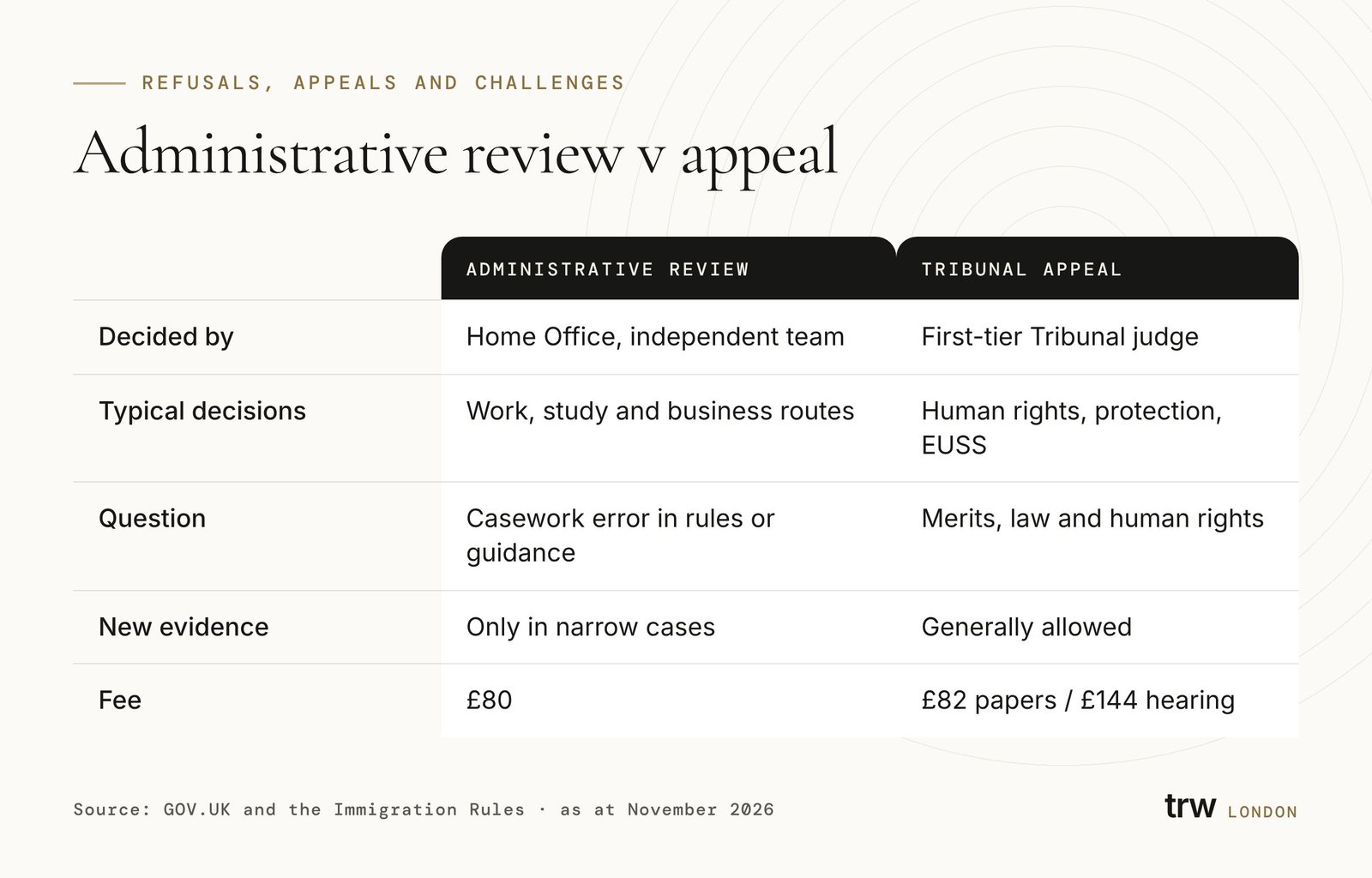
Administrative review
- Internal Home Office check by a different official
- For points-based and other listed routes
- Only errors in applying rules or guidance
- New evidence only in narrow cases
- £80; currently 12 months or more
Tribunal appeal
- Independent judge in the First-tier Tribunal
- For refused human rights and protection claims, EUSS decisions and others
- Merits, law and human rights considered
- Evidence after the decision can be considered
- £82 on the papers or £144 with a hearing
Which decisions can be reviewed
AR 2.1 lists the types of eligible decision: a refusal of entry clearance, of permission to enter or of permission to stay, and a cancellation of permission on arrival in the UK where the person is left without permission and the reason is a change of circumstances or false representations or non-disclosure. AR 2.6(e) also allows a review of the length or conditions of a grant within 14 days of receiving it.
The decision must be on a "specified route" in AR 1.1. As at November 2026 the list includes, among others:
- Skilled Worker, Global Business Mobility routes, T2 Minister of Religion and International Sportsperson
- Student, Child Student, Short-term Student (English Language) and Parent of a Child Student
- Graduate, High Potential Individual, Global Talent and Scale-up
- Temporary Work routes, including Creative, Charity, Religious, Government Authorised Exchange, International Agreement and Seasonal Worker
- Youth Mobility Scheme, UK Ancestry, Representative of an Overseas Business and Hong Kong BN(O)
- Bereaved Partner, Victim of Domestic Abuse, Returning Resident and Statelessness
- Appendix ECAA Settlement, added in the August 2026 guidance update
Notably absent are the Standard Visitor route, partner and family routes under Appendix FM, private life and protection claims. Family and private life refusals are usually human rights claims with a right of appeal; visit refusals have neither review nor appeal. EU Settlement Scheme administrative review closed to new applications in April 2024, and HC 584 removed Appendix AR (EU) from the Rules; EUSS decisions now go straight to appeal. Frontier worker reviews follow a separate process. If you are unsure which applies, our page for visa refusal solicitors sets out the remedies side by side.
Administrative review UK time limits and late review requests
| Decision | Time limit | Where you must be |
|---|---|---|
| Refusal of permission to stay, not detained | 14 calendar days from receiving notice | In the UK |
| Refusal of permission to stay or cancellation, detained on the decision date | 7 calendar days | In the UK |
| Refusal of entry clearance | 28 calendar days from receiving notice | Outside the UK |
| Cancellation of permission at the border, not detained | 14 calendar days | In the UK if given temporary admission |
| Cancellation at juxtaposed controls (Paris, Brussels, Dunkirk, Coquelles, Calais, Lille) | 28 days | After leaving the control zone |
| Length or conditions of a grant | 14 calendar days after receiving the grant | As applicable |
An application is made on the date it is submitted online (AR 2.7). AR 2.14 allows a late request only where the decision maker is satisfied it would be unjust not to waive the limit and the request was made as soon as reasonably practicable. The caseworker guidance gives emergency hospital admission as an example that may qualify, with a consultant's letter, and lists reasons that are unlikely to: forgetting the deadline, computer problems, waiting for an adviser, or a minor illness or a child's mild illness for a few days.
Someone who applied for permission to stay from inside the UK cannot request administrative review from abroad (AR 2.15). If you leave the UK, a pending review is treated as withdrawn. Plan travel around the review, not the other way round.
What counts as a casework error
The caseworker guidance gives worked examples of each kind of casework error that can be raised. They are a useful checklist when reading a refusal letter, because they reflect the Home Office's own view of what a reviewer should correct.
Wrong rules applied
For example, assessing an applicant under the Student rules when the Child Student rules applied.
Points miscounted
A master's degree certificate submitted, but points awarded only for a bachelor's degree.
Evidence overlooked
Two sets of bank statements submitted, but only one considered, so maintenance was refused.
Evidence misread
Bank balances added up incorrectly, or original documents wrongly treated as copies.
Guidance not followed
A sponsor losing its licence mid-application, without the policy allowing 60 days to find a new sponsor being applied.
Border cancellation wrong
A visitor's permission cancelled for a short course of study that is in fact permitted.
A good review request names the rule, quotes the evidence and shows the caseworker's error in one sentence each.
What is not a casework error matters just as much. A reviewer will not reassess a judgement that was open to the original decision maker simply because you disagree with it, and will not accept that the rule itself is unfair. Where the refusal turned on a genuine evidential gap, the honest answer is often that a new, complete application is the better course.
When new evidence is allowed
As a rule, the review is confined to what was before the original decision maker. AR 3.3 lists the exceptions where new evidence will be considered:
- Deception refusals and cancellations. Where the decision was made under Part Suitability (or Part 9 before 11 November 2025) on grounds of false representations or deception, you can submit evidence that the finding was wrong, for example a bank's confirmation that its earlier verification was mistaken.
- Previous breach refusals abroad. Where entry clearance was refused under Part Suitability or Part 9 for a previous breach of immigration laws.
- Paragraph 245AA. Where the decision maker wrongly failed to request specified documents under the points-based evidential flexibility rule; you can then supply what should have been requested.
- Evidential flexibility policy. Where the published evidential flexibility policy was not followed.
Where evidence is admissible, the reviewer may contact you for further information and set a reasonable timeframe (AR 3.4). If you do not respond in time, the review can be decided on what is available (AR 3.5).

Writing a strong administrative review UK request
The online form gives limited space, so precision matters more than volume. We usually start by putting the refusal letter, the application form and every document side by side, then build the request around three elements.
First, identify each refusal reason separately and say whether it is challenged. Second, for each challenged reason, cite the paragraph of the Rules or the section of guidance, state what the caseworker decided and explain exactly why that was a casework error, pointing to the document and page that proves it. Third, where new evidence is admissible under AR 3.3, attach it and explain which exception applies. Unchallenged reasons will stand, so a review request that addresses only some of them cannot succeed.
Dependants can be included only if they were dependants in the refused application, or if their permission is being cancelled at the same time as yours (AR 2.11). Otherwise each person must make a separate review request.
While your review is pending
If you applied in time for permission to stay while you still had leave, section 3C of the Immigration Act 1971 extends that leave while an administrative review could be sought and while one is pending. The caseworker guidance confirms that permission continues until you are served with the review decision or the request is withdrawn. AR 4.1 adds that a person with a pending review of an in-country decision will not be removed.
That protection is easily lost. Under AR 4.3 and 4.4, a review is treated as withdrawn if you leave the UK, ask for your passport back to travel, sign a waiver, or make any new application for entry clearance or permission; in the last case, withdrawal takes effect the day before the new application. A review requested after a new application is invalid (AR 2.16).
- Day 0
Refusal received
The 14-day (or 28-day) clock starts from the date you receive notice.
- By day 14
Request submitted
Online form, £80 fee and grounds. Section 3C leave continues if it applied.
- Month 6
Update
GOV.UK says the Home Office will contact you if there is no decision within 6 months.
- 12 months or more
Decision
GOV.UK currently warns that reviews can take this long.
- On decision
Next step
Reconsideration, onward options or leaving the UK if you have no permission.
Any Immigration Health Surcharge paid with the refused application is not refunded while an in-time review may be made or is under consideration. Employers of sponsored workers should note that the worker's right to work continues under section 3C during this period, provided the original application was made in time. Our section 3C guide covers the detail.

Outcomes, refunds and what comes next
AR 5.1 sets out four outcomes. The review succeeds and the decision is withdrawn for reconsideration; or it fails and the decision stands for all the original reasons; or it fails but one or more reasons are withdrawn; or it fails with different or additional reasons. The £80 fee is refunded if the review succeeds or the request is rejected as invalid, normally within three weeks, but not if the decision is maintained.
You can make a second review request only where the first maintained the decision for different or additional reasons, and only to challenge those new reasons; the guidance says no further fee is payable in that case. Otherwise, a failed review leaves three options: a new application that fixes the problem, a different route, or judicial review. In the Upper Tribunal, rule 28 requires a judicial review claim to be made promptly and within three months. Our guide to pre-action letters explains the first step.
If the review succeeds, the decision is withdrawn and reconsidered. That can still lead to a fresh refusal on a correct basis, but you will not need to enrol biometrics again.

Pitfalls in administrative review
Treating it as a fresh application
Adding new documents to a review request to fill gaps that existed at the time of application will not help outside the AR 3.3 exceptions, and can obscure the real casework error.
Ignoring one of several reasons
If a refusal has three reasons and the review request defeats two, the decision still stands on the third.
Raising Article 8 in the review
Human rights grounds in a review request are not considered. If family or private life is the real issue, make a human rights claim; see our human rights claim guide.
Booking travel
Leaving the UK, or asking for your passport back, withdraws an in-country review and ends section 3C leave.
Assuming the review protects a new job
A sponsored worker refused on a change of employment remains on section 3C leave tied to the conditions of their previous leave while the review is pending. Check what work is permitted. See our guide to changing employer.
Worked example
Example (hypothetical): J, aged 24, holds a Graduate visa and applies in the UK to switch to Skilled Worker with a salary of £35,000 in an eligible occupation. The refusal letter says the salary is below the £41,700 general threshold.
The GOV.UK guidance and Appendix Skilled Worker allow a "new entrant" rate, including for applicants under 26 and those switching from the Student or Graduate route: 70% of the going rate, subject to a £33,400 floor. If 70% of the occupation's going rate is no more than £35,000 and the certificate of sponsorship recorded J's new entrant status, the caseworker applied the wrong salary test. That is a casework error under AR 3.1(a), and it can be shown from the evidence already submitted.
J submits the review within 14 days, cites the new entrant provisions and the relevant CoS entries, and keeps working for the previous employer only to the extent the Graduate conditions allow, under section 3C. J does not make a new application while the review is pending, because that would withdraw it.
Visa refusal solicitors
Triage of every remedy after a refusal.
Read the guideRemediesFirst-tier Tribunal appeals
For human rights, protection and EUSS refusals.
Read the guideRemediesJudicial review
When review fails or is not available.
Read the guideStudyStudent visa refusals
Maintenance, CAS and credibility issues.
Read the guideNext steps
Write down the date you received the refusal and count the days. Read the remedy paragraph to confirm administrative review is available. Then test each refusal reason against the Rules and guidance: if you can point to a clear casework error, an administrative review UK request is worthwhile; if the problem is missing evidence, consider a new application instead, after checking the effect on section 3C leave.
TRW & Co prepares administrative review requests for individuals and sponsored workers, and advises employers on the right to work while reviews are pending. Book a consultation before your deadline. Further reading: GOV.UK: ask for an administrative review, reviews in the UK, border cancellations and the administrative review caseworker guidance.
Frequently asked questions
01Can I work while my administrative review is pending?
If your in-time application extended your leave under section 3C, that leave, with its existing conditions, continues while the review is pending. Your right to work depends on those conditions.
02Can I ask for administrative review of a visit visa refusal?
No. The Standard Visitor route is not listed in Appendix AR. See our visitor visa refusal guide for the options.
03Is the reviewer the same person who refused me?
No. The caseworker guidance says the review is carried out by a different person on an independent team.
04What happens if the review finds new reasons to refuse?
If the decision is maintained for different or additional reasons, you can request a second review of those new reasons. The decision letter will say whether this applies.
05Can I include my partner and children in my review request?
Only if they were dependants in the refused application, or their permission is being cancelled at the same time as yours.
06Can I request administrative review for the EU Settlement Scheme?
No longer. EUSS administrative review closed to new applications in April 2024 and HC 584 removed it from the Rules. EUSS refusals carry a right of appeal to the First-tier Tribunal.
07What if I miss the deadline?
A late request is accepted only if it would be unjust not to waive the time limit and you applied as soon as reasonably practicable. Serious, evidenced reasons such as emergency hospital admission may qualify.
Sources and official materials
- Ask for a visa administrative review (GOV.UK) — Fees, time limits, processing times and withdrawal
- Immigration Rules: Appendix Administrative Review — Eligible routes, validity, grounds and outcomes
- Administrative review: caseworker guidance (v18.0, August 2026) — Examples of casework errors, refunds and late requests
- Immigration Act 1971, section 3C — Continuation of leave during review
- Explanatory memorandum to HC 584 — Deletion of EUSS administrative review
- Appeal against a visa or immigration decision (GOV.UK) — Decisions that carry appeal rights instead
- Tribunal Procedure (Upper Tribunal) Rules 2008, rule 28 — Judicial review time limits
General information only, current as at 19 November 2026. It is not legal advice and does not create a solicitor–client relationship. It reflects the law of England and Wales unless stated otherwise; Scotland and Northern Ireland have separate legal systems, and the law changes frequently. Check current official sources and take advice on the facts of your matter.