TRW & Co · Asylum, deportation and detention
Voluntary departure from the UK

Voluntary departure means leaving the UK yourself rather than being removed. Paying your own way usually means a 12-month ban, and overstays of 30 days or less can be disregarded. Help from the voluntary returns service, including up to £3,000, counts as public expense and brings a 2 or 5-year ban. Removal brings 10.
Key pointWho pays for the ticket decides the length of the re-entry ban, so compare the ban before accepting Home Office help.
At a glance
Own expense
12-month mandatory refusal period; short overstays of 30 days or less can be disregarded.
Public expense
2 years if within 6 months of notice of liability for removal, otherwise 5 years.
Removal
10-year mandatory refusal period.
Support
Up to £3,000 on a card for eligible people using the voluntary returns service.
Appeals
Leaving the UK normally abandons an in-country appeal (s.92(8) NIAA 2002).
Swipe or scroll →
Voluntary departure: the short answer
Voluntary departure means leaving the UK yourself when you no longer have permission to stay, rather than waiting to be removed. You can do it at your own expense, or with help from the Home Office's voluntary returns service, which can arrange travel documents and tickets and, for some people, pay up to £3,000 in reintegration support. The choice matters later: how you leave, and when, decides how long any re-entry ban lasts.
Leaving the UK at your own expense usually carries the shortest ban, 12 months, and short overstays of 30 days or less can be disregarded altogether. Leaving at public expense carries a ban of 2 or 5 years depending on timing. Enforced removal carries 10 years. This guide explains each option as at November 2026, who qualifies for a voluntary return, and what to check before you go.

Voluntary departure, voluntary return and removal: the terms
The words overlap, and the Immigration Rules use their own. "Voluntary return" is the name GOV.UK gives to the Home Office service that helps people without permission to return home. "Voluntary departure" is the wider idea of leaving without being removed, whether through that service or on your own ticket. "Removal" and "deportation" are enforced: the Home Office sets directions and escorts the person if necessary.
For future applications, what matters is the distinction drawn in Part Suitability of the Immigration Rules between leaving "voluntarily at their own expense", leaving "voluntarily at public expense", and being "removed from the UK at public expense". Help from the Home Office with tickets or reintegration costs counts as public expense, even if the departure itself is voluntary.
| How the person left | Timing | Mandatory refusal period |
|---|---|---|
| Voluntarily, at own expense | Any time | 12 months from departure |
| Voluntarily, at public expense | Within 6 months of notice of liability for removal, or of appeal or review rights ending (whichever is later) | 2 years |
| Voluntarily, at public expense | More than 6 months after that point | 5 years |
| Left or removed as a condition of a conditional caution | N/A | 5 years |
| Removed | At public expense | 10 years |
| Used deception in an application | From date of refusal (visit entry clearance only for visits) | 10 years |
The periods are measured from the date the person left the UK, except for deception, which runs from the date of refusal. Where someone has more than one breach, only the one producing the longest period applies. These are mandatory refusal periods, often called re-entry bans; our guide to the UK re-entry ban covers them in more depth.
Who can use the voluntary returns service
According to the GOV.UK voluntary return page, you can usually apply if you are in the UK illegally or have overstayed, if you have withdrawn or want to withdraw an application to stay, if you have claimed asylum, or if you have a Home Office letter confirming you are a victim of modern slavery but have no permission to stay.
The service is not available to everyone. You cannot apply if you:
- have permission to stay, such as a student or work visa
- are being investigated by the police or are detained by the Home Office
- have been given a prison sentence of 12 months or longer
- have been convicted and given a deportation order
- have humanitarian protection, indefinite leave to remain or refugee status
- have a Service Providers from Switzerland visa, a Frontier Worker permit or an S2 Healthcare Visitor visa
- have applied for, or have, settled or pre-settled status under the EU Settlement Scheme
People who are excluded because of offending may be able to use the separate scheme for foreign national offenders described below. People with permission to stay do not need the service: they can simply leave, and should think carefully before doing so if they hold status that could be lost by absence.
Financial support of up to £3,000
The voluntary returns service can provide up to £3,000 in reintegration support, paid as a single payment on a card before departure that can only be used after arrival in the home country. GOV.UK says it can be used to find somewhere to live, find a job or start a business.
Financial support is targeted. You can apply if you are returning to a country classed as "developing" by the OECD, if your asylum claim has been refused, if you have a modern slavery confirmation letter, if you are part of a family group travelling together with children under 18 (British children excluded), if you are under 18 and travelling alone, if you are a care leaver under 21, if you are sleeping rough, or if you need more help, for example because of a medical condition.
You cannot get financial support if you are planning to buy, or have already bought, your own ticket. This is the core trade-off of a voluntary return: Home Office help with travel and money moves the departure from "own expense" to "public expense", which lengthens the re-entry ban from 12 months to at least 2 years.
Accepting a ticket or reintegration grant from the voluntary returns service is leaving at public expense. If you hope to come back to the UK within a year or two, for a visit, study or a family visa, compare the ban periods before accepting help.
How voluntary departure affects coming back
Three rules in Part Suitability work together. SUI 11.1 requires refusal of an entry clearance or entry application made within the relevant period after a breach of immigration law. SUI 11.2 allows refusal even after that period has passed, where the person also acted to frustrate immigration controls, for example by absconding, using a false identity or failing to co-operate with redocumentation. And SUI 11.3 allows refusal of any application where the person has been in breach of immigration laws.
There is an important exception for short overstays. Under SUI 11.5, overstaying is disregarded where the person left voluntarily, not at the Home Office's expense, and overstayed for 30 days or less (if the overstay began on or after 6 April 2017). Overstaying is also disregarded where the SUI 13.1 exceptions applied, such as an application made within 14 days with a good reason for lateness. For someone whose visa has just expired, leaving promptly at their own expense can avoid a breach being recorded at all.
For a recent overstayer, the fastest and cheapest exit, a self-funded flight within 30 days, also does most to protect future applications.

Leaving the UK at your own expense
GOV.UK confirms you do not need to contact the voluntary returns service if you are buying your own ticket and already have your travel and identity documents. Even so, leaving the UK without help needs some care if you want to rely on it later.
- Confirm your status. Check whether you have pending applications, appeals or 3C leave, and whether leaving will end them. See our guide to section 3C leave.
- Check documents. Make sure your passport is valid for the journey and for re-entry to your home country.
- Book and pay yourself. Use your own funds or those of family. Do not accept Home Office-funded travel if you want the 12-month period to apply.
- Keep evidence of departure. Retain your e-ticket, boarding pass and any receipts. They prove both the date you left and that you paid.
- Decide what to do about pending applications. An in-country application may be treated as withdrawn once you leave, so take advice on timing before you travel.
- Diarise the end of any ban. Note the date from which a new application will no longer face mandatory refusal.
If you are on immigration bail, leaving the UK ends bail under the Immigration Act 2016, but you should still tell the Home Office or reporting centre so that a missed reporting event is not recorded as absconding. Our guide to immigration bail conditions explains why that record matters.
Applying for a voluntary return through the service
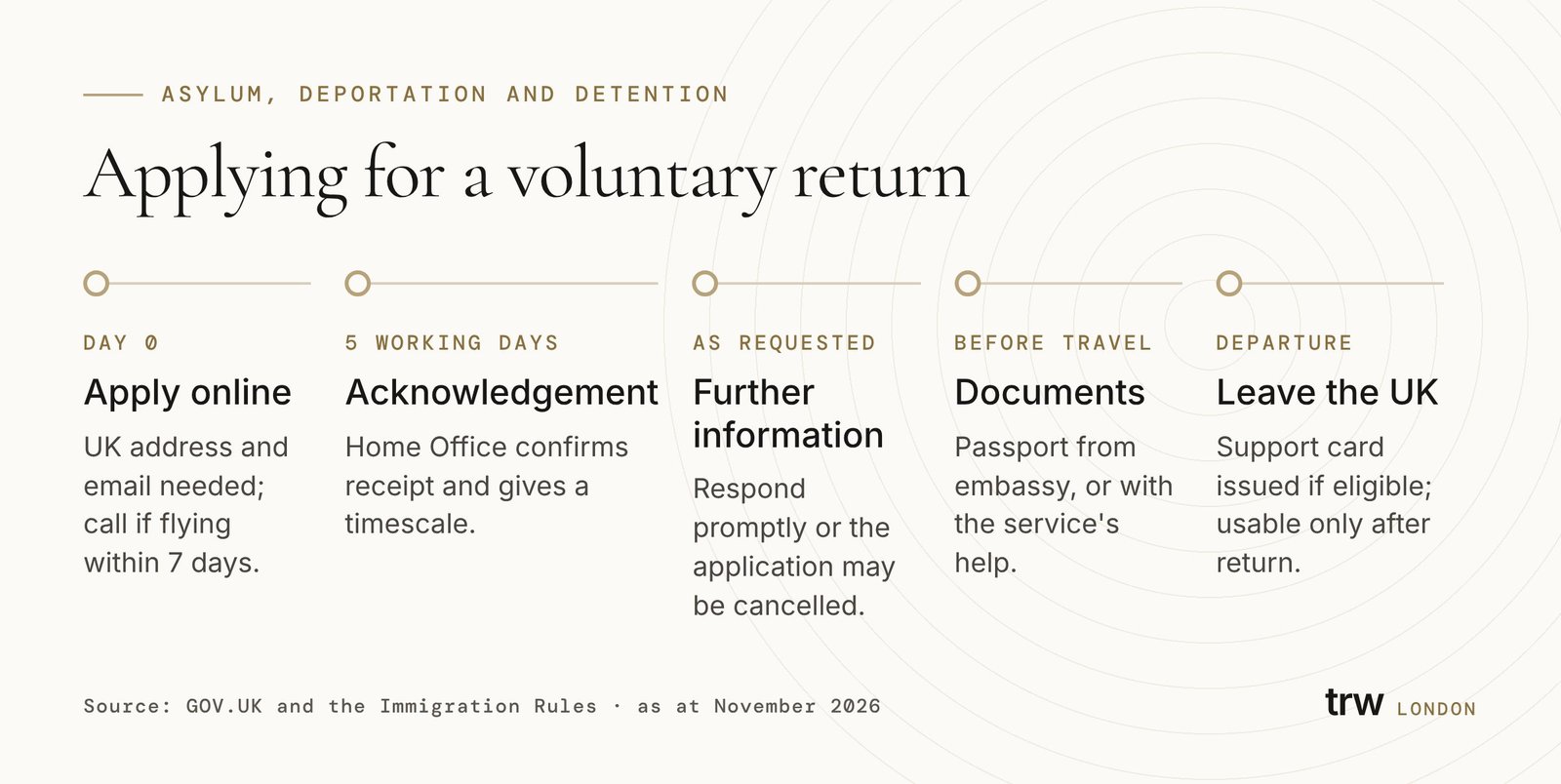
Applications are made online. You need a UK address and an email address. If you have already booked a flight leaving within the next 7 days, GOV.UK says you should not apply online but call the voluntary returns service instead. Help with the online form is available if you are not confident with computers, but the service does not give immigration advice.
- Day 0
Apply online
Give your UK address and email; say whether you need travel documents or help with tickets.
- Within 5 working days
Acknowledgement
The Home Office confirms receipt and emails an estimate of how long a decision will take.
- As requested
Further information
Provide any extra details asked for; failure to respond can lead to cancellation.
- Before travel
Travel document
Use your own passport, get one from your embassy, or ask the service to help (this can add time).
- Departure
Leave the UK
Any passport held by the Home Office is returned before you leave; any support card is issued.
There is no need to reapply while waiting for a decision. The Home Office's statutory guidance on adults at risk in immigration detention also expects officials to consider voluntary return options before detaining a vulnerable person for removal. Declining a realistic voluntary return can later be treated as non-compliance.
Check before you leave: claims, appeals and family
Leaving the UK can end legal processes that might otherwise have succeeded. Under section 92(8) of the Nationality, Immigration and Asylum Act 2002, an appeal brought from within the UK is treated as abandoned if the appellant leaves before it is finally determined, unless the claim had been certified. A pending human rights or protection claim also needs careful thought, because departure may be inconsistent with the basis of the claim.
Family position is the other area to check. A parent with a British child, a partner of a British or settled person, or someone with long residence may have an Article 8 claim that is stronger made in the UK than from abroad. Our guides to human rights claims and the private life route explain the main tests.
Reasons to consider leaving now
- Recent overstay of 30 days or less: possible to avoid a recorded breach
- No realistic basis to stay under the Rules or Article 8
- Wish to apply for a visa from abroad soon
- Need for reintegration support where eligible
Reasons to take advice first
- Pending appeal: departure normally abandons it
- British or settled children or partner in the UK
- Fear of harm on return, or a pending asylum claim
- Long residence that may support a private life claim
Foreign national offenders
People sentenced to 12 months or more, or who have a deportation order, cannot use the voluntary returns service. The Home Office runs a separate Facilitated Return Scheme for foreign national offenders, with resettlement grants of up to £1,500 for those who apply while serving a custodial sentence and up to £750 afterwards. Departure under that scheme is still deportation or removal, so it carries the long-term consequences of a deportation order.
Separately, section 5(6) of the Immigration Act 1971 allows the Home Office to pay the expenses of a person liable to deportation who, without an order being made, leaves to live permanently abroad, including travel for family members. Where a deportation order is made, revocation is governed by Part 13 of the Immigration Rules. Our automatic deportation guide explains how those orders work.
Common questions about leaving
Will I be stopped at the airport?
There is generally no bar on a person without permission leaving the UK. If you are on bail, reporting, or have a passport held by the Home Office, deal with that first. Taking advice before travelling is sensible if there is any doubt.
Can my family come with me on a voluntary return?
Yes, family groups can travel together and families with children under 18 may qualify for financial support. British children are not included in the support calculation.
Does a voluntary return count against me forever?
No. The mandatory refusal periods end after 12 months, 2 years, 5 years or 10 years depending on the circumstances. After that, the breach can still be taken into account under the discretionary grounds, so full disclosure in later applications is essential.
I overstayed by two weeks. What should I do?
If you leave voluntarily at your own expense, an overstay of 30 days or less that began after 6 April 2017 is disregarded under SUI 11.5. Leaving promptly and keeping proof of the date protects future applications.
Can I apply for a visa from abroad straight after leaving?
You can apply, but an application within the mandatory period will be refused. Check the date your period ends and whether a visa is needed using the GOV.UK visa checker.
Worked example
Example (hypothetical): Lucia's visit permission expired 20 days ago because she misread her grant. She wants to return to the UK next year to see her daughter. If she books and pays for her own flight now, the overstay is disregarded under SUI 11.5 because it lasted 30 days or less and she left at her own expense. A future visit application would still ask about her history, and she must answer honestly, but no mandatory refusal period would apply.
Compare her friend Tomas, who overstayed for three years and accepts a ticket and reintegration grant from the voluntary returns service two months after receiving notice of liability for removal. He left at public expense within 6 months of the notice, so a 2-year mandatory refusal period applies. Had he waited longer than 6 months after the notice, the period would have been 5 years.
Related guides before leaving the UK
UK re-entry bans
How mandatory refusal periods are calculated and when they end.
Read the guideStatusOverstaying in the UK
What overstaying means and the options for regularising.
Read the guideStatusSection 3C leave
When pending applications keep your permission alive.
Read the guideDetentionImmigration detention
Powers, limits and bail if the Home Office detains.
Read the guideEach of these guides deals with a question that often comes up before a voluntary departure. If you are unsure whether you are an overstayer, or whether an application you made keeps your permission alive, resolve that first; the answer may mean leaving the UK is unnecessary, or that a different route home is better.
Next steps
Before leaving, write down your immigration history, any pending applications or appeals, and the dates that matter. If your situation is simple and you have only just overstayed, leaving the UK quickly at your own expense may be the cleanest option. If there are children, long residence, offending or an appeal in progress, take advice first. Our team advises on overstaying, voluntary departure and the options for returning lawfully later, and our refusals team can help with a future application.
Book a consultation with TRW & Co.
Frequently asked questions
01Is voluntary departure the same as deportation?
No. Deportation is enforced under an order that bars return while it is in force. Voluntary departure is leaving without being removed; it can still trigger a re-entry ban, but a shorter one.
02How do I prove I left at my own expense?
Keep the booking confirmation, payment record and boarding pass. These show both the date of departure and who paid, which decide the applicable refusal period.
03Can I use the voluntary returns service if I am detained?
GOV.UK says people detained by the Home Office cannot apply for a voluntary return. Detained people should speak to their representative or the Home Office about removal and any bail options.
04Does the £3,000 have to be repaid?
GOV.UK describes it as financial support paid on a card for use after return. It is not described as a loan. It does make the departure one at public expense for re-entry purposes.
05What if I want to come back on a spouse visa?
Mandatory refusal periods apply to entry clearance applications generally, so check the date your period ends. Family applications can also raise Article 8 arguments; take advice before applying.
06Will leaving end my asylum claim?
Departure is usually inconsistent with a claim that you fear return, and any in-country appeal is normally treated as abandoned if you leave. Take advice before travelling if a claim or appeal is pending.
Sources and official materials
- Get help to return home if you are a migrant in the UK (GOV.UK) — Voluntary returns service, eligibility and support
- Immigration Rules Part Suitability — Breach of immigration laws and mandatory refusal periods
- Nationality, Immigration and Asylum Act 2002, section 92 — Appeals abandoned on leaving the UK
- Facilitated Return Scheme caseworker guidance — Scheme for foreign national offenders
- Immigration Act 1971, section 5 — Deportation orders and departure expenses
- Adults at risk in immigration detention — Voluntary return considered before detention
General information only, current as at 19 November 2026. It is not legal advice and does not create a solicitor–client relationship. It reflects the law of England and Wales unless stated otherwise; Scotland and Northern Ireland have separate legal systems, and the law changes frequently. Check current official sources and take advice on the facts of your matter.