TRW & Co · Asylum, deportation and detention
Automatic deportation: the UK Borders Act 2007 explained

Automatic deportation requires the Home Office to make a deportation order against a non-British, non-Irish national convicted in the UK and sentenced to 12 months or more, or to any term for a specified offence. Since 22 March 2026 suspended sentences of 12 months or more count. Six exceptions remain, with human rights the most important.
Key pointThe sentence is everything: its length, whether it is suspended and the date of conviction decide whether the automatic duty applies and which Article 8 test follows.
At a glance
Trigger
UK conviction and a sentence of at least 12 months, or any imprisonment for a specified offence.
Who is exempt
British and Irish citizens, plus narrow s.7 and s.8 categories in the 1971 Act.
2026 change
Suspended sentences of 12 months or more count for convictions on or after 22 March 2026.
Exceptions
Six remain in s.33, including human rights, the Refugee Convention and age under 18 at conviction.
Article 8 bar
Exceptions suffice under 4 years; very compelling circumstances needed for 4 years or more.
Swipe or scroll →
Automatic deportation in one paragraph
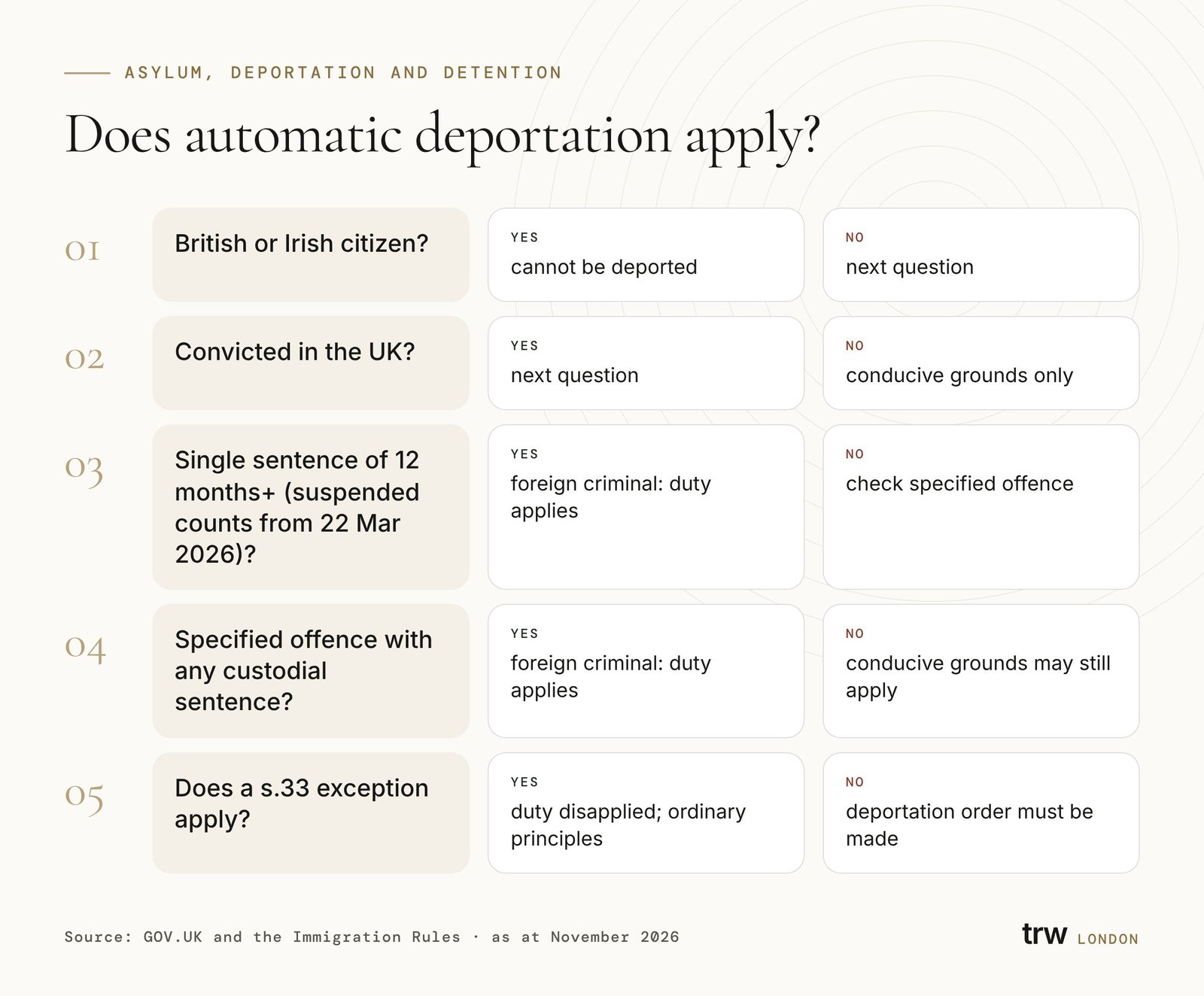
Automatic deportation is the statutory duty in section 32 of the UK Borders Act 2007 that requires the Home Secretary to make a deportation order against a "foreign criminal": a person who is not a British or Irish citizen and who is convicted in the UK and sentenced to at least 12 months' imprisonment, or to any term for certain serious offences. The duty is "automatic" in the sense that the public interest is presumed. It is not automatic in the sense of being unchallengeable, because six statutory exceptions remain, including human rights and the Refugee Convention.
This guide sets out who falls within the foreign criminal definition as at November 2026, the March 2026 change that brought suspended sentences into scope, the exceptions in section 33, and what happens between sentence and removal. It is written for people facing the process, their families, and criminal practitioners who need to understand the immigration consequences of a sentence.
Who is a "foreign criminal" under the UK Borders Act 2007
Section 32 defines a foreign criminal as a person who is not a British citizen or an Irish citizen, who is convicted in the UK of an offence, and who meets one of two conditions. Condition 1 is a sentence of imprisonment of at least 12 months. Condition 2 is a sentence of imprisonment of any length for an offence specified by order under section 72(4)(a) of the Nationality, Immigration and Asylum Act 2002.
Three points in the definition are often missed. The conviction must be in the UK, so overseas convictions are dealt with under the general "conducive" power instead. Indefinite leave to remain does not take a person outside the definition. And a British citizen is outside the definition however citizenship was acquired, although deprivation of citizenship may separately be considered where naturalisation or registration was obtained by fraud.
| Situation | Counts towards the 12-month threshold? |
|---|---|
| Single custodial sentence of 12 months or more | Yes |
| Consecutive sentences that only add up to more than 12 months | No (s.38(1)(b)) |
| Detention in a young offender institution or hospital for 12 months or more | Yes (s.38(1)(c)) |
| Indeterminate sentence that may last 12 months | Yes (s.38(1)(d)) |
| Suspended sentence of 12 months or more, conviction on or after 22 March 2026 | Yes, following the Sentencing Act 2026 |
| Suspended sentence for a Condition 2 (specified) offence, not activated | No (s.38(2)(a)) |
| Finding under s.5 Criminal Procedure (Insanity) Act 1964 | Not a conviction (s.38(3)) |
The table reflects section 38 as it reads in November 2026. The aggregation rule matters in practice. Two consecutive 8-month terms do not make a foreign criminal under Condition 1, though the Home Office can still consider deportation on conducive grounds, as explained below.

The March 2026 change: suspended sentences now count
Until 22 March 2026, section 38(1)(a) excluded suspended sentences from the 12-month threshold. Section 45 of the Sentencing Act 2026 omitted that paragraph with effect from 22 March 2026, and made a parallel change to section 117D(4)(a) of the 2002 Act. The explanatory memorandum to HC 259 records that the Home Office applies the change to convictions on or after 22 March 2026.
The practical effect is significant. A person given a suspended sentence of 12 months or more is now a foreign criminal for automatic deportation purposes, and is treated as having a 12-month sentence for the Article 8 tests in section 117C. The same sentence also triggers mandatory refusal or cancellation under Part Suitability of the Immigration Rules. Defence advocates who once saw a suspended sentence as protecting a client from immigration consequences need to revisit that assumption.
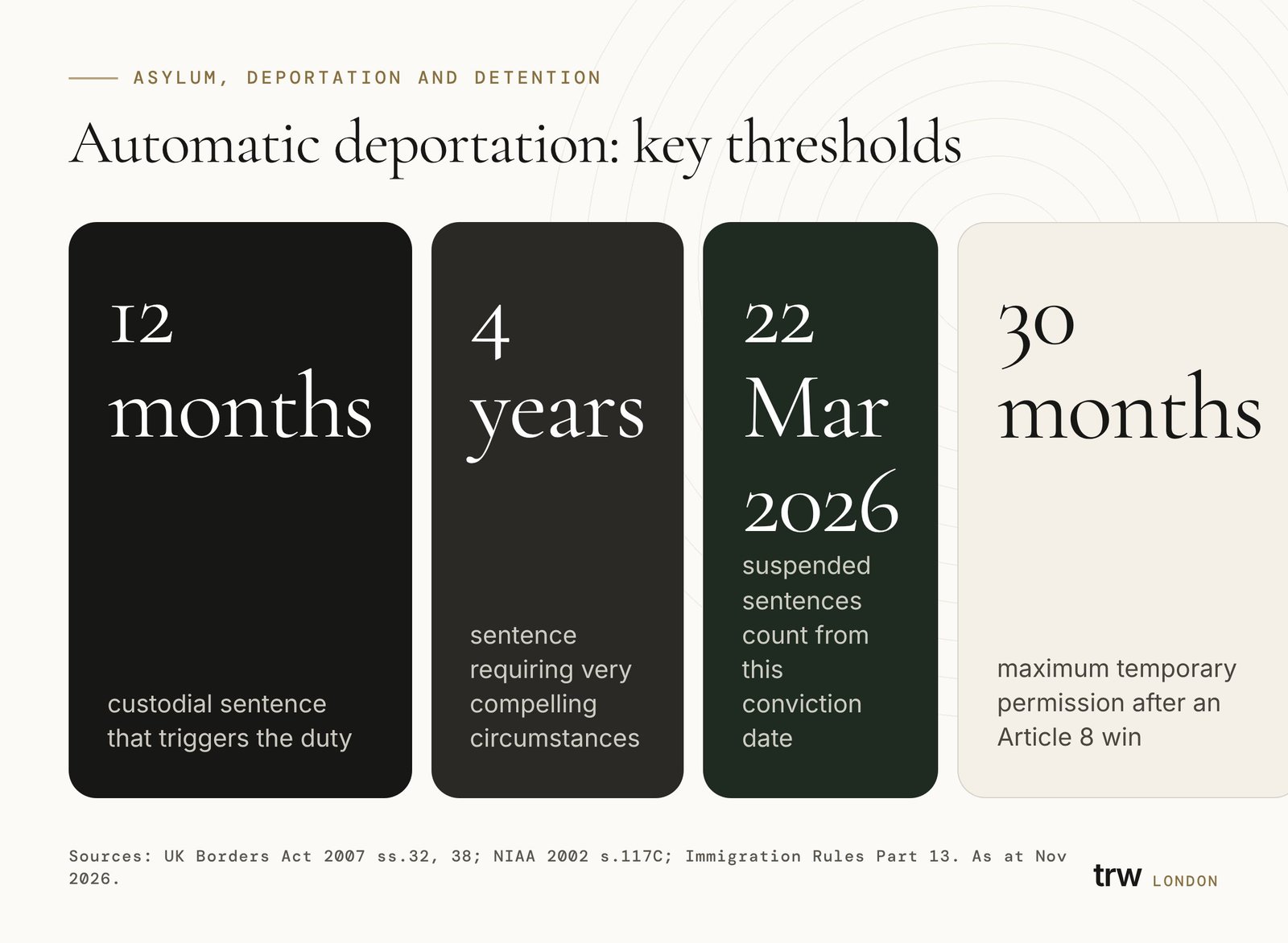
Check the conviction date, not the offence date. The Home Office position, recorded in HC 259, is that the change applies to convictions on or after 22 March 2026. A suspended sentence imposed for an earlier conviction is assessed under the old rule.
The exceptions in section 33
Section 33 disapplies the duty to make a deportation order where an exception applies. Exception 3 has been repealed, so six remain. The duty is also subject to sections 7 and 8 of the Immigration Act 1971, which protect certain long-resident Commonwealth and Irish citizens and some other categories.
| Exception | When it applies | Comment |
|---|---|---|
| 1 | Removal would breach Convention rights or the Refugee Convention | The main route in practice: Article 8, Article 3 and protection claims |
| 2 | The Home Secretary thinks the person was under 18 on the date of conviction | Age at conviction, not at the offence or at sentence |
| 4 | Extradition proceedings are in progress | Extradition takes priority while it lasts |
| 5 | A hospital, guardianship or transfer order under mental health legislation has effect | Lasts while the order is in force |
| 6 | Deportation would breach the Council of Europe trafficking convention | May be relevant to victims of trafficking |
| 7 | A person protected by the EU withdrawal agreement, for conduct before 31 December 2020 | The EEA public policy test applies instead |
An exception does not stop the Home Office making a deportation order. Section 33(7) provides that it removes the statutory presumption that deportation is conducive to the public good, leaving the Home Office to decide on ordinary principles. Where Exception 1 applies because removal would breach human rights, the person is likely to receive temporary permission rather than settled status. Under Part 13 of the Immigration Rules that permission is granted for no more than 30 months at a time.
Article 8 after a 12-month or 4-year sentence
Most foreign criminal cases are decided on Exception 1, and most of those on Article 8. Courts and tribunals must apply section 117C, which says that deportation of foreign criminals is in the public interest and that the more serious the offence, the greater that interest. The structure has two tiers.
Sentence of 12 months to under 4 years
- Private life exception: lawfully resident for most of life, socially and culturally integrated, very significant obstacles abroad
- Family life exception: genuine relationship with a qualifying partner or child, and deportation "unduly harsh"
- Otherwise, very compelling circumstances over and above the exceptions
Sentence of 4 years or more
- Exceptions alone are not enough
- Very compelling circumstances over and above the exceptions must be shown
- Rehabilitation, length of residence and the impact on children can all count, but the bar is high
These tests are applied in any deportation appeal, so the representations made at the outset should be built around them. Our guide to human rights claims explains how an Article 8 claim is presented more generally.
Automatic deportation versus conducive-grounds deportation
Not every deportation is automatic. Under section 3(5)(a) of the Immigration Act 1971, a person who is not a British citizen is liable to deportation if the Home Secretary deems it conducive to the public good. Part 13 paragraph 13.1.1 applies that power to people sentenced to less than 12 months, to persistent offenders, to those whose offending caused serious harm and to those with overseas convictions.
The difference matters for three reasons. First, under the 2007 Act the Home Secretary has no discretion to decline to make the order unless an exception applies. Second, an automatic order can only be revoked in the circumstances set out in section 32(6). Third, detention powers differ: section 36 of the 2007 Act applies once a sentence has been served, while conducive cases use the 1971 Act powers.
| Automatic (UK Borders Act 2007) | Conducive grounds (Immigration Act 1971) | |
|---|---|---|
| Trigger | UK conviction and 12-month sentence, or specified offence | Home Secretary deems deportation conducive to the public good |
| Discretion | Must make the order unless a s.33 exception applies | Discretionary decision |
| Revocation | Restricted by s.32(6) | Part 13 section 4; material change may suffice where no custodial sentence |
| Detention after sentence | s.36 UK Borders Act 2007 | Schedule 3 to the 1971 Act |
From sentence to removal: what happens and when
The Home Office's foreign national offender casework teams usually begin considering a case while the person is still serving the sentence. The sequence below is typical, though timings vary widely.
- At sentence
Referral
Non-British prisoners are referred to the Home Office and their nationality and status are checked.
- During sentence
Notice and s.120 statement
A notice of liability to deportation invites reasons why the person should not be deported.
- Representations
Claims made
Human rights and protection grounds set out with evidence; these form the basis of any later appeal.
- Decision
Deportation order
Order signed and any claims refused; certification under s.94B considered.
- End of custody
Detention or bail
Section 36 allows detention; immigration bail with conditions is the alternative.
- Removal
Travel documents
Removal once appeal rights are exhausted, or earlier if certified.
Section 36 allows the Home Office to detain a person who has served a period of imprisonment while it considers whether section 32(5) applies, and requires it to detain once an order is made unless immigration bail is granted. Detention is still subject to the limits explained in our guide to immigration detention in the UK, and bail is often granted with an electronic monitoring condition. See immigration bail conditions for how those work.
The Facilitated Return Scheme
Foreign national offenders who are liable to deportation or removal can apply to the Facilitated Return Scheme, which pays a resettlement grant to encourage early departure. The Home Office caseworker guidance (version 14.0, June 2025) sets the maximum grants at £1,500 for applications made while still serving a custodial sentence and £750 for those who apply after completing it. Grants of £750 are also available for people with overseas convictions or UK non-custodial sentences. Qualifying family members may receive up to £1,500, and a discretionary extra £500 may be paid in some vulnerable cases.
Two features are easily misunderstood. Departure under the scheme is still deportation or administrative removal, not an alternative to it, so the deportation order and its consequences remain. And a person who has previously received financial help to leave is not eligible again. Anyone considering the scheme should weigh it against any viable appeal, because accepting removal usually ends the chance to argue the case from within the UK.
A resettlement grant can make return easier, but it does not soften the order: the deportation, and the bar on returning, stay in place.
Long-term consequences for the foreign criminal and family
Leave is invalidated
A deportation order invalidates any leave to enter or remain, including indefinite leave, under s.5(1) of the Immigration Act 1971.
No return while in force
The order prohibits re-entry. Part Suitability requires refusal of any visa application while it remains in force.
Revocation is restricted
Under s.32(6) an automatic order can be revoked only if a s.33 exception applies, or on an application made from outside the UK.
Family members
A spouse, civil partner or child under 18 of a person being deported can also be liable to deportation (Part 13 para 13.1.1(c)), so their status needs separate advice.
Revocation is covered in more detail in our deportation appeal guide. In outline, Part 13 paragraph 13.4.4 allows revocation where an Article 8 exception or very compelling circumstances are shown (for sentences under 4 years), or very compelling circumstances alone (for 4 years or more), or where a Convention breach would otherwise result. Section 5(2) of the 1971 Act confirms that an order may be revoked at any time by a further order.

Questions people often get wrong
"I have indefinite leave, so I cannot be deported."
Indefinite leave to remain does not exempt anyone from the UK Borders Act 2007. Only British and Irish citizens fall outside the definition, together with the narrow exemptions in sections 7 and 8 of the 1971 Act.
"My sentence was suspended, so it does not count."
For convictions on or after 22 March 2026, a suspended sentence of 12 months or more does count. Check the date of conviction.
"Two short sentences add up to 12 months."
Consecutive sentences that only exceed 12 months in aggregate do not meet Condition 1. The Home Office may still pursue deportation on conducive grounds.
"I was a teenager when I offended."
Exception 2 depends on age at the date of conviction, not the date of the offence. A person who offended at 17 but was convicted at 18 is outside it.
"If I win under Article 8 I will get settlement."
A successful Exception 1 case usually leads to temporary permission of up to 30 months under Part 13, not indefinite leave.
Worked example
Example (hypothetical): Amira, a national of a non-EU country with indefinite leave to remain, is convicted in April 2026 and receives an 18-month suspended sentence. Before 22 March 2026 that sentence would not have made her a foreign criminal. Because her conviction post-dates the change, she now falls within Condition 1, and the Home Office must make a deportation order unless an exception applies.
Amira has lived lawfully in the UK since she was 6 and is now 30, so she has spent most of her life here lawfully. Her representations focus on the private life exception: integration, and very significant obstacles in a country she left as a child. Because her sentence is under 4 years, meeting that exception would be enough. If the claim is refused, she can appeal to the First-tier Tribunal within 14 days unless the claim is certified.
Compare a second hypothetical: Ben receives two consecutive 7-month custodial sentences for separate offences. He is not a foreign criminal under the UK Borders Act 2007, because section 38(1)(b) stops consecutive terms being added together to reach 12 months. Automatic deportation does not apply. The Home Office may still decide that deporting him is conducive to the public good, but it must then exercise a genuine discretion, and the presumption written into section 32 does not apply.
Reform: the Immigration and Asylum Bill
The Immigration and Asylum Bill completed its Commons stages on 17 November 2026 and had its Lords first reading the next day. It would introduce a new statutory Article 8 framework for foreign national offenders, requiring the public interest to be considered in every case. Deportation would be "always appropriate unless the individual impact is out of all proportion to the public interest". This is Bill material, not law, and existing cases continue under section 117C.
The Home Office has also said, in a news release on faster removals, that nearly 10,000 foreign national offenders were removed in the period it measured, up 36% on the 21 months before the July 2024 election. Policy direction is clearly towards more and faster removal, which puts a premium on getting representations right at the first stage.
Next steps
If you have been sentenced, or a family member has received a notice of liability to deportation, act on the deadline in the notice. Collect the sentencing remarks, immigration history and evidence of family life. If a criminal case is still running, make sure defence counsel knows the immigration status before plea and sentence. Our deportation team advises on automatic deportation, representations and appeals, and works with criminal practitioners where needed.
Book a consultation with TRW & Co.
Frequently asked questions
01Does automatic deportation apply to people with indefinite leave?
Yes. The definition of foreign criminal turns on nationality, not immigration status. A deportation order invalidates indefinite leave under s.5(1) of the Immigration Act 1971.
02Does an overseas conviction trigger automatic deportation?
No. Section 32 requires a conviction in the UK. Overseas convictions can still lead to deportation on conducive grounds under the 1971 Act and Part 13 of the Rules.
03Can I be deported if I was born in the UK?
Birth in the UK does not by itself confer British citizenship. A person born here who is not a British citizen can be a foreign criminal, although long lawful residence will be central to any private life argument.
04Is there an appeal?
The order itself is not appealable, but refusal of a human rights or protection claim made in response is, under s.82 of the 2002 Act. The deadline is 14 days from inside the UK unless the claim is certified.
05What is a specified offence under Condition 2?
An offence specified by order under s.72(4)(a) of the Nationality, Immigration and Asylum Act 2002. For those offences any custodial sentence triggers the duty, but an unactivated suspended sentence does not.
06Can a deportation order be revoked later?
Yes, but s.32(6) restricts revocation of automatic orders to cases where a s.33 exception applies or the application is made from abroad. Part 13 sets the test the Home Office applies.
Sources and official materials
- UK Borders Act 2007, section 32 — Automatic deportation duty and definition
- UK Borders Act 2007, section 33 — Exceptions
- UK Borders Act 2007, section 38 — How sentences are counted
- Nationality, Immigration and Asylum Act 2002, section 117C — Article 8 in foreign criminal cases
- Immigration Rules Part 13: deportation — Home Office approach and revocation
- Facilitated Return Scheme caseworker guidance — Resettlement grants for FNOs
- HC 259 explanatory memorandum — Suspended sentence change applied from 22 March 2026
General information only, current as at 19 November 2026. It is not legal advice and does not create a solicitor–client relationship. It reflects the law of England and Wales unless stated otherwise; Scotland and Northern Ireland have separate legal systems, and the law changes frequently. Check current official sources and take advice on the facts of your matter.