TRW & Co · Work and sponsorship
Genuine vacancy: how UKVI tests whether a sponsored role is real

A sponsored job must be a genuine vacancy: real, needed, and as described on the certificate of sponsorship. If UKVI has reasonable grounds to believe a role does not exist, is a sham or was created mainly for immigration purposes, the visa is refused and the sponsor licence will be revoked.
Key pointMost genuine vacancy problems are about proportion and paperwork rather than fraud: a role that looks out of scale with the business, or is poorly documented, is at real risk even if it is genuine.
At a glance
Standard
"Reasonable grounds to believe", not proof beyond doubt.
Worker
Fails sponsorship points under SW 5.5; administrative review only.
Sponsor
Mandatory revocation under Annex C1(z) of Part 3.
Eligible role
Since March 2026: must fit the business model, plan and scale.
Strongest defence
A short evidence file prepared before the CoS is assigned.
Swipe or scroll →
A genuine vacancy is a real job that the sponsor actually needs, that exists (or will exist) when the certificate of sponsorship is assigned, and that matches the duties, hours, skill level and pay stated on the certificate. If the Home Office has reasonable grounds to believe a sponsored role does not exist, is a sham or was created mainly to get someone a visa, the worker's application is refused and the sponsor licence will be revoked.
The genuine vacancy test is short to state and wide in effect. It applies at three moments: when an employer applies for a licence, when a worker applies for a visa, and at any point afterwards when UKVI checks how the role works in practice. This guide explains each, with the evidence that usually persuades a caseworker.
What "genuine vacancy" means in UK sponsorship
The phrase "genuine vacancy" is shorthand. Neither the Immigration Rules nor the sponsor guidance now use it as a defined term, but both contain the same core idea: sponsorship is a privilege that exists to fill real jobs, not to create immigration permission. The Rules ask whether the job is real; since March 2026 the sponsor guidance asks whether the role is an "eligible role", a broader test that also covers scale, business model and duration.
For employers, the practical point is that the genuine vacancy test is assessed on evidence the business generates in its ordinary operations: organisation charts, budgets, recruitment records, contracts, payroll and the worker's day-to-day activity. A genuine vacancy that is poorly documented is at almost as much risk as a sham role.
Where the genuine vacancy test sits in the law
The test appears in the Immigration Rules, Appendix Skilled Worker and the equivalent appendices for other sponsored routes, and separately in the three-part sponsor guidance. The Rules govern the worker's application; the guidance governs the sponsor's licence. The same facts can lead to a refusal for the worker and revocation for the employer.
| Provision | What it says | Who it affects |
|---|---|---|
| Appendix Skilled Worker SW 5.5 | No reasonable grounds to believe the job does not exist, is a sham, or was created mainly so the applicant can apply | Worker: points for sponsorship are refused |
| SW 5.6 | The job must not be a hire-out to a third party or routine contract work for a third party | Worker |
| SW 6.2–6.3 | The occupation code must be appropriate; the caseworker may consider whether the sponsor has shown a genuine need for the job as described | Worker |
| SW 14A.1 | The applicant must genuinely intend, and be able, to do the sponsored role and no other work beyond what is permitted | Worker |
| Glossary: "eligible role" | The role must exist, match the CoS, meet route requirements and be appropriate to the business's model, plan and scale | Sponsor |
| Part 3, Annex C1(z) | Reasonable grounds to believe the role is not genuine is a mandatory revocation ground | Sponsor |
Equivalent wording appears for the Global Business Mobility routes, including the Senior or Specialist Worker visa, at SNR 5.5. The standard throughout is "reasonable grounds to believe", not proof beyond doubt. The March 2026 update to Part 1 of the sponsor guidance also confirmed that the Home Office may act on a reasonable suspicion of non-compliance and that membership of the scheme is voluntary.
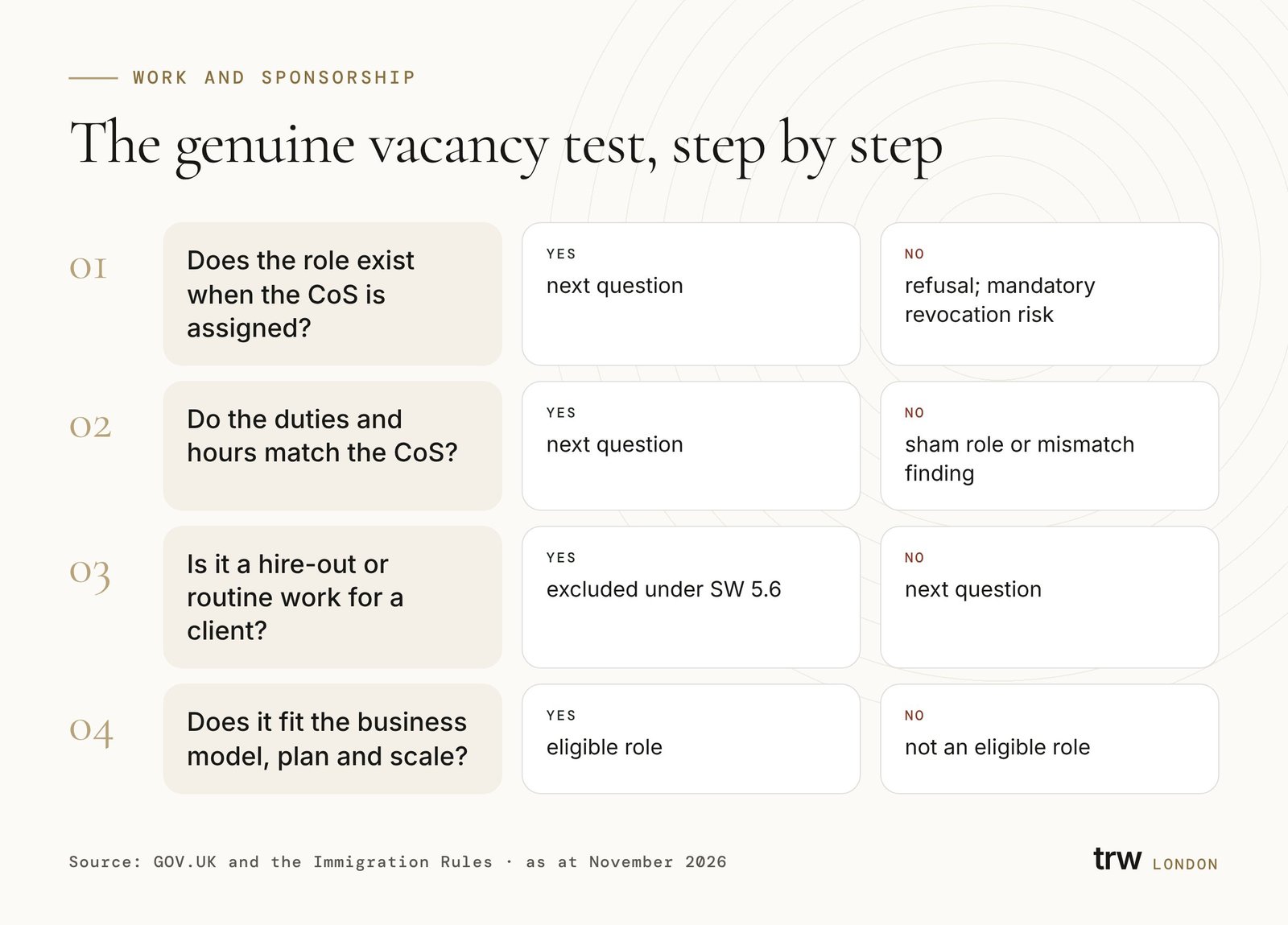
The "eligible role" definition introduced in 2026
The sponsor guidance glossary defines an "eligible role" as a vacancy or role that the Home Office is satisfied meets all of the following, and will continue to meet them for the whole period of sponsorship:
- it exists when the certificate of sponsorship (CoS) is assigned, or can reasonably be anticipated to exist by then, within the sponsor or another organisation the guidance allows the sponsor to place the worker with;
- it requires the jobholder to perform the specific duties and responsibilities set out on the CoS, including the weekly hours;
- it meets all the requirements of the route, including skill level and salary, and complies at all times with the National Minimum Wage and Working Time Regulations;
- it is appropriate to the business in light of its business model, business plan and scale.
The last limb is the part of the genuine vacancy test that catches most employers. A role can be real and well paid but still look out of proportion to the business that is sponsoring it. Part 1 of the guidance gives three examples where the Home Office may not be satisfied: an employer whose existing staff are all in lower-skilled roles, a small fast food outlet claiming to need a full-time business development or HR manager, and salaries that do not appear commensurate with turnover where the employer cannot explain how they will be funded sustainably.
The definition also links to duration. Part 3, paragraph C1.44, says the period on the CoS must accurately reflect the expected duration of the role and must not be exaggerated to secure longer permission. A two-year project role sponsored for five years is a genuine vacancy problem even if every other detail is right, and a deliberately exaggerated job description can turn it into a sham role finding.
The "eligible role" wording was introduced in the March 2026 update to the sponsor guidance, alongside the clarification on reasonable suspicion. Licence applications, CoS requests and compliance responses drafted before then may use older language; it is worth checking that current files address all four limbs.
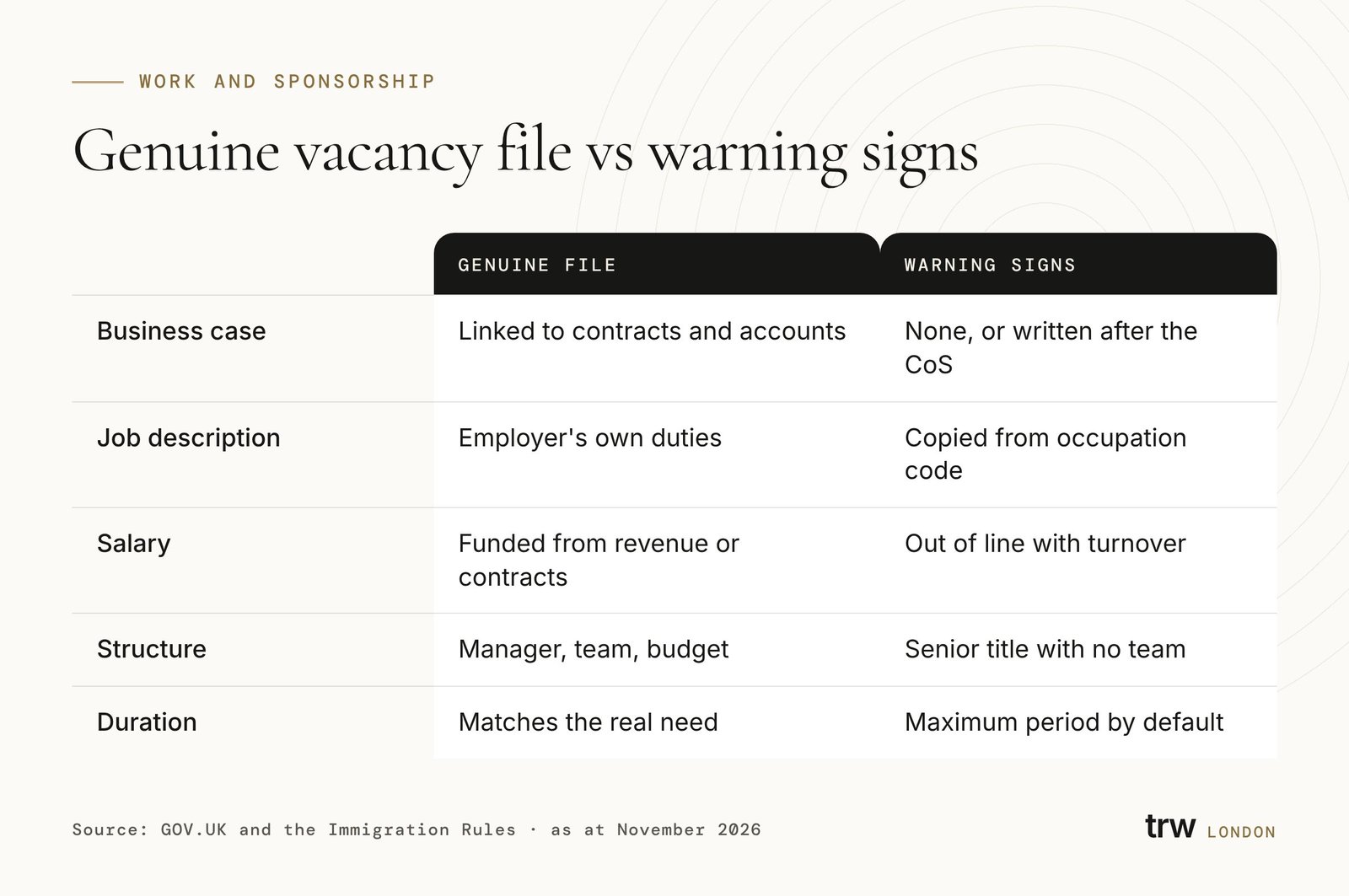
Warning signs caseworkers and compliance officers look for
Caseworkers do not usually reach a sham role conclusion from a single fact, and a genuine vacancy is rarely doubted because of one detail. They build a picture from several indicators, which is why an employer should test a proposed role against the same indicators before assigning a CoS.
Scale mismatch
A senior or specialist role in a business that has no structure, budget or workload to support it.
Salary that does not add up
Pay that looks unaffordable against turnover, or that appears set just above a threshold. Artificially inflated salary is itself a mandatory revocation ground.
Generic job description
Duties copied from the occupation code description rather than describing this employer's work.
No recruitment trail
No advert, shortlist, interview notes or reasons for selection, particularly where the worker was already known to the business.
Skills gap
A worker whose qualifications and experience do not fit the duties described.
Role drift
A worker doing something different in practice, often lower-skilled, from the job on the CoS.
The Home Office's own sponsor compliance visit caseworker guidance (version 17.0, March 2026) tells compliance officers on post-licence visits to assess whether sponsored workers were recruited to fill genuine vacancies that meet the skill and pay requirements of the route. Officers interview workers, and their answers about what they actually do are compared with the CoS. Our guide to the sponsor compliance visit explains how that works.

Sham role findings and third-party placements
A sham role finding is the most serious form of genuine vacancy failure. Annex C1(z) of Part 3 gives three illustrations of a role that is not genuine: it does not exist; it is a sham, including where the CoS contains an exaggerated or incorrect job description deliberately designed to appear to meet the route's requirements; or it has been created mainly so the worker can apply for permission.
A finding of this kind means the licence will be revoked, and the worker may be treated as complicit. The guidance gives the example of a worker who agreed that the employer would arrange a non-existent job; in that situation the Home Office will normally cancel all of the worker's remaining permission.
Third-party placements and labour supply
A related trap, which can turn a genuine vacancy into a sham role in the Home Office's eyes, is placing the sponsored worker with a client. The Rules exclude jobs that amount to hiring the worker out to a third party to fill a position, or contract work to provide an ongoing routine role or service for a third party. Part 2 of the sponsor guidance allows a sponsor to send a worker to a client only to deliver a defined project or service with an end date, while the sponsor keeps full responsibility for the worker's duties and outputs.
If UKVI finds that a sponsor is supplying workers as routine labour to another organisation, Part 2 says it will revoke the licence. Employment agencies and businesses can hold a licence, but only to sponsor staff employed directly in running their own business.
A role can be real, well paid and still fail the test if it looks out of proportion to the business that is sponsoring it.
Building a genuine vacancy evidence file
The most reliable protection is a short genuine vacancy file, prepared before the CoS is assigned, that answers the questions a caseworker would ask. We usually build it in the following order.
- Write the business case. One page explaining why the role exists now: new contract, growth, a departing employee, a regulatory requirement. Link it to figures in management accounts or a board paper.
- Fix the job description. Describe this employer's tasks, reporting lines and outputs in its own words, then choose the occupation code that fits most closely. Do not reverse-engineer the description from the code.
- Show where it sits. Prepare an organisation chart showing the role, its manager and anyone reporting to it. A senior role with no team and no budget needs an explanation.
- Evidence affordability. Show how the salary is funded: revenue, contract value, investment or group funding. This answers the "commensurate with turnover" concern directly.
- Keep the recruitment trail. Retain adverts, applications, interview notes and the reasons for choosing the candidate. Part 2 of the sponsor guidance requires sponsors to keep evidence of any recruitment activity for the role, even where no formal resident labour market test was required.
- Match the duration. Set the CoS end date to the real expected duration of the role, with the business reason recorded.
- Monitor after start. Check periodically that the worker is doing the job on the CoS, on the stated hours and pay, and report permitted changes within 10 working days.
Part 3 of the guidance allows UKVI to ask for details of recruitment practices to check that a sponsor is recruiting responsibly for eligible roles. A failure to provide requested documents within the deadline is itself a normal revocation ground under Annex C2, so the file needs to be retrievable quickly.
What happens if the genuine vacancy test is failed
The consequences of failing the genuine vacancy test depend on whether the problem is found in the worker's application or in a check on the sponsor, but they often travel together.
For the worker
- Visa application refused for lack of sponsorship points
- No right of appeal; administrative review only (£80, 14 days inside the UK, 28 days outside)
- If the licence is later revoked and the worker was not complicit, permission is normally cut to 60 days
- If complicit, all remaining permission is normally cancelled
For the sponsor
- Mandatory revocation where there are reasonable grounds to believe the role is not genuine (Annex C1(z))
- Revocation in every route on the licence and cancellation of unused CoS
- No right of appeal; 12-month cooling-off period (24 months after a second revocation)
- Key personnel can affect future licence applications by other organisations
A refused worker can seek administrative review, which corrects caseworking errors but does not usually allow new evidence. GOV.UK currently warns that it can take 12 months or more. Sponsor licence revocation can only be challenged by judicial review, which under CPR 54.5 must be brought promptly and in any event within 3 months. See our guides to administrative review and sponsor licence revocation.
The stakes have risen in sectors the Home Office regards as high risk. In its 2 November 2026 announcement, the Home Office said around 1,800 exploitative employers in the care sector have had their licences removed.
Difficult cases: start-ups, family links and evolving roles
A newly incorporated company sponsoring its founder or first hire
Part 1 gives an example of a foreign national who registers a company from abroad, employs one UK-based worker as Level 1 User and then assigns themselves a CoS. The Home Office is likely to consider such a company to exist mainly to facilitate entry, a mandatory revocation ground. New businesses can sponsor, but need real trading activity, funding and a role the business needs independently of the visa. The Innovator Founder route may be more appropriate for a founder.
Sponsoring a relative or partner of someone in the business
This is not prohibited, but an SMS user must never assign a CoS to themselves or to their own close relative or partner, and the sponsor must add a note if it knows that a CoS has gone to a close relative or partner of anyone in the organisation. Expect extra scrutiny of the recruitment trail.
A role that has changed since the CoS was assigned
Roles evolve. Changes that do not need a new application must be reported within 10 working days. Where the worker now does a job that no longer matches the occupation code or description and the change is not permitted, that is a mandatory revocation ground in its own right.
A remote or home-based worker
Compliance officers can visit any address where sponsored work is done, including a home address. Make sure the duties, supervision and outputs of a remote role are documented as clearly as for an office role.
A salary funded by a single client contract
This can be a genuine vacancy, but if the contract may end before the CoS does, the duration claim and affordability may be questioned. Record the contract term and what happens to the role if it ends.
Worked example: a small practice hiring a senior role
Example (hypothetical): a London architecture practice with six staff and a growing residential portfolio wants to sponsor a project architect from abroad. It has recently won two contracts that will run for at least three years and its partners are at capacity on design work.
The practice writes a one-page business case referring to the two contracts, prepares a job description based on its own project workflow, and maps the role into its organisation chart beneath a partner. It shows the salary is affordable from contracted fees, keeps the advert and interview notes, and sets the CoS for three years to match the contract pipeline.
Compare a version of the same practice that instead sponsors a "head of strategy" on a salary roughly equal to a third of annual turnover, with no team, no budget and a job description lifted from the occupation code. Each fact alone might be explicable; together they are the pattern the guidance describes, the genuine vacancy test is unlikely to be met, and the practice risks a sham role finding.
Responding when UKVI questions a role
UKVI may raise doubts about whether a post is a genuine vacancy through a request for information on a CoS or visa application, during a compliance check, or in a letter proposing to downgrade, suspend or revoke a licence. Each needs a different response, but the timetable is usually tight.
- Day 0
Request or letter received
Note the deadline. Suspension and downgrade letters usually allow 20 working days to respond.
- Days 1–5
Gather the file
Business case, accounts, contracts, organisation chart, recruitment records, payroll.
- Days 5–15
Prepare representations
Address each concern specifically, with documents, rather than general assurances.
- Before deadline
Submit and log
Send everything relied on at once; there is no oral hearing.
- Decision
Outcome and options
Reinstatement, B-rating with action plan, or revocation; consider judicial review promptly.
Where an action plan follows, the steps usually focus on processes rather than the role itself. Our guide to the sponsor licence action plan explains the three-month process, and our sponsor compliance solicitors page explains how we help with representations.

Next steps
Before assigning a CoS for a new or unusual role, run the genuine vacancy test yourself: check it against the four limbs of the eligible role definition and the warning signs above. If you are applying for a licence, our guide to certificates of sponsorship explains defined and undefined CoS. If UKVI has already raised concerns, act within the deadline: book a consultation and we will review the file with you.
Frequently asked questions
01Do we need to advertise the role?
The sponsor guidance does not require a formal resident labour market test for most roles, but Part 2 says you must keep evidence of any recruitment activity you carried out. Those records help show the vacancy was real.
02Can a family business sponsor a relative?
It is not prohibited, but the SMS user must not assign a CoS to themselves or their own close relative or partner, and closer scrutiny of the role and recruitment should be expected.
03Does a high salary prove the role is genuine?
No. A salary that looks unaffordable for the business can count against it, and artificially inflating a salary to meet a threshold is a mandatory revocation ground.
04Can UKVI question a role after the visa is granted?
Yes. Compliance checks can take place at any time, and officers compare what workers say they do with the certificate of sponsorship.
05What if the job ends earlier than planned?
Report it through the SMS within the required time. Ending a role for genuine business reasons is not a breach; failing to report it is.
06Is a refusal on genuine vacancy grounds appealable?
There is no appeal for a points-based refusal; the worker can seek administrative review. Licence revocation can be challenged only by judicial review.
Sources and official materials
- Immigration Rules: Appendix Skilled Worker — SW 5.5, 5.6, 6.2–6.3 and 14A.1
- Sponsor guidance Part 1: apply for a licence — Eligible role requirement and examples (L8.10–L8.12)
- Sponsor guidance Part 2: sponsor a worker — Third-party and contract working
- Sponsor guidance Part 3: sponsor duties and compliance — Annex C1(z) and duties
- Sponsor guidance glossary — Definition of eligible role
- Sponsor compliance visits: caseworker guidance — What compliance officers assess
- Ask for a visa administrative review — Fees, deadlines and processing
General information only, current as at 19 November 2026. It is not legal advice and does not create a solicitor–client relationship. It reflects the law of England and Wales unless stated otherwise; Scotland and Northern Ireland have separate legal systems, and the law changes frequently. Check current official sources and take advice on the facts of your matter.