TRW & Co · Talent, founders and investors
Youth Mobility Scheme visa: who can apply and how it works
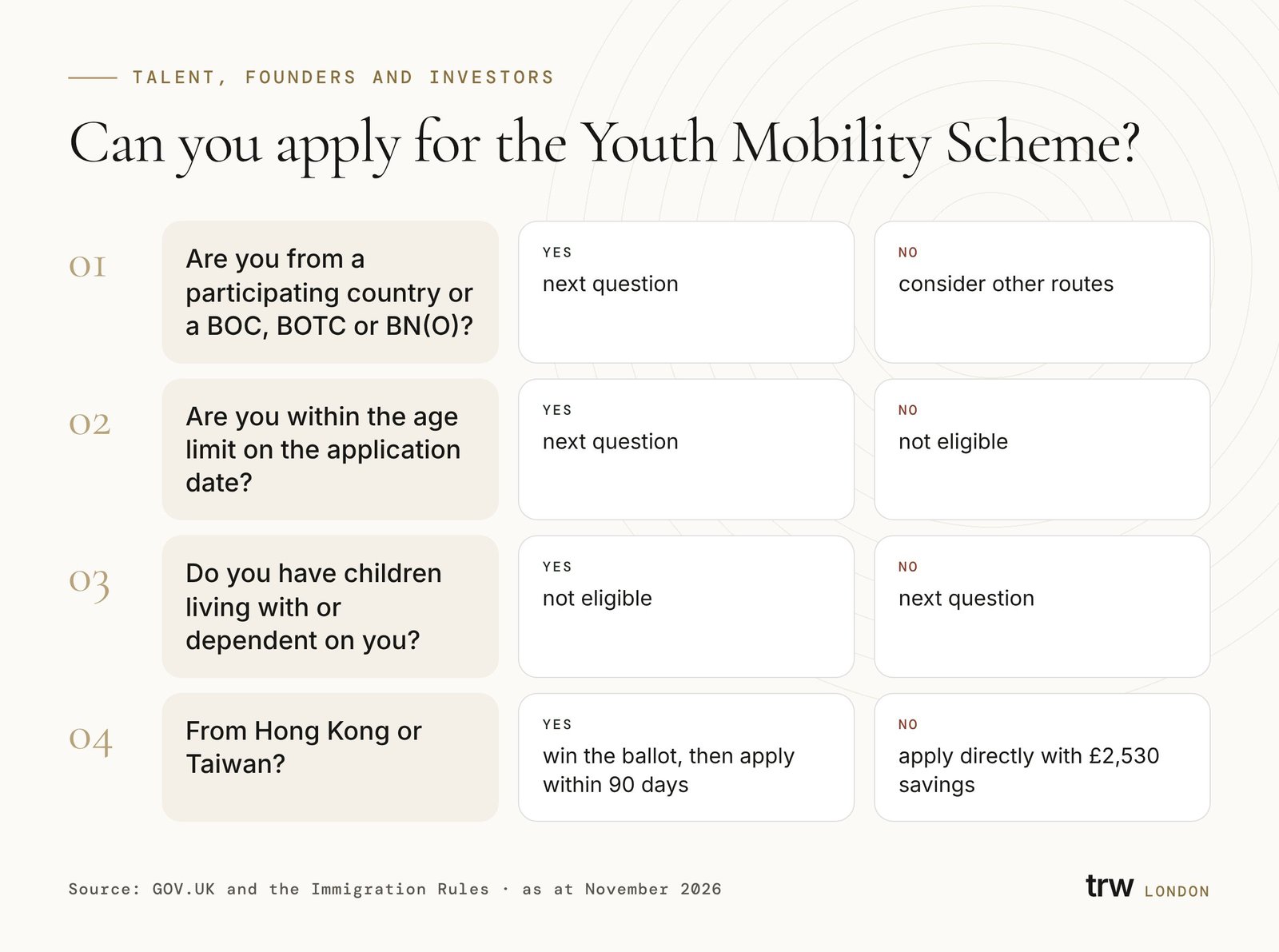
The Youth Mobility Scheme lets 18 to 30 year olds from participating countries (18 to 35 for Australia, Canada, New Zealand and South Korea) live and work in the UK for up to two years. You need £2,530 savings, a £340 fee and the surcharge. Hong Kong and Taiwan applicants must win a ballot first.
Key pointThe visa is flexible on work but rigid on eligibility: age at application, 28 days of savings, and no children living with or dependent on you.
At a glance
Length
Up to 2 years; a third year for Australians, Canadians and New Zealanders.
Ages
18–30, or 18–35 for Australia, Canada, New Zealand and South Korea.
Money
£2,530 savings held 28 days, £340 fee, £776 a year surcharge (as at November 2026).
Ballot
Only Hong Kong SAR passport holders and Taiwanese nationals.
Limits
No dependants, no settlement, restricted self-employment.
Swipe or scroll →
The youth mobility scheme at a glance
The youth mobility scheme lets young people from a short list of countries and territories live and work in the UK for up to two years without a job offer or sponsor. Applicants are usually aged 18 to 30, or 18 to 35 for nationals of Australia, Canada, New Zealand and South Korea. They need £2,530 in savings, a £340 fee and the immigration health surcharge, which is £776 a year for this route, as at November 2026.
The legal rules are in Appendix Youth Mobility Scheme and the country quotas in Appendix Youth Mobility Scheme: eligible nationals. Hong Kong SAR passport holders and Taiwanese nationals must first be selected in a ballot; everyone else applies directly. The route does not lead to settlement and dependants cannot come on it.
Participating countries, ages and 2026 quotas
Who can apply depends on nationality, and the upper age limit varies. The Rules test the age on the date of application, while the applicant must be 18 or over on the date the entry clearance becomes valid (YMS 1.4 and 3.4). GOV.UK confirms you can apply shortly before turning 18, and you can be over the upper limit when the visa starts, provided you applied in time.
| Country or group | Age at application | Ballot? | 2026 places |
|---|---|---|---|
| Australia | 18–35 | No | 38,500 |
| Canada | 18–35 | No | 10,000 |
| New Zealand | 18–35 | No | 8,000 |
| South Korea | 18–35 | No (ballot ended) | 5,000 |
| Japan | 18–30 | No (ballot ended) | 6,000 |
| Hong Kong (SAR passport) | 18–30 | Yes | 1,000 |
| Taiwan | 18–30 | Yes | 1,000 |
| Iceland, Monaco, San Marino | 18–30 | No | 1,000 each |
| Uruguay | 18–30 | No | 500 |
| Andorra | 18–30 | No | 100 |
| British overseas citizens, BOTCs, BN(O)s | 18–30 | No | No quota |
India also has 3,000 places in the same appendix, but Indian nationals apply under the separate India Young Professionals Scheme, which runs only by ballot. Bangladesh, the United States and EU member states are not participants. For years where new quotas have not yet been set, paragraph 1.A of the appendix carries places forward: the same number for countries below 1,000, and otherwise 1,000 or half of the previous year's allocation, whichever is greater.

How the Youth Mobility Scheme ballot works
For Hong Kong and Taiwan, places are allocated through an invitation-to-apply system. Under paragraph 3 of the eligible nationals appendix, the Home Office invites expressions of interest, selects at random from those received, and issues invitations with a time limit. Japanese and South Korean nationals no longer need to enter a ballot, according to the GOV.UK ballot page.
The 2026 ballots are closed. GOV.UK records a first ballot in February 2026 and a second in July 2026, with 1,000 places for each territory, most allocated in February. Details of the 2027 ballot will be published on the same page.
- Ballot opens
Send one email
Entry is by email in English, open for 48 hours; one entry per person, duplicates are discarded.
- Within 48 hours
Automated reply
The Home Office confirms receipt. Entry is free.
- About 2 weeks
Result
Successful entrants are emailed an invitation; unsuccessful entrants are told within 2 weeks of closing.
- Within 90 days
Apply and give biometrics
Submit the visa application, pay the fee and attend the visa application centre.
- About 3 weeks later
Decision
GOV.UK gives three weeks from the appointment as the usual decision time.
The subject line must follow the published format: surname, first name, date of birth and passport number. The body must repeat those details and add a mobile number. GOV.UK states that emails without this information "will not be considered", and that ballot results are final with no right of appeal. An unsuccessful entrant can try again in a later ballot while still eligible.
Only enter the ballot if you meet every requirement now, including the £2,530 savings and the age rule. A place is wasted if you are selected and then cannot apply within 90 days.
Savings, fees and documents
YMS 5.1 sets the financial requirement at £2,530. GOV.UK says the money must have been in your account for at least 28 days in a row, with day 28 falling within 31 days of the application.
The costs, as at November 2026, are a £340 application fee and the immigration health surcharge of £776 per year (see GOV.UK surcharge rates). Check the current fee table before you pay.
- Valid passport or travel document
- Bank statement showing at least £2,530 held for 28 consecutive days
- Tuberculosis test certificate if you are resident in a listed country
- Hong Kong or Taiwan: the Home Office email confirming ballot success
- Andorra: certificate of criminal records issued within 6 months
- Iceland: Criminal Certificate for Private Use (Sakavottorð) issued within 6 months
- San Marino: suitability letter from the Department of Foreign Affairs issued within 6 months
- Uruguay: Certificate of Judicial Records issued within 6 months
- Certified translations of anything not in English or Welsh
There is one more eligibility condition that catches people out. YMS 5.3 bars applicants with children under 18 who live with them or are financially dependent on them, and GOV.UK adds that you cannot apply if you have already been in the UK under the scheme.
Work, study and self-employment
The scheme is one of the most flexible temporary routes in the Rules. The conditions in YMS 7.2 and 7.3 set the limits.
You can
- Work in most jobs, full-time or part-time, for any employer
- Work without a sponsor or job offer
- Study (with an ATAS certificate for some subjects)
- Leave and re-enter the UK during the visa
- Be self-employed or set up a company, within limits
You cannot
- Work as a professional sportsperson, including as a coach
- Bring a partner or children as dependants
- Claim public funds
- Extend, unless you are from Australia, Canada or New Zealand
- Count the time towards settlement
Self-employment is allowed only if three conditions in YMS 7.3(b) are all met: you own no business premises other than your home, the equipment used in the business is worth no more than £5,000, and you have no employees. GOV.UK describes the premises point as requiring rented premises. Freelancers and contractors often fit easily; anyone planning to hire staff or buy significant equipment should consider an Innovator Founder route instead.

Applying for the Youth Mobility Scheme visa
The route is entry clearance only. YMS 3.1 requires a visa before arrival, so you cannot switch into it from inside the UK. GOV.UK says the earliest you can apply is six months before you travel.
- Check eligibility and timing. Confirm nationality, age at application, and no children living with or dependent on you. Hong Kong and Taiwan applicants must hold a ballot invitation.
- Build the savings record. Hold £2,530 for 28 consecutive days and apply within 31 days of the end of that period.
- Apply online. Use the "Temporary Work or Youth Mobility Scheme" form and pay the fee and surcharge.
- Prove your identity. Depending on nationality and passport, either scan your passport with the UK Immigration: ID Check app or attend a visa application centre.
- Get your eVisa. Successful applicants create a UKVI account to access their eVisa. GOV.UK notes that ballot applicants receive an eVisa, not a vignette.
- Travel and start work. Enter at any time while the visa is valid; the period runs from the start date, not from arrival.
Refusals carry a right to administrative review under YMS 6.2. Because most refusals stem from savings evidence or the timing of documents, a corrected fresh application is often quicker, but a ballot invitation may have expired by then.
The third year for Australians, Canadians and New Zealanders
Nationals of Australia, Canada and New Zealand can extend once, from inside the UK, so that their total time on the route reaches three continuous years (YMS 1.4.A and 7.1(b)). GOV.UK's extension guidance says the extension lasts one year from the day after the original visa ends, should be applied for no more than 28 days before expiry, and usually takes eight weeks to decide.
The extension costs another £340 plus the surcharge. The savings and children requirements do not apply at this stage (YMS 5.4). South Korean nationals share the higher age limit but not the right to extend. You must not travel outside the Common Travel Area while the extension is pending.
Your first months on the scheme
Once you arrive, a few practical steps make the two years run smoothly and protect your options later. None of them is an immigration requirement in itself, but each one touches your status, your tax record or your evidence for the next application.
Start with your digital status. Your permission exists as an eVisa linked to your passport, so update your UKVI account whenever you renew or replace the passport. Landlords, employers and the NHS check status online using share codes, and an out-of-date passport link is one of the most common causes of delays at the border.
Next, deal with National Insurance. GOV.UK says you can start work before your National Insurance number arrives if you can prove your right to work, and that a number can take up to four weeks. Your eVisa account may already show a number. Paying tax and National Insurance through PAYE from the start creates the payslip trail you will need if you later switch to a sponsored route.
Healthcare is covered by the surcharge you paid. According to the GOV.UK surcharge guidance, you can use the NHS free of charge from the date your visa starts, although prescriptions, dental treatment and eye tests may still be charged. On this route the surcharge is £776 a year, so £1,552 for a two-year visa, as at November 2026.
Finally, keep a simple record of employers, dates, job titles and pay. If a firm wants to sponsor you, it will need to choose an occupation code that matches your actual duties and assess whether you meet the salary rules. Accurate records also help if your time in the UK becomes relevant to a future settlement or citizenship application. Travel is unrestricted during the visa, but plan long trips with the visa end date in mind: the clock does not stop while you are abroad, and the youth mobility scheme gives no credit for time lost.
If you turn 31 (or 36) after your visa is issued, GOV.UK confirms you can stay for as long as the visa remains valid. The age test bites only on the application date.
What comes after the scheme
The youth mobility scheme is not a route to settlement, so a participant who wants to stay must move to another route before the visa ends. The Youth Mobility Scheme is not on the list of routes from which switching to Skilled Worker is barred, so a participant who finds a sponsoring employer can usually switch without leaving the UK, provided the job, salary and English requirements are met.
Several other routes are open in principle, depending on circumstances. Each has its own requirements, and timing matters: an application must be made before the current visa expires.
Skilled Worker
Graduate-level job, £41,700 or the going rate; switching from YMS is possible.
Read the guideTalentGlobal Talent
For recognised leaders or emerging leaders; no sponsor needed.
Read the guideHeritageUK Ancestry
For Commonwealth citizens with a UK-born grandparent; apply from abroad.
Read the guideFamilyPartner visa
If you have formed a relationship with a British or settled partner.
Read the guideMistakes that cost applicants their place
Savings dipping below £2,530 for a day
The 28-day period must be unbroken. A single day below the threshold restarts the clock. Move the money into a separate account and leave it there.
Ballot email in the wrong format
The Home Office says emails without the required details or not in the specified format will not be considered. Copy the format exactly, including the passport number in the subject line.
Applying after the age limit
The age test applies on the date of application. Applying the week after your 31st (or 36th) birthday is too late, even if you were eligible when you started preparing.
Assuming a partner can follow
There are no dependants on this route. A partner needs their own visa, perhaps their own youth mobility place.
Starting a business with staff
Self-employment is permitted only without employees, owned premises or equipment over £5,000. Breaching conditions can lead to cancellation of permission and later refusals.
Example (hypothetical): Mei, 27, a Taiwanese software tester, enters the 2027 ballot and is selected. She has 90 days to apply. She already holds NT$ savings worth well over £2,530 but moved part of them three weeks earlier, so she waits until the balance has been held for 28 days before applying, then books her visa centre appointment within the invitation window. In London she contracts as a freelance tester from her rented flat with a laptop, which fits the self-employment limits. In her second year, an employer offers her a graduate-level role and she switches to Skilled Worker from inside the UK.
For employers hiring scheme participants
Employers do not need a sponsor licence to hire a participant, but they must carry out a right to work check before employment starts. Participants hold eVisas, so the check is done online with a share code beginning "W"; see our eVisa share code guide. Diarise the visa end date and run a follow-up check before it.
If the business wants to keep someone beyond the scheme, start early: sponsorship requires a sponsor licence, an eligible graduate-level role and a certificate of sponsorship, and the worker must apply before the youth mobility permission expires.

Outlook: EU youth experience and settlement reform
EU citizens are not eligible for the scheme today. In June 2025 the EU Council authorised the European Commission to negotiate a youth experience scheme with the UK, and the government published an explanatory memorandum on that negotiating mandate. As at November 2026 no such scheme appears in the Immigration Rules; any arrangement would need new Rules before anyone could apply.
On settlement, the government's earned settlement response (CP 1707) lists Youth Mobility Scheme time among periods that will not count towards settlement. That is announced policy, not law, and has no implementation date. Its practical relevance is to people relying on mixed lawful residence: the same paper says the ten-year Long Residence route will close.
Next steps
Check your nationality and age against the table, build the savings record, and if you are from Hong Kong or Taiwan watch the GOV.UK ballot page for 2027 dates. If you are already in the UK on the scheme and want to stay, plan the next route at least six months before your visa ends.
We usually help participants and employers with the move from the scheme into sponsored work or a talent route, where timing and evidence matter most. To talk it through, book a consultation.
Frequently asked questions
01Can I bring my partner on the Youth Mobility Scheme?
No. Dependants are not permitted. A partner needs a visa in their own right.
02Can I apply from inside the UK?
No. The first grant is entry clearance only. Only Australian, Canadian and New Zealand nationals can extend from inside the UK.
03Do I need a job offer?
No. You can look for work after arrival and work in most jobs, apart from professional sport.
04Can I do the scheme twice?
No. GOV.UK says you cannot apply if you have already been in the UK under the scheme.
05Is the ballot still needed for Japan and South Korea?
No. GOV.UK says Japanese and South Korean nationals can now apply at any time without entering a ballot.
06Can I switch to a Skilled Worker visa?
Usually yes, from inside the UK, if you have an eligible sponsored job and meet the salary and English rules. See our Skilled Worker team.
07What if I have a child while in the UK?
GOV.UK says a child born in the UK is not automatically British, and you can apply for their visa as your dependant.
Sources and official materials
- Youth Mobility Scheme visa (GOV.UK) — Eligibility, fees, documents and extension
- Youth Mobility Scheme visa: ballot system — Hong Kong and Taiwan ballot rules
- Immigration Rules Appendix Youth Mobility Scheme — Legal requirements and conditions
- Appendix Youth Mobility Scheme: eligible nationals — 2026 quotas and invitation arrangements
- India Young Professionals Scheme visa — Separate scheme for Indian nationals
- EM on negotiation of a UK-EU youth experience scheme — Status of EU negotiations
- A Fairer Pathway to Settlement (CP 1707) — Announced settlement reform
General information only, current as at 19 November 2026. It is not legal advice and does not create a solicitor–client relationship. It reflects the law of England and Wales unless stated otherwise; Scotland and Northern Ireland have separate legal systems, and the law changes frequently. Check current official sources and take advice on the facts of your matter.