TRW & Co · Talent, founders and investors
Switching from a Graduate visa: your options and deadlines

You cannot extend a Graduate visa, so to stay you must switch before it expires. Skilled Worker is the usual route, often at the 70% new entrant rate with a £33,400 floor, but that rate is capped at four years including Graduate time. Global Talent, Innovator Founder, Scale-up and partner routes are also open; HPI is not.
Key pointThe Graduate visa does not count towards settlement, so every month spent on it before switching delays settlement by a month.
At a glance
Deadline
Apply before your Graduate permission expires; section 3C covers you while it is decided.
Main route
Skilled Worker: RQF 6 job, £41,700 or going rate, or £33,400 at the new entrant rate.
Cap
New entrant rate: maximum 4 years in total, including Graduate time.
Closed
High Potential Individual: not available after a Graduate visa.
2027
Graduate grants fall to 18 months for applications from 1 January 2027.
Swipe or scroll →
Switching from Graduate visa status: the short answer
Switching from Graduate visa permission to another route is how most international graduates stay in the UK long term, because the Graduate visa itself cannot be extended and does not lead to settlement. The usual destination is a Skilled Worker visa with a licensed employer, but Global Talent, Innovator Founder, Scale-up and family routes are also open from inside the UK. The one notable exception is the High Potential Individual visa, which is closed to anyone who has held a Graduate visa.
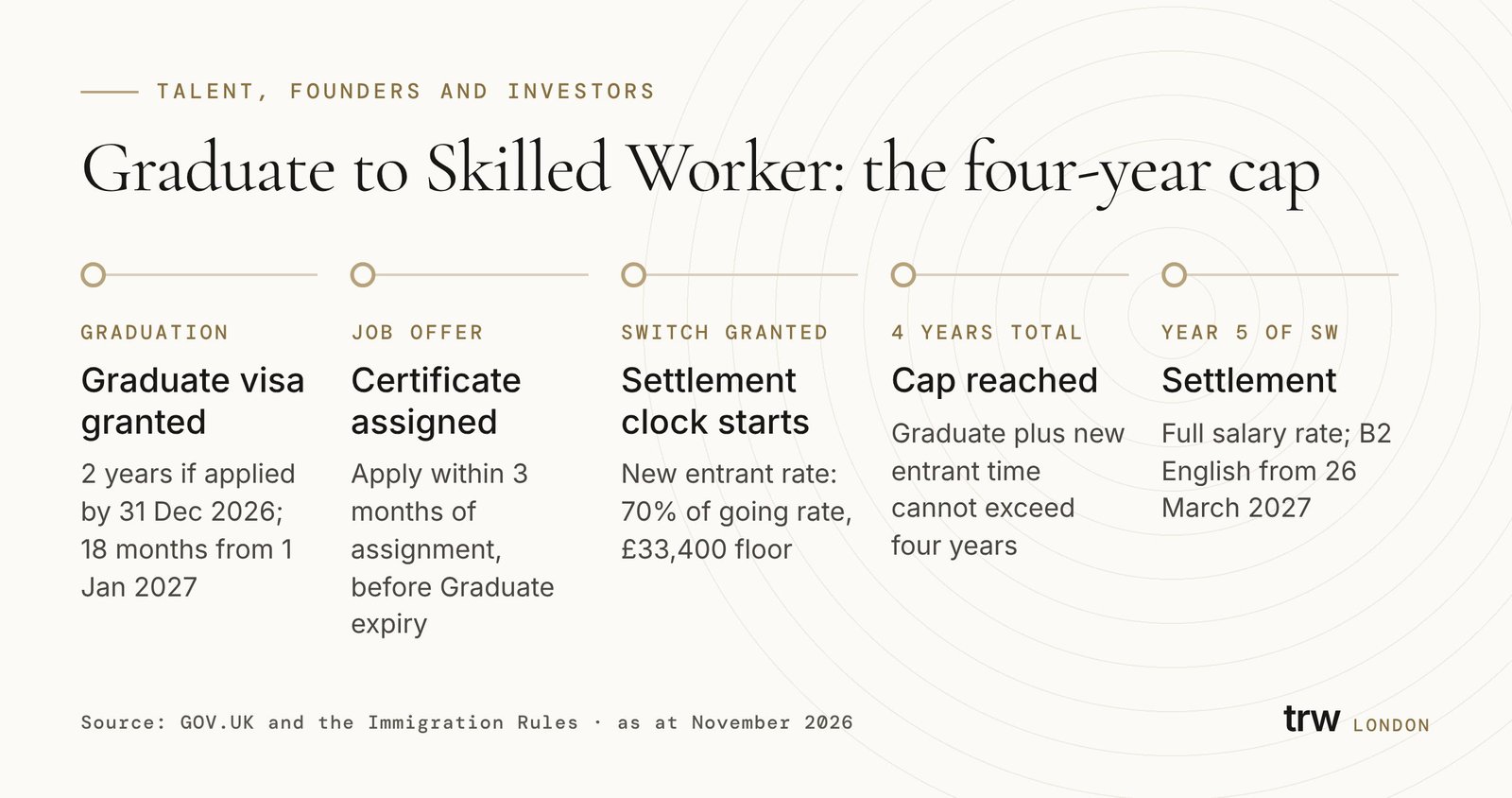
The application must be made before your Graduate permission expires. As at November 2026 the Graduate route itself is changing: GOV.UK says it lasts two years for applications made on or before 31 December 2026 and 18 months for applications made on or after 1 January 2027 (three years for PhD graduates). A shorter Graduate visa means less time to find a sponsor, so the switch needs planning from the first month.
Why the Graduate route ends in a switch
Appendix Graduate describes the route as unsponsored and states that it "is not a route to settlement". GR 1.4 also prevents a second grant: you cannot apply if you have previously had permission as a Graduate. When the permission ends, the only ways to stay are to move onto another route or to leave.
Time on the Graduate route also does not count towards the five-year qualifying period for Skilled Worker settlement. GOV.UK's settlement guidance lists the visas that can be combined (Skilled Worker, Scale-up, Innovator Founder, Global Talent and some others), and Graduate is not among them. So the settlement clock usually starts on the day the switch is granted, not on graduation.
The Graduate route buys time, not residence: the five-year settlement clock starts when you switch, so the earlier you move, the earlier you can settle.
Timing: the dates that decide everything
Several separate clocks run at once for anyone on the Graduate route. Missing any one of them can force an applicant to leave the UK and apply from abroad, or close a route entirely.
- 31 Dec 2026
Last day for a 2-year Graduate grant
Graduate applications made on or after 1 January 2027 receive 18 months (PhD: 3 years).
- 31 Dec 2026
Shortage-list cut-off
Medium-skilled roles on the Temporary Shortage List count only if the CoS is issued before this date.
- CoS assigned
Three-month window opens
A Skilled Worker application must be made within 3 months of the certificate being assigned.
- Start date minus 3 months
Earliest application
You can apply up to 3 months before the job start date on the certificate.
- Graduate expiry
Hard deadline
Apply before this date. A valid in-time application extends your permission while it is decided.
- 26 Mar 2027
B2 English for settlement
Already in the Rules: settlement applications from this date need B2.
The protection while an in-time application is pending comes from section 3C of the Immigration Act 1971, which continues your existing permission, on its existing conditions, until the application is decided. You can usually keep working under your Graduate conditions while waiting. Our guide to section 3C leave explains the limits, including what happens if the application is rejected as invalid rather than refused.
Do not travel outside the UK, Ireland, the Channel Islands or the Isle of Man while the switch is pending. GOV.UK warns that an application is treated as withdrawn if you do.
Where Graduate visa holders can go next
The table summarises the main in-country options open to Graduate visa holders, as at November 2026. Fees are the current GOV.UK in-UK fees; the immigration health surcharge is payable on top of each.
| Route | Switch from Graduate? | Key requirement | Leads to settlement? |
|---|---|---|---|
| Skilled Worker | Yes | Sponsored RQF 6 job; £41,700 or going rate, or £33,400 as a new entrant | Yes, after 5 years |
| Global Talent | Yes | Endorsement or eligible prize; no job offer needed | Yes, after 3 or 5 years |
| Innovator Founder | Yes | Endorsement for an innovative, viable and scalable business | Yes, after 3 years |
| Scale-up | Yes | Job with a qualifying scale-up sponsor; £39,100 or going rate | Yes, after 5 years |
| High Potential Individual | No | Closed to anyone who has held a Graduate visa | No |
| Partner (family) | Usually | Genuine relationship; £29,000 financial requirement; English | Yes, usually after 5 years |
| Student | Yes | New course at a higher level or as permitted | No |
GOV.UK states that you "cannot switch to this visa if you're on a Graduate visa" on its High Potential Individual switching page, and that you cannot apply at all if you have already been given a Graduate visa. Our HPI guide explains who that route is designed for.
Switching from Graduate visa to Skilled Worker
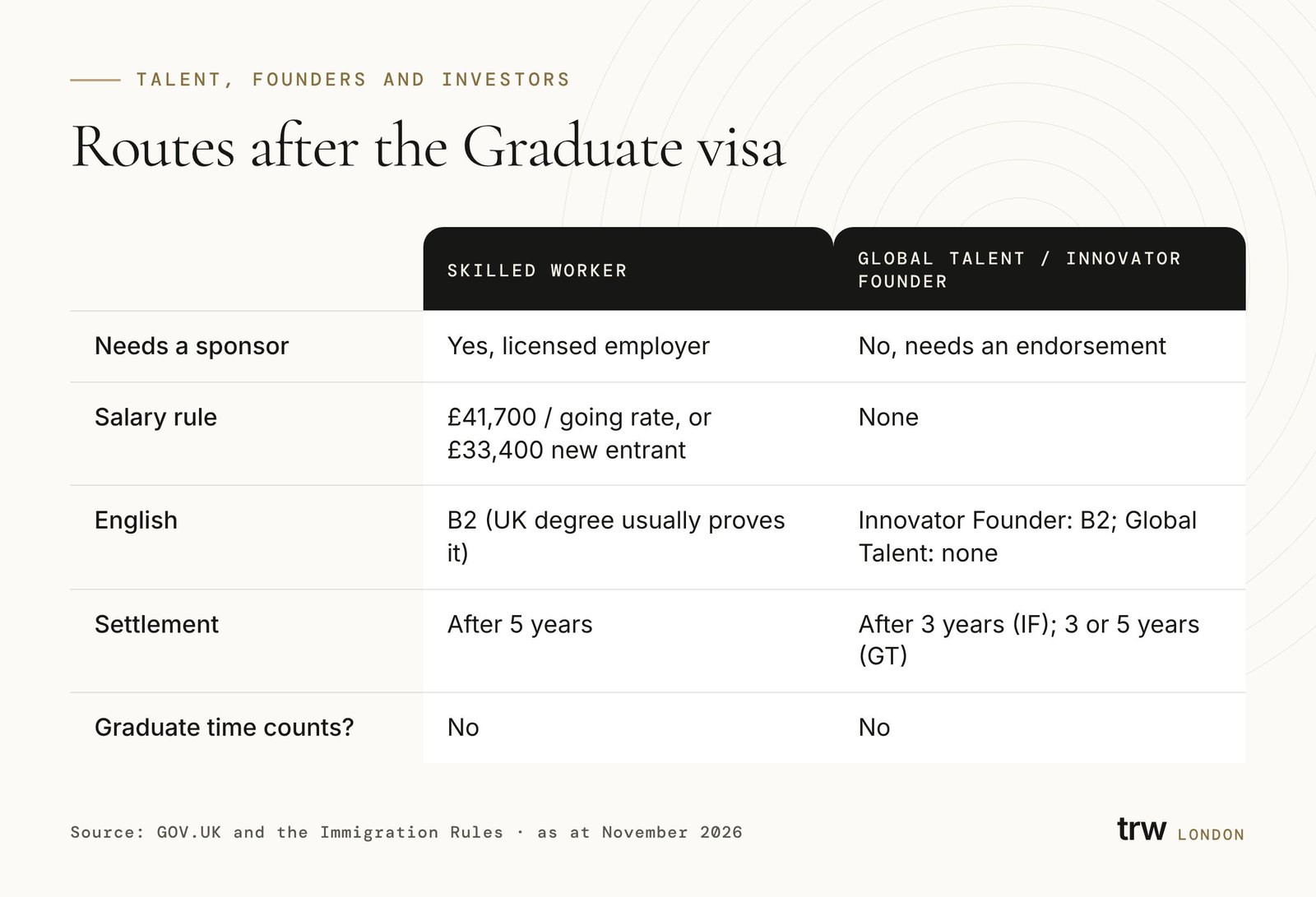
Most people switching from Graduate visa permission move to the Skilled Worker visa. The employer needs a sponsor licence and must assign a certificate of sponsorship for an eligible job. Since 22 July 2025, new sponsorship generally requires an occupation at RQF level 6 (graduate level). A medium-skilled role qualifies only if it is on the Immigration Salary List or Temporary Shortage List, and as at November 2026 most of those entries apply only to certificates issued before 31 December 2026 (GOV.UK: your job).
The new entrant salary rate
Graduates often qualify for the lower "new entrant" rate. GOV.UK says you can be paid 70% of the standard going rate, with a floor of £33,400 a year, if you are currently in the UK on a Graduate visa, or have been in the last two years and a Graduate or visit visa was your most recent visa. Being under 26 on the application date also qualifies.
The catch is time. GOV.UK states that if you rely on the new entrant rate, your total stay "cannot be more than 4 years", and that this "includes any time you've already spent in the UK on a Graduate visa". A graduate who used the full two years on the Graduate route therefore has about two years at the new entrant rate. By the end of that period, the salary must meet the full rate (the higher of £41,700 and the going rate) to extend.
English and other requirements
New Skilled Worker applicants, including switchers, must show English at B2. GOV.UK lists a degree from a UK institution taught in English as one way to prove it, so most Graduate visa holders already have the evidence. The in-UK fee is £943 for up to three years or £1,865 for longer, and GOV.UK gives eight weeks as the usual decision time for in-country applications.
On the employer's side, the Immigration Skills Charge is payable at the point of assigning the certificate. GOV.UK's ISC guidance sets out an exemption where someone switches from a visa that allows them to study; employers should check whether it applies to the particular worker before assigning the certificate, rather than assume it.
Pick the occupation code first and check the going rate before you make an offer. If the code is medium skilled, the shortage-list cut-off of 31 December 2026 may decide whether you can sponsor at all. Our Skilled Worker team often reviews codes before offers are signed.
Talent, founder and scale-up routes
Three unsponsored or lightly sponsored routes are worth considering for Graduate visa holders, especially for graduates who want to build a business or whose work already has external recognition.
Global Talent
Requires endorsement in academia and research, arts and culture, or digital technology, or an eligible prize. No job offer or salary threshold. GOV.UK confirms you can switch to this visa from inside the UK.
Innovator Founder
Requires an endorsement from an approved endorsing body for a business that is innovative, viable and scalable, plus B2 English. Settlement is possible after three years. See our endorsing body guide.
Scale-up
A job with a qualifying scale-up sponsor paying at least £39,100 or the going rate, for at least six months. After six months the worker can change jobs freely. GOV.UK sets out the switching rules.
Senior or Specialist Worker
Usually needs 12 months' prior overseas work for the employer's group, so it rarely suits recent graduates. It does not lead to settlement.
Each of these routes counts towards settlement except Senior or Specialist Worker. The Innovator Founder route also allows work outside the business in a role at RQF level 3 or above, which can help founders bridge the early months. Our Global Talent endorsement guide covers the evidence endorsing bodies expect.
Family and partner routes
A Graduate visa holder in a genuine relationship with a British citizen or settled person may be able to switch to a partner visa from inside the UK. GOV.UK's family visa guidance says you can switch "at any time before your current permission to stay in the UK expires". The partner route has its own conditions: a £29,000 minimum income requirement for most couples, English at A1 for the first grant, and a relationship that meets the definition of partner.
For couples who meet the requirements, the partner route usually leads to settlement after five years. Where the financial requirement cannot be met, exceptional circumstances may still allow a grant, but with a ten-year path. See our spouse visa guide before relying on this option.

What switching from Graduate visa status costs
Graduate visa holders should budget for the destination route's fee, the immigration health surcharge for the full length of the new grant, and sometimes an English test or endorsement fee. The figures below are GOV.UK in-UK fees as at November 2026; check the current fee table before applying, because fees usually change each April.
| Destination | Application fee (in UK) | Other costs to plan for |
|---|---|---|
| Skilled Worker, up to 3 years | £943 | Surcharge £1,035 a year; sponsor pays licence, certificate and any Immigration Skills Charge |
| Skilled Worker, over 3 years | £1,865 | As above |
| Scale-up | £937 | Surcharge £1,035 a year |
| Innovator Founder | £1,693 | £1,000 endorsement and £500 per contact point, paid to the endorsing body |
| Global Talent | £766 in total | Split between endorsement and visa stages |
| Partner (family) | £1,407 | Surcharge for 2.5 years; financial and English evidence |
The surcharge is the largest item for most people moving off the Graduate route. A five-year Skilled Worker grant attracts five years of surcharge at £1,035 a year, paid up front. Some Graduate visa holders and sponsors therefore choose a certificate of three years or less first, which lowers the fee band and the surcharge paid on day one, and extend later. Skilled Worker time counts towards settlement whether it is held in one grant or two, although the later extension brings its own fee.
Students finishing courses now should note that a Graduate application made on or after 1 January 2027 gives 18 months, not two years. If you are eligible and your university has already confirmed completion, applying for the Graduate route before 31 December 2026 secures the longer grant and more time to arrange a switch.
Partners and children when you switch
When switching from Graduate visa status, remember that your partner's and children's permission does not switch automatically. GOV.UK says their existing visa stays valid until its original end date, and they can apply at the same time as you or later, but before it expires. They should usually apply together with you so that all the family's permissions align.
Whether dependants can join you depends on the destination route and job. On Skilled Worker, workers in RQF 6 roles can generally bring a partner and children. Workers switching into a medium-skilled role (other than care) generally cannot bring new dependants, with limited exceptions such as a child born in the UK. Read our Skilled Worker dependants guide before accepting a medium-skilled offer.
The switching process step by step
- Map your deadline. Note the expiry date of your permission on the Graduate route and work backwards: you need a certificate, documents and an application before that date.
- Choose the route. Compare Skilled Worker, Global Talent, Innovator Founder, Scale-up and family options against your circumstances, not just the job you have now.
- Confirm the role and code (Skilled Worker). The employer checks the occupation code, skill level and going rate, and whether the new entrant rate applies.
- Get the certificate or endorsement. Sponsors assign a certificate of sponsorship; founders and talent applicants obtain an endorsement letter, valid for three months.
- Apply online and pay. Pay the fee and immigration health surcharge, then prove identity using the ID Check app or a UKVCAS appointment.
- Stay put while it is decided. Section 3C continues your permission; do not travel outside the Common Travel Area.
- Update records once granted. Check the eVisa, update employer right to work records with a new share code, and diarise the next expiry date.

Pitfalls when switching from Graduate visa status
Leaving it too late
Employers often need weeks to assign a certificate, and a sponsor without a licence may need about eight weeks just to get one. A Graduate holder who starts looking in the final months may run out of time.
Forgetting the four-year cap
The new entrant rate is time-limited, and Graduate time counts. Build the step up to the full salary into the employment contract or career plan.
Applying for HPI after Graduate
The High Potential Individual route is closed to anyone who has held a Graduate visa. An HPI application made in that position will fail on eligibility.
Assuming the dependants switch with you
Each family member needs their own application. If theirs lapses, they may need to leave and apply from abroad.
Travelling while the application is pending
Leaving the Common Travel Area withdraws the application, and you may not be able to re-enter on an expired Graduate visa.
Wrong occupation code
Choosing a code to fit the salary rather than the duties can lead to refusal and compliance action against the sponsor.
Worked example
Example (hypothetical): Arjun completed a one-year MSc in data science at a London university and was granted a two-year Graduate visa in October 2025, which expires in October 2027. He is 27. In November 2026, a London fintech offers him a data analyst role at £36,000. The employer holds a sponsor licence.
Arjun is over 26, but he is currently on a Graduate visa, so he can use the new entrant rate: 70% of the going rate for the code, with a £33,400 floor. The employer confirms the role sits in an RQF 6 code and that £36,000 meets 70% of its going rate. His UK master's degree proves English. He applies to switch, pays the £943 fee and the surcharge, and continues working under section 3C while waiting.
Because he spent about a year on the Graduate route before switching, he has about three years at the new entrant rate within the four-year cap. To extend after that, his salary must reach the full rate. His five-year settlement clock starts on the date of the Skilled Worker grant, and if he applies for settlement on or after 26 March 2027, he will need B2 English, which his degree evidence should already cover.
Next steps
Check your Graduate expiry date today and decide which route fits. If you are an employer, confirm the occupation code and salary before offering, and leave time to obtain or update a sponsor licence. If you are thinking of starting a business, speak to an endorsing body early.
We usually start by mapping the dates on one page: Graduate expiry, certificate timing, the four-year cap and the 2027 English change. To discuss switching, book a consultation. Related reading: moving from Student to Skilled Worker and our Graduate visa guide.
Frequently asked questions
01Can I extend my Graduate visa?
No. Appendix Graduate allows only one grant. To stay longer you need to switch to another route before it expires.
02Does Graduate time count towards indefinite leave to remain?
Not for Skilled Worker settlement. GOV.UK's list of visas that can be combined for the five years does not include Graduate.
03Do I need an English test to switch to Skilled Worker?
Usually not if your UK degree was taught in English. GOV.UK accepts a degree from a UK institution as proof of English.
04Can I keep working while my switch is decided?
Section 3C continues your Graduate permission on its existing conditions, which allow most work. Agree with the sponsor how the certificate start date fits the decision timetable.
05Can my employer charge me the visa costs?
The sponsor must not pass the licence fee, certificate fee or Immigration Skills Charge to the worker. The worker's own visa fee and surcharge are a separate matter.
06What if my employer has no sponsor licence?
It must apply for one first. GOV.UK says most licence decisions take under eight weeks. See our sponsor licence team.
07Does the 18-month change affect a Graduate visa I already hold?
No. GOV.UK ties the length to the date of the Graduate application: two years if made on or before 31 December 2026, 18 months if made on or after 1 January 2027.
Sources and official materials
- Graduate visa (GOV.UK) — Duration, extension bar and dependants
- Immigration Rules Appendix Graduate — Route is not a route to settlement
- Skilled Worker visa: when you can be paid less — New entrant rate and four-year cap
- Skilled Worker visa: switch to this visa — Switching eligibility and excluded routes
- High Potential Individual visa: switch to this visa — HPI closed to Graduate visa holders
- Immigration Act 1971, section 3C — Continuation of leave pending decision
- Indefinite leave to remain (Skilled Worker) — Visas that count towards the five years
General information only, current as at 19 November 2026. It is not legal advice and does not create a solicitor–client relationship. It reflects the law of England and Wales unless stated otherwise; Scotland and Northern Ireland have separate legal systems, and the law changes frequently. Check current official sources and take advice on the facts of your matter.