TRW & Co · Work and sponsorship
Skilled Worker dependants: partners and children

A Skilled Worker's partner and children can apply as dependants if the worker is sponsored in a higher-skilled job. Workers first sponsored in medium-skilled roles after 22 July 2025, and most care workers, generally cannot bring family, subject to narrow exceptions. Each dependant pays a fee and the health surcharge and may need to show funds.
Key pointCheck the worker's occupation code and sponsorship history before anyone relocates: it is now the gateway to family eligibility.
At a glance
Who
Partner aged 18+, children under 18, and adult children already here as dependants.
Bar
Medium-skilled and care roles generally exclude new dependants (in force).
Funds
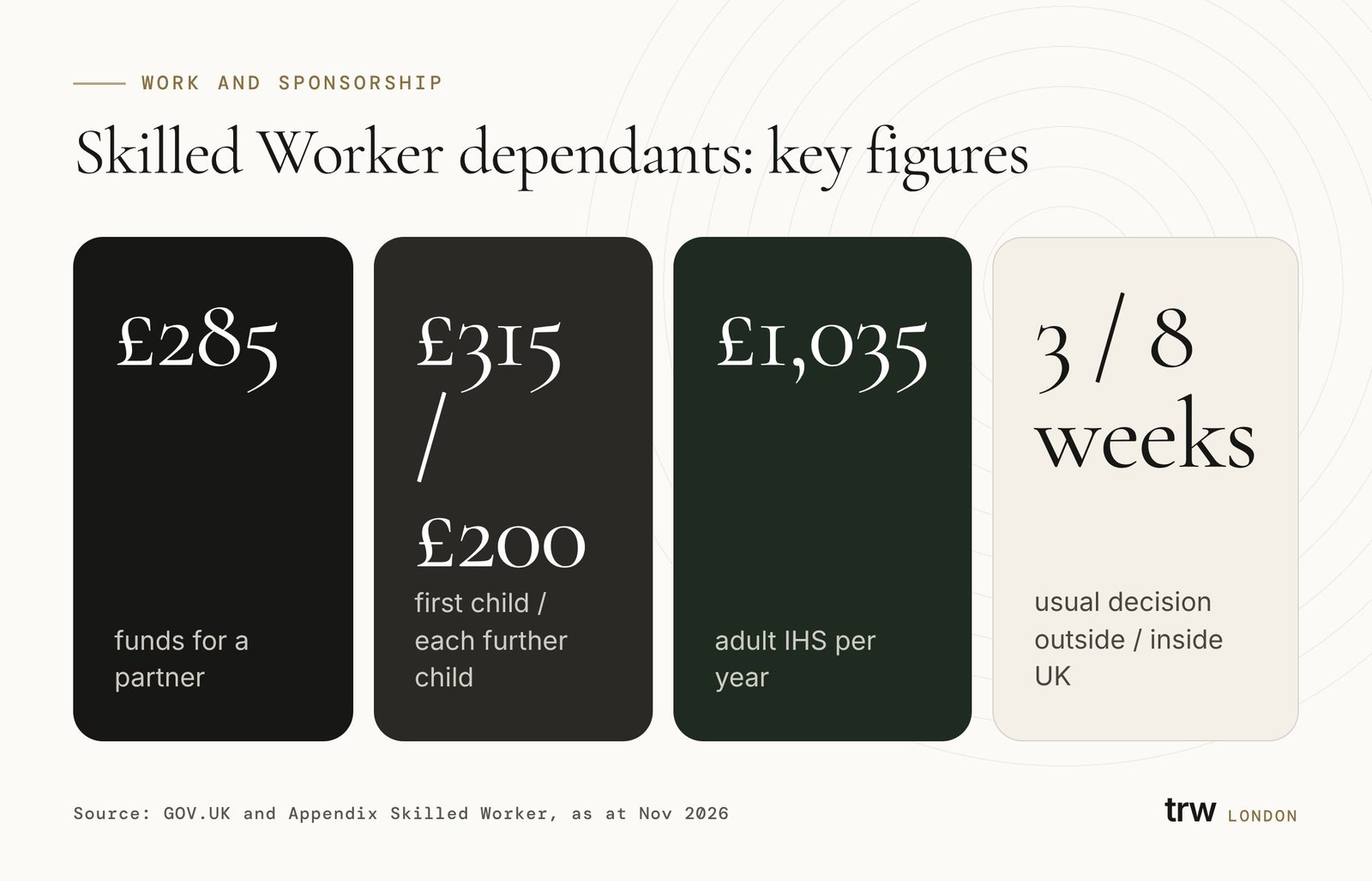
£285 partner, £315 first child, £200 each further child.
Fees
Same fee band as the worker, plus IHS of £1,035 or £776 a year.
Settlement
Currently after 5 years; earned settlement changes are announced, not law.
Swipe or scroll →
Skilled Worker dependants: the position in November 2026
Skilled Worker dependants are the partner and children of a sponsored worker who apply to come to or stay in the UK on the strength of that worker's permission. For most people sponsored in graduate-level jobs the rules are familiar: a dependant partner and dependent children can join, work, study and later settle. Since 22 July 2025, however, the occupation the worker is sponsored in decides whether the family can come at all.
Each family member makes a separate application, pays a separate fee and the Immigration Health Surcharge, and may need to show funds. This guide works through the rules in Appendix Skilled Worker (SW 26 to SW 36), the occupation test, the money, the process and the points where applications usually go wrong.
The legal basis for Skilled Worker dependants
Skilled Worker dependants are not a separate visa category. They are dealt with in the dependants section of Appendix Skilled Worker. SW 26 sets the validity rules, SW 27 suitability, SW 29 the partner relationship test, SW 32A the child test (which imports Appendix Children), SW 33 the financial requirement and SW 36 the length of permission.
Two other appendices do much of the work. Appendix Relationship with Partner defines a qualifying marriage, civil partnership or durable relationship. Appendix Finance sets out how funds must be held. The common Part Suitability grounds for refusal apply to dependants just as they do to the main worker.
Who qualifies as a dependant
GOV.UK lists three kinds of family member who may apply as Skilled Worker dependants. A dependant partner must be aged 18 or over at the date of application (SW 26.3), and dependent children must not be married or in a civil partnership.
Spouse or civil partner
A marriage or civil partnership that is recognised in the UK.
Unmarried partner
Two years living together, or two years in a relationship with evidence of ongoing commitment where cohabitation is not possible.
Child under 18
Including a child born in the UK during the worker's stay; must live with the parent unless in full-time education away from home, and must not be married.
Child over 18
Only if they already have permission as the worker's dependant; a new application from an adult child is not possible.
For couples who do not live together, GOV.UK gives examples of evidence of an ongoing commitment: regular communication, financial support, shared care of children and time spent together. Dependent children need evidence of their address, such as a bank statement, NHS registration document or a letter from their university.
The occupation test for Skilled Worker dependants
SW 29.1A (partners) and SW 32A.2 (children) now ask a single threshold question: is the worker sponsored in a job in Table 1, 2 or 3 of Appendix Skilled Occupations, the higher-skilled and listed health and education codes? If so, a dependant partner and dependent children can apply in the usual way. If the worker is in a "medium skilled" job, including roles that are eligible only through the Temporary Shortage List or Immigration Salary List, the family is shut out unless an exception applies.
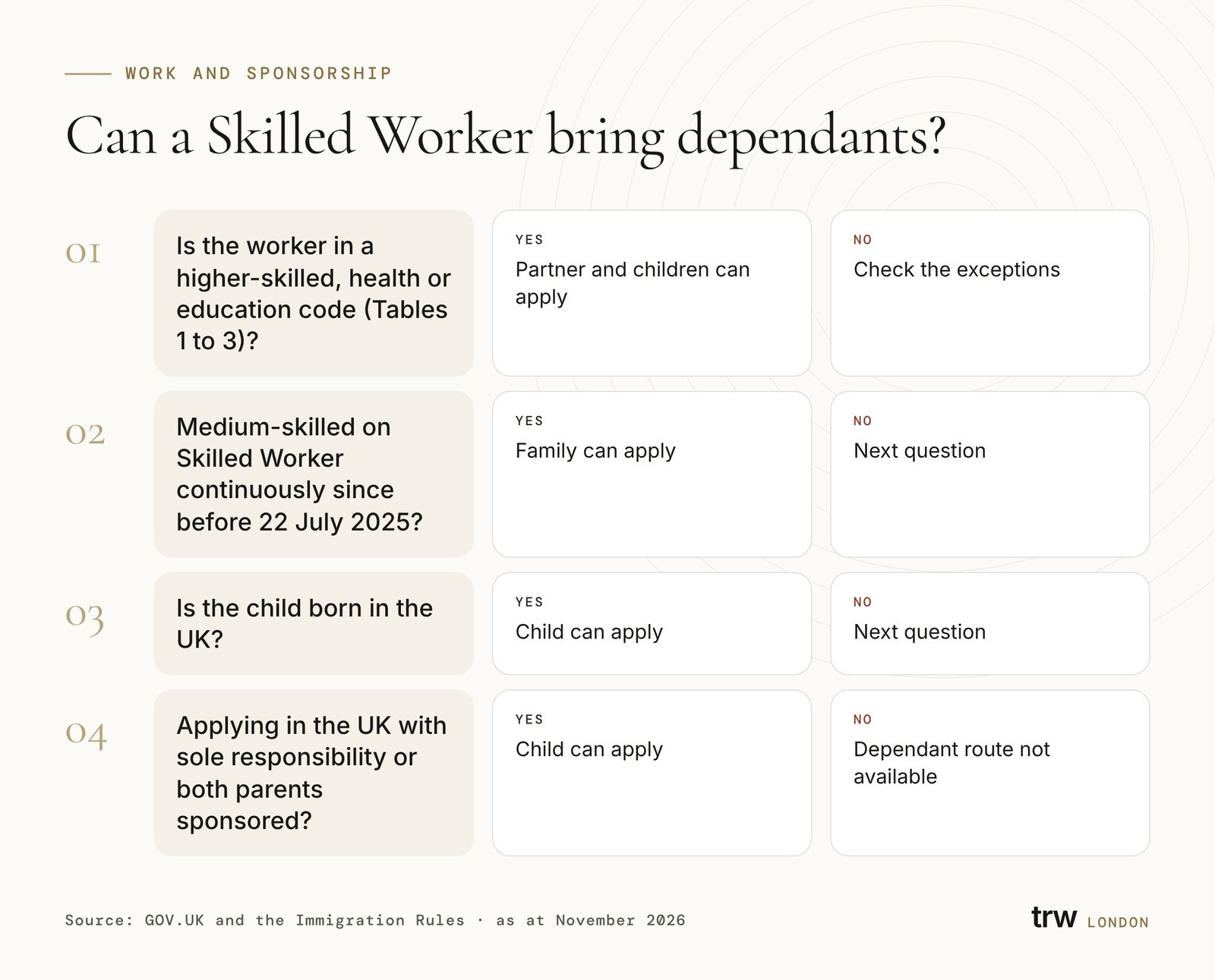
| Exception | Partner | Child outside UK | Child inside UK |
|---|---|---|---|
| Worker continuously employed on Skilled Worker in a medium-skilled job since before 22 July 2025 | Yes | Yes | Yes |
| Child born in the UK | n/a | Yes | Yes |
| Worker is the sole surviving parent or has sole responsibility | n/a | No | Yes |
| Other parent also sponsored in a medium-skilled job | n/a | No | Yes |
| Worker extending or switching as a prison officer (3314) | Yes (in UK) | No | Yes |
The table reflects SW 29.1A and SW 32A.2 as summarised on GOV.UK. Note the asymmetry. The sole-responsibility and two-sponsored-parents exceptions are available only for permission to stay, so a child abroad in those situations cannot rely on them to come to the UK.
For Skilled Worker dependants, the occupation code on the certificate now matters as much as the family relationship.
Care workers: a separate regime
Care workers and senior care workers (SOC 6135 and 6136) have had their own bar since 11 March 2024. A dependant partner or child can join only if the worker has been continuously employed in care on a Skilled Worker visa since before 11 March 2024, or if the child was born in the UK. In-country, the sole-parent and two-sponsored-parents exceptions also apply.
Care workers are also subject to the separate rule that entry clearance in those codes is closed. Families of care workers who are unsure which cohort they fall into should check the date of the worker's first grant in the care codes before anyone applies.
The bar follows the worker's current sponsorship, not their past. A worker who moves from a higher-skilled job into a medium-skilled one, or who was first sponsored in a medium-skilled job after 22 July 2025, may find that family members who are already in the UK cannot extend with them. Take advice before a change of role.
Maintenance funds
SW 33.3 sets the funds Skilled Worker dependants must show: £285 for a dependant partner, £315 for the first child and £200 for each further child. These amounts are in addition to the £1,270 the worker needs for their own application. Funds must have been held for 28 consecutive days, with day 28 no more than 31 days before the application, in line with Home Office financial evidence guidance.
The money can be held by the dependant, by the worker, or, for a child, by a parent who is in the UK lawfully or applying at the same time. No funds are needed where the dependant has been in the UK with permission for 12 months or more, or where an A-rated sponsor certifies on the certificate of sponsorship that it will maintain the family to the end of the first month.
Fees and the health surcharge
Skilled Worker dependants pay the same application fee as the worker, for the same length of time. GOV.UK illustrates the point: if the worker's five-year certificate runs to 2027 and a child applies in 2025, the child pays the fee for a stay of more than three years. As at November 2026 the fees per person are £819 or £1,618 from outside the UK and £943 or £1,865 from inside, with £628 or £1,235 where the worker's job is on the Immigration Salary List.
Each dependant also pays the Immigration Health Surcharge: £1,035 a year for adults and £776 a year for children under 18. Fees change; check the current Home Office fee table before applying.
| Item | Partner | Child (under 18) |
|---|---|---|
| Visa fee (up to 3 years, standard job) | £819 | £819 |
| Immigration Health Surcharge, 3 years | £3,105 | £2,328 |
| Funds to show (unless certified by sponsor) | £285 | £315 |
| TB test, if from a listed country | Clinic fee | Usually no X-ray under 11 |
Example (hypothetical): a software architect sponsored by a London fintech in a higher-skilled code brings a spouse and a seven-year-old. On a three-year grant the family pays £1,638 in visa fees and £5,433 in surcharge for the two dependants, on top of the worker's own costs. Because the employer certifies maintenance on the certificate, no bank statements are needed.
How dependants apply
- Confirm eligibility first. Check the worker's occupation code and history against the occupation test before anyone books a flight or gives notice.
- Link the applications. The first applicant can obtain a family linking code; dependants also quote the worker's GWF or unique application number.
- Apply online for each person. Partners and children use separate forms, inside or outside the UK, and each pays the fee and surcharge.
- Prove identity. Either through the UK Immigration: ID Check app or by giving biometrics at a visa application centre or UKVCAS service point.
- Provide documents. Relationship evidence, passports, TB certificate where required and, for some partners, criminal record certificates.
- Wait for the decision. Usually 3 weeks from outside the UK and 8 weeks inside; priority services may be offered.
Where the worker is sponsored in education, health, therapy or social services codes listed in SW 16.1, a partner applying from abroad must also provide criminal record certificates from any country where they spent 12 months or more in the last 10 years as an adult (SW 34.1). Applicants who have lived in a listed country may need a TB test certificate.
- Passport for each family member
- Marriage or civil partnership certificate, or evidence of two years' relationship
- Full UK birth certificates naming both parents for UK-born children
- Evidence of the child's address with the parent
- Bank statements covering 28 days, unless exempt or certified
- TB certificate and criminal record certificates where required
Switching to dependant status inside the UK
A partner or child already in the UK can usually switch into dependant status without leaving, so that the dependant partner and any dependent children hold permission linked to the worker. The exceptions in SW 26.4ZA mirror those for the main route: a person who has, or last had, permission as a visitor, short-term student, parent of a child student, seasonal worker, domestic worker in a private household, or permission outside the Rules cannot switch and must apply from abroad. A person on immigration bail cannot switch either.
A partner currently on a Student visa can switch only if they have completed their course or have studied full time for a PhD for at least 24 months (SW 26.4A). Applicants must not travel outside the Common Travel Area while an in-country application is pending; GOV.UK warns the application will be withdrawn if they do.

Rights in the UK and the route to settlement
A dependant partner can work and study, and dependent children can attend school. The main exception on GOV.UK is work as a professional sportsperson or sports coach. Dependants have no recourse to public funds. Their permission normally ends on the same date as the worker's; a child's permission ends with whichever parent's permission ends first (SW 36).
Permission does not extend automatically. When the worker extends, changes employer or switches, each dependant must apply too, either at the same time or before their own permission expires. Dependent children who turn 18 in the UK can keep extending as dependants, but a child born in the UK must be granted dependant status before turning 18 to stay.
Settlement for Skilled Worker dependants
Under the current Rules a dependant can apply for indefinite leave to remain alongside, or after, the worker once they have five years in the UK and meet the other requirements on GOV.UK. Time as a dependant does not count towards the worker's own five-year Skilled Worker qualifying period.
The government's earned settlement response (CP 1707, 2 November 2026) proposes that partners who arrive with the main applicant settle at the same time, while partners who join later must complete the same period themselves; children under 18 would settle with their parents. This is announced policy only. No Statement of Changes has been laid and no commencement date has been published.

Worked example: two families, two outcomes
Example (hypothetical): two overseas recruits accept offers from the same London logistics group in spring 2026. Amira is sponsored as a software engineer in a graduate-level occupation code listed as higher skilled in Appendix Skilled Occupations. Ben is sponsored as a logistics manager under SOC 1243, which is eligible only because it is on the Temporary Shortage List. Both are married and each has one child aged nine.
Amira's dependant partner and child apply from abroad with her, using the family linking code. Her employer certifies maintenance on the certificate, so no bank statements are needed. All three are granted permission ending on the same date.
Ben's position is different. He was first sponsored after 22 July 2025 in a medium-skilled job, his child was not born in the UK, and the in-country exceptions do not help an application from abroad. His spouse and child cannot apply as Skilled Worker dependants. They would need a route of their own, and many families in Ben's position decide not to relocate. The difference turns entirely on the occupation code on each certificate.
Put the dependants position in writing before an offer is accepted. For roles that rely on the Temporary Shortage List or the Immigration Salary List in a medium-skilled code, tell candidates plainly that a dependant partner and dependent children are unlikely to qualify, and record that you did so.
Recent changes affecting Skilled Worker dependants
The rules for Skilled Worker dependants have moved several times in a short period. The care worker bar came first, for workers sponsored in care codes from 11 March 2024. From 22 July 2025 the same principle was extended to every medium-skilled occupation, with protection for people already on the route in such jobs. The Statements of Changes laid in 2026 have not reversed either bar: both remain in SW 29.1A and SW 32A.2 as at November 2026.
Looking ahead, the earned settlement response would change how long a dependant partner who joins later must wait before settling, and would require dependants aged 25 and over to qualify independently. None of this is yet law. Families planning a long stay should keep the timelines for each person under review rather than assume today's five-year route will apply unchanged.
Pitfalls for families of Skilled Workers
Accepting a medium-skilled job without checking family eligibility
The most expensive mistake is a family that relocates on the assumption that dependants can follow. If the job is medium skilled and the worker was first sponsored after 22 July 2025, the partner and children generally cannot qualify.
Paying the wrong fee length
A dependant who joins late still pays for the same length of time as the worker's permission. Underpaying can make the application invalid.
Forgetting the dependants when the worker changes job
A new certificate for the worker does not update the family's permission. Each dependant needs to apply before their own permission runs out; see our guide to change of employment.
Using funds that dipped below the threshold
If the balance falls below the required amount on any day of the 28-day period, the evidence fails. Certification by the sponsor avoids the problem where it is available.
Leaving a UK-born child without status
A child born in the UK to non-settled parents is not automatically British. Without a dependant application the child may have no permission to travel and return, and must be granted status before turning 18 to stay.
Next steps
Before an offer is signed, check the occupation code and the worker's sponsorship history against the dependants rules, then budget for fees and surcharge for each person. Our guides to Skilled Worker visa extensions, child dependant visas and ILR for Skilled Workers cover the later stages, and the Skilled Worker practice page explains how we help employers.
We usually start by mapping the whole family's permissions on one timeline so that no one's leave lapses. To discuss your family's position, book a consultation.
Frequently asked questions
01Can my partner work in any job?
GOV.UK says a dependant partner can work, except as a sportsperson or sports coach. There is no requirement for the partner's job to be sponsored or to meet a salary threshold.
02Can my parents join me as dependants?
No. Only a partner and children can be Skilled Worker dependants. Parents would need a separate route, such as the adult dependent relative visa, which has its own, much stricter requirements.
03Does my dependant need to prove English?
There is no English language requirement for Skilled Worker dependants at the point of entry or extension in Appendix Skilled Worker. English requirements apply at settlement.
04My child turned 18 while here. Can they still extend?
Yes, a child over 18 can apply as a dependant if they currently have permission as your dependant. They must still meet the Appendix Children requirements, including not living an independent life.
05Can dependants travel while an application is pending?
Not if the application was made inside the UK. Travel outside the UK, Ireland, the Channel Islands or the Isle of Man before a decision causes the application to be withdrawn.
06Will the earned settlement changes affect my family?
The government has announced that partners who arrive with the main applicant would settle at the same time and children would settle with their parents. These proposals are not yet in the Immigration Rules and no start date has been given.
07What happens to my family if my visa is refused?
Dependant applications generally fall with the worker's. A refused Skilled Worker application can be challenged by administrative review within 14 days if made in the UK.
Sources and official materials
- Immigration Rules: Appendix Skilled Worker — SW 26 to SW 36 dependants rules
- Skilled Worker visa: your partner and children — GOV.UK summary of eligibility, exceptions and process
- Skilled Worker visa: how much it costs — Application fees and funds
- Immigration Health Surcharge: how much you pay — Annual surcharge rates
- Immigration Rules: Appendix Children — Relationship, care and age requirements for children
- Immigration Rules: Appendix Relationship with Partner — Partner relationship requirements
- A Fairer Pathway to Settlement (CP 1707) — Announced earned settlement policy on dependants
General information only, current as at 19 November 2026. It is not legal advice and does not create a solicitor–client relationship. It reflects the law of England and Wales unless stated otherwise; Scotland and Northern Ireland have separate legal systems, and the law changes frequently. Check current official sources and take advice on the facts of your matter.