TRW & Co · Visits and travel
Visit visa solicitors in London

Most UK visits need either a Standard Visitor visa or, for non-visa nationals, a £20 ETA, mandatory since 25 February 2026. The application must show a genuine visitor: a permitted purpose, ties that mean you will leave, and enough funds. We advise on business visits, family trips, paid engagements and refusals.
Key pointA visit visa is decided on credibility: the purpose, the itinerary, the funding and the ties abroad must tell one consistent story.
At a glance
Who needs a visa
Visa nationals need a Standard Visitor visa; most others need an ETA for visits up to 6 months.
Fee
£135 for a visit visa of up to 6 months; £20 for an ETA (as at Nov 2026).
Decision time
About 3 weeks for a visa outside the UK; ETAs usually within 3 working days.
Key test
Genuine visitor under Appendix V paragraph V 4.2.
If refused
No administrative review or appeal; reapply or seek judicial review.
Swipe or scroll →
Visit visa solicitors in London: who we act for
Our visit visa solicitors in London advise individuals, families and organisations on coming to the UK as a visitor: whether a visit visa or an electronic travel authorisation (ETA) is needed, whether the planned activities are allowed, and how to present an application that meets the "genuine visitor" test. Most visits are straightforward. The ones that are not tend to involve a previous refusal, frequent or long trips, business activity close to the line of work, third-party funding or an adverse immigration history.
We act for people visiting family in London, for parents and relatives invited by UK-based families, for employers receiving business visitors, and for event organisers and professionals arranging permitted paid engagements. We also act for academics, private patients and people whose Standard Visitor application has been refused. This page sets out the law as at November 2026, the costs, and how we work.

How our visit visa solicitors help
Visa or ETA assessment
We confirm whether the traveller is a visa national, needs an ETA, or is exempt, including dual nationals and UK permission holders.
Activity review
For business visitors and paid engagements we check each planned activity against Appendix Visitor: Permitted Activities.
Application strategy
We identify the issues a caseworker is likely to probe, from ties abroad to funding, and plan the evidence to address them.
Sponsor and invitation letters
We advise UK family and businesses on what their letters should cover, without overstating what they can promise.
Refusals and reapplications
We review refusal notices line by line and decide whether to reapply, make a human rights claim or challenge by judicial review.
Complex histories
Previous overstaying, refusals or criminal records need careful disclosure. We assess the Part Suitability position before anyone applies.
We usually start with a short call to understand the trip, the traveller's circumstances and any previous applications. From that we can say whether the case needs full preparation or whether a well-organised application by the traveller is likely to be enough.
The legal framework for a visit visa
The Visitor route is in Appendix V: Visitor of the Immigration Rules. It covers the Standard Visitor, the Marriage/Civil Partnership Visitor and the Transit Visitor. What a visitor may do is listed in Appendix Visitor: Permitted Activities. Suitability (criminality, deception, previous breaches) is governed by the common Part Suitability. Home Office caseworkers apply the Visit caseworker guidance when they assess the evidence.
Whether a person must apply for a visit visa in advance depends on nationality. Visa nationals must hold entry clearance as a visitor. Non-visa nationals visiting for up to six months do not need a visa but, since 25 February 2026, must hold an electronic travel authorisation before travelling, unless exempt. The GOV.UK visa checker gives the answer for each nationality and purpose.
| Traveller | What they need for a visit of up to 6 months | Notes |
|---|---|---|
| Visa national | Standard Visitor visa (entry clearance) | Apply online and attend a visa application centre |
| Non-visa national | Electronic travel authorisation (ETA) | Mandatory since 25 Feb 2026; carriers can deny boarding without one |
| British or Irish citizen | Nothing | Dual British or Irish citizens cannot get an ETA and must travel on that passport or a certificate of entitlement |
| Holder of UK visa or permission (including EUSS status) | No ETA needed | Travel on existing permission |
| Airside transit passenger | No ETA needed | Landside transit requires an ETA for non-visa nationals |
| Nationals of Nauru, Nicaragua, St Lucia | Visit visa | Moved from ETA eligibility to visa nationals (Dec 2025 and Mar 2026) |

The genuine visitor test
Every Standard Visitor must satisfy the decision maker that they are a genuine visitor. Paragraph V 4.2 sets five elements, and most refusals turn on one or more of them. The burden is on the applicant, and caseworkers assess the whole picture rather than ticking boxes.
| Requirement | What it means | Typical evidence |
|---|---|---|
| Will leave at the end of the visit | Credible intention and incentive to return | Employment, study, family and property ties; return ticket plans |
| Will not live in the UK through frequent or successive visits | The UK must not become the main home | Travel history showing time spent abroad |
| Genuine permitted purpose | The activity is allowed under Permitted Activities | Itinerary, invitation, event or conference details |
| No prohibited activities | No work, study beyond limits, or marriage without the right visa | Clear description of what will and will not happen |
| Sufficient funds | All reasonable costs covered without work or public funds | Bank statements, payslips; third-party support if allowed |
Third-party funding is permitted under V 4.3 only where the supporter has a genuine professional or personal relationship with the applicant, is not in breach of immigration laws, and can and will support the applicant for the visit. A UK son or daughter paying for a parent's trip is common and acceptable, but the evidence must show the supporter can afford it. Funds relied on must be held in a financial institution permitted under Appendix Finance.
A visit visa is refused far more often for an unclear purpose or weak ties than for lack of money.
What visitors can and cannot do
Visitors may not work. Paragraph V 4.4 rules out taking employment, working for a UK organisation, running a business as a self-employed person, doing an internship or work placement, selling directly to the public and providing goods or services, unless Permitted Activities expressly allows it. Under V 4.5 a visitor must not fill a role or provide short-term cover for a role in a UK organisation, and a person employed and paid abroad must remain so.
Permitted business activities include meetings, conferences, negotiating deals, site visits and some intra-corporate activities. Permitted paid engagements allow certain professionals, such as lecturers, speakers, artists and sportspeople, to be paid by a UK source for specific engagements if invited in advance. Study of up to six months at an accredited institution, private medical treatment and certain academic and clinical activities are also allowed. Marriage or giving notice of marriage requires the Marriage/Civil Partnership Visitor route instead, unless the person is a relevant national.
Before inviting an overseas colleague, map each day of the itinerary against Permitted Activities. Hands-on project work for a UK client, or covering an absent employee, can turn a business visit into unauthorised work, with consequences for both the visitor and the business.
Business visitor visa
Meetings, conferences and permitted business activities.
Read the guidePaid workPermitted paid engagements
Paid lectures, performances and events.
Read the guideFamilyVisit visa for parents
Inviting parents and relatives to the UK.
Read the guideFamilyMarriage visitor visa
Marrying or giving notice in the UK.
Read the guideMedicalMedical treatment visits
Private treatment and longer visas.
Read the guideSpeedPriority visa services
Faster decisions where available.
Read the guideAdvice for UK hosts and employers
Visitors are not sponsored in the way Skilled Workers are. There is no licence, no certificate and no formal sponsor duty. A UK host's role is evidential: explaining who the visitor is, why they are coming, what they will do and, where relevant, who will pay. That makes the invitation letter important, but it should describe the visit accurately rather than vouch for the applicant's intentions.
For businesses, the larger risk sits after arrival. A visitor who is put to productive work for a UK client, or who fills a vacancy, is working without permission. Employing someone who is not allowed to do the work can expose the business to an illegal working civil penalty of up to £60,000 per worker, as well as harming the visitor's immigration record. Our visit visa solicitors regularly review itineraries with HR and travel teams so that business visits stay within the rules.
Process and timeline
A Standard Visitor application is made online, usually followed by an appointment at a visa application centre for fingerprints and a photograph. GOV.UK says you can apply up to three months before travel, and that the standard decision time outside the UK is three weeks. An ETA is applied for online or through the app and usually decided within three working days.
- 3 months before
Plan and check
Confirm visa or ETA, purpose, permitted activities and any suitability issues.
- Weeks 1-2 of preparation
Gather evidence
Employment, finances, travel history, invitation and itinerary documents.
- Application
Submit online
Pay the fee and book a visa application centre appointment.
- Appointment
Biometrics
Fingerprints and photo; documents uploaded or submitted as directed.
- About 3 weeks
Decision
Standard service outside the UK; priority services may be available for a fee.
- Arrival
Border examination
Carry key documents; Border Force can question the purpose of the visit.
Visitors already in the UK can in limited cases apply to extend their stay, for example for continuing private medical treatment. GOV.UK gives a standard processing time of eight weeks for in-UK visitor extensions.
Costs and Home Office fees
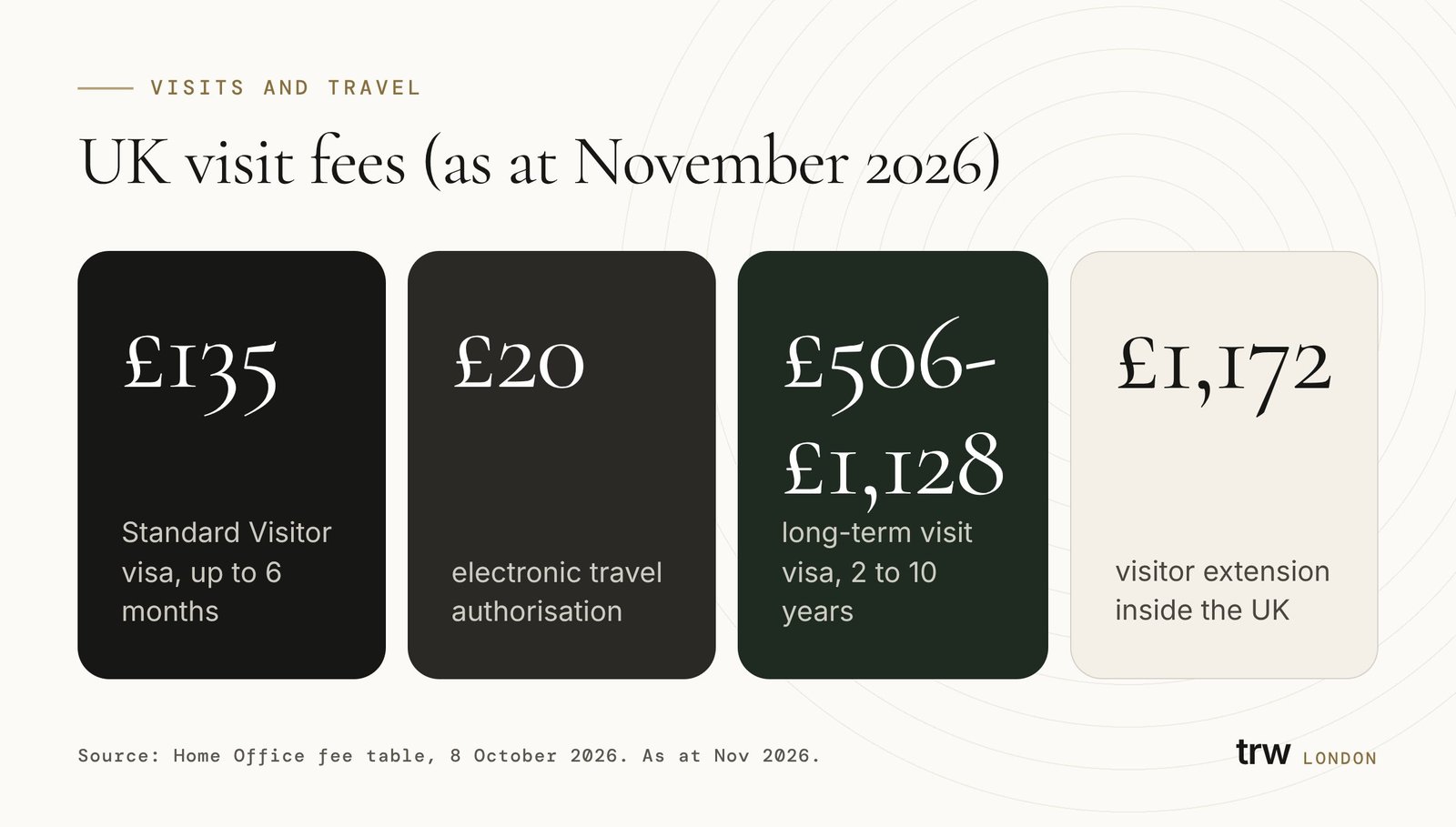
Home Office fees are set by the Home Office fee table and change from time to time, so check the current table before applying. As at November 2026 the main visit fees are:
| Application | Fee |
|---|---|
| Standard Visitor visa (up to 6 months) | £135 |
| Long-term visit visa: 2 years / 5 years / 10 years | £506 / £903 / £1,128 |
| Longer academic or private medical treatment visit visa | £234 |
| Visitor extension (inside the UK) | £1,172 |
| Electronic travel authorisation | £20 |
| Priority / super priority (where offered) | £500 / £1,000 |
The Immigration Health Surcharge is not payable on visas of six months or less applied for from abroad. Long-term visit visas still allow a maximum of six months per visit, and the Home Office may cancel one if the pattern of travel shows the holder is living in the UK. Faster priority services are not available in every location, so check before relying on them. Our professional fees are agreed in advance and depend on the work needed.
Common problems we see
"The decision maker is not satisfied you will leave the UK at the end of your visit"
The most common refusal reason. It usually reflects thin evidence of ties abroad, inconsistent answers about the trip, or a travel history the caseworker reads as residence. A reapplication should address the specific points made, not simply add more documents.
Frequent long visits on a multi-year visa
Long-term visit visas allow up to six months per visit, but successive visits can suggest the UK has become the main home. We look at total time spent in the UK and the reasons for each trip.
Business activities that look like work
Training staff, delivering client projects or covering a role can fall outside Permitted Activities. We review contracts and itineraries before travel.
Previous overstaying or refusals
Part Suitability can require or allow refusal. Previous refusals must be disclosed; failure to disclose can be treated as deception, which carries a 10-year mandatory refusal period for visit entry clearance.
Recent offending
HC 1691 tightened Part Suitability for visitors with recent offending. Criminal records, including cautions and out-of-court disposals, need assessing before any application.
Funding from a UK relative
Acceptable under V 4.3 if the relationship is genuine and the supporter can afford it. Large unexplained deposits into the applicant's account can raise more questions than a clear sponsor letter with the sponsor's own evidence.
If a visit visa is refused
There is no administrative review of a visit visa refusal: the Visitor route is not among the routes listed in Appendix AR. There is no statutory right of appeal either, unless the application included a human rights claim that was refused. The usual options are to reapply with a stronger application addressing each reason given, or, where the decision is legally flawed, to challenge it by judicial review within three months.
A refusal is not a ban in itself, but it must be disclosed in every future UK application and in many other countries' visa forms. Our visa refusal team and our guide to visitor visa refusals explain the options in more detail. Where a refusal alleges deception, see visa refusal for deception.

Recent changes for visitors, 2025 to 2026
In force
- ETA mandatory for eligible non-visa nationals since 25 February 2026; fee £20 from 8 April 2026
- Nauru (9 Dec 2025), Nicaragua and St Lucia (5 Mar 2026) became visa nationals
- From 8 October 2026 (HC 584): no need to show training is unavailable at home; artists may attend rehearsals; workshops, debates and skills competitions allowed; new Erasmus+ activities
- HC 1691 tightened Part Suitability for visitors who have recently offended
Worth watching
- Further Statements of Changes: none laid after HC 584 as at 19 November 2026
- Fee levels, reviewed periodically by the Home Office
- Changes to the visa national list, which can be made at short notice
- Digital-only permissions: ETAs are linked to the passport used to apply, and eVisa holders must keep passport details up to date
The HC 584 changes are explained in the explanatory memorandum to HC 584; the visitor suitability change appears in the HC 1691 explanatory memorandum. GOV.UK confirms that an ETA is linked to the passport used to apply and lasts two years or until that passport expires, whichever is sooner, so a traveller with a new passport should check whether a new ETA is needed.
Documents checklist for a Standard Visitor application
- A current passport or travel document, with a blank page for any visa
- Details of the trip: dates, itinerary, accommodation and who is paying
- Evidence of employment, business or study abroad, such as an employer letter confirming approved leave
- Bank statements and payslips showing funds held in a permitted financial institution
- Where a UK supporter is paying: their letter, status, finances and relationship evidence
- Invitation letters for business, conferences or permitted paid engagements
- Travel history, including previous UK visits and any refusals anywhere
- Translations of any documents not in English or Welsh
GOV.UK lists the information the online form will ask for, including travel history over the past 10 years in some cases, employer details and the details of anyone paying for the trip. Answers must match the documents. Inconsistencies, even innocent ones, are a frequent cause of refusal.
How we work with you
We keep the work proportionate. For straightforward visits we can review a draft application and documents on an agreed fee. For refused, business-critical or sensitive cases, our visit visa solicitors prepare the full application, draft representations and liaise with the UK host. We will tell you plainly if we think a visit visa is not the right route, for example where the real plan is work, study for longer than six months or joining family, and point you to the right guide, such as our spouse visa or business immigration pages.
Bangladeshi nationals can also read our guide to the UK visit visa from Bangladesh.
To discuss a visit, book a consultation with TRW & Co.
Frequently asked questions
01How long can I stay on a Standard Visitor visa?
Up to six months per visit in most cases. Longer grants apply only to specific categories, such as private medical treatment (up to 11 months) or certain academics (up to 12 months).
02Do I need an ETA if I already have a UK visa?
No. People who hold a UK visa or permission, including EU Settlement Scheme status, do not need an ETA. British and Irish citizens, including dual nationals, cannot get one.
03Can I work remotely for my overseas employer while visiting?
Visitors must not work for a UK organisation or fill a UK role. Whether incidental remote work for an overseas employer is acceptable depends on the facts and the current Permitted Activities wording; take advice if it is more than incidental.
04Can my UK family member sponsor my visit?
Yes, a third party can pay for travel, maintenance and accommodation if they have a genuine relationship with you, are not in breach of immigration laws and can afford it. Their evidence should accompany the application.
05Can I switch from a visit visa to another visa in the UK?
Generally visitors cannot switch into most other routes from inside the UK and must apply from abroad. There are limited exceptions in specific routes; check before travelling if a change of plan is likely.
06Is there a right of appeal against a visit visa refusal?
Only if the application included a human rights claim that was refused. Otherwise there is no appeal and no administrative review; the options are a fresh application or judicial review.
07How early should I apply?
GOV.UK allows applications up to three months before travel. Applying early gives time to deal with requests for more information.
Sources and official materials
- Visit the UK as a Standard Visitor (GOV.UK) — Eligibility, permitted activities and documents
- Electronic travel authorisation (GOV.UK) — Who needs an ETA, fee and validity
- Immigration Rules Appendix V: Visitor — Genuine visitor test and conditions
- Immigration Rules Appendix Visitor: Permitted Activities — What visitors may do
- Visit caseworker guidance — How caseworkers assess visit applications
- Home Office immigration and nationality fees (8 October 2026) — Current fees
- HC 584 explanatory memorandum — Visitor changes from 8 October 2026
General information only, current as at 19 November 2026. It is not legal advice and does not create a solicitor–client relationship. It reflects the law of England and Wales unless stated otherwise; Scotland and Northern Ireland have separate legal systems, and the law changes frequently. Check current official sources and take advice on the facts of your matter.