TRW & Co · Visits and travel
Marriage visitor visa: marrying in the UK as a visitor

A marriage visitor visa lets a couple give notice, marry or form a civil partnership in the UK and then leave. It costs £135 and lasts up to 6 months as at November 2026. Anyone who is not British, Irish or covered by the EU Settlement Scheme needs one to marry in the UK, even nationals who usually visit with an ETA.
Key pointIn England and Wales, allow at least 7 days in the district before notice and 29 days from notice to ceremony, and do not plan to stay after the wedding.
At a glance
Fee and length
£135; up to 6 months from arrival.
Who needs it
Everyone except relevant nationals, whatever their usual visa status.
Notice
In person, together, after 7 days' residence in the district.
Earliest ceremony
At least 29 days after notice.
Afterwards
Leave the UK; no switching to a spouse visa from inside.
Swipe or scroll →
The marriage visitor visa at a glance
A marriage visitor visa lets a couple come to the UK to give notice of marriage or civil partnership, marry or register a civil partnership, and then leave. It costs £135, lasts up to 6 months, and is for people who do not intend to live in the UK afterwards. As at November 2026, almost anyone who wants to marry in the UK and is not British, Irish or protected by the EU Settlement Scheme needs one, including nationals who can otherwise visit with just an electronic travel authorisation.
The route is short and the rules are simple, but timing is unforgiving. In England and Wales, notice must be given in person at a register office after a residence period, and the ceremony cannot take place until the notice period has run. A couple who arrive on the wrong visa, or arrive too late, may find they cannot lawfully marry at all on that trip.
This guide explains who needs the visa, how the notice of marriage process fits around it, how it compares with a fiancé visa, and how to plan a wedding in the UK without immigration surprises.
Who needs a marriage visitor visa
Under paragraph V 1.1(b) of Appendix V: Visitor, anyone seeking to come to the UK to marry, form a civil partnership or give notice must obtain entry clearance before arrival, unless they are a "relevant national" as defined in section 62 of the Immigration Act 2014. That rule applies regardless of nationality. A US, Australian or EU citizen who would usually travel visa-free still needs a marriage visitor visa to marry in the UK.
The caseworker guidance is blunt about what happens otherwise: non-visa nationals who arrive to marry or give notice without the right visa must be refused entry. An ETA does not help. GOV.UK states that you cannot use an ETA to marry, register a civil partnership or give notice.
| Your status | Marriage visitor visa needed? | Notes |
|---|---|---|
| British or Irish citizen | No | A relevant national under section 62 |
| EUSS settled or pre-settled status | No | Also covers EUSS applications made by 30 June 2021 and still pending |
| Indefinite leave to remain | No visa to give notice | GOV.UK lists ILR holders among those who need no visa |
| In the UK on a visa of more than 6 months | No visa to give notice | You may need to tell the Home Office you have married |
| Standard Visitor or ETA holder | Yes | A visitor visa or ETA cannot be used to marry or give notice |
| Any other non-British national abroad | Yes | Applies to visa and non-visa nationals alike |
Someone who qualifies for British citizenship, including as a dual national, cannot use the route and should apply for citizenship or a certificate of entitlement instead, according to the GOV.UK Marriage Visitor visa page.
Requirements under the Immigration Rules
A marriage visitor must meet the general visitor requirements and two extra conditions in paragraphs V 12.1 and V 12.2. The general requirements are that the applicant is a genuine visitor who will leave at the end of the visit, will not live in the UK through repeated visits, and has enough money for the trip without working or claiming public funds. The extra conditions are that the applicant is aged 18 or over on the date of application and intends, within the period of the visit, to give notice of marriage or civil partnership, or to marry or form one, which is not a sham.
Allowed
Give notice, marry or register a civil partnership within 6 months of arrival, at a venue licensed for the purpose.
Also allowed
Most other visitor activities, such as tourism or business meetings, and transit through the UK.
Not allowed
Study, permitted paid engagements, work, public funds, or living in the UK through frequent visits.
Not possible
Switching to another visa, such as a spouse visa, from inside the UK.
Under Appendix Visitor: Permitted Activities (PA 1), a Marriage/Civil Partnership Visitor can do all permitted visitor activities except study and permitted paid engagements. The caseworker guidance adds a practical point: the name of the fiancé, fiancée or proposed civil partner is included on the visitor permission. Each partner who needs a visa makes a separate application and pays a separate fee. Children who need a visa apply as Standard Visitors.
A marriage visitor visa is permission to marry in the UK and then go home. It is not a first step to living here.
Giving notice of marriage in England and Wales
Giving notice of marriage means signing a legal statement at a register office that you intend to marry or form a civil partnership. GOV.UK sets out the notice rules for England and Wales. You usually need an appointment at your local register office, and you must have lived in that registration district for the past 7 days. The notice must include the details of the final venue, so the venue has to be chosen first.
Where one partner is from outside the UK, the couple must give notice together, unless both are British or Irish citizens or have EUSS settled or pre-settled status (or a pending EUSS application made by 30 June 2021). Notice is given at a register office in the district where at least one of you lives.
Notice must be given at least 29 days before the ceremony. GOV.UK's example is that notice given on 1 May allows a ceremony on 30 May at the earliest. The ceremony must then take place within 12 months of giving notice. Anglican weddings can follow a different process, so check with the venue.
The Home Office referral and the 70-day wait
Registrars must tell the Home Office in certain cases. GOV.UK warns that if you give notice without the right visa, the Home Office will be told and may ask questions about you and your relationship, in which case you may need to wait up to 70 days before marrying. The Home Office may also decide not to approve the notice, and if that happens you cannot marry or form a civil partnership in the UK. Holding a valid marriage visitor visa is the way to avoid that outcome.
Documents for the notice of marriage appointment
- Details of the final ceremony venue
- A valid passport (or UK birth certificate, with parents' nationality evidence if born after 1 January 1983)
- Proof of home address, or a UK contact address if you normally live abroad
- Proof of any name change, such as a deed poll
- A passport-sized photo of each partner where either is from outside the UK
- Proof of current immigration status, such as a share code or the visa in your passport
- A decree absolute or final order, or a former partner's death certificate, if previously married
- Translations of any documents not in English
If a previous divorce, annulment or dissolution was granted outside the UK, Channel Islands or Isle of Man, the register office must check it and a fee is payable, as listed in GOV.UK's documents guidance. Allow time for that check. Different notice rules apply in Scotland and Northern Ireland, where the caseworker guidance notes that notice can be given by post. Check the local requirements before you book.
You cannot give notice on a Standard Visitor visa or an ETA. A couple who enter as ordinary visitors and then try to give notice risk a referral to the Home Office, a refused notice and a wasted trip.
Timing the trip
The marriage visitor visa lasts up to 6 months from arrival, which is usually ample. The constraint is the sequence in England and Wales: 7 days in the district before notice, then at least 29 days from notice to ceremony. A couple who arrive on a Monday, give notice the following Monday and choose the earliest available date are looking at a ceremony roughly five to six weeks after arrival, assuming no referral and registrar availability.
- Up to 3 months before travel
Apply for the visa
Book the venue and a provisional notice appointment first; use them as evidence.
- Around 3 weeks
Decision
GOV.UK's usual standard after biometrics; faster options may be offered.
- Day 1
Arrive in the UK
Carry venue and notice confirmations; border officers may ask about the plans.
- Day 8 or later
Give notice together
After 7 days living in the district; bring original documents.
- Notice + 29 days
Earliest ceremony
Within 12 months of notice and within 6 months of arrival.
- After the ceremony
Leave the UK
Before the visa expires; honeymoon abroad and transit back is possible.
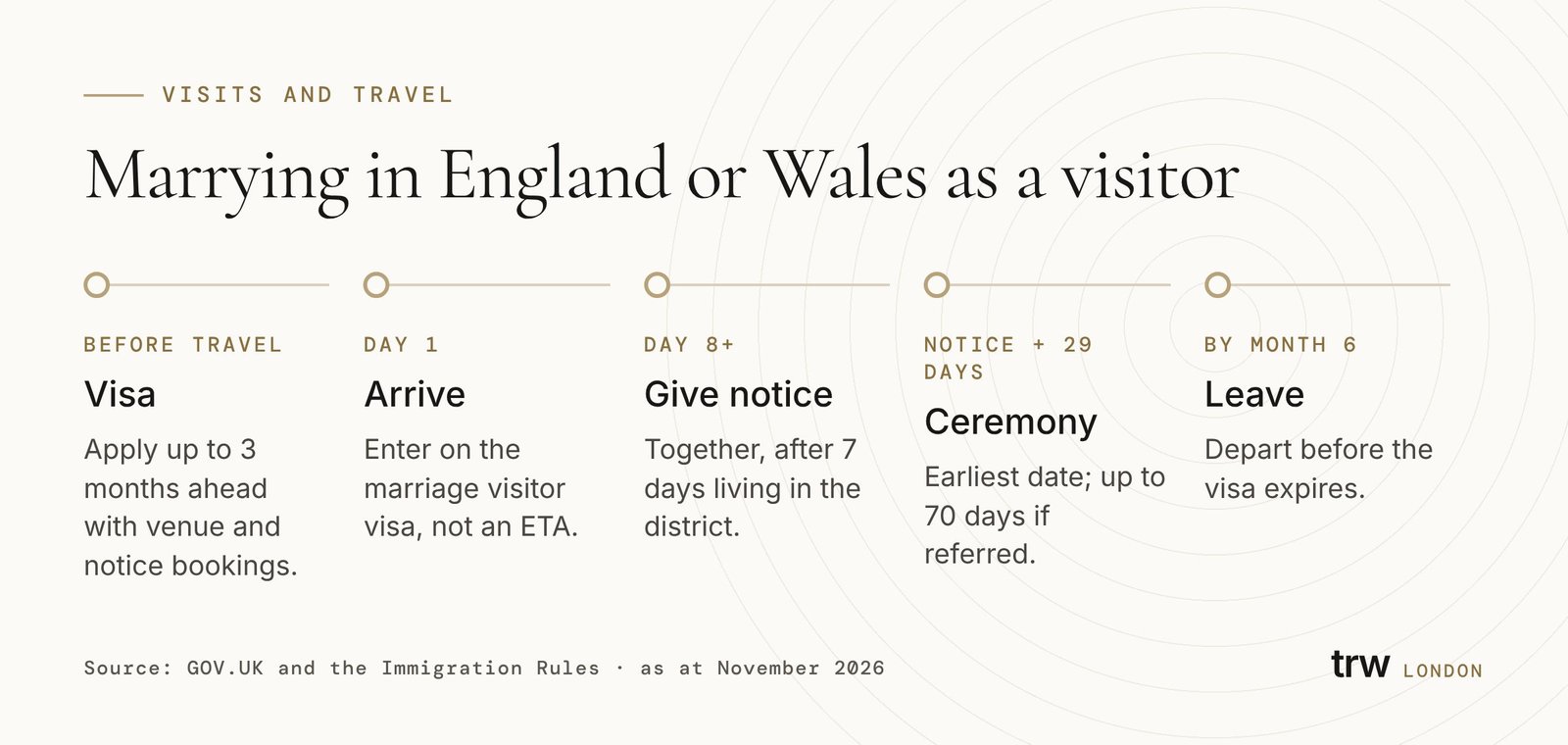
The caseworker guidance gives an example: a couple can come on a 6-month marriage visitor visa, marry, leave for a honeymoon in a third country, and transit the UK on the way home using the same visa. The Rules allow a marriage visitor granted less than 6 months to extend up to a 6-month total, but not beyond. If speed matters, see our guide to the priority visa service.
Evidence for the marriage visitor visa application
The caseworker guidance says a person coming to give notice should show they have arranged to do so, for example with an appointment card or email confirming a provisional advance booking. A person coming to marry should show the ceremony is arranged, for example the register office or church booking or a receipt for the venue. GOV.UK also suggests proof that you have paid some of the costs.
Because the caseworker must be satisfied the relationship is genuine and the marriage is not a sham, evidence of the relationship helps: how and when you met, time spent together, communication and future plans, including where you will live after the wedding. The usual visitor evidence also matters: employment or other ties at home, funds for the trip and previous travel.

Marriage visitor visa or fiancé visa?
The choice depends on what happens after the wedding. If the couple will live outside the UK, the marriage visitor visa is the right tool. If the non-British partner intends to live in the UK with a British or settled partner, a fiancé visa is usually needed instead. It is a 6-month family visa, the couple must marry within that period, and the partner can then apply from inside the UK for a spouse visa.
Marriage visitor visa
- £135 per person, as at November 2026
- Usual decision in 3 weeks from abroad
- No minimum income requirement
- Must leave after the visit; cannot switch to a spouse visa
- Either partner's nationality can be any
Fiancé visa
- Family visa fee (£2,064 from outside the UK as at November 2026)
- Usual decision in 12 weeks from abroad
- Financial and English requirements of the partner route apply
- Can apply for a spouse visa in the UK after the wedding
- Sponsor must be British, settled or have certain other status
The difference matters because Appendix FM, at paragraph E-LTRP.2.1, prevents an applicant who is in the UK as a visitor from applying for permission to stay as a partner. A couple who marry on a marriage visitor visa and then decide to stay will usually have to leave and apply for a spouse visa from abroad. Our spouse visa guide and our guide to the financial requirement explain the partner route.

Special cases
Converting an existing civil partnership into a marriage does not require a marriage visitor visa. The caseworker guidance says non-visa nationals can seek entry as Standard Visitors for this, and visa nationals can apply for a Standard Visitor visa, but only where the civil partnership was formed under the law of England and Wales or Scotland. The original civil partnership certificate will be needed.
A ceremony that is not legally recognised as a marriage under UK law, such as a purely religious blessing with no legal effect, also falls outside the route; the guidance treats it as a Standard Visitor activity. Couples should be careful here, because whether a ceremony creates a valid marriage under English law is a legal question with lasting consequences. Our guide to recognition of overseas marriages discusses related issues.
Finally, sham marriage is a mandatory concern. If the caseworker is satisfied that it is more likely than not that the applicant is, or has been, involved in a sham marriage or civil partnership, the application is refused under paragraph SUI 8.1 of Part Suitability.
Mistakes that derail a wedding
Travelling on an ETA and planning to "sort it out" in the UK
The ETA and the Standard Visitor visa do not allow you to give notice or marry. Non-visa nationals arriving to marry without a marriage visitor visa must be refused entry.
Booking the ceremony too soon after arrival
In England and Wales the 7-day residence period and the 29-day notice rule mean a ceremony is unlikely to be possible in the first five weeks. A referral to the Home Office can extend the wait to 70 days.
Giving notice separately
Where one partner is from outside the UK, the couple must usually give notice together. If your partner gave notice alone before 1 July 2021, you will need to give notice again together.
Bringing copies, not originals
Register offices require originals of the listed documents. Foreign divorce documents may need a separate check and fee, so build in time.
Planning to stay after the wedding
The marriage visitor visa cannot be extended beyond 6 months or switched. If you plan to live together in the UK, use the fiancé route or apply for a spouse visa from abroad after the wedding. A refusal for misusing the visitor route can affect later applications; see our guide to visitor visa refusals.
Worked example: a destination wedding in Bath
Example (hypothetical): Daniel, a US citizen, and Mei, an Australian citizen, live in Singapore and want to marry at an approved venue in Bath before returning home. Neither is a relevant national, so both need a marriage visitor visa, even though both could otherwise visit with an ETA.
They book the venue for a date seven weeks after their planned arrival, then book a joint notice appointment at the Bath register office for their second week. Each applies online with the venue booking, the notice appointment confirmation, evidence of their relationship, employment letters from their Singapore employers and bank statements. Each pays £135. They arrive, stay in Bath for the required 7 days, give notice together, and marry after the 29-day period has run. They leave for a honeymoon in Italy, transit the UK on the same visas, and fly home.
After the wedding
Once married, a marriage visitor must leave before the visa expires. If the couple later decide to live in the UK, the non-British partner applies for a spouse visa from outside the UK. The marriage certificate will be central to that application, so order copies before leaving.
If a partner is already in the UK on a visa of more than 6 months and marries, GOV.UK says they may need to tell the Home Office about the change. Partners of British citizens who later settle may in time be able to apply for citizenship; see our guide to naturalisation as a spouse.

Next steps
Decide first where you will live after the wedding; that decides the route. If it is abroad, book the venue and a notice appointment, then apply for the marriage visitor visa with that evidence up to 3 months before travel, leaving at least five to six weeks in the UK before the ceremony date. If it is the UK, look at the fiancé or spouse route instead.
We can check the plan and the evidence before you apply. To talk it through, book a consultation with our family immigration team or see our family visa services.
Frequently asked questions
01My partner is British. Do I still need a marriage visitor visa?
Yes, if you are not a relevant national and you will not live in the UK afterwards. If you plan to live in the UK together, a fiancé visa is usually more suitable.
02Can I get married on a Standard Visitor visa?
No. Standard Visitors and ETA holders cannot give notice, marry or form a civil partnership. The only exceptions are converting an eligible civil partnership into a marriage, or a ceremony with no legal effect under UK law.
03Can our children come to the wedding?
Yes. Children who need a visa apply as Standard Visitors, not as marriage visitors.
04How long after arriving can we marry?
In England and Wales, you must live in the registration district for 7 days before giving notice, and then wait at least 29 days. A Home Office referral can extend the wait to up to 70 days.
05Can we have a religious ceremony?
A religious wedding can take place at a registered religious building with an authorised person present. Civil partnerships cannot be formed in a religious ceremony.
06Can I switch to a spouse visa after marrying?
No. Appendix FM prevents visitors from applying for partner permission in the UK. Apply for a spouse visa from abroad; see our guide to proving a genuine relationship.
07What if the marriage visitor visa is refused?
There is normally no right of appeal. Most couples reapply with better evidence, or consider whether a fiancé visa fits their plans. Our visit visa team can review the refusal.
Sources and official materials
- Immigration Rules Appendix V: Visitor — V 1.1(b), V 12.1–12.2 and V 17
- Immigration Rules Appendix Visitor: Permitted Activities — What marriage visitors may and may not do (PA 1)
- Marriage Visitor visa — Fee, eligibility, documents and decision times
- Marriages and civil partnerships in England and Wales — Notice periods, residence and documents
- Visit caseworker guidance (version 18.0) — Relevant nationals, evidence and sham marriage assessment
- Immigration Act 2014, section 62 — Definition of relevant national
- Immigration Rules Appendix FM — E-LTRP.2.1 bar on partner applications by visitors
General information only, current as at 19 November 2026. It is not legal advice and does not create a solicitor–client relationship. It reflects the law of England and Wales unless stated otherwise; Scotland and Northern Ireland have separate legal systems, and the law changes frequently. Check current official sources and take advice on the facts of your matter.