TRW & Co · Refusals, appeals and challenges
Refused a UK visa for deception? What it means and what you can do
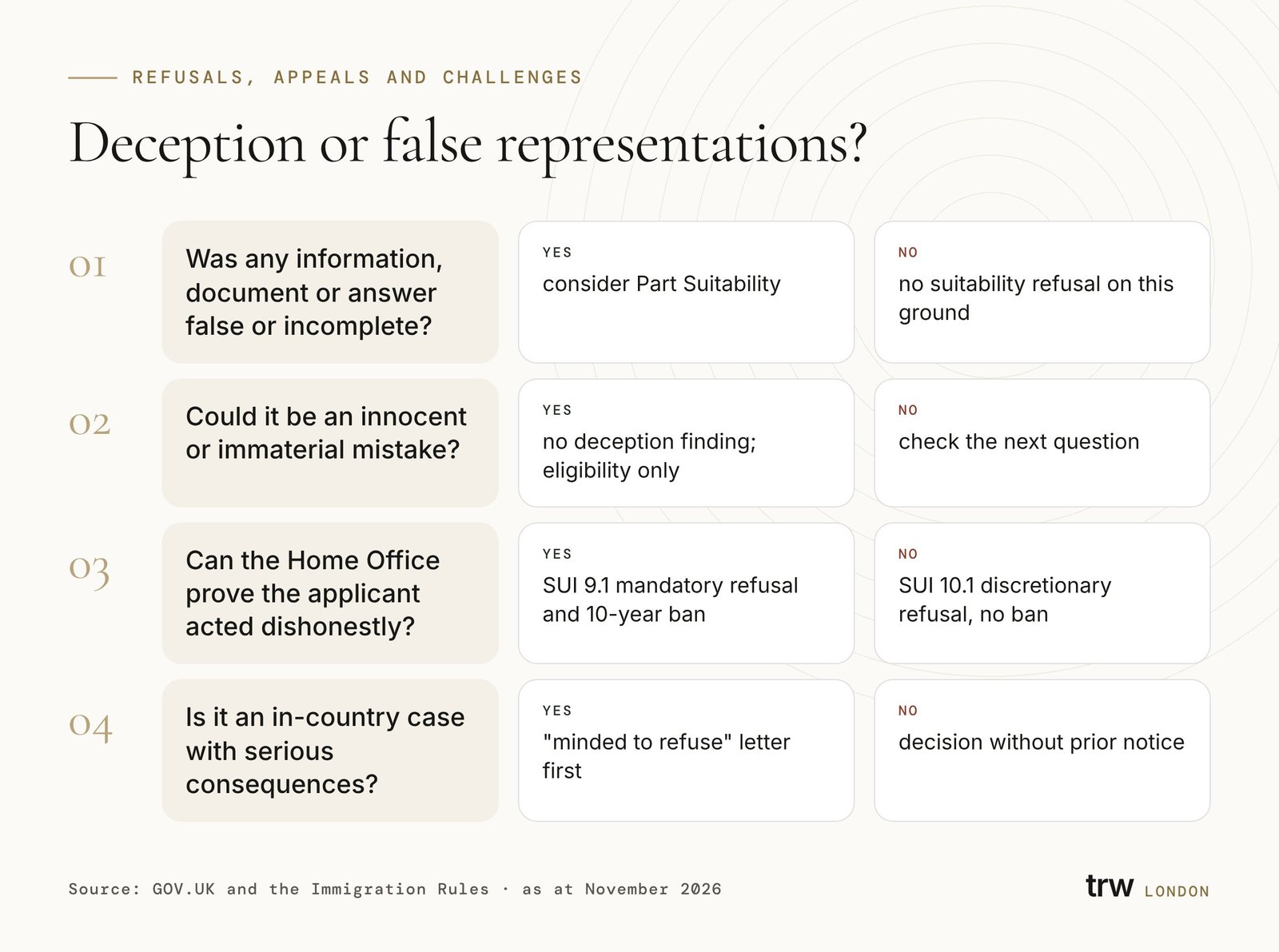
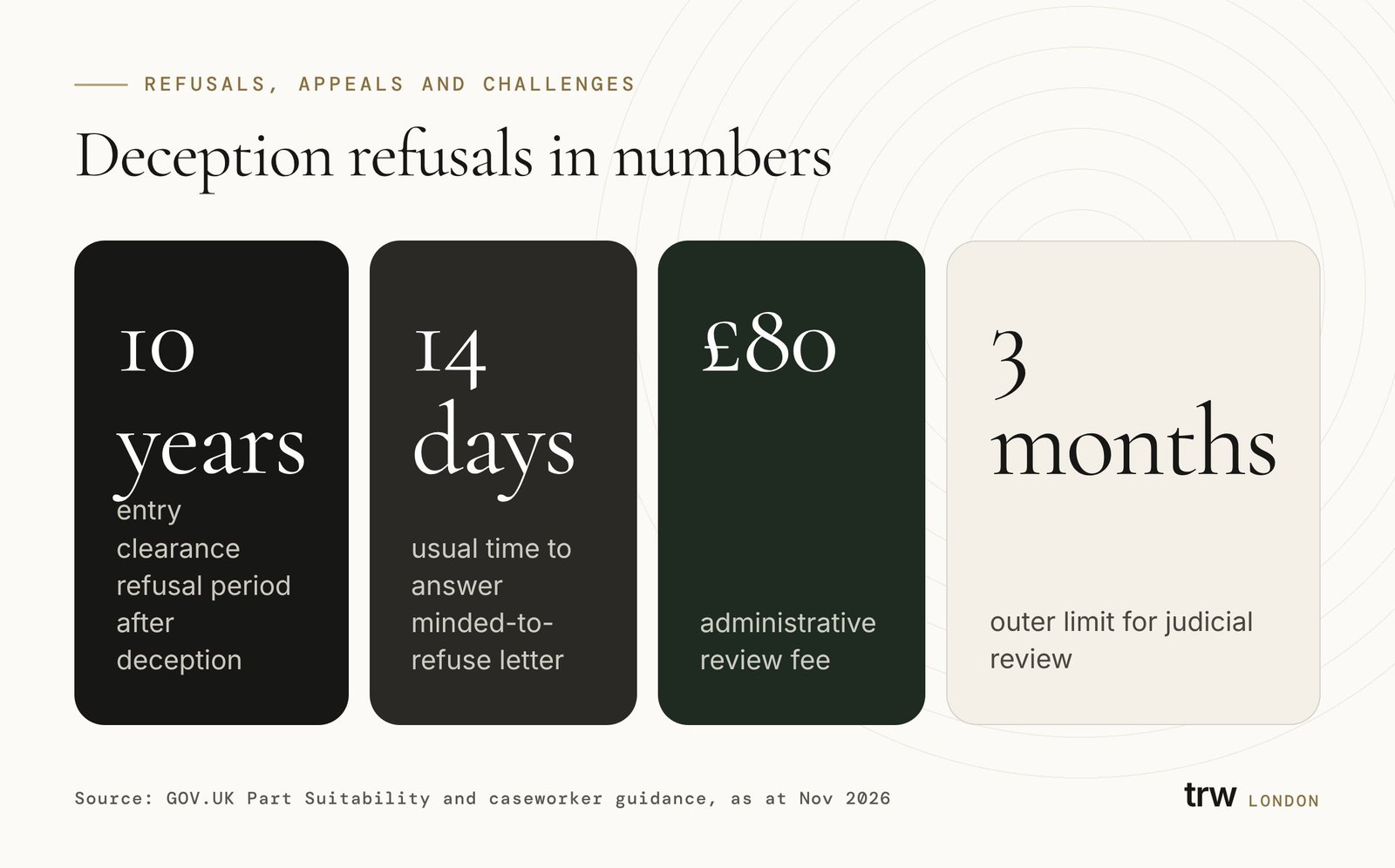
A deception refusal under paragraph SUI 9.1 means the Home Office is satisfied you deliberately gave false information or hid a relevant fact. Refusal is mandatory and later entry clearance applications must be refused for 10 years. A false representations refusal under SUI 10.1 is discretionary and carries no ban. The Home Office must prove dishonesty, and the finding can be challenged.
Key pointCheck which paragraph was used: a deception finding under SUI 9.1 brings a 10-year ban, while SUI 10.1 false representations does not.
At a glance
Rule
Part Suitability SUI 9.1 (deception) and SUI 10.1 (false representations), since 11 November 2025.
Proof
The Home Office must prove dishonesty on the balance of probabilities.
Fairness
In-country applicants facing serious consequences should get a "minded to refuse" letter first.
Ban
10 years from the refusal date for later entry clearance applications.
Remedies
Administrative review, appeal, judicial review or a reasoned fresh application.
Swipe or scroll →
Visa refusal for deception: the short answer
A visa refusal for deception is a finding by the Home Office that you deliberately lied, used a false document or hid a relevant fact in order to get permission. It is one of the most serious refusal grounds: refusal is mandatory, and the finding triggers a 10-year period in which future applications for entry clearance must be refused. It also follows you into settlement and citizenship applications.
Not every refusal that mentions false information is a deception refusal. The Immigration Rules separate deliberate deception from false representations that may have been innocent or made by someone else, and the consequences are very different. Reading the decision letter carefully, to see which paragraph was used, is the first step in any response.
Two different grounds: deception and false representations
Since 11 November 2025, refusals for dishonesty sit in Part Suitability of the Immigration Rules, which replaced the old Part 9 general grounds. The Home Office caseworker guidance, Part Suitability: deception, false representations, false documents and non-disclosure of relevant facts (version 1.0, November 2025), explains how the paragraphs fit together.
| Paragraph | Test | Mandatory or discretionary | 10-year ban? |
|---|---|---|---|
| SUI 9.1 | Decision-maker satisfied the applicant used deception: false representations, false documents or information, or non-disclosure of relevant facts | Mandatory refusal | Yes, for later entry clearance applications |
| SUI 9.2 | Deception in an application, where permission is extended by section 3C | Discretionary cancellation of 3C leave | Linked to the deception finding |
| SUI 10.1 | False representations, documents or information, or non-disclosure, by the applicant or a third party, whether or not to the applicant's knowledge | Discretionary refusal | No |
| SUI 10.2 | Same as SUI 10.1, applied to permission already held | Discretionary cancellation | No |
The dividing line is intention. The guidance defines deception as "an act which deliberately causes someone to believe something that is not true", and tells caseworkers that SUI 9.1 requires them to be satisfied there was "a deliberate intention to deceive by the applicant". Where false information was submitted but dishonesty cannot be shown, the case belongs under SUI 10.1, and the guidance says in terms that such refusals "do not lead to a ban".
That distinction is often the whole case. A deception refusal that should have been a false representations refusal carries a decade of consequences that the Rules did not intend.
Who has to prove what
Ordinarily the applicant must prove they meet the Rules. Deception reverses that. The guidance states that if the Home Office alleges deception, it bears the burden of showing both that the representations were untrue and that the applicant acted dishonestly, on the balance of probabilities. It quotes the Court of Appeal in Balajigari v Secretary of State for the Home Department [2019] EWCA Civ 673: the Secretary of State must be satisfied that dishonesty occurred, "bearing in mind the serious nature of the allegation and the profound consequences which follow".
Caseworkers are told that an allegation of deception "must not be made unless there is evidence to support" it, and that it is not appropriate to refuse for false representations "simply because you are not satisfied that the applicant has given correct information". Typical evidence includes verification checks with the issuer of a document, discrepancies between the current and earlier applications, and data from other government departments such as HMRC.
Ask what evidence the Home Office relied on. If the decision refers to a verification report, a phone call to an employer or a bank, or HMRC data you were never shown, that is relevant both to the merits and to whether the procedure was fair.
The "minded to refuse" letter and procedural fairness
Following Balajigari, the guidance requires caseworkers in some cases to tell the applicant about the allegation and give them a chance to respond before deciding. A "minded to refuse" (or "minded to cancel") notification must be sent where the implications of a deception finding are significant, or where the applicant may not know about the information relied on, for example data obtained from another department.
The guidance gives in-country examples of significant implications: a person seeking settlement or further leave who would have to leave the UK, or who would be exposed to restrictions on renting and banking. By contrast, it says entry clearance cases will rarely reach that level of seriousness, so the process usually does not apply to applications made from abroad. Where a letter is sent, 14 calendar days will normally be a reasonable time to reply.
- Read the allegation precisely. The letter must set out exactly what is alleged and whether the deception is said to be yours or a third party's.
- Request the underlying evidence. Ask for the verification report or data relied on, and note what you have and have not been shown.
- Gather independent proof. Bank statements direct from the bank, employer letters on headed paper with contact details, HMRC records, or the original issuer's confirmation.
- Explain, do not just deny. If there was an error, explain how it arose and why it was innocent; if a third party was responsible, provide your complaint and their response.
- Raise mitigating and human rights factors. The guidance requires caseworkers to consider mitigating and positive factors, and a sufficiently particularised human rights claim must be treated as one.
Innocent mistakes and how caseworkers assess them
The guidance tells caseworkers that they "must not refuse on grounds of deception or false representations grounds if there may have been an innocent mistake", or because of minor inaccuracies such as a wrong postcode or misspelt name. An innocent mistake can still lead to refusal on eligibility grounds, for example where a typed income figure cannot be matched by evidence, but not to a deception finding. Caseworkers are directed to ask a series of questions, which are worth asking of your own case.
- How easy would it have been to make this mistake on the form?
- How likely is it that the applicant did not know the information had been given?
- Does the false information benefit the applicant?
- Is it contradicted by other answers or documents in this or an earlier application?
- Do passport stamps or endorsements contradict any answer?
- Has a new passport been presented, and if so why?
- Has the same "innocent mistake" been made before?
The guidance's own case studies show where explanations fail. An applicant who did not declare two previous visa refusals and later said they forgot was not believed: it was not credible to forget paying fees and receiving two refusals. An applicant who omitted a brother-in-law in the UK because he was not a blood relative was also not believed, because the form did not limit the question to blood relatives, though caseworkers are told to check whether the form actually allowed that relative to be declared.
An untrue answer is not the same as a dishonest one, and the Rules treat them very differently.
When an agent, sponsor or relative supplied the document
Third party deceived the Home Office
If the Home Office can prove you knew and were involved, SUI 9.1 applies. If it cannot, it may still refuse under SUI 10.1, which does not carry a ban.
You deceived a third party
For example, giving a sponsor a false English certificate to obtain a CAS. The guidance treats this as false representations to obtain documents.
Children
A breach of immigration laws by deception counts only where the applicant was 18 or over. A child can still be refused under SUI 10.1 for false representations in their application.
Proving an agent's error
The guidance expects evidence of a complaint to the agent, the correspondence about it and, ideally, a witness statement from the agent explaining the error.
Every online application contains a declaration that the information given by the applicant, or by any helper or proxy, is correct. The guidance reminds caseworkers of it when assessing claims of forgetfulness. Using a representative does not transfer responsibility, so check every answer on the form before it is submitted, even if someone else filled it in.

When permission you already hold is cancelled
False representations are not only a reason to refuse a new application. Under SUI 10.2, permission a person already holds may be cancelled where it was obtained by false representations, false documents or non-disclosure, and under SUI 9.2 permission extended by section 3C may be cancelled where deception was used. The guidance explains that in-country cancellation usually happens where the problem comes to light after a grant and there is no other decision pending, and such cases are normally referred to specialist cancellation teams.
At the border, Border Force officers can hold a "minded to cancel" interview on the spot, putting the allegation and recording the answer. The guidance says that if cancellation with immediate effect is being considered, the officer must explain why and give the person a chance to respond. That interview is the first and sometimes only opportunity to explain, so travellers who know of a discrepancy in an earlier application should be ready to address it.
Rights of challenge are narrower here. The guidance states that a person generally has no right of appeal or administrative review against a cancellation decision unless a human rights claim is refused. The exception is an administrative review where permission on a route listed in Appendix Administrative Review is cancelled at the border, either for a change of circumstances or because it was obtained by false representations or non-disclosure. Outside those cases, the remedy is usually judicial review, which is why the record made at interview matters so much.
Consequences of a deception refusal
The mandatory refusal period table in SUI 12.1 runs the 10 years for deception from the date of the refusal, not from departure, and for visitors it applies to applications for entry clearance only. Our guide to the UK re-entry ban sets the deception ban alongside the other periods. In-country, previous deception counts as a breach of immigration laws under SUI 11.4(d), which allows refusal of later applications for permission to stay.
The finding also reaches settlement and citizenship. Under Appendix Private Life (PL 12.4), deception during the qualifying period means settlement is refused unless the applicant completes a 10-year qualifying period, with 5 years after the first grant made once the ground came to light. The good character guidance for naturalisation treats deception as a serious adverse factor, and citizenship obtained by fraud, false representation or concealment of a material fact can later be removed under section 40(3) of the British Nationality Act 1981.
Challenging a visa refusal for deception
The right remedy depends on the type of application and where it was made. Several can be pursued in sequence, but time limits are short, so the choice needs to be made within days of the decision.
Administrative review
For eligible refusals (most points-based and many other routes), administrative review costs £80 and must be sought within 14 days in the UK or 28 days from abroad. It checks for caseworking errors, which can include a deception finding that the evidence did not support. See our guide to administrative review.
Appeal
If the refused application included a human rights claim, there is a right of appeal to the First-tier Tribunal (14 days in the UK, 28 days from abroad). The tribunal decides for itself, on the evidence, whether deception is proved.
Judicial review
Where there is no appeal or review, or the review was itself unlawful, judicial review can challenge a deception finding made without a fair opportunity to respond, or on no proper evidence. The claim must be brought promptly and within 3 months.
A fresh application that addresses the finding
The previous breach guidance allows an applicant to ask, in a later entry clearance application, for the ban to be reconsidered and to explain why there was no deception. If the caseworker is satisfied there was no deception, "there is no ban to apply".
Complaints about an adviser
If a regulated adviser caused the error, a complaint to their regulator or the Legal Ombudsman may support your explanation and provide redress. It does not itself overturn the decision.
Worked example: an undisclosed refusal
Example (hypothetical): Daniel, a software engineer, applies from abroad as a Skilled Worker. Eight years earlier he was refused a visit visa, which he does not mention on the form because a friend helping him told him only the last five years mattered. The Home Office refuses under SUI 9.1 for non-disclosure and imposes a 10-year ban.
Because this is an entry clearance application, there was no "minded to refuse" letter. Daniel seeks administrative review within 28 days, arguing that the form question was ambiguous on the time period and producing the friend's messages. Whether he succeeds will depend on the exact wording of the question and whether the omission benefited him. If the review fails, he can apply again later and ask the Home Office to reconsider the deception finding with fuller evidence. Either way, his employer's hiring timetable should assume a delay.

Preventing a false representations refusal
Most deception refusals we see begin with an answer given quickly, by someone other than the applicant, about something that seemed unimportant. A short checklist before submission prevents most of them: declare every previous UK and overseas visa refusal, every criminal conviction, and every family member the form asks about; reconcile salary figures with payslips and tax records; and obtain documents directly from banks, employers and universities rather than through intermediaries.
If you have discovered an error after submitting, it is usually better to correct it before the Home Office finds it. A voluntary correction, with an explanation, is strong evidence that there was no intention to deceive. Where an application is still pending, it may be possible to correct the record through the Home Office's contact routes or by varying the application. Allegations about English language test certificates issued by Educational Testing Service have their own Home Office casework instructions, last updated in April 2026.
The earned settlement response (CP 1707, 2 November 2026) proposes a 20-year route to settlement for adults who have committed specified immigration breaches, including deception. It is announced policy only; nothing has been laid in the Immigration Rules and no start date has been given.
Next steps after a deception refusal
Start by identifying the paragraph in the decision letter: SUI 9.1 or SUI 10.1 changes everything that follows. Diarise the deadline for any review or appeal, collect the evidence you need to answer the allegation, and do not make a new application until you have a strategy for the deception finding, because a repeat application that does not address it is likely to fail for the same reason.
We usually start by obtaining the Home Office file and comparing it, line by line, with the application form and supporting documents. If you or an employee has received a deception refusal or a "minded to refuse" letter, book a consultation. Related guides: visa refusal solicitors, spouse visa refusals and student visa refusals.
Frequently asked questions
01Does a deception refusal stop me visiting the UK?
For 10 years from the refusal, applications for entry clearance must be refused. For visitors the ban applies to applications for entry clearance; whether you need a visa or an ETA depends on your nationality.
02Can a deception finding be removed from my record?
The record remains, but the finding can be overturned on review, appeal or judicial review, or reconsidered in a later application where you show there was no deception. If the caseworker accepts that, no ban applies.
03Is non-disclosure treated the same as lying?
It can be. SUI 9.1 covers "not disclosing relevant facts". The guidance says a person need not volunteer information unless the context makes clear it is required, which is why the wording of the form question matters.
04Will my family members be refused too?
Dependants whose applications depend on yours are likely to be refused with you. Whether a separate deception finding is made against them depends on what each person knew and did.
05Can I be prosecuted for deception in a visa application?
Yes, potentially. Under section 24A of the Immigration Act 1971, obtaining or seeking to obtain leave by deception is an offence, but most cases are dealt with through refusal and the mandatory refusal period. Take advice before answering questions in any criminal investigation.
06Does a deception refusal affect my employer's sponsor licence?
It can attract scrutiny if the sponsor supplied or relied on the false document. Sponsors should review their recruitment checks; see our sponsor compliance page.
Sources and official materials
- Immigration Rules: Part Suitability — SUI 9.1 to 10.2, SUI 11.4 and the SUI 12.1 refusal periods
- False representations: caseworker guidance — How deception and false representations are assessed
- Previous breach of UK immigration laws: caseworker guidance — The 10-year ban and reconsideration
- Balajigari v SSHD [2019] EWCA Civ 673 — Court of Appeal on dishonesty findings and fairness
- Immigration Rules: Appendix Private Life — Effect of deception on settlement (PL 12.4)
- British Nationality Act 1981, section 40 — Deprivation of citizenship obtained by fraud
- Ask for an administrative review — Fee and time limits
General information only, current as at 19 November 2026. It is not legal advice and does not create a solicitor–client relationship. It reflects the law of England and Wales unless stated otherwise; Scotland and Northern Ireland have separate legal systems, and the law changes frequently. Check current official sources and take advice on the facts of your matter.