TRW & Co · Settlement and citizenship
Indefinite leave to remain solicitors in London

Indefinite leave to remain lets you stay in the UK without a time limit and is usually the step before citizenship. We advise on which route you qualify for, when to apply, how to deal with absences, salary or suitability issues, and what the announced earned settlement reforms mean for you.
Key pointSettlement is decided under the rules in force at the date of decision, so anyone who qualifies under the current Rules should apply when eligible rather than wait for the earned settlement reforms.
At a glance
Fee
£3,226 per person, as at November 2026, with no health surcharge.
Typical routes
Skilled Worker after 5 years, family routes, Long Residence after 10 years.
Absences
For most routes, no more than 180 days outside the UK in any 12 months.
Tests
Life in the UK test and English; B2 English for most routes from 26 March 2027.
Reforms
Earned settlement is announced policy, not yet in the Rules, with no start date.
Swipe or scroll →
Indefinite leave to remain solicitors in London: who we act for
TRW & Co's indefinite leave to remain solicitors advise individuals, families and employers on settlement in the UK. Indefinite leave to remain (ILR) removes the time limit on a person's stay, lets them work and study without route conditions, and is usually the step before British citizenship. It is also the point at which the Home Office looks back over the whole immigration history, so small gaps in the record can become decisive.
We act for Skilled Workers and their sponsors, partners and parents of British citizens, people approaching ten years of lawful residence, Global Talent and Innovator Founder visa holders, and families whose children need to settle with them. We also act where an ILR application has been refused, or where travel, a criminal matter or a sponsor problem puts settlement at risk.
Fees, thresholds and rules below are stated as at November 2026. Settlement law is in transition: the government published its final earned settlement policy on 2 November 2026, but it is not yet in the Immigration Rules.
How our indefinite leave to remain solicitors help
Most of our work is preventive. A settlement application is assessed against the rules in force when it is decided, and the Home Office will test residence, absences, salary, English, the Life in the UK test and suitability together. Our role is to find and fix the weak point before the fee is paid.
Eligibility review
We check which settlement route you qualify on, the earliest date you can apply, and whether a different route gives a better result.
Absences and residence audit
We reconstruct travel history against the continuous residence rules and identify absences that need explanation or evidence.
Employer and sponsor support
For Skilled Workers we coordinate with HR on the sponsor confirmation and salary evidence the Rules require at settlement.
Family applications
We plan partner and child applications so the family can settle together, or in the right order if not.
Complex suitability issues
Convictions, previous refusals, overstaying and deception allegations are analysed against Part Suitability before filing.
Refusals and challenges
We advise on administrative review, fresh applications, appeals and judicial review where an ILR application fails.

The legal framework for settlement
Indefinite leave is granted under the Immigration Act 1971 and the Immigration Rules made under it. There is no single "ILR rule". Each route that leads to settlement has its own appendix: Appendix Skilled Worker, Appendix Global Talent, Appendix Long Residence, Appendix Settlement Family Life and others. These appendices are amended by Statements of Changes, listed on the GOV.UK collection page; the most recent at the time of writing is HC 584 of 3 September 2026.
Three cross-cutting appendices matter in almost every case. Appendix Continuous Residence sets the absence limits and what breaks residence. Part Suitability (which replaced Part 9 from 11 November 2025) governs criminality, deception, debts and other conduct. The knowledge of language and life rules set out who must pass the Life in the UK test and prove English.
Home Office caseworker guidance explains how decision-makers apply each appendix. It is not law, but it shows how discretion is likely to be exercised, for example on absences for compelling and compassionate reasons, which Appendix Continuous Residence allows to be disregarded.
Immigration law is reserved to Westminster, so the same Rules apply in England, Wales, Scotland and Northern Ireland. Decisions are made by UK Visas and Immigration, part of the Home Office. Where a refusal engages human rights, the First-tier Tribunal can hear an appeal; most other refusals are reviewed internally through administrative review, and judicial review in the Upper Tribunal is the remedy of last resort for unlawful decisions.
Main ILR routes and their requirements
The table summarises the routes we see most often. It is a starting point, not a substitute for checking the rule that applies to you; several routes contain transitional provisions for people who were already on them before a change.
| Route | Qualifying period | Key requirements | Guide |
|---|---|---|---|
| Skilled Worker (and Health and Care Worker) | 5 years on qualifying routes, not as a dependant | Sponsor still licensed and confirms the job; salary at the settlement threshold; Life in the UK test | ILR for Skilled Workers |
| Long Residence | 10 years' continuous lawful residence | Usually current permission held for a year; English and Life in the UK test (ages 18 to 64) | Long residence ILR |
| Partner or parent of a British or settled person | 5 years on the 5-year route; 10 years on the 10-year route | Relationship, finances, accommodation, English and Life in the UK test | Spouse visa solicitors |
| Refugee or humanitarian protection | 5 years for claims made by 1 March 2026 | Appendix Settlement Protection, including a safe return review | Refugee status |
| Victims of domestic abuse | No fixed period | Relationship broke down because of domestic abuse; evidence of abuse | Domestic abuse ILR |
| Bereaved partner | No fixed period | Partner of a British or settled person who has died | Bereaved partner settlement |
Global Talent and Innovator Founder holders can settle after three years in many cases, and Scale-up workers after five. Their time can also count towards Skilled Worker settlement in the right combination. People who first came under the EU Settlement Scheme follow a separate system: see our guide to moving from pre-settled to settled status.
The ILR application process and timeline
Most in-country settlement applications are made online and followed by an identity appointment or app-based identity check. The Skilled Worker guidance on GOV.UK says you can apply up to 28 days before you complete five years, and warns that applying earlier may lead to refusal. If your current visa will expire first, you must extend it rather than wait.
- 3-6 months before
Eligibility and absences review
Confirm the route, the earliest application date and any absences or gaps that need evidence.
- 2-3 months before
Life in the UK test and English
Book the test (at least 3 days ahead) and confirm whether a new English test is needed.
- 1 month before
Evidence and sponsor documents
Collect payslips, sponsor confirmation, relationship evidence and passports.
- Application date
Submit and pay
File online, pay the fee for each applicant and choose any priority service offered.
- Days after
Identity and biometrics
Attend the appointment or use the ID Check app; do not travel abroad until decided.
- Up to 6 months
Decision
Standard decisions usually take up to 6 months; status is issued as an eVisa.
GOV.UK warns that if you travel outside the UK, Ireland, the Channel Islands or the Isle of Man before a decision, your application will be withdrawn. On some route pages it adds that the fee will not be refunded.

Families, children and employers
Partners and children of a main applicant
On the work routes, a partner normally needs five continuous years as the main applicant's dependant before they can apply, and they cannot count time on their own visa. If the partner arrived later than the main applicant, the family may settle at different times. Children can usually be included where both parents are applying or are already settled, or where a sole responsibility or sole surviving parent rule applies.
Children who were under 18 when first granted permission as a dependant can still be included after turning 18, provided they are not living an independent life. Over-18s must also pass the Life in the UK test and meet the English requirement. We map each family member's dates at the outset so that nobody is left on a shorter permission than the rest of the household.
Employers with sponsored workers approaching five years
For a Skilled Worker, the Rules require the sponsor in the most recent permission to remain licensed on the date of decision and to confirm that it still needs the worker and will pay at least the required salary for the foreseeable future. A restructuring, a pay freeze below the threshold or a licence downgrade at the wrong time can therefore defeat an otherwise straightforward case.
We work with HR teams to diarise five-year dates, check salaries against the current threshold and the relevant going rate, and prepare sponsor letters in the form caseworkers expect. Once a worker holds ILR, they no longer need sponsorship to work in the UK.
From ILR to British citizenship
Most people can apply to naturalise once they have held ILR for 12 months and meet the residence, absence, language and good character requirements; spouses of British citizens do not have to wait the 12 months. The naturalisation fee is £1,709 plus a £130 ceremony fee, as at November 2026. Because the good character test looks back over many years, we flag at the ILR stage anything that may matter later, so that the two applications tell a consistent story.
A clean ILR application is also the foundation of a clean citizenship application: the Home Office reads them together.
Costs and Home Office fees
The Home Office fee for indefinite leave to remain is £3,226 for each person, including partners and children on the same form. It rose from £3,029 on 8 April 2026, and the Home Office fee table for 8 October 2026 shows no further change. There is no Immigration Health Surcharge on an ILR application, and biometric enrolment is free.
Priority and super priority places are limited and not offered on every route. The GOV.UK faster decisions page says priority settlement decisions usually take 30 working days, while some route pages quote shorter times, so we check the position when you apply. Holders of refugee status or humanitarian protection pay no fee for settlement, according to GOV.UK. For a full breakdown, see our guide to the indefinite leave to remain fee.
Our own fees depend on the route and complexity. We give a written estimate after the initial review, and we tell you if we think an application is not yet ready.
Common problems we resolve
Too many days outside the UK
For most routes the limit is 180 days in any 12-month period. Absences for serious illness, the death of a close relative, travel disruption and some other reasons can be disregarded under Appendix Continuous Residence, but they must be evidenced. Our guide to ILR absences explains the calculation.
A gap in lawful residence
Short gaps may be disregarded in limited circumstances, for example where an application was made within the permitted time. Others break residence and restart the clock. We map every grant and application date before advising on which applies.
Salary below the settlement threshold
Skilled Workers must meet the salary threshold at settlement, not only at entry. Since March 2026 the required salary must be paid in each pay period, subject to permitted variations, which catches people whose pay fluctuates.
A criminal record or previous refusal
Part Suitability contains mandatory and discretionary grounds for refusal. A suspended sentence of 12 months or more for a conviction on or after 22 March 2026 now triggers mandatory refusal. Earlier refusals and allegations of deception need careful disclosure.
Sponsor or job changes
A change of employer mid-route is often fine, but the new sponsor must hold a licence and confirm the job at settlement. Redundancy close to the application date needs urgent planning.
Refused application
Many ILR refusals carry administrative review rather than an appeal. The administrative review fee is £80 and the in-country deadline is 14 days. See our guide to ILR refusals.
Settlement changes in 2025 and 2026
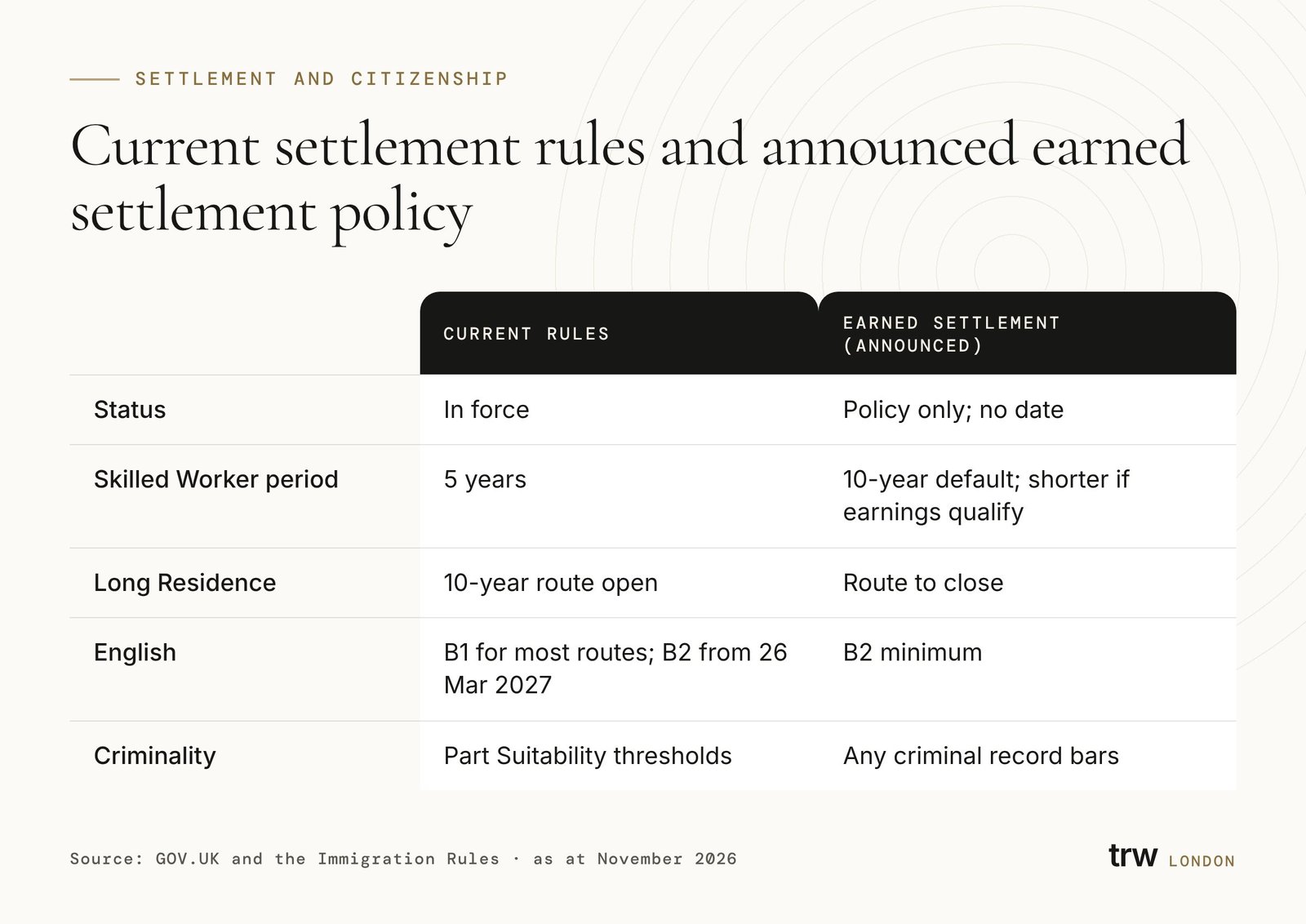
Settlement is changing in two stages, and it is important to separate what is law from what is policy.
What is law: from 26 March 2027, most settlement routes will require English at B2 rather than B1. This was laid in HC 1691 in March 2026, as the explanatory memorandum explains, and it covers people already on a route. The settlement fee rose on 8 April 2026, and Part Suitability now applies to settlement on most routes.
What is policy: on 2 November 2026 the government published A Fairer Pathway to Settlement (CP 1707), its final earned settlement framework. It would make 10 years the default qualifying period, with 3- and 5-year pathways for higher earners, specified public service roles and those with a British connection, and longer pathways for people who have used public funds or breached immigration rules. No Statement of Changes has been laid and no date has been set.
Current Rules (in force)
- Skilled Worker ILR after 5 years
- Long Residence ILR after 10 years
- English B1 for most routes until 25 March 2027
- Criminality assessed under Part Suitability thresholds
- Life in the UK test for applicants aged 18 to 64
Earned settlement (announced, not law)
- 10-year default; 5 years at £50,271+ or in listed public service roles; 3 years at £125,141+
- Long Residence route to close
- B2 English as a minimum for everyone
- Any criminal record would bar settlement
- Life in the UK test retained and under review
Because the government says settlement rules continue to apply at the point of application, people who already qualify under the current Rules should not wait for the new framework to see whether it helps them. Our earned settlement and transitional arrangements guides cover the policy in detail.
Documents checklist for an ILR application
Exact requirements depend on the route. This is the core list we work from for an in-country ILR application; the online form will add route-specific items.
- Current passport and every passport held during the qualifying period
- Access to your UKVI account and eVisa, with up-to-date passport details
- A full travel history with dates of each absence and the reason for longer trips
- Life in the UK test unique reference number, unless exempt
- English language evidence where required by your route
- For Skilled Workers: sponsor confirmation of continued employment and salary, plus recent payslips
- For partners: evidence of living together and of the relationship over the qualifying period
- For children: birth certificates and evidence of where they live and who supports them
- Details and documents for any criminal record, caution or previous refusal

Working with our indefinite leave to remain solicitors
We usually start with a fixed-scope review: we read your immigration documents, travel history and current permission, and give a written view on eligibility, timing and risk. If you are ready to apply, we prepare the application and covering representations; if not, we tell you what to fix and when to come back.
Employers who sponsor several workers approaching settlement often ask us to run a group review, so that HR can prepare sponsor letters and payroll evidence in one exercise. Individuals with more complex histories, such as overstaying, refused applications or convictions, receive advice from a solicitor with immigration expertise from the outset.
ILR for Skilled Workers
The five-year requirements, salary rules and sponsor confirmation.
Read the guideSettlementLife in the UK test
Booking, format, exemptions and how the result is used.
Read the guideCitizenshipBritish citizenship
The next step after ILR, usually after 12 months.
Read the guideSettlementILR explained
Our general guide to indefinite leave to remain.
Read the guideNext steps: gather your passports and a list of your trips abroad, check your eVisa details, and book a consultation with our indefinite leave to remain solicitors. We will tell you candidly whether your settlement application is ready.
Frequently asked questions
01How long does an ILR decision take?
GOV.UK says standard settlement decisions usually take up to 6 months from the identity appointment. Priority and super priority services may be offered for an extra fee, with limited places.
02Can I travel while my ILR application is pending?
You should not. GOV.UK states that travelling outside the UK, Ireland, the Channel Islands or the Isle of Man before a decision withdraws the application.
03Can my partner and children apply with me?
Often yes, if they meet the dependant requirements for your route. A partner usually needs their own qualifying period with you and must pass the Life in the UK test and meet the English requirement.
04Can I lose ILR once I have it?
ILR can lapse if you stay outside the UK for more than 2 years at a time, and it can be revoked in limited circumstances set out in legislation. The government has said settled status will not be removed from people who already hold it under the earned settlement reforms.
05Do I need a solicitor for an ILR application?
Not always. Straightforward cases can be made directly. Advice is most valuable where there are long absences, gaps in leave, salary changes, criminal records or previous refusals.
06When can I apply for British citizenship after ILR?
Usually after holding ILR for 12 months, unless you are married to a British citizen. See our British citizenship solicitors page.
07Will earned settlement change my qualifying period?
Possibly, but it is not law yet and there is no commencement date. The government has announced transitional arrangements only for specific cohorts, such as some care workers.
Sources and official materials
- Indefinite leave to remain: Skilled Worker and Tier 2 — Requirements, fee and timing for work-route settlement
- Indefinite leave to remain (long residence) — 10-year route and continuous residence
- Immigration Rules Appendix Continuous Residence — Absence limits and disregards
- Immigration Rules Part Suitability — Grounds for refusal
- Home Office immigration and nationality fees, 8 October 2026 — Current fee table
- Get a faster decision on your visa or settlement application — Priority and super priority services
- A Fairer Pathway to Settlement: government response (CP 1707) — Earned settlement policy, 2 November 2026
- Explanatory memorandum to HC 1691 — B2 English for settlement from 26 March 2027
General information only, current as at 19 November 2026. It is not legal advice and does not create a solicitor–client relationship. It reflects the law of England and Wales unless stated otherwise; Scotland and Northern Ireland have separate legal systems, and the law changes frequently. Check current official sources and take advice on the facts of your matter.