TRW & Co · Settlement and citizenship
Moving from pre-settled to settled status in 2026

A pre-settled status holder now qualifies for settled status after at least 30 months' residence in the most recent 60 months. The Home Office extends pre-settled status by five years before expiry and may convert it automatically, but conversion depends on its data. If you are eligible, you can apply yourself, free, at any time.
Key pointAutomatic conversion is a safety net, not a plan. If your UK residence does not show clearly in tax and benefit records, check the 30-month test yourself and apply.
At a glance
Qualifying residence
At least 30 months in total in the most recent 60 months (from July 2025).
Automatic extension
Pre-settled status is extended by five years before it expires.
Automatic conversion
The Home Office may grant settled status without an application, using tax, benefit and travel data.
Cost
Applying for settled status is free.
If refused
You keep pre-settled status unless separately cancelled, and can appeal to the First-tier Tribunal.
Swipe or scroll →
Moving from pre-settled to settled status: the short answer
Moving from pre-settled to settled status is now easier than when the EU Settlement Scheme opened, and for many people it happens without an application. Since July 2025 the Immigration Rules allow a pre-settled status holder to qualify for settled status once they have been resident in the UK for at least 30 months in total in the most recent 60-month period. The Home Office also extends pre-settled status by five years before it expires and may convert it automatically.
Automatic conversion is not guaranteed, however. It depends on tax, benefit and travel data the Home Office holds about you, and people with long absences, patchy records or a change in family circumstances are the ones most likely to fall through the net. This guide explains the rules as at November 2026, how automatic conversion works, when to apply yourself and what to do if things go wrong.
What changed in 2025 and 2026
When the scheme opened, pre-settled status was five years' limited leave that would simply expire unless the holder applied for settled status in time. Three developments have changed that picture.
The original position
- The original grant lasted five years and lapsed if no further application was made
- Settled status needed five years' continuous residence, broken by more than six months' absence in any 12 months (subject to limited exceptions)
- Every holder had to make a fresh application
- Administrative review was available for some EUSS refusals
The position at November 2026
- The grant is extended by five years before it expires, with an email confirming this
- A holder qualifies with at least 30 months' residence in the most recent 60 months (HC 836, from 16 July 2025, clarified by HC 1333)
- The Home Office may grant settled status automatically, without an application
- EUSS administrative review closed to new applications in April 2024 and was removed from the Rules by HC 584; refusals carry a right of appeal
The 30-month rule appears in the definition of "continuous qualifying period" in Appendix EU, as an additional category of permitted absence for people holding pre-settled status. The explanatory memorandum to HC 1333 describes it as enabling a pre-settled holder "to be granted settled status where they have been resident in the UK for at least 30 months in total in the most recent 60-month period".
HC 584, laid on 3 September 2026 and in force from 8 October 2026, made two further changes relevant here. It allows a small number of people who no longer meet the scheme's requirements, but whose status it would be disproportionate to remove, to stay within the scheme and qualify for settled status in due course. It also gives effect to the Court of Appeal's 2025 decision in Ayoola, so that a child with limited leave under the scheme whose EU parent was formerly a worker or self-employed person can keep that status until completing their education, and their primary carer can obtain or retain it.
The continuous residence test for settled status
Settled status turns on "continuous residence". For most people the question is simple arithmetic: how much time have you spent outside the UK, the Channel Islands and the Isle of Man, and when? GOV.UK summarises the test for conversion as not having been outside the UK for more than either 30 months in the last five years, or six months in any 12-month period, subject to exceptions.
| Type of absence | How it is treated |
|---|---|
| Up to six months in total in any 12-month period | Permitted for everyone |
| One period of up to 12 months for an important reason | Permitted: examples given include pregnancy, childbirth, serious illness, study, vocational training, an overseas posting or COVID-19 |
| Compulsory military service | Permitted, of any length |
| Time abroad as a Crown servant or in HM Forces, or as their family member | Permitted |
| Work in the UK marine area | Permitted |
| Absences totalling no more than 30 months in the most recent 60 months | Permitted for pre-settled status holders considered for settled status |
| More than five consecutive years outside the UK and Islands | Pre-settled status is lost automatically |
The practical effect of the 30-month rule is generous. A person who spent a long stretch abroad several years ago, but has been largely in the UK since, may now qualify even though they would have failed the old six-months-in-twelve test. What matters is the most recent 60-month window at the date the Home Office considers your case.
Settled status before 30 months
Some people qualify for settled status earlier. GOV.UK lists, among others, the child of a parent with settled status; EU, EEA or Swiss citizens who stop working because of permanent incapacity, reach State Pension age or retire early after specified periods of work and residence; people who start work in an EEA country while returning to their UK home at least weekly; family members of an EU citizen who has died in specified circumstances; and people whose relationship has broken down permanently because of domestic violence or abuse. Each category has its own conditions, set out in the GOV.UK guide.

How automatic conversion to settled status works
Paragraph EU4 of Appendix EU allows the Secretary of State both to extend pre-settled status without an application and to grant settled status "without a valid application ... having been made" where satisfied the requirements are met. That is the legal basis for automatic conversion.
The Home Office cancellation and curtailment guidance, updated on 12 October 2026, describes the process. The Home Office first checks tax and benefit data to verify continuous residence and reviews any evidence of criminal conduct. If eligibility is established, the person's digital status is converted and they are notified. GOV.UK says you will receive an email telling you that conversion is being considered, then another telling you whether it has happened.
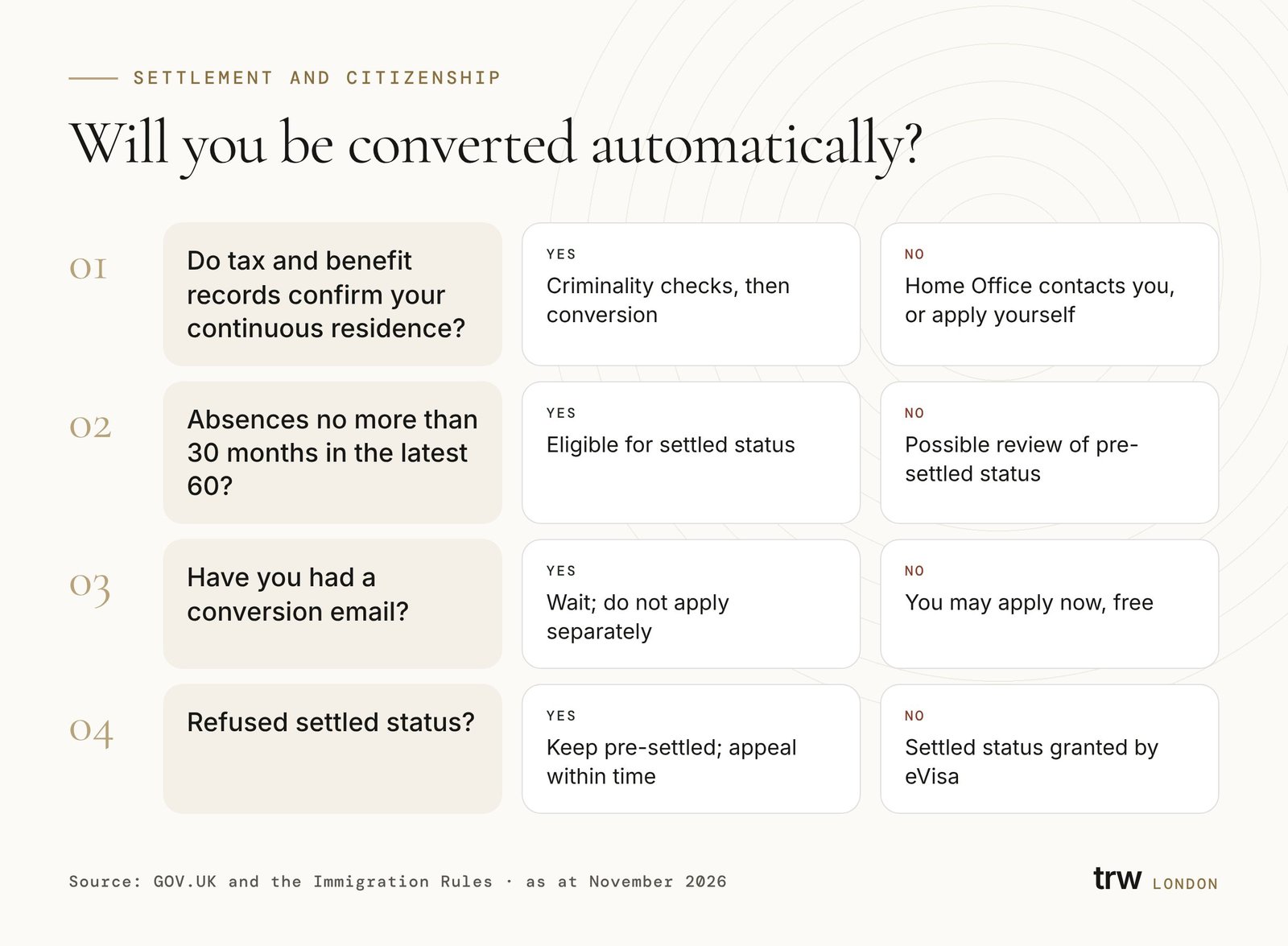
Where the data does not confirm eligibility, the Home Office contacts the person to explain what to do. Separately, it uses travel data to identify holders who appear to have been absent for more than 30 months in the most recent 60, prioritising those with the longest absences, and refers them to a caseworker to consider whether cancelling or curtailing pre-settled status would be appropriate.
Automatic conversion is better seen as a safety net rather than a plan. It works well for people with a steady PAYE employment record and a stable address. It is less reliable for the self-employed with irregular filings, people who were students, carers or not working, and anyone whose time in the UK is not reflected in HMRC or DWP records.
GOV.UK says not to apply for settled status if you have already had an email confirming you are being considered for automatic conversion. If a manual application is made, the caseworker guidance says the automated consideration is concluded first; if it results in settled status, the manual application is treated as void.
Applying for settled status yourself
You can apply for settled status as soon as you are eligible instead of waiting. The application is free and is made online. For many people, applying on their own timetable is sensible: it allows you to choose the evidence and to deal with any gaps on your terms.
- Check your 60-month window. List every trip abroad in the last five years with dates. Confirm that total absences do not exceed 30 months, or that you meet the six-months-in-twelve test with any permitted exceptions.
- Update your UKVI account first. If your passport, identity card or personal details have changed since you got pre-settled status, update your UKVI account. GOV.UK notes you cannot update your identity document in the ID Document Check app.
- Prove your identity. EU, EEA and Swiss citizens use a valid passport or national identity card. Non-EEA family members use a valid passport or a UK-issued biometric residence card that expired no more than five years ago. From 9 December 2026 a biometric residence permit can no longer be used.
- Give evidence of continuous residence. Provide your National Insurance number for the automated check, and be ready to upload documents covering any gaps it reveals.
- Show the family relationship, if relevant. If your pre-settled status was based on being a family member, you need evidence of that relationship and of the family member's status.
- Declare criminal convictions. Applicants aged 18 or over declare convictions in the UK or overseas. Spent convictions, cautions and alternatives to prosecution such as speeding fines need not be declared.
- Keep the confirmation. You will receive a decision letter by email and an eVisa. Any posted documents are usually returned within six to eight weeks.
If you are applying for children as well, their applications can be linked to yours. GOV.UK points out an important limit: a child will not receive the same status as a parent if the child is eligible for settled status and the parent only has pre-settled status. Children can switch from pre-settled to settled status once they reach the required residence or once a parent has been granted settled status.
When pre-settled status can be cancelled instead
The flip side of automatic processing is that the Home Office can identify people who no longer qualify. Paragraph EU4 requires a pre-settled holder to continue to meet the eligibility requirements on which status was granted, or other eligibility requirements. If they do not, the Home Office may cancel or curtail their status, but only where that is proportionate.
For excess absences, the guidance tells caseworkers to consider why the person left, how far the absence exceeds the permitted period and why they did not return sooner. Relevant reasons include illness or medical emergency, caring responsibilities, travel delays, overseas employment and overseas study. The longer the absence, the more substantial the reasons must be.
Long absence does not automatically end pre-settled status, but it shifts the burden: the longer you were away, the stronger the reasons you will need to show.
The guidance's own examples illustrate the range. A person who spent nearly three years abroad caring for a dying parent, with hospital records and a death certificate, kept their pre-settled status. A person abroad for four years at a second home, giving no other reason, had their status cancelled. People who keep their leave after a proportionality review are told they still need 30 months' residence in the most recent 60 months before they can convert.
Other grounds for curtailment include serving a sentence of imprisonment, permanent breakdown of the family relationship on which status depends, false or misleading information, and marriages or partnerships of convenience. Each is subject to the same proportionality assessment.
Refusals, appeals and what happens to your status
If your application is refused, you keep your existing limited leave unless it is separately cancelled. You have a right of appeal: regulation 3(1)(d) of the Immigration (Citizens' Rights Appeals) (EU Exit) Regulations 2020 allows an appeal against a decision not to grant indefinite leave where limited leave is granted or held. The appeal goes to the First-tier Tribunal (Immigration and Asylum Chamber).
The grounds of appeal are that the decision breaches rights under the Withdrawal Agreement (or the EEA EFTA or Swiss agreements) or is not in accordance with the residence scheme rules. GOV.UK gives time limits of 14 days from receipt of the decision inside the UK and 28 days outside it, and fees of £82 on the papers or £144 with a hearing, as at November 2026. EUSS administrative review is no longer available.
Our guide to First-tier Tribunal appeals covers preparation and hearings. Where the problem is a Home Office decision that cannot be appealed, judicial review may be the route.
Life after settled status
Settled status is indefinite leave to remain under the EU Settlement Scheme. You can stay as long as you like, and you can spend up to five consecutive years outside the UK, the Channel Islands and the Isle of Man without losing it (four years for Swiss citizens and their family members). That is more generous than the two-year rule for other indefinite leave, which is why some people who already hold ILR choose to apply to the scheme.
Children born in the UK while a parent holds settled status are automatically British citizens. Children born while a parent holds only pre-settled status are not, unless they qualify through the other parent; they are eligible for pre-settled status instead. GOV.UK explains that you can usually apply for British citizenship 12 months after getting settled status; the naturalisation fee is £1,709 plus a £130 ceremony fee as at November 2026.

The government's earned settlement response (CP 1707, 2 November 2026) lists the EU Settlement Scheme among arrangements that sit outside the new settlement framework. This is announced policy, not law, and no implementation date has been published. EUSS settlement remains governed by Appendix EU and the Withdrawal Agreement.
If you plan to naturalise, read our guides to British citizenship and dual citizenship first: the absence limits and good character rules for naturalisation are different from those for settled status.

Pitfalls to avoid
Waiting for automatic conversion without checking your records
If your residence is not visible in tax and benefit data, conversion may not happen. Check your own position against the 30-month test and apply if you are eligible.
Applying after a conversion email
GOV.UK advises against applying once you have been told you are being considered for conversion. A duplicate application will be voided if conversion succeeds.
Ignoring an expired identity document
Out-of-date passport details in your UKVI account can cause problems at the border and delay applications. Update them before you apply or travel.
Relying on a biometric residence permit
From 9 December 2026, HC 584 removes the ability to use a BRP as proof of identity for the EUSS. Non-EEA family members should use a valid passport or a qualifying biometric residence card.
Assuming a refusal ends your status
A refusal does not by itself remove your existing leave. Cancellation is a separate decision that must be proportionate, and both decisions carry appeal rights.
Worked example
Example (hypothetical): M, a Portuguese national, arrived in London in 2019 and was granted pre-settled status in 2020. M spent 14 months in Lisbon in 2022 and 2023 caring for a parent, then returned and has worked for a London employer under PAYE ever since. M's leave was extended automatically in 2025.
Under the old test, the 14-month absence would have exceeded both the six-months-in-twelve rule and the single 12-month important-reason exception. Under the rules as at November 2026, the question is whether M's absences total no more than 30 months in the most recent 60 months. With roughly 14 months away and the rest in the UK, M is well within it, and the PAYE record should support automatic conversion.
If no conversion email arrives, M can apply directly, using the National Insurance number for the automated check and adding evidence for any period the check does not cover. Once settled status is granted, M can consider naturalisation after 12 months.
Related EU Settlement Scheme guides
EU Settlement Scheme advice
Complex applications, cancellations and appeals.
Read the guideSettlementLate EUSS applications
Missed the deadline? The reasonable grounds test.
Read the guideSettlementEUSS family permit
Bringing a family member to join you.
Read the guideStatuseVisas and share codes
Proving your status to employers and landlords.
Read the guideNext steps
Start by listing your absences over the last five years and checking the details in your UKVI account. If your record is straightforward, automatic conversion or a short online application is likely to be all you need. If you have long absences, gaps in tax records, a relationship that has ended or a criminal record, take advice before you apply, because the way the evidence is presented can affect both the application and any later cancellation review.
TRW & Co helps EU, EEA and Swiss citizens and their families with settled status applications, cancellation reviews and appeals. Book a consultation to discuss your position. Further reading: GOV.UK: convert pre-settled to settled status, what settled and pre-settled status mean, the EUSS caseworker guidance and the HC 584 explanatory memorandum.
Frequently asked questions
01Do I need to do anything when my pre-settled status is about to expire?
GOV.UK says it will be extended by five years before it expires and you will receive an email. The Home Office can cancel the extension if it believes you no longer meet the requirements.
02Does the 30-month rule apply if I already applied under the old rules?
The rule applies to decisions made under Appendix EU as it now stands, assessed at the date of application or the date the Home Office considers automatic conversion. If you were refused under the old test and your position has changed, take advice on a fresh application.
03Is settled status the same as indefinite leave to remain?
Yes. Settled status is indefinite leave to enter or remain granted under Appendix EU. It is lost after more than five consecutive years outside the UK and Islands (four for Swiss citizens and their family members).
04Can my employer rely on my pre-settled status while I wait?
Yes. Pre-settled status gives the right to work. Employers check it through the Home Office online service using a share code. See our eVisa and share code guide.
05I am self-employed. Will automatic conversion work for me?
It may, if your Self Assessment records show continuous activity. If they do not, the Home Office may contact you, or you can apply and provide documents such as invoices, bank statements and tax returns covering any gaps.
06Can I apply for British citizenship with pre-settled status?
No. GOV.UK says you can usually apply 12 months after you get settled status. Naturalisation has its own residence, absence and good character requirements.
07What happens to my children's status when I get settled status?
Children with pre-settled status can apply to switch once they have five years' continuous residence or once you have been granted settled status. Children born in the UK after you get settled status are British automatically.
Sources and official materials
- Apply to the EU Settlement Scheme (GOV.UK) — Official guide, including conversion and absences
- Immigration Rules: Appendix EU — Paragraphs EU2, EU3 and EU4 and the continuous qualifying period
- EU Settlement Scheme caseworker guidance — Validity, automated conversion and cancellation guidance
- Explanatory memorandum to HC 1333 — Clarifies the 30-months-in-60 rule introduced by HC 836
- Explanatory memorandum to HC 584 — Proportionality, Ayoola children, BRP removal, EUSS AR deletion
- Immigration (Citizens' Rights Appeals) (EU Exit) Regulations 2020, reg. 3 — Right of appeal against EUSS decisions
- Appeal against a visa or immigration decision — Tribunal time limits and fees
General information only, current as at 19 November 2026. It is not legal advice and does not create a solicitor–client relationship. It reflects the law of England and Wales unless stated otherwise; Scotland and Northern Ireland have separate legal systems, and the law changes frequently. Check current official sources and take advice on the facts of your matter.