TRW & Co · Settlement and citizenship
Dual citizenship in the UK

UK law allows you to be British and a citizen of other countries at once, with no application needed. Whether you keep another nationality depends on that country's law. British dual citizens must enter the UK on a British or Irish passport or a certificate of entitlement, and cannot get an ETA.
Key pointUK law rarely causes the dual nationality problem; the other country's law and the UK border rules for British citizens are what need planning.
At a glance
UK position
Dual nationality is allowed; no application is needed.
Travel
Enter on a British or Irish passport or certificate of entitlement; no ETA.
Consular help
Not available from the UK in your other country of nationality.
Renunciation
Form RN, £513; lapses if no new nationality within 6 months.
Resumption
A one-off entitlement under section 13 in limited cases.
Swipe or scroll →
Dual citizenship UK: the overview
On dual citizenship, UK law is permissive: you can be a British citizen and a citizen of one or more other countries at the same time, and you do not need to apply for dual nationality or tell the Home Office. Becoming British does not require you to give up another nationality, and acquiring a foreign nationality does not end British citizenship. Whether you keep your other citizenship is a question for the other country's law, not UK law.
Dual nationality does bring practical rules that catch people out, particularly when travelling. As a British dual citizen you must enter the UK on a British or Irish passport or a certificate of entitlement, and you cannot get an electronic travel authorisation. This guide covers the dual citizenship UK position in November 2026, including travel, consular help, children, renouncing citizenship and the risks that only affect people with more than one nationality.
What UK law says about dual nationality
The GOV.UK dual citizenship page states the position simply: dual citizenship is allowed in the UK, you do not need to apply for it, and you can apply for foreign citizenship and keep your British citizenship. The British Nationality Act 1981 contains no provision that removes British citizenship because someone acquires another nationality. British citizenship ends only by a registered declaration of renunciation under section 12, or by a deprivation order under section 40.
The Home Office also recognises dual nationality from the other direction. The Form AN guidance for naturalisation confirms that the UK allows British nationals who hold another nationality to hold a British passport. There is no oath of exclusive allegiance in UK law, and the citizenship oath and pledge do not require you to renounce any other citizenship. For most people becoming British, dual citizenship UK rules are therefore not the obstacle: the other country's rules are.
One point is often misunderstood. The UK does not issue any document that confirms you are a dual citizen. A British passport proves British nationality, and your foreign passport or certificate proves the other. If you need formal confirmation of British nationality without a passport, the Home Office offers a nationality status letter, which the fee table lists at £489 as at November 2026.

The other country's law decides the outcome
Before naturalising, check whether your current country of nationality allows dual nationality. The Form AN guidance warns that some countries do not allow it, so you may lose, or have to give up, your existing nationality when you become British. It also notes that if your other country continues to treat you as its citizen, you may remain subject to its duties when you are there, which can include military service. GOV.UK advises checking with that country's embassy, consulate or high commission in the UK.
The rules vary widely and change over time. Some countries end citizenship automatically when a citizen voluntarily acquires another nationality; others permit dual nationality only with listed countries; others require a declaration or permission in advance. Some treat a married person or a child as having a parent's or spouse's nationality automatically. We do not advise on foreign law, but we do build the foreign-law question into the timing of a UK citizenship application, so that a client does not lose a nationality they intended to keep.
Automatic loss
Some countries end citizenship when you voluntarily take another. Get written confirmation of the position before applying to naturalise.
Permission first
Some countries require permission, or a declaration, to keep their nationality alongside a new one. Apply for it before the UK ceremony.
Duties continue
If the other country still treats you as its citizen, you may owe obligations such as military service when you are there.
Documents matter
Property, inheritance and banking abroad may require proof of local citizenship. Keep that country's passport or ID current.
For one common example, our guide to British Bangladeshi dual nationality explains how one country's nationality law interacts with British citizenship, and the documents that country's offices expect to see.
Travelling to the UK as a dual citizen
Travel is where dual citizenship UK rules have tightened. Since electronic travel authorisations became mandatory for visa-exempt visitors, a dual British citizen cannot simply arrive on a foreign passport. GOV.UK confirms that British and Irish dual citizens cannot get an ETA. The table sets out which documents work.
| Document | Can you use it to enter? | Notes |
|---|---|---|
| Valid British passport | Yes | The standard document for British citizens |
| Valid Irish passport | Yes | For British and Irish dual citizens |
| Certificate of entitlement to the right of abode | Yes | Now issued digitally, linked to your foreign passport through a UKVI account; costs £589 |
| Foreign passport with an ETA | No | British dual citizens cannot obtain an ETA |
| Foreign passport or EEA ID card with EUSS status | Yes, in limited cases | If you became British after settling under the EU Settlement Scheme and your document is linked to your UKVI account |
| Expired UK passport (issued 1989 or later) plus valid ETA-eligible passport | At the carrier's discretion | Personal details on both must match |
| Certificate of naturalisation or registration | No | It proves citizenship but is not a travel document |
A certificate of entitlement suits people who do not want a British passport, for example because their other country restricts holding a foreign passport. It is now a digital record that does not expire, but you must update your UKVI account when your foreign passport changes. You cannot hold a certificate of entitlement and a valid British passport at the same time, and would need to surrender the passport to get one.
When you naturalise, your eVisa and any biometric residence permit can no longer be used to enter the UK as a British citizen. The Form AN guidance says there are no current plans to provide digital evidence of British citizenship. Apply for a British passport or certificate of entitlement before any trip abroad, and allow for processing time.
If you hold a foreign passport, the name and gender on it must match those you want on your British passport. GOV.UK passport guidance says you should change the details on the foreign passport first if they differ. Our page on electronic travel authorisations covers the ETA scheme for non-British family members travelling with you.

Consular help and obligations abroad
Dual nationality limits the help the British government can give you in your other country. GOV.UK states that a dual national cannot get diplomatic help from the British government when in the other country where they hold citizenship. Its example is a British and French citizen in France. In practice, the other state will treat you as its own national, apply its own laws to you, and may not recognise your British citizenship at all.
That matters for family disputes, criminal proceedings, conscription and exit permissions. A dual citizen who travels to their other country on that country's passport is usually treated as a local citizen throughout the stay. Before travelling, check whether you are registered as a citizen there, whether any service obligations apply, and whether you will need that country's documents to leave again. These questions are outside UK law, but they affect how much protection your British nationality gives you.
Holding two passports does not mean having two governments to call on: in your other country, you are usually treated only as its citizen.
Children and dual nationality
Many children are dual nationals from birth without anyone applying for anything. A child born in the UK to a parent who is British or settled is usually British automatically, and may also hold a parent's nationality by descent under that country's law. GOV.UK warns that the Home Office does not hold records of everyone who is British automatically, so it is your responsibility to check before the child travels. Our guide to British citizenship for children born in the UK explains who is British at birth.
Children born abroad to British parents may be British by descent, and some need to be registered. A child who is British by descent cannot usually pass British citizenship to their own children born abroad, which can matter for families who expect to live outside the UK. Where a child has a choice of registration routes, the Form MN1 guidance explains that some routes give citizenship by descent and others give citizenship "otherwise than by descent". See our guide to registering a child as British.
Renouncing British citizenship
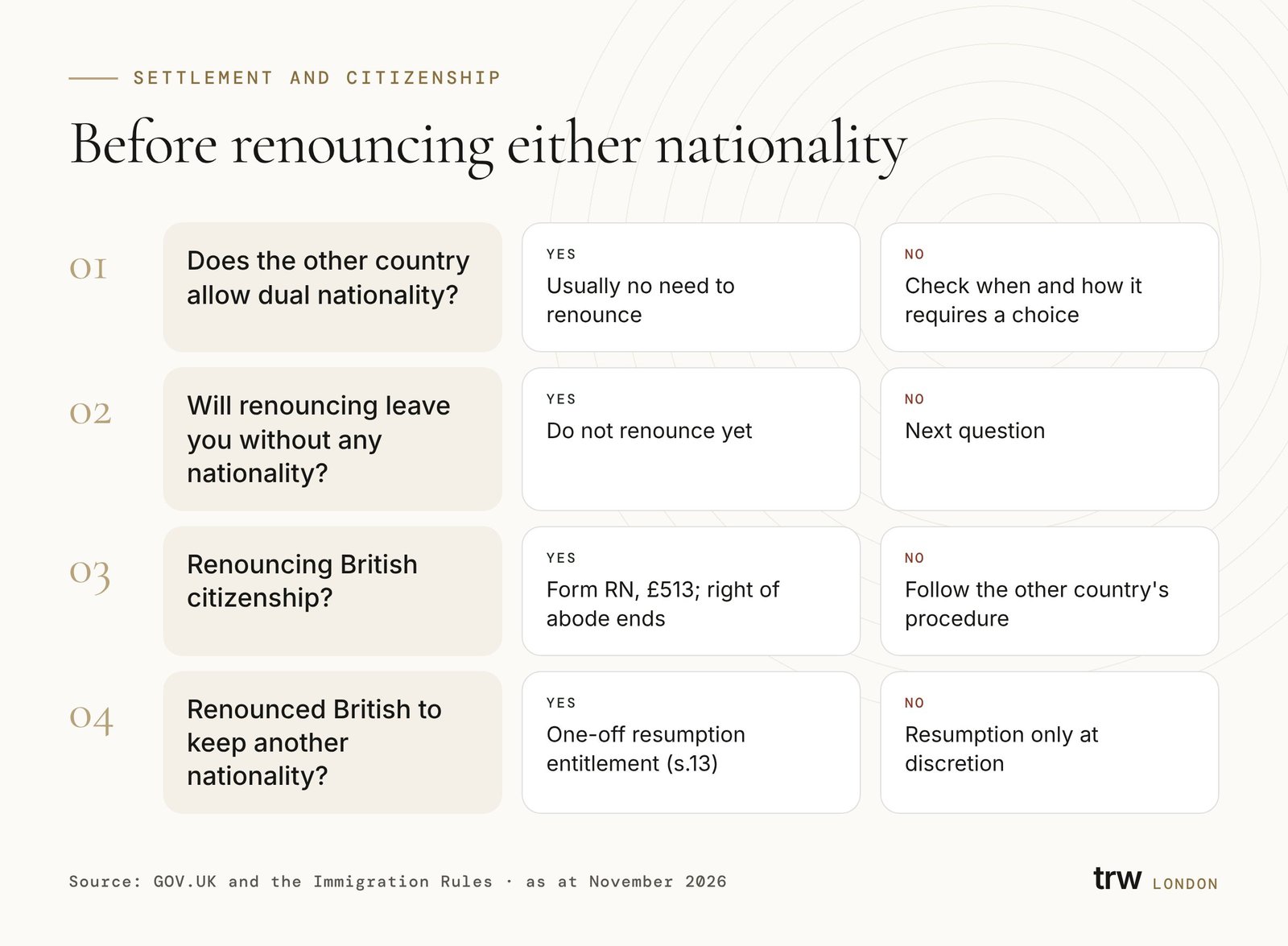
Renouncing citizenship is sometimes necessary where another country will not accept dual nationality. Under section 12 of the 1981 Act, a British citizen of full age and capacity can make a declaration of renunciation, which the Home Office registers. The declaration is made on Form RN online or by post; the fee is £513 as at November 2026. The Form RN guidance (August 2026) sets out who can renounce and what happens afterwards.
- Have, or be about to get, another nationality. You must already hold another citizenship, or satisfy the Home Office that you will acquire one within six months.
- Be aged 18 or over. Anyone under 18 who has been married or in a civil partnership is treated as of full age.
- Make the declaration. Apply on GOV.UK with evidence of your British nationality and your other citizenship, or a statement that you will receive it.
- Receive the declaration. Renunciation takes effect on the date of registration shown on the signed and stamped form.
- Acquire the new nationality within six months. If you do not, the declaration lapses and you are treated as having remained British.
The consequences are significant. A British citizen who renounces loses the right of abode, unless they also have it as a Commonwealth citizen. Any immigration permission you held before becoming British, including indefinite leave to remain, does not revive, because it fell away when you naturalised. If you renounce but want to keep living here, you must apply under the Immigration Rules; the guidance allows a settlement application at the same time, decided after the renunciation. Renouncing affects only you, not other members of your existing family.
Resumption is possible but limited. Section 13 gives an entitlement to register again as a British citizen where the renunciation was necessary to keep or acquire another nationality, but only once. Any other resumption is at the Home Secretary's discretion. Our citizenship team can advise on resumption applications.
Renouncing citizenship of another country
The reverse situation is more common in our practice: renouncing citizenship of another country in order to keep or gain a different one. UK law does not require anyone becoming British to renounce another nationality. If your other country requires you to choose, the timing matters. Renouncing too early can leave you stateless if a UK application is later refused, and stateless people face their own rules and delays.
A sensible sequence is to complete the UK application and ceremony first, and then deal with renouncing citizenship of the other country, unless that country's law makes renunciation a condition that must be met earlier. Where the other country treats naturalisation abroad as automatic loss, there is no choice to make; the planning question becomes whether to naturalise at all. The comparison below sets out the trade-offs.
Keep both nationalities (where allowed)
- Freedom to live and work in both countries
- Access to both consular networks, except in each other's territory
- Possible obligations such as military service abroad
- Exposure to deprivation under section 40(2), discussed below
Renounce one nationality
- May be required by the other country's law
- Loss of the right to live there freely
- Renouncing British citizenship ends the right of abode in the UK
- Section 13 resumption is available only once, and only in limited cases
Deprivation of citizenship and dual citizens
Dual nationality has one legal consequence that single nationals do not face to the same degree. Under section 40(2) of the 1981 Act, the Home Secretary may deprive a person of British citizenship if satisfied that deprivation is conducive to the public good. That power cannot be used where it would make the person stateless, except in the narrow case in section 40(4A) for naturalised citizens. A dual national is not made stateless by losing British citizenship, so that protection does not apply to them.
Separately, section 40(3) allows deprivation where naturalisation or registration was obtained by fraud, false representation or concealment of a material fact, whether or not the person has another nationality. The practical message for applicants is to make complete and accurate disclosure in every nationality application. Our guide to deprivation of citizenship explains how decisions are made and challenged.
A practical checklist for new dual citizens
If you are about to become British while keeping another nationality, or have just done so, these are the steps that avoid most problems. They reflect GOV.UK's dual nationality, passport and right of abode guidance as at November 2026.
- Confirm in writing whether your other country allows you to keep its nationality, and whether permission or a declaration is needed
- Keep your other passport or ID card valid, and make sure names and dates of birth match across documents
- Apply for a British passport or certificate of entitlement before travelling abroad after your ceremony
- Do not book travel on your foreign passport alone: you cannot get an ETA as a British citizen
- If you became British after settled status, keep your UKVI account linked to your current foreign passport or ID card
- Destroy any biometric residence permit after the ceremony, as the current Form AN guidance instructs
- Check your children's status in both countries before they travel
- Keep naturalisation and registration certificates safe; certified copies cost £456 each as at November 2026
Dual citizenship UK questions we are often asked
Do I have to tell the Home Office that I have another nationality?
Not as a separate step. Nationality applications ask about other nationalities, and your passport application may involve your foreign passport, but there is no registration of dual citizenship in UK law.
Can I use my foreign passport to leave the UK?
Exit is governed by the destination country and your carrier. The key UK rule concerns entry: you must return on a British or Irish passport or with a certificate of entitlement, unless you fall within the EU Settlement Scheme exception.
Will becoming British affect my settled status?
Once you are British, you no longer need immigration status. Some people who became British after settling under the EU Settlement Scheme also keep Withdrawal Agreement rights and may enter on their EEA document if it is linked to their UKVI account.
Does the UK limit how many nationalities I can hold?
No. UK law does not limit the number of other nationalities a British citizen may hold. The limits, if any, come from the other countries' laws.
Is renouncing citizenship reversible?
For British citizenship, only partly. Section 13 gives a one-off entitlement to resume where renunciation was needed to keep or obtain another nationality; otherwise resumption is discretionary. Other countries apply their own rules.

Naturalisation
Residence, English and Life in the UK requirements for becoming British.
Read the guideCitizenshipCitizenship ceremony
The oath, pledge and what to do after the ceremony.
Read the guideTraveleVisas and share codes
How digital status works until you become British.
Read the guideNext steps
Dual nationality is usually straightforward under UK law, but the interaction with another country's law, travel plans and family circumstances can make timing important. We usually start by mapping where a client holds or could hold citizenship, which documents they need in each country, and whether any step, such as renouncing citizenship, would be hard to undo. Our British citizenship solicitors then handle the UK side, from naturalisation to resumption.
For advice on dual citizenship UK questions, renunciation or resumption, book a consultation. Bring your current passports, any naturalisation or registration certificates and details of the other country's requirements you have already received.
Frequently asked questions
01Can I lose British citizenship by taking another nationality?
Not under UK law. British citizenship ends only by registered renunciation or a deprivation order. The other country may, however, require you to give up British citizenship to become its citizen.
02How much does a certificate of entitlement cost?
It costs £589 as at November 2026, whether applied for in or outside the UK. It is now issued digitally and does not expire, but must be kept linked to your current foreign passport.
03Can my British passport and foreign passport have different names?
GOV.UK says the name and gender on your foreign passport must match those you want on your British passport. Update the foreign passport first if they differ.
04I am British and Irish. Do I need an ETA?
No. British and Irish citizens do not need, and cannot get, an ETA. Travel on either passport.
05Does renouncing British citizenship affect my children?
A declaration of renunciation affects only the person making it and not the current status of other family members. It could affect children born to you afterwards, because their status depends on yours at their birth.
06Can I renounce British citizenship if I would become stateless?
No. Section 12 allows registration only where you have or will acquire another nationality, and the declaration lapses if you do not acquire one within six months.
Sources and official materials
- GOV.UK: Dual citizenship — UK position and travel rules
- GOV.UK: Give up (renounce) British citizenship — How to renounce and resume
- Form RN: guidance (August 2026) — Consequences of renunciation
- British Nationality Act 1981, sections 12 and 13 — Renunciation and resumption
- British Nationality Act 1981, section 40 — Deprivation of citizenship
- GOV.UK: Prove you have right of abode — Certificate of entitlement
- GOV.UK: When you do not need an ETA — ETA rules for dual citizens
- Home Office immigration and nationality fees, 8 October 2026 — Renunciation and certificate fees
General information only, current as at 19 November 2026. It is not legal advice and does not create a solicitor–client relationship. It reflects the law of England and Wales unless stated otherwise; Scotland and Northern Ireland have separate legal systems, and the law changes frequently. Check current official sources and take advice on the facts of your matter.