TRW & Co · Settlement and citizenship
How to register a child as a British citizen

Children under 18 who are not British automatically can often be registered on form MN1, by entitlement or at the Home Secretary's discretion. The fee is £1,000 per child as at November 2026, with a fee waiver for families who cannot afford it. A child under 18 becomes British on the day the application is approved.
Key pointCheck the parents' status on the child's date of birth first: it tells you whether the child is already British and, if not, which section of the 1981 Act applies.
At a glance
Form
MN1 online for most children; form T for section 1(4) cases.
Fee
£1,000 per child; £130 more if they turn 18 during the application.
Timing
Usually 6 months; priority service about 30 working days for £500.
Character
Good character applies from age 10.
Result
British on the approval date if under 18; no ceremony needed.
Swipe or scroll →
How to register a child as British: the short answer
You can register a child as British if they are under 18 and qualify under the British Nationality Act 1981, either by entitlement or at the Home Secretary's discretion. The usual application is form MN1, made online, for a fee of £1,000 per child as at November 2026. A decision normally takes up to six months.
The most common cases are a child born in the UK before a parent settled or became British, a child born abroad to a parent who is British by descent, and a child living in the UK whose parents are naturalising. Before applying, check that the child is not already British automatically: many are, and registration is then unnecessary.
Check first: is the child already British?
Under section 1(1) of the British Nationality Act 1981, a child born in the UK on or after 1 January 1983 is British automatically if, at the time of the birth, a parent was a British citizen or "settled" in the UK. Settled means free of immigration time limits: indefinite leave to remain, settled status under the EU Settlement Scheme, permanent residence status or the right of abode. A child born in the UK to a parent serving in the UK armed forces is also British automatically.
For children born before 1 July 2006, citizenship did not pass automatically through a British father who was not married to the mother, although registration under section 4G may now be possible; for later births, it passes through either parent, unless the mother was married to someone else. The MN1 guidance (August 2026) also sets out detailed rules for children of EEA nationals, which turn on the parent's status on the date of birth.
If the child is already British, apply for a passport, or ask for a letter confirming status. Registering a child who is already a citizen wastes the fee: the guidance asks applicants to include only children who are not already British.

Entitlement or discretion
The MN1 guidance divides child registration into two kinds of route, and the first task is to work out which one lets you register a child as British. The difference affects how strong the application is and how much evidence it needs.
Entitlement
- The child has a legal right to be registered if the statutory conditions are met
- Includes section 1(3), 1(3A), 3(2), 3(5) and 4D
- Good character still applies from age 10
- Evidence focuses on dates, parentage and residence
Discretion (section 3(1))
- The Home Secretary may register any child under 18
- Published criteria indicate when registration is normally granted
- Outside the criteria, the child's circumstances must be compelling
- Evidence covers the child's connection with the UK, future and best interests
A parent who is applying for citizenship at the same time as their child should note one detail in the guidance. If the parent's application is refused and the relevant section of the child's form was not completed, the child's application is treated as withdrawn, with no refund. The form lets you confirm that the child should still be registered if they qualify on their own.
Children born in the UK
Section 1(3): a parent settles or becomes British after the birth
A child born in the UK when neither parent was British or settled is entitled to registration under section 1(3) if, while the child is under 18, a parent becomes a British citizen or settled. GOV.UK's guidance for children born in the UK lists the qualifying statuses: British citizenship, indefinite leave to remain, settled status under the EUSS, indefinite leave to enter and permanent residence status. The parent must also have considered the UK their home.
This is the most common basis for child registration in London families, and the simplest MN1 case. A typical case is a child born while a parent held a Skilled Worker visa, where the parent later obtained ILR. The child can be registered as soon as the parent is settled; there is no further residence requirement for the child. Section 1(3A) gives a similar entitlement where a parent joins the UK armed forces after a birth on or after 13 January 2010.
Section 1(4): the first 10 years of life in the UK
A child born in the UK who has lived here for the first 10 years of their life has a separate entitlement under section 1(4), using form T rather than MN1. GOV.UK says the child must not have spent more than 90 days outside the UK in each of those 10 years, with an explanation on the form if there were special reasons. The entitlement continues into adulthood, but the fee rises from £1,000 to £1,540 plus a £130 ceremony fee for applicants aged 18 or over. Our guide to British citizenship for children born in the UK covers this route in detail.
Children born abroad to British parents
British citizenship passes automatically to one generation born abroad. A child born abroad to a parent who is British "otherwise than by descent" (for example, born or naturalised in the UK) is British by descent from birth. A child born abroad to a parent who is British by descent has no automatic claim, but may be registered under section 3 of the 1981 Act.
| Section 3(2) | Section 3(5) | |
|---|---|---|
| Who must have lived in the UK | The British-by-descent parent | The child and both parents (one parent if the marriage or civil partnership has ended or they are legally separated) |
| When | Any continuous 3-year period before the child's birth | The 3 years ending with the date the application is received, present in the UK at the start |
| Absence limit | No more than 270 days in the 3 years | No more than 270 days; no discretion to disregard more |
| Extra condition | A grandparent was British otherwise than by descent on 1 January 1983 or at the parent's birth | Both parents consent (surviving parent only, if one has died) |
| Result | Child is British by descent and cannot pass citizenship automatically to children born abroad | Child is British otherwise than by descent and can pass it on |
The difference in result is important for the next generation. The guidance suggests that families living abroad who may return to the UK before the child turns 15 consider whether to wait and apply under section 3(5) rather than section 3(2), and asks applicants to confirm on the form that they understand the choice. The 3-year parental residence requirement under section 3(2) does not apply if the child is stateless.

Registration at the Home Secretary's discretion
Section 3(1) allows the Home Secretary to register any child under 18, and discretionary child registration is often the only option for families whose circumstances fit no entitlement. The MN1 guidance sets out situations in which registration is "normally" granted. Each also requires the consent of both parents (unless there are good reasons) and no reason to refuse on character grounds.
Applying in line with parents
One parent is British or about to become British, the other (if involved) is British or settled, and the child is settled and has lived in the UK for the last 2 years (a shorter period may be accepted under age 2).
Settlement and residence
The child has more than 5 years' lawful residence and has held settled status for at least 12 months, and the parents have 5 years' residence and are settled.
More than 10 years in the UK
The child and parents are in the UK lawfully and the child has lived here for more than 10 years.
Adopted abroad
At least one adoptive parent is British otherwise than by descent, the adoption complied with all relevant laws and was not one of convenience.
Outside these categories, caseworkers consider the child's connections with the UK, where their future is likely to lie, the parents' views and immigration status, the length of residence (normally at least 2 years, particularly for children over 13), good character and any compelling circumstances. The guidance is careful to say that meeting some criteria does not guarantee registration if others are not met.
A discretionary MN1 application should therefore explain why registration is right for this child, not merely list documents. School reports, letters from professionals who know the child, and evidence of the family's settled life in the UK help show where the child's future lies.
In discretionary child registration, the application is an argument about the child's future, not just a set of documents.
Good character for children aged 10 and over
The 1981 Act requires good character for child registration applicants aged 10 or over. The MN1 guidance asks for details of any convictions, cautions, warnings or reprimands, civil penalties and outstanding charges. If the child has been charged and is awaiting trial or sentence, the guidance advises waiting for the outcome before applying, and parents must tell the Home Office if the child is arrested or charged while the application is pending.
Immigration history is also relevant. Under the good character guidance, an application will normally be refused where the person entered the UK illegally, however long ago, or arrived without a required entry clearance or ETA after a dangerous journey. For children, the guidance says breaches outside the child's control will normally be overlooked, taking account of the child's age at the time, and mitigating factors such as a positive decision through the National Referral Mechanism can be explained in the application.
Fees, timing and the MN1 application
The Home Office fee table of 8 April 2026 reduced the child registration fee from £1,214 to £1,000. GOV.UK says a fee waiver may be available if the child is under 18 and cannot afford the fee; the request is made online before the main application.
Since 20 July 2026, applications made online from within the UK can use the citizenship priority service for £500, with a decision usually within 30 working days. There is no super priority service for citizenship applications, and paper applications cannot use the priority service. Check current fees before applying.
Two changes in 2026 make child registration cheaper and potentially quicker: the MN1 fee fell from £1,214 to £1,000 on 8 April 2026, and the citizenship priority service opened to online applications from within the UK on 20 July 2026. The MN1 guidance was last updated in August 2026.
The MN1 application, step by step
- Identify the section. The guidance asks you to state which section of the 1981 Act you rely on. It helps the caseworker and keeps your evidence focused.
- Gather the evidence. The child's full birth certificate and passports, the parents' status documents (for example a parent's ILR or naturalisation certificate), the parents' marriage or civil partnership certificate, and residence evidence where the section requires it.
- Obtain consents. Where both parents must consent, get signed consent, or a letter explaining why one parent does not agree. A guardian applying must show their authority, such as a court order.
- Arrange two referees. One must be a professional person; the other must hold a British passport and be a professional or over 25. Each must have known you for 3 years and be unrelated. For child applicants, at least one should know the child professionally, such as a teacher, doctor or health visitor.
- Apply online and pay. Complete the MN1 form online (a paper form is available for postal applications), pay the fee and choose priority if wanted.
- Enrol biometrics. Children under 5 give a photograph only; children under 16 must attend with a parent or legal guardian.
After registration
When you register a child as British and they are still under 18 when the application is decided, they become British on the date it is approved. Such children do not need to attend a citizenship ceremony, although the family may be invited to one as a celebration. A child who has turned 18 by the decision date must attend a ceremony and take the oath and pledge, which is the point at which they become British.
There is no digital proof of British citizenship. The child cannot enter the UK on the registration certificate, and once British cannot use their old immigration status to enter either, so apply for a British passport or a certificate of entitlement before any travel. The child's other nationality is a separate question: the UK permits dual citizenship, but the guidance warns that some countries remove nationality when a citizen acquires another. Check with the other country first; our dual citizenship guide explains the UK side.

Worked example
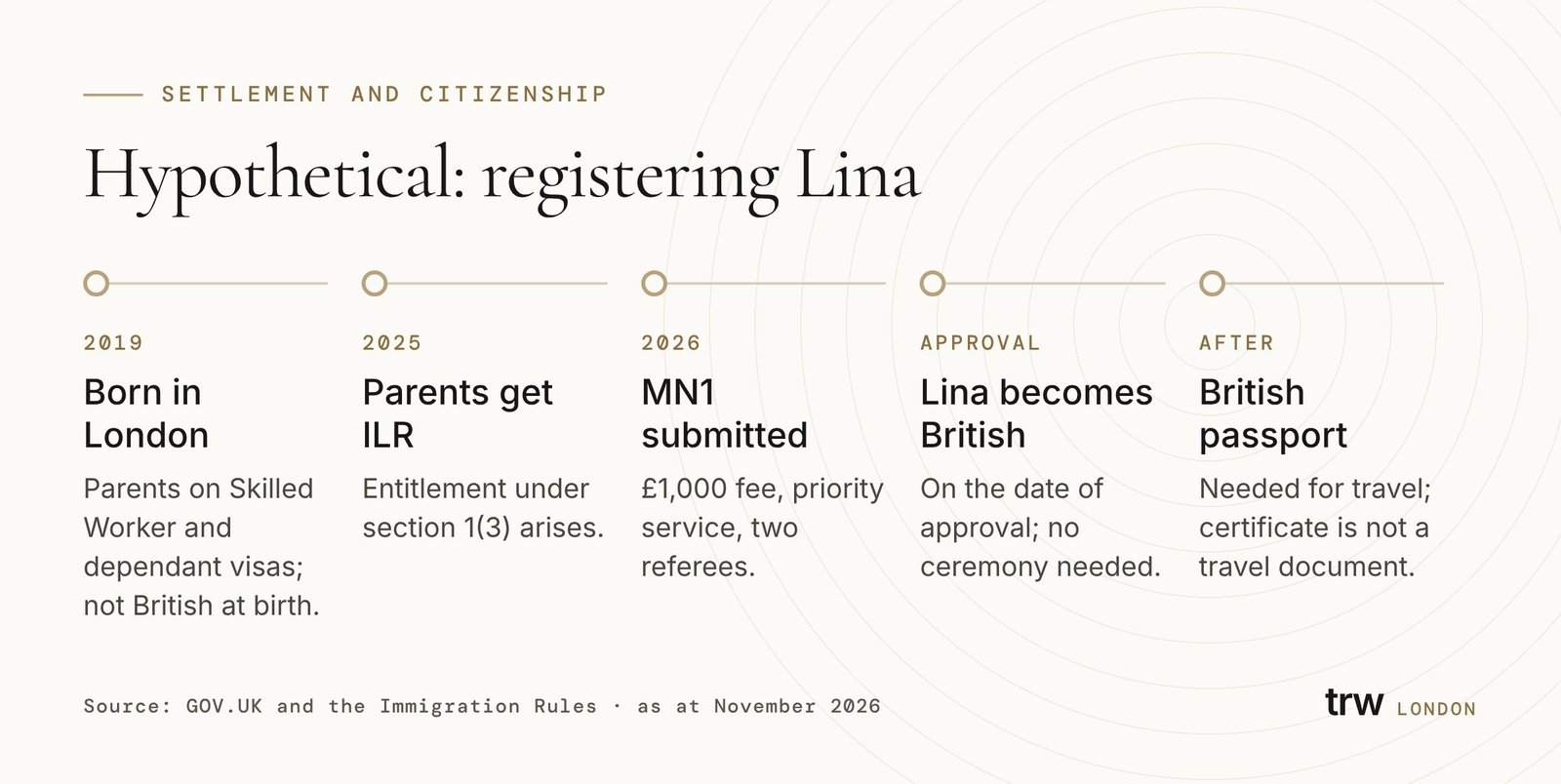
Example (hypothetical): Lina was born in London in 2019 while her mother held a Skilled Worker visa and her father was her mother's dependant. Neither parent was settled, so Lina was not British at birth. In 2025 both parents were granted ILR. In 2026 they apply to register Lina under section 1(3).
Lina's entitlement arose when her mother became settled; she needs no separate period of residence. She is under 10, so good character checks do not apply to her. The parents complete form MN1 online, rely on section 1(3), upload her birth certificate, passport and their ILR evidence, and nominate two referees, one of whom is her primary school teacher. They pay £1,000 and choose the priority service. On approval, Lina becomes British that day and the family applies for her first British passport.
Pitfalls
Waiting until the child is nearly 18
MN1 is only for children under 18 on the date the Home Office receives the application. A child who turns 18 before applying must use an adult route, if one is available, at a higher fee.
Applying under section 3(2) without considering 3(5)
Section 3(2) produces citizenship by descent, which cannot pass automatically to the child's own children born abroad. If the family can complete three years in the UK, section 3(5) gives a stronger status.
Exceeding 270 days' absence under section 3(5)
The guidance says there is no discretion to disregard absences over 270 days in the 3-year period. A family holiday that pushes the total over the limit means waiting for a later 3-year window.
Missing consent from the other parent
Several routes require both parents' consent unless there are good reasons. Where parents are separated or one is uninvolved, explain the position with evidence rather than leaving the section blank.
Assuming EUSS pre-settled status is enough
Pre-settled status is not settled status. For section 1(3), the parent needs settled status or another qualifying status, so the child's entitlement usually arises only when the parent upgrades. See our guide to moving from pre-settled to settled status.
Next steps
If you want to register a child as British, start by confirming the section that applies and whether the child might already be a citizen. We usually check the parents' status history on the child's date of birth first, because that answers both questions.
For the wider family picture, see our British citizenship solicitors page and our guide to the good character requirement. If a parent is not yet settled, our indefinite leave to remain solicitors can help with that step first. To discuss your child's case, book a consultation.
Frequently asked questions
01My child was born in the UK after I got ILR. Do I need to register them?
Usually not. A child born in the UK on or after 1 January 1983 when a parent was settled is British automatically. You can apply for a British passport for them directly.
02Can I register my child while my own naturalisation application is pending?
Yes. Children can apply alongside parents. Complete the section of MN1 that confirms the child should still be registered if your own application is refused, otherwise the child's application is treated as withdrawn.
03Does my child need to take the Life in the UK test or prove English?
No. Those requirements apply to adult naturalisation, not to child registration on form MN1.
04Will registration affect my child's other nationality?
UK law allows dual nationality, but some countries remove their nationality when a citizen acquires another. The MN1 guidance advises checking with the other country before applying.
05Can a child with pre-settled status be registered?
Not usually by entitlement under section 1(3), which depends on a parent being settled. A discretionary application may be possible in some cases, but the published criteria generally expect the child to be settled.
06What if the application is refused?
There is no statutory appeal against a refusal of registration. Options include asking for reconsideration, applying again with better evidence, or in some cases judicial review. Take advice on the reasons given.
Sources and official materials
- Form MN1: guidance (August 2026) — Sections, discretion criteria, referees, character and documents
- Register child under 18 as British citizen (form MN1) — How to apply and processing times
- GOV.UK: Apply for citizenship if you were born in the UK — Sections 1(3) and 1(4), fees and fee waiver
- British Nationality Act 1981, section 1 — Acquisition by birth and registration of UK-born children
- British Nationality Act 1981, section 3 — Registration of minors
- GOV.UK: Get a faster decision — Citizenship priority service
- Good character caseworker guidance — Illegal entry and immigration breaches
- Home Office fees, 8 April 2026 — Child registration fee reduced to £1,000
General information only, current as at 19 November 2026. It is not legal advice and does not create a solicitor–client relationship. It reflects the law of England and Wales unless stated otherwise; Scotland and Northern Ireland have separate legal systems, and the law changes frequently. Check current official sources and take advice on the facts of your matter.