TRW & Co · Settlement and citizenship
Long residence indefinite leave to remain after 10 years

You can apply for indefinite leave to remain after 10 years of continuous lawful residence in the UK, combining time on most visas. Gaps between visas, absences over the limits and time as a visitor do not count. The route is open as at November 2026 but the government has announced it will close.
Key pointA gap between visas that is excused still adds days to your 10 years, and since April 2024 most applicants also need 12 months on their current visa.
At a glance
Qualifying period
10 years lawful residence under LR 11.1, combining most routes.
Absences
180 days in any 12 months; older absences use the 184 and 548-day limits.
English
B1 now; B2 for applications on or after 26 March 2027.
Fee
£3,226 for ILR; £1,407 for 24 months' permission (as at Nov 2026).
Future
Announced to close under earned settlement; no date set.
Swipe or scroll →
Long residence indefinite leave to remain: the short answer
Long residence indefinite leave to remain is settlement for people who have spent 10 years lawfully and continuously in the UK, usually on a mix of visas that would not each lead to settlement on their own. A student who became a graduate and then a sponsored worker, or a dependant who later took a visa in their own right, can often combine that time on the Long Residence route.
As at November 2026 the Long Residence route is open and governed by Appendix Long Residence of the Immigration Rules, with absences tested under Appendix Continuous Residence. The Home Office has announced that the Long Residence route will close under its earned settlement reforms, but no rule change or date has been published. Anyone approaching 10 years should treat the current window as worth using.
The legal basis for long residence settlement
Appendix Long Residence has two parts. Paragraphs LR 1 to LR 8 deal with permission to stay for people who have 10 years lawful residence but cannot yet meet the English or Life in the UK requirements. Paragraphs LR 9 to LR 15 deal with settlement itself. Both parts depend on the same core test in LR 3.1 and LR 11.1: a qualifying period of 10 years spent lawfully in the UK.
Continuity is tested separately. LR 12.1 requires the applicant to meet the continuous residence requirement in Appendix Continuous Residence for the whole qualifying period. That appendix sets the absence limits, lists the events that break residence, and explains which date the period is counted back from. The Home Office applies both appendices using its continuous residence caseworker guidance (version 10.0, 8 October 2026).
Applicants must also clear Part Suitability, must not be in breach of immigration laws (subject to the exceptions for short overstaying), and must not be on immigration bail when they apply. There is no provision for dependants on the Long Residence route: a partner or child must qualify in their own right or use a different route.
What counts as 10 years lawful residence
LR 11.1 lists four kinds of time that can make up the qualifying period. LR 11.2 and the GOV.UK long residence guide list the time that cannot. The distinction is often less obvious than people expect.
| Counts towards the 10 years | Does not count |
|---|---|
| Permission on most immigration routes, including Student, Graduate, Skilled Worker, family and dependant visas | Permission as a Visitor (with or without a visa), Short-term Student (English language) or Seasonal Worker |
| Time exempt from immigration control | Any Ukraine scheme permission |
| Time before 11pm on 31 December 2020 as an EEA national or family member exercising rights under the 2016 EEA Regulations (and until 30 June 2021 or an EUSS decision) | Time on immigration bail, temporary admission or temporary release |
| Time as a British citizen, unless citizenship was later removed by deprivation | Overstaying between grants, even where the gap is later disregarded |
| Time with leave extended by section 3C while an in-time application, review or appeal is pending | Time in prison, a young offender institution or a secure hospital following a sentence |
Section 3C leave deserves a word on the Long Residence route. The caseworker guidance confirms that time with leave extended by law while an in-time application is decided, or while an administrative review or appeal is pending, counts as time with permission. That is why making every extension application before the current visa expires is so important for anyone heading towards 10 years lawful residence.
Time in the Channel Islands or the Isle of Man can also count towards 10 years lawful residence and be treated as time in the UK if it was lawful on an equivalent route and the most recent grant of permission was in the UK (CR 3.5). Time working offshore beyond UK territorial waters, for example on an oil rig, is treated as an absence.
Gaps between visas and overstaying
Most refusals of long residence indefinite leave that we review turn on a gap, not on travel. Appendix Continuous Residence says residence is broken if the applicant "does not currently have, or did not have, permission", subject to narrow exceptions. The most important exception is where a later application was granted under the Exceptions for overstayers in Part Suitability.
Under SUI 13.1, an applicant is not treated as an overstayer where the application was made within 14 days of permission expiring and there was a good reason beyond their control for the delay, or within 14 days of a refusal of an in-time application (or of the end of any review or appeal). For gaps before 24 November 2016, a 28-day window applied (CR 4.1(d)(iv)).
Even where one of these exceptions stops a gap from breaking continuity, the gap itself does not count towards 10 years lawful residence (CR 4.2 and LR 11.2). A 10-day gap therefore adds 10 days to the date on which you reach 10 years. Counting from your first entry date without deducting gaps is a common reason for an early, refused application.
Leaving the UK and coming back is treated more generously on the Long Residence route than on other routes. For long residence indefinite leave, continuity is not broken if the applicant had permission when they left and returned with valid permission on the same or another route, provided the absence limits are not exceeded (CR 4.1(d)(iii)). Removal under section 10 of the Immigration and Asylum Act 1999, a deportation order, or a custodial sentence breaks residence altogether.
Absences: the 180-day and 548-day rules
Absences are where the old and new Long Residence route rules overlap. For absences that began on or after 11 April 2024, the general rule in CR 3.1 applies: no more than 180 days outside the UK in any 12-month period, assessed on a rolling basis. For absences that began before 11 April 2024, CR 3.3 keeps the former Long Residence limits: no single absence of more than 184 days, and no more than 548 days in total where that total was reached before 11 April 2024.
The caseworker guidance gives a worked illustration of a qualifying period that straddles the change: completed absences before 11 April 2024 are tested against the 184 and 548-day limits, and absences beginning on or after that date are tested on the rolling 180-day basis, with the first rolling period starting at the first new absence. Only whole days count; a part day of less than 24 hours is not an absence.

Some absences do not count towards the limits for long residence indefinite leave at all. CR 3.4 disregards time abroad for compelling and compassionate reasons such as a life-threatening illness or the death of a close family member, travel disruption caused by a natural disaster, military conflict or pandemic, and assistance with a humanitarian or environmental crisis. The applicant must evidence the reason. Our separate guide to ILR absences works through those exceptions and how to document them.
English, Life in the UK and the 12-month current-permission rule
For settlement, LR 13.1 requires English speaking and listening at CEFR level B1 for applications made before 26 March 2027 and at B2 for applications made on or after that date, unless an exemption applies. The B2 change was laid in HC 1691 (explanatory memorandum) and is already part of the Rules. GOV.UK explains the accepted evidence on its English language page.
Applicants aged 18 to 65 must also pass the Life in the UK test (fee £50, pass mark 75%), unless exempt. Our Life in the UK test guide covers booking and exemptions.
A newer requirement on the Long Residence route catches people out. LR 11.3 says the applicant must have held permission on their current route for at least 12 months on the date of application. LR 11.4 disapplies that requirement if the current permission was granted before 11 April 2024. Someone who switched route in, say, mid-2026 may therefore need to wait until they have held the new permission for a year, even if they already have 10 years in total.
Ten years in total is not enough on its own: since April 2024 most applicants also need a year on their current visa.
If you are not ready: the 24-month permission to stay
The Long Residence route has a built-in fallback. A person who meets the suitability, qualifying period and continuous residence requirements, but not the English or Life in the UK requirement, can apply for permission to stay on the Long Residence route. LR 7.1 grants it for 24 months, with permission to work and study and no access to public funds. The GOV.UK fee is £1,407, plus the Immigration Health Surcharge, currently £1,035 a year for adults.
That permission can then be followed by a settlement application once the missing requirement is met. Because B2 English will apply to settlement applications made from 26 March 2027, some applicants who choose the 24-month option will need to plan for a higher English level than they would have needed if they had applied for settlement straight away.
How to apply for long residence indefinite leave, step by step
- Reconstruct your 10 years lawful residence. List every grant of permission with start and end dates, using passports, decision letters and your UKVI account. Deduct any gap between grants.
- Calculate absences. List every trip abroad from travel records. Test pre-11 April 2024 absences against the 184 and 548-day limits and later absences against the rolling 180-day rule.
- Choose the counting date. Under CR 1.1 the 10 years can end on the day you apply, on the decision date, or on any day in the 28 days after applying, whichever helps you most.
- Check the current route and suitability. Confirm you have held current permission for 12 months (unless granted before 11 April 2024) and review any convictions, debts or past refusals.
- Secure English and Life in the UK evidence. Book the test early; if you cannot meet either requirement in time, consider the 24-month permission instead.
- Apply online and enrol biometrics. Use the "Apply to settle in the UK - long residence" form, attend a UKVCAS appointment and upload supporting documents.
- Stay in the UK until the decision. Travelling outside the UK, Ireland, the Channel Islands or the Isle of Man before a decision withdraws the application without a refund.
- Current passport and every passport held during the 10 years
- BRP (even expired) or an eVisa share code
- Decision letters for each grant of permission
- Evidence for any absence you say should be disregarded
- English language and Life in the UK test evidence, or exemption evidence
- Certified translations of documents not in English or Welsh
Costs and timings
As at November 2026 the GOV.UK long residence guide gives an ILR fee of £3,226 per person and £1,407 to extend for 24 months. Settlement decisions are usually made within six months of biometric enrolment; the 24-month permission usually within eight weeks. A super priority service costs £1,000 extra for a settlement decision usually by the end of the next working day after a weekday appointment. Check the current fee table before you apply.
Complex applications for long residence indefinite leave take longer. GOV.UK warns that applications needing document verification, an interview or consideration of a criminal record may be delayed, and the Home Office will contact you if so.
Worked example
Example (hypothetical): Amira arrived in London on a Student visa on 15 September 2016 to start a four-year degree. She extended as a Student for a master’s in 2020, then held a Graduate visa and, from 2022, a Skilled Worker visa with a London employer. She has held permission throughout, apart from one gap.
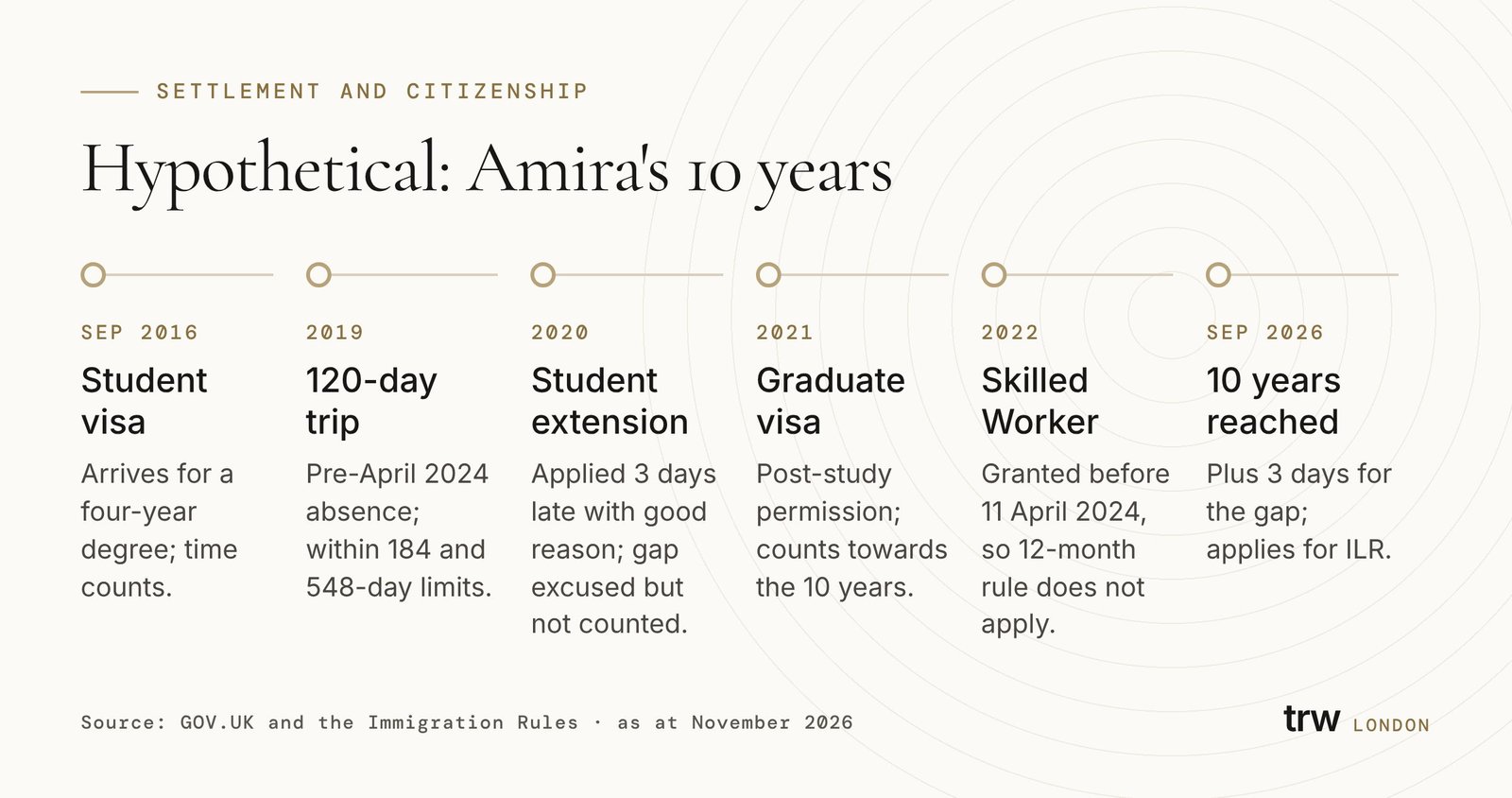
In 2020 Amira applied for her second Student visa three days after her first one expired, because a family bereavement kept her abroad; the application was granted under the 14-day exception. Continuity is preserved, but those three days do not count, so her 10 years end three days after 15 September 2026, not on that date. She spent 120 days abroad in 2019 (tested against the 184 and 548-day limits) and 60 days in 2025 (tested on the rolling 180-day basis). Neither breaks continuity.
Her Skilled Worker permission was granted before 11 April 2024, so the 12-month current-permission rule does not apply. If she applies before 26 March 2027, she needs B1 English, which she proves with an approved test result, and a Life in the UK pass. Applying a few days early would not be fatal, because CR 1.1 allows the period to be counted up to 28 days after the application date, but we would still advise her to wait until her calculated date.
Pitfalls
Counting from the first entry stamp
The qualifying period runs from when lawful residence began, but gaps are deducted and any time between an entry clearance grant and arrival counts as an absence. Counting from the date on your first visa can overstate your time.
Assuming a visitor period counts
Time as a visitor never counts, even if you later switched in the UK. Neither does time on the Ukraine schemes, which matters for people who arrived under those schemes and later moved to work routes.
Forgetting eGates trips
Entry through eGates leaves no passport stamp, but the Home Office can check other records. The caseworker guidance tells staff to query discrepancies, and unexplained omissions can raise a deception concern.
Applying while on immigration bail
LR 10.2 bars settlement while on immigration bail, except where the overstayer exceptions apply. Anyone who has been on bail needs advice before applying.
Including your family on the form
The route has no dependant category. GOV.UK says family members must apply separately if they qualify, or apply as the partner or child of a settled person once you have ILR.
If an application is refused, Long Residence is not among the routes listed in Appendix Administrative Review. LR 15.2 also allows the Home Office to consider the application under Appendix FM or Appendix Private Life instead, which can affect what remedy is available. Our ILR refusal guide explains the options.
The announced closure of the Long Residence route
On 2 November 2026 the government's earned settlement response (CP 1707) stated that "the Long Residence route will close" and that time on temporary routes such as Student, Graduate, Visit, Youth Mobility and Global Business Mobility will no longer count towards settlement. This is announced policy only. No Statement of Changes implementing it had been laid as at November 2026, and no closure date has been published.
The government has said settlement is decided under the rules in force at the date of decision, without general protection for people already in the UK. For someone whose 10 years lawful residence depends on study or graduate time, that makes timing the main risk. We cannot predict the closure date, but we can make sure an application is ready on the first date it can validly be made.
Readers comparing options should also look at our page on earned settlement solicitors and our guide to transitional arrangements.
Related routes and next steps
Long residence indefinite leave is one of several ways to settle. Depending on your history, one of these may be faster or more secure:
ILR for Skilled Workers
Settlement after 5 years on qualifying work routes, with salary and sponsor checks.
Read the guideHuman rightsPrivate life route
For people with long residence that was not all lawful; usually a 10-year path.
Read the guideFamilyPartner of a British or settled person
A 5-year route that may suit people who have married during their stay.
Read the guideSettlementILR absences
How the 180-day rule and its exceptions are applied.
Read the guide
We usually start with a residence audit: a dated chronology of every grant, gap and trip, checked against the Rules, with a clear answer on your earliest application date. To arrange one, book a consultation with our settlement team.
Frequently asked questions
01Can I count time on a dependant visa?
Yes. Permission as a partner or child dependant counts on the Long Residence route, because it is permission on an immigration route that is not excluded. This differs from Skilled Worker settlement, where dependant time does not count towards the main applicant's five years.
02Does the 10 years have to be on one visa?
No. The route exists precisely to allow people to combine different types of permission, as long as each period was lawful and the residence was continuous.
03I was an EU citizen living here before 2021. Does that count?
Time exercising rights under the 2016 EEA Regulations before 11pm on 31 December 2020 can count, and up to 30 June 2021 or a decision on an EUSS application made by then. Many EU citizens will be better served by the EU Settlement Scheme.
04Can I travel while my application is pending?
GOV.UK says you must not travel outside the UK, Ireland, the Channel Islands or the Isle of Man until you get a decision. If you do, the application is withdrawn and the fee is not refunded.
05What happens if I have an appeal pending when I apply?
The Home Office caseworker guidance says a long residence application made by someone with an outstanding appeal must be accepted as a human rights claim and considered within or alongside the appeal. Take advice before applying in that situation.
06Will my ILR lapse if I leave the UK afterwards?
Indefinite leave to remain lapses if you stay outside the UK for more than two years at a time. You would then need a Returning Resident visa to come back as a settled person.
07Can I apply for citizenship straight after?
Usually you must hold ILR for 12 months before applying to naturalise, unless you are married to a British citizen. See our British citizenship solicitors page.
Sources and official materials
- Immigration Rules Appendix Long Residence — Qualifying period, 12-month rule, English and grant period
- Immigration Rules Appendix Continuous Residence — Absence limits and events breaking residence
- GOV.UK: Indefinite leave to remain (long residence) — Fees, timings, documents and what time does not count
- Continuous residence caseworker guidance (v10.0) — How caseworkers calculate absences and 3C leave
- Immigration Rules Part Suitability — Exceptions for overstayers (SUI 13.1)
- HC 1691 explanatory memorandum — B2 English for settlement from 26 March 2027
- A Fairer Pathway to Settlement (CP 1707) — Announced closure of the Long Residence route
General information only, current as at 19 November 2026. It is not legal advice and does not create a solicitor–client relationship. It reflects the law of England and Wales unless stated otherwise; Scotland and Northern Ireland have separate legal systems, and the law changes frequently. Check current official sources and take advice on the facts of your matter.