TRW & Co · Settlement and citizenship
ILR refusal: your options and deadlines
If your indefinite leave to remain application is refused, act within 14 days. Work and many other routes allow administrative review (£80); refusals of human rights claims, common in family cases, can be appealed. Where evidence was missing, a fresh application is often the quicker fix. Your current status depends on whether your visa had expired and on section 3C leave.
Key pointThe route you applied under, not the strength of your complaint, decides whether you get a review or an appeal, so identify the remedy in the letter before anything else.
At a glance
Review
£80, within 14 days in the UK; for routes listed in Appendix AR.
Appeal
Only for refused human rights or protection claims; 14 days in the UK.
Judicial review
Promptly and within 3 months, where no other remedy works.
Fresh application
Full fee again; apply within 14 days of 3C leave ending.
Status
Section 3C leave continues during an in-time review or appeal; it lapses if you travel.
Swipe or scroll →
ILR refusal: the short answer
An ILR refusal is rarely the end of the road, but the clock starts the day the decision arrives. Depending on the route you applied under, you may be able to ask for administrative review within 14 days, appeal to the First-tier Tribunal within 14 days, or make a fresh application, usually within 14 days if your visa has run out. Choosing the wrong remedy, or missing a deadline, can leave you without permission to stay.
This guide explains why indefinite leave to remain applications are refused, how to read the refusal letter, which remedy fits which kind of refusal, and how to protect your immigration status while you challenge it. All deadlines and fees are as at November 2026.
Why ILR applications are refused
Most ILR refusal decisions fall into one of six groups. Knowing which group yours is in usually tells you which remedy is realistic.
Qualifying period
Applying too early, or miscounting time on qualifying routes. GOV.UK warns Skilled Workers that applying more than 28 days before completing five years may lead to refusal, and dependant time does not count towards the main applicant's five years.
Continuous residence
Absences over 180 days in a 12-month period, or a gap between visas that broke continuity. Permitted absences that were claimed but not evidenced are a frequent cause.
Route-specific requirements
For Skilled Workers, a salary below the applicable threshold or going rate, or a sponsor that could not confirm the job continues. For other routes, the specific settlement conditions.
English and Life in the UK
Missing or unacceptable evidence of English, or no Life in the UK pass. From 26 March 2027 many routes require B2 rather than B1 English.
Suitability
Criminal convictions, deception, false representations, unpaid NHS charges of £500 or more, unpaid Home Office litigation costs, or a history of immigration breaches under Part Suitability.
Evidence and process
Documents that did not show what the Rules require, inconsistent information, or a failure to respond to a Home Office request within the time allowed.
A settlement refusal on suitability grounds is the most serious kind. Under Part Suitability, a custodial or suspended sentence of 12 months or more, persistent offending or offending that caused serious harm means mandatory refusal (SUI 5.1), and so does deception in the application (SUI 9.1). Shorter sentences, out-of-court disposals, NHS debt and litigation costs are discretionary grounds, where the Home Office must weigh the circumstances.
Reading the refusal letter
An ILR refusal letter has a structure, and each part matters for the next step. We read it in this order:
- The date of service. Deadlines run from when you receive notice of the decision. Note the date and how it was sent.
- The route and the rule. Identify the appendix and paragraph numbers cited (for example SW, LR or SUI paragraphs). These determine whether administrative review or an appeal is available.
- Each reason, separately. List every ground of refusal. A remedy that answers one reason but not another will not produce a grant.
- The evidence the caseworker relied on. Check what documents the letter says were missing or inadequate, and compare with what you actually submitted.
- The remedy paragraph. The letter states whether you can apply for administrative review or appeal. GOV.UK says you will be told in the decision letter if review is available.
- Any human rights or protection element. If the decision refuses a human rights claim, a right of appeal may arise even though the settlement application itself was routine.
The remedy follows the route, not the seriousness of the mistake: a clear caseworker error on a family settlement case may still need an appeal, not a review.
Which remedy fits your refusal
The table maps the main settlement routes to the usual first remedy after a settlement refusal. Always confirm against the decision letter, which is the authoritative statement of your rights in the individual case.
| Route refused | Usual first remedy | Why |
|---|---|---|
| Skilled Worker, Global Talent, UK Ancestry, Scale-up, T2 Minister of Religion, International Sportsperson, Hong Kong BN(O) | Administrative review | Listed as specified routes in Appendix AR, para AR 1.1 |
| Bereaved Partner, Victim of Domestic Abuse, Statelessness | Administrative review | Also listed in AR 1.1 |
| Settlement Family Life (partner or parent), Private Life | Appeal, if the decision refuses a human rights claim | Section 82(1) NIAA 2002 gives a right of appeal against refusal of a human rights claim |
| Long Residence | Depends on the decision letter | Not listed in AR 1.1; an appeal arises only if a human rights claim was refused, and LR 15.2 allows the application to be considered under family or private life rules |
| Protection-based settlement | Appeal | Refusal of a protection claim or revocation of protection status is appealable under section 82(1) |
| Any route, no review or appeal available | Fresh application or judicial review | Judicial review challenges lawfulness; a fresh application fixes the evidence |
Administrative review
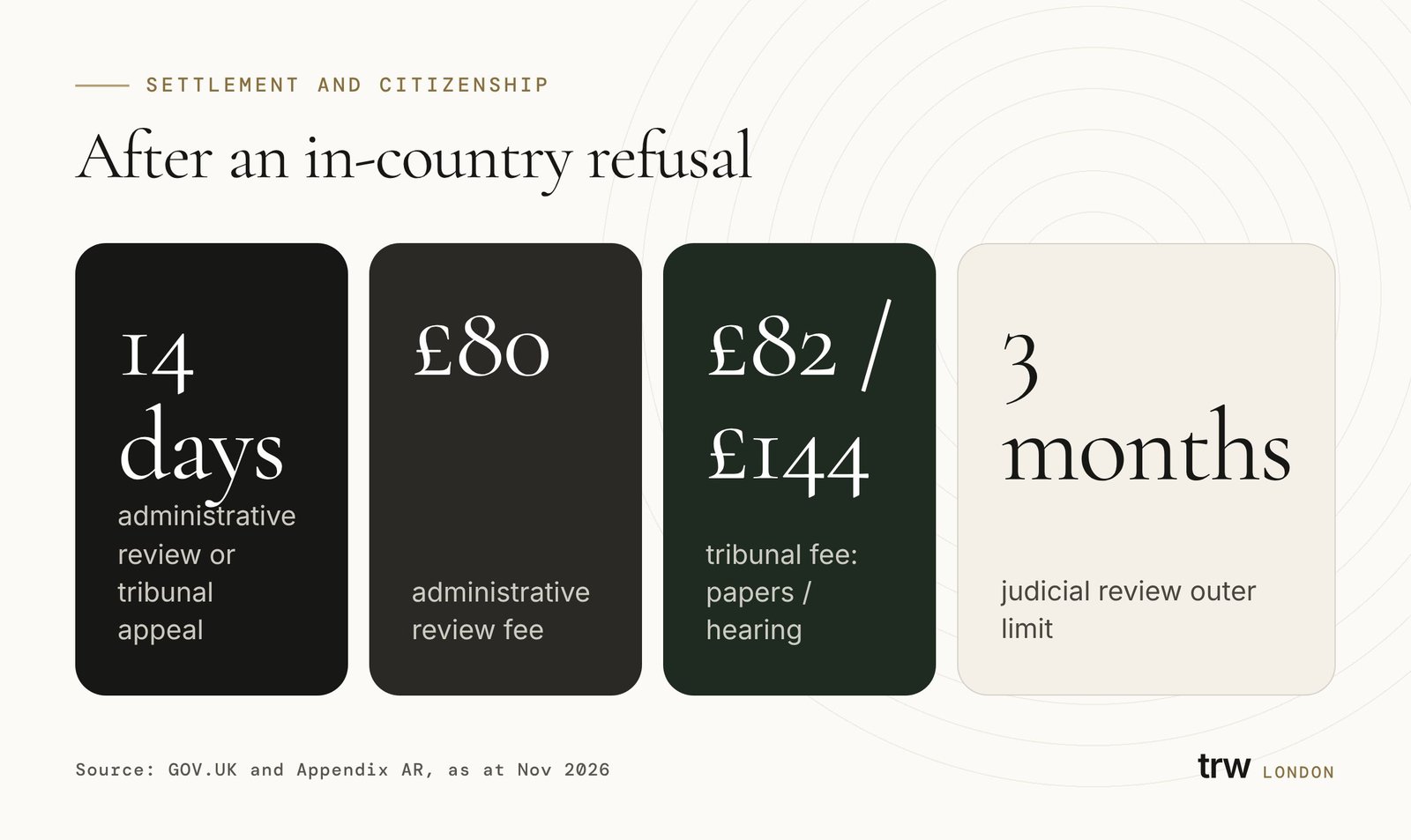
After an ILR refusal on an eligible route, administrative review asks another Home Office official to decide whether the original caseworker made a caseworking error by failing to apply, or wrongly applying, the Immigration Rules or published guidance (Appendix AR, AR 3.1). It costs £80. For an in-country refusal you must apply within 14 calendar days of receiving the decision, or 7 days if you were detained.
Review is not a re-run of the application. Under AR 3.3, new evidence is considered only in limited situations, for example where the refusal was for deception or false representations, or where the caseworker failed to follow the evidential flexibility policy. If your ILR refusal happened because a document was genuinely missing, review rarely helps; if the document was there and the caseworker overlooked it, review is the right tool.
Timing is a practical concern after any ILR refusal. GOV.UK currently warns that administrative review "can take 12 months or more", with an update after six months. While a review is pending for an in-country decision you will not be removed (AR 4.1). The review is treated as withdrawn if you leave the UK, ask for your passport back to travel, or make a new application.
If the review fails, the decision may be maintained for the same reasons, for some of them, or for different or additional reasons (AR 5.1). Where new reasons are given, a second review is possible against those reasons only (AR 2.8). Read the review decision as carefully as the original.
Appeal to the First-tier Tribunal
A statutory appeal exists only where the decision refuses a protection claim, refuses a human rights claim, or revokes protection status (section 82(1) of the Nationality, Immigration and Asylum Act 2002). Many family and private life cases of refused indefinite leave involve a human rights claim, because the application relies on Article 8 family or private life.
From inside the UK the appeal must reach the First-tier Tribunal (Immigration and Asylum Chamber) within 14 days of receiving the decision. The fee, as shown on GOV.UK, is £82 for a decision on the papers or £144 with a hearing, with exemptions for some appellants. Appeals are usually lodged online. The tribunal considers the evidence afresh, so it is the place to put in documents that were missing at the application stage.
Appeal timescales are long and uneven. Our guide to First-tier Tribunal appeals explains preparation, and our immigration appeal solicitors can represent you at the hearing.
Judicial review
Where an ILR refusal carries no appeal, and administrative review is unavailable or has failed, judicial review is the remaining legal challenge. It tests whether the decision was lawful, rational and procedurally fair, not whether you should have been granted ILR. Most immigration judicial reviews are heard by the Upper Tribunal, where rule 28 of the Upper Tribunal Procedure Rules requires the application to be made promptly and in any event within 3 months of the decision.
Judicial review is normally preceded by a pre-action letter giving the Home Office the chance to reconsider, and some cases are resolved at that stage by an agreement to remake the decision. See our judicial review solicitors page for the process and costs risk.
Making a fresh application
For an ILR refusal caused by missing evidence, a fresh application with the right documents is often quicker and more reliable than review. It does, however, mean paying the full fee again: £3,226 per person for most ILR applications as at November 2026, plus any priority fee. GOV.UK states that priority fees are not refunded if an application is refused.
A fresh application after refused indefinite leave has knock-on effects. Under AR 4.4, a pending administrative review is treated as withdrawn the day before a new application is made, and AR 2.16 makes a later review application invalid once a new application has been lodged. Section 3C(4) of the Immigration Act 1971 also restricts new applications while leave is extended by that section. The order of steps therefore needs to be planned, not improvised.
Your status after a settlement refusal
After refused indefinite leave, what happens to your right to stay depends on whether your visa was still valid when the refusal arrived. If it still has time to run, you normally keep that permission until it expires. If it had already expired while the ILR application was pending, your leave was being extended by section 3C of the Immigration Act 1971, provided you applied in time.
Section 3C leave continues while an administrative review could be sought or is pending, and while an in-country appeal could be brought or is pending. It lapses if you leave the UK. When it ends, you have no permission unless you act. Part Suitability (SUI 13.1(b)) means you are not treated as an overstayer if you make a fresh application within 14 days of the refusal, the expiry of 3C leave, the end of the time to seek review or appeal, or the conclusion of the review or appeal.
- Day 0
Decision received
Note the date of service and the remedy offered in the letter.
- Within 7 days
Detained cases
Administrative review deadline if you were detained on the date of decision.
- Within 14 days
Review or appeal
In-country deadline for administrative review (£80) or a First-tier Tribunal appeal (£82 or £144).
- 14 days after 3C ends
Fresh application window
Applying within this window avoids being treated as an overstayer under SUI 13.1(b).
- Within 3 months
Judicial review
Outer limit for an Upper Tribunal claim; it must also be made promptly.
Our guide to section 3C leave covers the detail, including working rights while 3C applies, and the guide on overstaying explains what happens if a deadline is missed.

Avoiding a second ILR refusal
A second ILR refusal is more damaging than the first. It costs another fee, adds months, and the caseworker deciding the next application will see the history of refused indefinite leave. Whatever remedy you choose, we treat the refusal letter as a checklist of what the next decision maker will look for.
In practice that means three things. First, answer every reason in the letter, including the ones that seem minor; a grant needs all of them resolved. Second, front-load the evidence: for absences, the dated chronology and documents for every permitted absence; for salary, payslips and the sponsor letter covering the whole period; for suitability, court records and a frank explanation. Third, check whether anything has changed since the first application, such as a new English requirement after 26 March 2027 or a further trip abroad, so the new settlement refusal risk is not a different one.
Where the refusal involved a dependant, check their position separately. A partner or child who was refused alongside you may have different absence or English issues, and on some routes they can apply later rather than with you.
Worked example
Example (hypothetical): Priya, a Skilled Worker, applied for ILR before her visa expired. She had spent 200 days abroad in one 12-month window, 70 of them caring for her mother during a life-threatening illness, and she uploaded hospital letters explaining this. The refusal letter counted all 200 days and did not mention the letters. By the time it arrived, her visa had expired and she was on section 3C leave.
This is an ILR refusal on a route listed in Appendix AR, and the evidence was before the caseworker. Administrative review is the natural remedy: the caseworker appears to have failed to apply CR 3.4(c) and the published continuous residence guidance. Priya applies within 14 days, keeps her 3C leave while the review is pending, and does not travel. If the review succeeds, the decision is withdrawn and reconsidered. If it fails for a reason she cannot answer, she has 14 days from the end of the review to make a fresh application without being treated as an overstayer.

Pitfalls
Travelling while a review is pending
Leaving the UK withdraws the review (AR 4.3) and ends any section 3C leave. People sometimes travel for a family emergency without realising both consequences.
Sending new documents with an administrative review
Except in the limited cases in AR 3.3, the reviewer will not look at evidence that was not before the original caseworker. New evidence belongs in an appeal or a fresh application.
Assuming a family settlement refusal can be reviewed
Settlement Family Life is not on the AR 1.1 list. If the decision refused a human rights claim the remedy is usually an appeal, and missing the 14-day appeal window cannot be cured by applying for review instead.
Ignoring a deception finding
A refusal under SUI 9.1 for deception can affect future applications. Challenge the finding itself, with evidence, rather than simply reapplying and hoping it is not repeated.
Letting the 14-day fresh-application window pass
Once section 3C leave ends, the overstayer exception in SUI 13.1(b) gives 14 days to apply. After that, any overstaying counts against you and does not count towards residence.
Why timing matters more now
The government has said that, under its earned settlement reforms, "the rules around settlement are determined when a settlement decision is made" (Home Secretary's statement). Those reforms are announced policy, not law, as at November 2026, and no implementation date has been published. Depending on the transitional provisions eventually laid, a challenge that takes a year could mean a decision is remade under different rules.
English is the clearest example of how a settlement refusal can become harder to fix later. Settlement applications on many routes made on or after 26 March 2027 must show B2 English. If a refused application is withdrawn and remade after that date, the higher standard is likely to apply to the new application. We factor this into the choice between review, appeal and a fresh application. See our earned settlement solicitors page for the wider picture.
Next steps after refused indefinite leave
Administrative review
How to frame grounds that identify a caseworking error.
Read the guideRemedyFirst-tier Tribunal appeal
For refusals of human rights and protection claims.
Read the guideHelpVisa refusal solicitors
Our team for refusals across all routes.
Read the guideSettlementILR absences
If your refusal turned on the 180-day rule.
Read the guide
If you have received an ILR refusal or any other settlement refusal, send us the decision letter and your application as soon as possible: the 14-day deadlines leave little room. We usually start by identifying every ground of refusal, the remedy each one allows, and your current status, then recommend one plan. Book an urgent consultation or read more on our indefinite leave to remain solicitors page.
Frequently asked questions
01Can I stay in the UK while I challenge an ILR refusal?
If you applied before your visa expired, section 3C of the Immigration Act 1971 extends your leave while a review could be sought or is pending, and while an in-country appeal could be brought or is pending. If your visa is still valid, you keep it until it expires.
02Will I get my fee back if my settlement application is refused?
GOV.UK says priority and super priority fees are not refunded if the application is refused. Budget on the basis that a fresh application means paying the full application fee again.
03Can I work while my administrative review is pending?
If you had permission to work and your leave is extended under section 3C, the conditions of that leave continue.. See our right to work page.
04How long does administrative review take?
GOV.UK currently says it can take 12 months or more, and that the Home Office will contact you with an update if there is no decision within 6 months.
05Does a refusal stop me applying for ILR again?
Not in itself. A fresh application can be made when you meet the requirements, but any deception finding or immigration breach will be considered again. Explain the earlier refusal and how it has been addressed.
06Should I complain instead of applying for review?
A complaint is not a legal remedy and does not stop deadlines running. Use the remedy in the decision letter first; a complaint can run alongside where service was poor.
07Can my partner and children be included in my review?
Yes, if they were dependants in the application that was refused (AR 2.11).
Sources and official materials
- Immigration Rules Appendix Administrative Review — Eligible routes, time limits, new evidence and effect of review
- GOV.UK: Ask for a visa administrative review — Fee, deadlines and current processing times
- Immigration Rules Part Suitability — Refusal grounds and overstayer exceptions
- Immigration Act 1971, section 3C — Continuation of leave pending decisions, reviews and appeals
- Nationality, Immigration and Asylum Act 2002, section 82 — Rights of appeal
- GOV.UK: Appeal to the immigration and asylum tribunal — Deadlines and tribunal fees
- Tribunal Procedure (Upper Tribunal) Rules 2008, rule 28 — Judicial review time limit
- Home Secretary's earned settlement statement — Settlement rules determined at decision date
General information only, current as at 19 November 2026. It is not legal advice and does not create a solicitor–client relationship. It reflects the law of England and Wales unless stated otherwise; Scotland and Northern Ireland have separate legal systems, and the law changes frequently. Check current official sources and take advice on the facts of your matter.