TRW & Co · Settlement and citizenship
The Life in the UK test

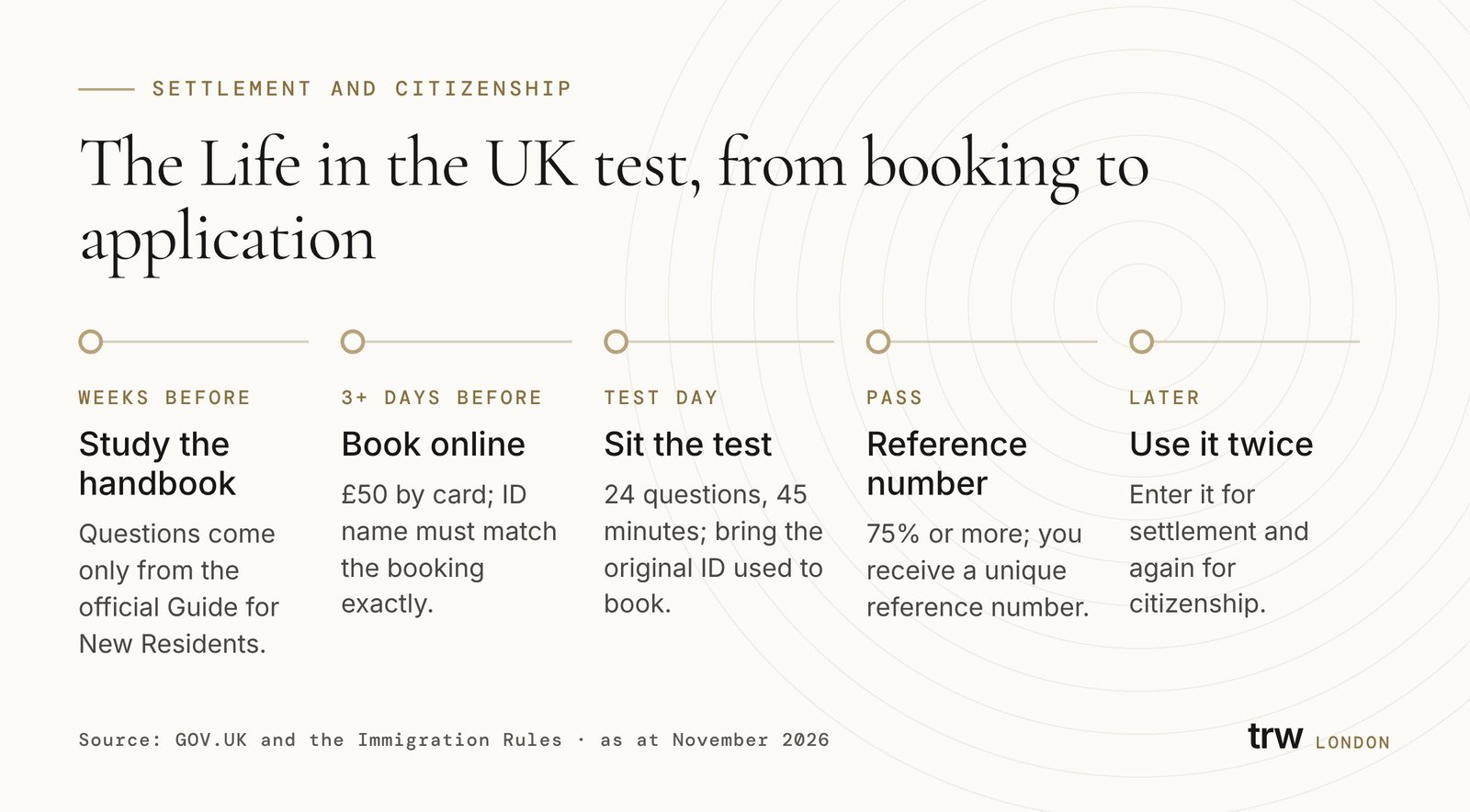
The Life in the UK test is 24 questions in 45 minutes with a 75% pass mark. Most people aged 18 to 64 need it for indefinite leave to remain and for naturalisation. It costs £50, must be booked at least 3 days ahead, and a pass is reused for citizenship.
Key pointQuestions come only from the official handbook, and the ID you book with must be the original you bring on the day; most avoidable failures and lost fees come from those two points.
At a glance
Format
24 multiple-choice questions in 45 minutes; 75% to pass.
Cost
£50 per attempt as at November 2026, refundable only in limited cases.
Who is exempt
Under 18s, people aged 65 or over, and those prevented by a condition.
Legal basis
Appendix KOL UK for most routes; Appendix KoLL for others.
Reform
Retained under earned settlement; content under government review.
Swipe or scroll →
The Life in the UK test in brief
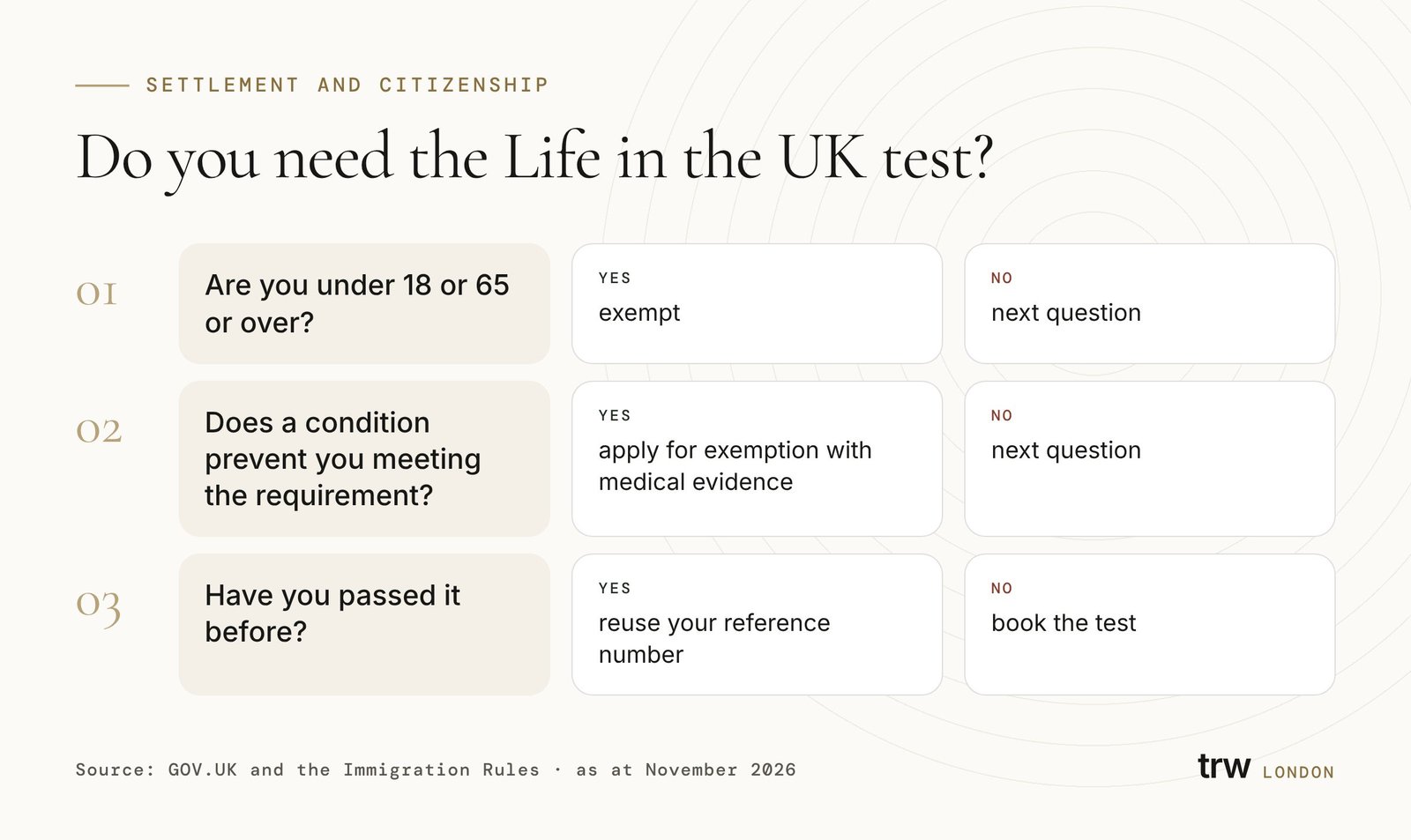
The Life in the UK test is a computer-based test of 24 multiple-choice questions on British traditions, customs, history and institutions. You have 45 minutes and need 75% to pass. Most people applying for indefinite leave to remain or for British citizenship by naturalisation must pass it, unless they are under 18, aged 65 or over, or have a long-term physical or mental condition that prevents them from doing so.
As at November 2026 the test costs £50 and must be booked online at least three days in advance through the official GOV.UK service. You can take it as many times as you need, paying each time. A pass gives you a unique reference number, which the Home Office uses to check your result when you apply.
The legal basis: KoLL and KOL UK
The requirement comes from the Immigration Rules, not from the test provider. Historically it sat in Appendix KoLL (Knowledge of Language and Life in the UK), which combines an English language test and the knowledge of life test for settlement. Paragraph 2.3 of Appendix KoLL says an applicant demonstrates sufficient knowledge about life in the UK by passing the "Life in the UK test" administered by a person approved by the Secretary of State, or the equivalent tests run in the Isle of Man, Guernsey or Jersey for residents there.
Most work, talent and family settlement routes have since moved to a separate, shorter appendix, Appendix KOL UK. It applies to settlement under Appendix Skilled Worker, Global Talent, Innovator Founder, Scale-up, UK Ancestry, Long Residence, Settlement Family Life, Private Life, Hong Kong British National (Overseas), HM Armed Forces and several others. Appendix KOL UK says that applications for settlement under other routes must continue to meet Appendix KoLL.
Under paragraph KOL 2.1, the requirement is met by a valid digital reference number showing a pass. The practical difference between the two appendices is mainly about English: in KOL UK routes, English is dealt with by each route's own rules and Appendix English Language, while KoLL routes test English and knowledge of life together. For British citizenship, the Life in the UK test is a separate statutory knowledge requirement, explained on the GOV.UK naturalisation page.
Who needs to pass the Life in the UK test
| Application | Test required? | Rule |
|---|---|---|
| Skilled Worker settlement (main applicant) | Yes, aged 18 to 64 | Appendix Skilled Worker SW 23.1, via KOL UK |
| Partner or adult child settling as a Skilled Worker dependant | Yes, aged 18 to 64 | SW 45.1, via KOL UK |
| Partner of a British or settled person | Yes, unless exempt | Appendix Settlement Family Life, via KOL UK |
| Long residence (10 years) | Yes, unless exempt | Appendix Long Residence, via KOL UK |
| Settlement under routes not listed in KOL UK | Yes, unless exempt | Appendix KoLL |
| British citizenship by naturalisation | Yes, unless already passed or exempt | British Nationality Act 1981 requirements |
| Refugee or humanitarian protection settlement | Check route rules | Appendix Settlement Protection |
If you passed the test for settlement, you do not take it again for citizenship. GOV.UK says you do not need to take the test if you have "passed it before", giving exactly that example. Keep the reference number safe; you will need it for both applications. For the settlement routes themselves, see our guides to ILR for skilled workers and long residence.

Exemptions and waivers from the knowledge of life requirement
Appendix KOL UK, paragraph KOL 1.1, exempts four groups at the date of application. Appendix KoLL contains equivalent exceptions in Part 3: applicants under 18, those aged 65 or over, and cases where the decision-maker considers it unreasonable to expect the applicant to meet the requirement because of a mental or physical condition.
Under 18
Children are exempt, even when they settle as dependants of a parent.
65 or over
Applicants aged 65 or over at the date of application are exempt.
Physical or mental condition
A disability or condition that prevents you meeting the requirement; GOV.UK asks for an exemption form or a doctor's letter.
15-year English exemption
Some partners, parents and adult dependent children exempt from English after 15 years under Appendix EL 1.1(d) are also exempt from KOL.
The medical exemption is the one most often misunderstood. It is not enough to find the test difficult or to have a diagnosis; the evidence must show that the condition prevents you from meeting the requirement. If the condition only affects how you sit the test, for example limited mobility or a hearing impairment, the better course is usually to ask for adjustments when booking. GOV.UK says you can make special requests, such as extra equipment or help accessing the centre.
Booking the Life in the UK test
There is only one official booking service, linked from the GOV.UK Life in the UK test page. GOV.UK says there are over 30 test centres in the UK and that you choose the centre when you book. You need an email address, a debit or credit card and an accepted form of ID, and the name on the booking must match the ID exactly.
- Check your ID. If you have an eVisa, book using a share code generated from your UKVI account. Otherwise use a valid passport, an EU, Swiss, Icelandic, Liechtenstein or Norwegian ID card, or a valid photo travel document.
- Check any BRP rules. A biometric residence permit or card can be used only if the test is no later than 24 months after its printed expiry date or before 31 December 2026, whichever is earlier.
- Book at least 3 days ahead. Choose a centre and date, and pay the £50 fee by card.
- Request adjustments if needed. Make any special requests for disability or access when you book, not on the day.
- Sensitive bookings. If you have changed gender and do not want staff to see your previous gender, email the Home Office sensitive bookings address before you book.
Book with your application date in mind. Leave enough time for a possible second attempt before you plan to apply for settlement, particularly on a work route where the earliest application date is fixed at 28 days before you complete the qualifying period. If your current permission is close to expiring, an unexpected fail can force an extension application and its fees. For families, it is usually simplest to book every adult who needs the test in the same few weeks so that the application is not held up by one person.
Contact details for the official helpline, run by the test provider, are on GOV.UK. Use only those details: the GOV.UK page states that its booking link is the only official government service for the test.
Expired BRPs stop being usable as booking ID after 31 December 2026. If your BRP has expired, set up your UKVI account and use an eVisa share code instead; our guide to eVisa share codes explains how.
On the day of the test
You must bring the same original ID you used to book; copies and screenshots are not accepted. Your photo is taken at the centre to confirm your identity. GOV.UK states that you will not be able to take the test, and will not get a refund, if you bring the wrong ID or refuse to have your photo taken. You cannot bring children or other family members into the centre.
The test itself is 24 questions in 45 minutes, so time is rarely the problem. Accuracy is: 75% means you can afford very few mistakes. Read each question carefully, since many test a specific date, number or name from the handbook.
Most failed attempts we hear about come down to preparation, not nerves: the test only asks what the handbook says.
Results and your unique reference number
If you pass, you receive a unique reference number. You enter it in your settlement or citizenship application, and the Home Office uses it to verify the pass. Under Appendix KOL UK, a "valid digital reference number" is how you meet the requirement, so there is nothing to post. People who took the test before 17 December 2019 have a letter with a "test reference ID" instead; GOV.UK says that if the letter is lost, you should include an explanation with your application.
GOV.UK does not give an expiry date for a pass, and the same result is reused for citizenship. Keep a record of the number, the test date and the centre with your other immigration papers.
How to prepare for the Life in the UK test
GOV.UK is explicit that you will only be tested on information from the official handbook, Life in the United Kingdom: A Guide for New Residents. It is available as a book, eBook and audio, and official e-learning and a practice app are sold through the official shop. Unofficial websites may use outdated material, so treat them with care.
- Weeks 1-2
Read the handbook once
Read it end to end without memorising, to understand its structure.
- Weeks 3-4
Focus on dates and names
History chapters generate many factual questions; make your own notes.
- Week 5
Institutions and values
Parliament, the courts, elections and the responsibilities of residents.
- Week 6
Practice under time
Use official practice material and aim well above 75%.
- Week 7
Book and sit
Book at least 3 days ahead, with the right ID ready.
Plan the test well before your settlement date. Applicants for indefinite leave to remain who have not passed may be refused, and on some family routes a partner who has not met the knowledge of language and life requirement is granted further limited leave instead of settlement under Appendix FM, with the extra cost that brings.
Worked example: one household, three positions
Example (hypothetical): a Skilled Worker in Bristol is applying for settlement with his wife and their two children, aged 19 and 15. His mother, aged 67, lives with them on a separate visa and will apply on her own route later.
The Skilled Worker and his wife both need to pass the Life in the UK test, because they are between 18 and 64 and neither has a condition that prevents them. The 19-year-old was under 18 when first granted permission as a dependant, so she can be included if she is not living an independent life, but because she is now over 18 she must also pass the test. The 15-year-old is exempt because he is under 18 at the date of application. When the grandmother applies, she will be exempt from the knowledge of life requirement because she is aged 65 or over.
The family therefore books three tests, for the two parents and the older daughter. Each pays £50 per attempt, and each will keep their own reference number for citizenship later.
The Life in the UK test and British citizenship
For naturalisation, the knowledge of life requirement sits alongside the other statutory requirements described on GOV.UK: usually five years' residence and 12 months with indefinite leave, limits of 450 days' absence in the five years and 90 days in the last 12 months, English at B1 or above, and good character. The naturalisation fee is £1,709 plus a £130 ceremony fee, as at November 2026.
Because GOV.UK lets you reuse a previous pass, most people take the Life in the UK test once, at the settlement stage. People who settled under a route that did not require it, or who were exempt at the time because of age, may need to take it before they naturalise if they are no longer exempt. Check your position when you plan the citizenship application, and see our guides to naturalisation and the good character requirement.
Problems and how to fix them
I failed the test
You can rebook as many times as you need, paying £50 each time. There is no mandatory waiting period stated on GOV.UK, but use the gap to revise the sections you found hardest.
I need to cancel or move my test
You get a refund if you cancel at least 3 days (72 hours) before the test, through your Life in the UK account. Cancelling or rearranging within 3 days means no refund.
The centre cancelled my test
You can ask for a refund if the centre cancels. You must ask within 3 months of the test date. No refund is available if you were ill, late, or brought the wrong ID.
My name does not match my ID
The booking name must match your ID exactly. Correct the booking before the day; a mismatch can stop you sitting the test.
I have lost my pass letter from before 2019
GOV.UK says you should send a letter explaining that you have lost it with your citizenship or settlement application.
Reform: earned settlement and the content review
The government's earned settlement response, CP 1707 (2 November 2026), keeps the Life in the UK test as one of the mandatory minimum requirements for settlement, with the existing exemptions for children, people aged 65 and over, and those with a relevant condition. It also says the government "is reviewing the test to ensure it better reflects life in modern Britain". No new test content or format has been announced, and earned settlement itself is announced policy, not law, with no commencement date.
Separately, and already in the Rules, the English requirement for most settlement routes rises from B1 to B2 for applications made on or after 26 March 2027 (HC 1691, see the explanatory memorandum). Under Appendix KoLL, B1 evidence counts for applications made before that date and B2 evidence from it. The English rise does not change the Life in the UK test, but people planning both should treat them as one project.
Take the Life in the UK test early. GOV.UK gives no expiry date for a pass, it is reused for citizenship, and passing it removes one variable while the settlement rules are changing.

Related guides
ILR solicitors
How we help with the whole settlement application.
Read the guideCitizenshipBritish citizenship
Naturalisation after ILR, including good character.
Read the guideFamilySpouse visa English
English levels at each stage of the partner route.
Read the guideCitizenshipCitizenship ceremony
The final step after a successful application.
Read the guideNext steps
Check whether you need the Life in the UK test for your route and age, buy or borrow the official handbook, and book through the GOV.UK service once you are scoring comfortably above 75% in practice. If you think you may qualify for a medical exemption, or you are unsure whether KoLL or KOL UK applies to your settlement route, book a consultation and we will review your position alongside the rest of your application.
Frequently asked questions
01How many times can I take the Life in the UK test?
As many times as you need. You pay £50 for each attempt, as at November 2026.
02Does the pass expire?
GOV.UK does not describe any expiry. You use the same reference number for settlement and later for citizenship.
03Can someone come with me to the test centre?
GOV.UK says you cannot bring children or other family members with you to the centre. If you need help accessing the centre because of a disability, make a special request when you book.
04Do children need to take it?
No. Applicants under 18 are exempt. Children who turn 18 before applying as dependants will usually need to pass it.
05What ID can I use if my BRP has expired?
An expired BRP can be used only if the test is within 24 months of its expiry and before 31 December 2026. Otherwise use an eVisa share code or a valid passport.
06Is the test changing?
The government has said it is reviewing the test to better reflect modern Britain, but no new format or content has been announced.
07What is the difference between KoLL and KOL UK?
Both contain the knowledge of life requirement. KOL UK applies to most work, talent and family settlement routes; Appendix KoLL still applies to routes not listed in KOL UK and also covers English.
Sources and official materials
- Life in the UK Test — Official booking, format, ID, results and refunds
- Immigration Rules Appendix KOL UK — Knowledge of life requirement and exemptions for listed routes
- Immigration Rules Appendix KoLL — Knowledge of language and life for other routes
- Apply for citizenship if you have ILR — Requirements for naturalisation
- Home Office immigration and nationality fees, 8 October 2026 — Life in the UK test fee
- A Fairer Pathway to Settlement (CP 1707) — Test retained; content review
- Explanatory memorandum to HC 1691 — B2 English for settlement from 26 March 2027
General information only, current as at 19 November 2026. It is not legal advice and does not create a solicitor–client relationship. It reflects the law of England and Wales unless stated otherwise; Scotland and Northern Ireland have separate legal systems, and the law changes frequently. Check current official sources and take advice on the facts of your matter.