TRW & Co · Settlement and citizenship
Earned settlement transitional arrangements

CP 1707 (2 November 2026) promises one-off protection for care workers and some health and education staff who arrived before May 2025, and longer extension terms for pre-April 2024 Skilled Workers. Everyone else faces the new pathways once implemented. None of it is law yet and no start date has been set.
Key pointThe default under the settlement reforms is that the rules at the date of decision apply; transitional protection is the exception, limited to named cohorts, so anyone who qualifies under today's Rules should apply now.
At a glance
Status
Announced policy in CP 1707; no Statement of Changes and no commencement date.
Care workers
Pre-May 2025 entrants keep 5 years if they meet £25,000 and other requirements.
Public service
Health and education workers below RQF 6 on national pay scales keep 5 years.
Pre-2024 cohort
Can extend on current terms until 2035; not a 5-year settlement promise.
Not protected
Long Residence is to close; most later arrivals go on the 10-year default.
Swipe or scroll →
Earned settlement transitional arrangements: where things stand
The earned settlement transitional arrangements are the one-off protections the government has promised for specific groups already in the UK when it moves the default qualifying period for settlement from five years to ten. They were set out on 2 November 2026 in A Fairer Pathway to Settlement: Government response to the consultation (CP 1707), Chapter 8, alongside the wider settlement reforms.
They are announced policy, not law. As at 19 November 2026 no Statement of Changes implementing earned settlement has been laid; the latest on the GOV.UK collection is HC 584 of 3 September 2026. No implementation date has been published, and the response says further technical guidance will appear "before implementation". Everything below describes what the government has said it will do, and could change in detail when the Rules are drafted.
Until earned settlement is in the Immigration Rules, the current settlement rules apply. If you qualify for indefinite leave to remain now, the transitional arrangements are not a reason to wait.
The general rule: no transitional protection by default
The starting point matters more than the exceptions. CP 1707 says that, unless transitional provisions are made, applications are ordinarily considered under the Immigration Rules in force at the date of the settlement decision, and that "being in the UK does not give someone an automatic right to settle under the rules that existed when they first arrived". The Home Secretary repeated the point in her statement to the House of Commons: the rules around settlement are determined when a settlement decision is made, not when someone arrives.
The Home Office news release put it more briefly: settlement rules "will otherwise continue to apply at the point of application". In other words, outside the named cohorts there is no general grandfathering for people who are part-way through a five-year route when the new rules start.
Under the announced settlement reforms, the date that matters is the date of decision, not the date you arrived.
The response also explains why the government chose May 2025 as its cut-off. The Immigration White Paper published that month announced the intention to move the standard pathway to ten years, so, in the government's words, it "provides a clear and transparent cut-off point" after which new applicants "would have been aware of the intended change".
Earned settlement transitional arrangements: who will be protected
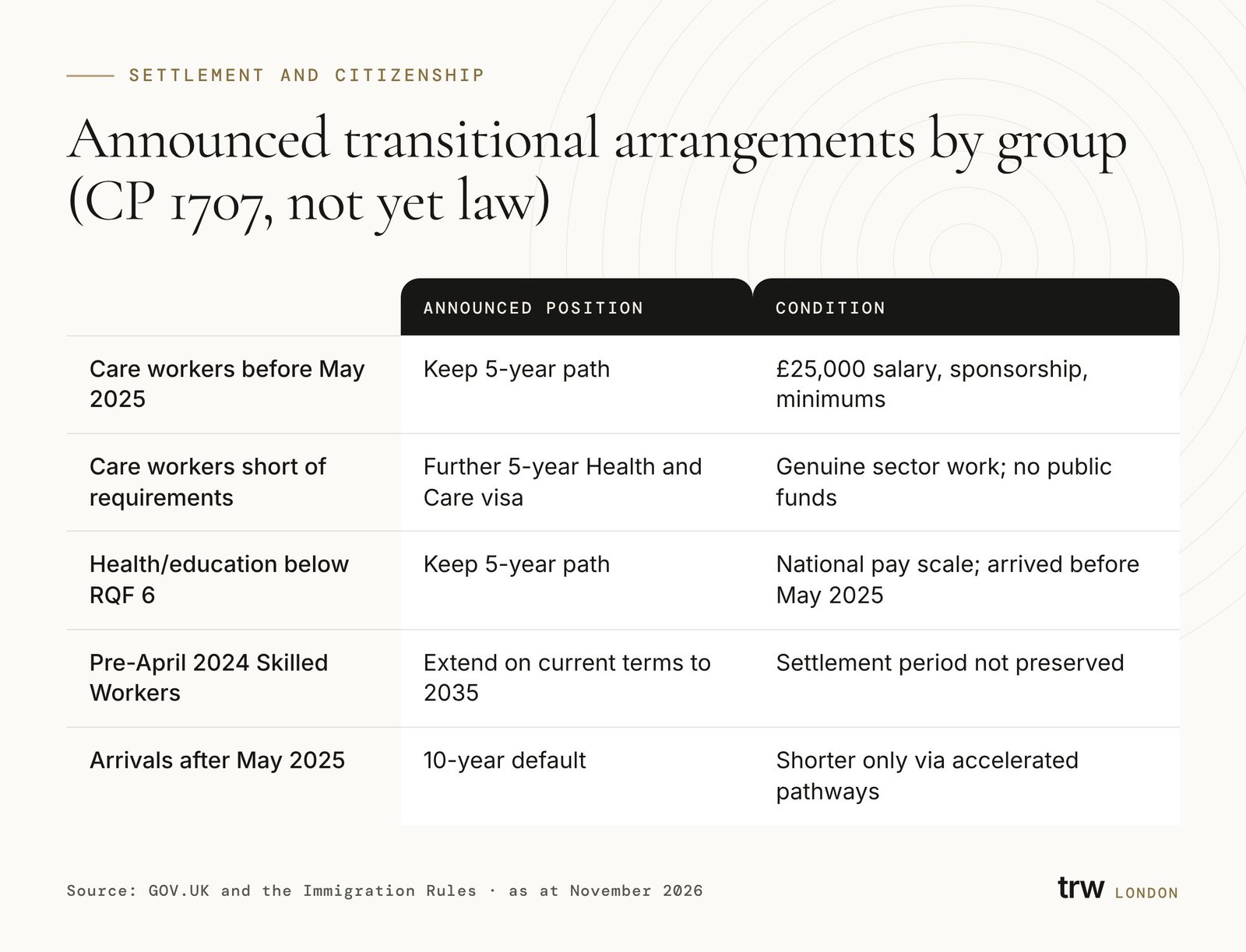
Chapter 8 of CP 1707 sets out the earned settlement transitional arrangements and identifies three cohorts for targeted transitional protection. A wider set of groups sits outside the earned settlement framework altogether. The table summarises each, with its status as at November 2026.
| Cohort | Who qualifies | What is promised | Conditions |
|---|---|---|---|
| Care workers | Entered or switched into the care route before the May 2025 White Paper | Keep the 5-year qualifying period | £25,000 salary, sponsorship and employment requirements; new minimum requirements |
| Care workers who fall short | Same cohort, not meeting the requirements at five years | A further 5-year Health and Care visa restricted to genuine sector work | No recourse to public funds; can then apply to settle again |
| Health and education workers below RQF 6 | On national pay scales and in the UK before the May 2025 White Paper | Keep a 5-year route to settlement | Meet the requirements of their visa |
| Pre-April 2024 Skilled Workers | First certificate of sponsorship before 4 April 2024, continuous permission since | Extend on current terms until 2035 | Applies to extension terms, not to the settlement period itself |

Care workers: the most detailed transitional protection
The government describes care workers already in the UK as "a unique cohort". It acknowledges that many were recruited when the sector needed them, and also that the route was abused, with sponsors offering jobs or hours that did not exist. The earned settlement transitional arrangements for care workers try to reflect both.
Care workers who meet the requirements
Those who entered or switched into the route before publication of the White Paper in May 2025 will keep the existing five-year qualifying period if they meet the applicable salary (£25,000 a year), sponsorship and employment requirements. They must also meet the strengthened minimum requirements that will apply to everyone under earned settlement, including on criminality and English, unless an exemption applies.
Care workers who do not
Those who do not meet the requirements will not qualify after five years. Instead they will be able to apply for a further five-year Health and Care visa, restricted to genuine work in the sector, and then apply for settlement again. The Home Secretary said these workers "will not be tied to their old employer". They will continue to have no recourse to public funds on the further visa. The news release says this group is around a quarter of the total.
Workers whose sponsor loses its licence
From 1 February 2027, according to CP 1707, care workers whose employment ends because their sponsor's licence is revoked will have up to 120 days to secure a job offer and a further 60 days to resolve their visa and employment status, before their permission is curtailed. That date is announced policy and is not yet in the Immigration Rules. See our guide to sponsor licence revocation for the employer side.
Transitional protection for health and education workers below RQF 6
The permanent earned settlement framework would give a five-year pathway to public service workers at RQF 6 and above in health and education, such as doctors, nurses and teachers. CP 1707 adds a one-off transitional protection for a smaller group: workers in healthcare and education occupations below RQF 6 that are on a national pay scale for Immigration Rules purposes, giving nursing auxiliaries and teaching assistants as examples.
Those who came to the UK before the May 2025 White Paper and meet the requirements of their visa will retain a five-year route. The response is explicit that this is "not a permanent five-year pathway for these occupations". People arriving in those roles after May 2025 go on the standard ten-year pathway, with the chance to qualify sooner if they later meet an accelerated pathway.
The pre-April 2024 Skilled Worker cohort
Skilled Workers who received their first certificate of sponsorship before 4 April 2024 and have held Skilled Worker permission continuously since can currently extend at lower salary thresholds: the higher of £31,300 or the lower going rate, for applications made before 4 April 2030, as GOV.UK explains.
CP 1707 says that, with settlement moving to ten years for roles below RQF 6, this cohort will be able to "extend their visas on their current terms until 2035". Read carefully, that is transitional protection for extension terms, not a promise of settlement after five years. Members of this cohort who do not qualify for a shorter pathway would still face the longer qualifying period, but could renew on the lower thresholds while they build it up.
If you are in the pre-April 2024 cohort and already qualify for ILR as a Skilled Worker under the current Rules, the 2035 extension promise does not help you settle sooner. Applying now under the current five-year rule does.
Groups outside the framework altogether
Separate from the transitional cohorts, CP 1707 keeps current settlement arrangements for a list of groups that sit outside earned settlement. The B2 English and criminality minimums still apply to most of them.
British connection
Partners, parents and children of British citizens, and UK Ancestry, keep a 5-year pathway.
BN(O) and armed forces
Hong Kong British Nationals (Overseas) keep 5 years; HM Armed Forces arrangements continue.
Vulnerable groups
Bereaved partners, domestic abuse victims, unaccompanied children and children in care keep current arrangements.
Legacy schemes
Windrush, Afghan schemes, legacy safe and legal routes and the EU Settlement Scheme sit outside the framework.
The Home Office news release also states that settled status "will never be removed from anyone who already holds it". People who already have ILR or settled status under the EU Settlement Scheme are not affected by the settlement reforms, although they may be affected by any later citizenship changes, which have not been specified.
Who the settlement reforms leave without transitional protection
Announced protection
- Care workers on the route before May 2025 (5 years, if requirements met)
- Health and education workers below RQF 6 on national pay scales, before May 2025
- Pre-April 2024 Skilled Workers (extension terms to 2035)
- Groups outside the framework, such as British-connection families and BN(O)
No specific protection announced
- Most Skilled Workers below the £50,271 threshold who are not in a listed role
- Care workers who switched into the route after May 2025
- People relying on the 10-year Long Residence route, which is to close
- Family members of non-British sponsors (around 39,000 people, per the Home Office)
The closure of Long Residence is the part of the settlement reforms most likely to surprise people. CP 1707 says time on temporary routes such as Student, Graduate, Visitor and Global Business Mobility will no longer build towards settlement simply because someone reaches ten years of lawful residence. No transitional protection for people part-way to ten years has been announced in the earned settlement transitional arrangements. Our guide to long residence ILR explains the current route, which remains open until the Rules change.
Minimum requirements that apply to everyone
Under the settlement reforms, transitional protection affects the length of the qualifying period, not the minimum standards. CP 1707 says all applicants will need good character and suitability, no criminal record (including cautions, fines and community sentences), no outstanding government debt, B2 English, a Life in the UK test pass, and sustained contribution. For care workers the response expressly says the strengthened minimums apply "unless an exemption applies".
One of those minimums is already in the Rules. HC 1691 requires B2 English for settlement on most routes for applications made on or after 26 March 2027, including for people already on a route, as the explanatory memorandum explains. Anyone in a transitional cohort who plans to settle after that date should prepare for B2 now. See our Life in the UK test guide for the other integration requirement.
Key dates for the settlement reforms
- May 2025
Immigration White Paper
Announces a 10-year default; becomes the transitional cut-off date.
- 20 Nov 2025
Consultation opens
A Fairer Pathway to Settlement; closes 12 February 2026.
- 2 Nov 2026
Government response
CP 1707 published with Chapter 8 transitional arrangements.
- 1 Feb 2027
Care worker job-search period
Announced: 120 + 60 days after a licence revocation.
- 26 Mar 2027
B2 English for settlement
Already laid in HC 1691; applies on most routes.
- Not set
Earned settlement in the Rules
No Statement of Changes or commencement date yet.
The consultation attracted 204,667 responses, according to CP 1707. Annex A estimates that, as a result of earned settlement, more than 500,000 people will become eligible to settle later than under current arrangements, reducing the central 2026 to 2030 settlement estimate from 1.9 million to 1.4 million. The full consultation history is on the GOV.UK consultation page.

Scenarios: applying the earned settlement transitional arrangements
I am a Skilled Worker who will reach five years in 2027
If you qualify under the current Rules before earned settlement is implemented, you can apply under the current five-year rule. If implementation comes first, you would need to meet a shorter pathway, such as earnings of £50,271 or more in three of the last five years, or wait for the 10-year default. No date is set, so plan on the basis of the current Rules and apply as soon as you are eligible.
I am a care worker who arrived in 2023 and my sponsor was revoked
You are in the protected care cohort. If you meet the £25,000 salary, sponsorship and employment requirements when you apply, the announced policy keeps your five-year route. If not, the second-chance Health and Care visa is intended for you. The 120-day job-search period is announced from 1 February 2027 but is not yet law.
I switched into care work in July 2025
The government says the transitional arrangements do not apply to anyone who joined the care route after the May 2025 White Paper. You would go on the standard ten-year pathway unless you later qualify for a shorter one.
I am a teaching assistant on a national pay scale who arrived in 2024
You appear to fall within the health and education transitional cohort, which keeps a five-year route if you meet the requirements of your visa. The detail will depend on how the Rules define the cohort.
I am on a Graduate visa and planned to use Long Residence
CP 1707 says Long Residence will close and Graduate time will not count towards settlement. No protection for this situation has been announced. Consider whether a route that leads to settlement in its own right, such as Skilled Worker, fits your plans.
What to do now, before the settlement reforms are in the Rules
- Work out your position under the current Rules. Identify your route, your qualifying date and whether you meet every requirement today.
- Apply when eligible. If you already qualify, apply; the government says rules apply at the point of application.
- Check whether you are in a named cohort. Note your route entry date relative to May 2025 and keep evidence of it.
- Prepare for the minimums. Plan for B2 English from 26 March 2027 and keep a clean record on debts and criminality.
- Keep evidence of salary and employment. Care and public service cohorts will need to show they met the conditions of their visa.
- Watch for the Statement of Changes. The transitional detail will only be fixed when the Rules are laid; take advice then.

Related guides
Earned settlement solicitors
Advice on the new pathways and how they may apply to you.
Read the guideSettlementILR solicitors
Applying under the current Rules while they still apply.
Read the guidePolicyWhite Paper changes
The May 2025 proposals that set the cut-off date.
Read the guideWorkSkilled Worker extension
Extending while the settlement reforms take shape.
Read the guideNext steps
Earned settlement transitional arrangements will matter most to care workers, lower-paid health and education staff and long-standing Skilled Workers, but every migrant on a route to settlement should check where they stand. We usually start by confirming whether you can apply under the current Rules now, and if not, which pathway and which transitional protection, if any, is likely to apply. To review your position, book a consultation.
Frequently asked questions
01Are the earned settlement transitional arrangements law?
No. They are announced policy in CP 1707. They will take effect only when a Statement of Changes to the Immigration Rules is laid and commences, and no date has been given.
02What is the cut-off date for transitional protection?
The government uses the publication of the Immigration White Paper in May 2025. People who entered or switched into the relevant route after that are not covered.
03Do transitional cohorts still need B2 English?
Yes, unless an exemption applies. B2 for settlement on most routes is already laid for applications from 26 March 2027, and the earned settlement minimums include B2.
04Will people who already have ILR be affected?
The Home Office says settled status will never be removed from anyone who already holds it.
05Is there transitional protection for Long Residence?
None has been announced. CP 1707 says the Long Residence route will close and time on temporary routes will not count towards settlement.
06Does the 2035 promise mean pre-2024 Skilled Workers settle after five years?
No. It allows that cohort to extend on current terms until 2035. The settlement period they face depends on which pathway they qualify for.
07Should I wait for the new rules before applying?
If you qualify under the current Rules, generally no. The government says settlement rules apply at the point of application, and the reforms are longer for most people.
Sources and official materials
- A Fairer Pathway to Settlement: Government response (CP 1707) — Chapter 8 transitional arrangements and Annex A estimates
- Home Secretary statement on earned settlement — Statement to Parliament, 2 November 2026
- Home Secretary unveils new rules for migrants settling in the UK — Home Office news release, 2 November 2026
- Immigration Rules: statements of changes — Confirms no implementing statement yet
- Explanatory memorandum to HC 1691 — B2 English for settlement from 26 March 2027
- Skilled Worker: CoS before 4 April 2024 — Current transitional salary rules
- Restoring control over the immigration system (White Paper) — May 2025 White Paper setting the cut-off
General information only, current as at 19 November 2026. It is not legal advice and does not create a solicitor–client relationship. It reflects the law of England and Wales unless stated otherwise; Scotland and Northern Ireland have separate legal systems, and the law changes frequently. Check current official sources and take advice on the facts of your matter.