TRW & Co · Visits and travel
Priority visa service: how faster UK visa decisions work
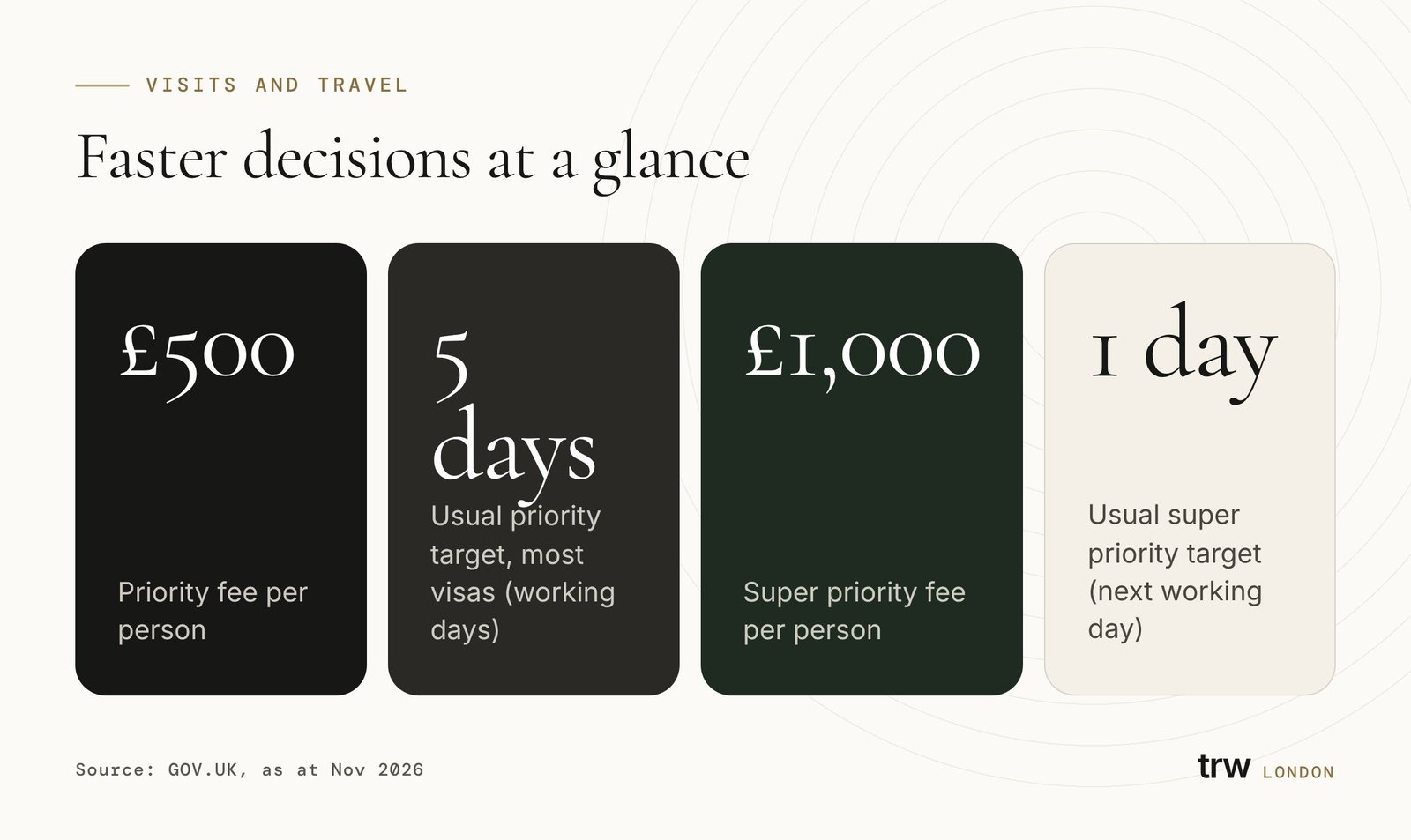
The Home Office sells two faster-decision options as at November 2026: priority at £500, usually deciding most visa applications within 5 working days, and super priority at £1,000, usually deciding by the end of the next working day. Availability depends on the route, where you apply and how you prove your identity, and the fee is not refunded if you are refused.
Key pointSpeed does not improve the merits. Buy a faster decision only when the application is complete and a real deadline makes waiting expensive.
At a glance
Priority
£500 per person; usually 5 working days for most visa applications.
Super priority
£1,000 per person; usually a decision by the end of the next working day.
Slower categories
Settlement, citizenship and overseas family cases usually take 30 working days on priority.
Clock start
From your biometric appointment, or the working day after an ID app upload.
Refunds
None on refusal; limited refunds on cancellation before biometrics.
Swipe or scroll →
The priority visa service in short
The priority visa service is a paid add-on that asks the Home Office to decide an eligible application faster than the standard timetable. As at November 2026 there are two levels: priority, at £500 on top of the application fee, and super priority, at £1,000. Priority usually brings a decision within 5 working days for most visa applications. Super priority usually brings one by the end of the next working day.
Neither level changes the law that applies to your case. A faster decision is not a better decision, and a weak application refused in 24 hours is still a refusal, with the extra fee lost. The service is also rationed. There is a daily limit on places, not every route qualifies, and the options differ depending on whether you apply inside or outside the UK and how you prove your identity.
This guide explains how each service works, which applications can use it, what happens to the fee if things go wrong, and how to decide whether paying for speed is sensible. Figures are as at November 2026 and come from GOV.UK; check the current fee table before you apply.
How the priority visa service works
GOV.UK describes the two options on its faster decision page. You choose the service when you apply, if it is offered for your application, and you pay the extra fee alongside the application fee. Nothing else about the application changes: the same form, the same evidence and the same Immigration Rules apply.
Priority: usually 5 working days
The priority service costs £500. For most visa applications the target is a decision within 5 working days. Settlement and citizenship applications are slower even on priority: GOV.UK says they usually take 30 working days. Family visa applications made from outside the UK also usually take 30 working days on priority.
Super priority service: usually the next working day
The super priority service costs £1,000. For visa and settlement applications, GOV.UK says you will usually get a decision by the end of the next working day. If your identity appointment falls on a weekend or bank holiday, the usual target becomes 2 working days. Super priority is not available for citizenship applications at all.
The word "usually" matters. These are service standards, not legal deadlines. The Home Office can take longer if it needs to check details with another department, interview you or ask for more evidence, and it says so in terms. If you are asked for more information, your application is prioritised again once the information arrives, but the original target date has gone.
What the priority visa service does not change
Using the priority visa service does not move your file to a different team with a lighter touch, and it does not waive any requirement. Caseworkers still check identity, suitability, finances and the purpose of the application. Applications that need verification of documents, an interview or a criminal record check can be taken out of the fast lane, and GOV.UK says you will be contacted if that happens.
Nor does the super priority service guarantee that a physical or digital status update arrives the same day. A successful applicant receives an eVisa, and GOV.UK says the eVisa can usually be accessed straight away once linked to the UKVI account, but this can take up to 24 hours.
A faster decision buys you an earlier answer, not a different one. Pay for speed only once the application itself is ready.
When the clock starts
Many applicants assume the 5-day or next-day clock starts when they press "submit" and pay. It does not. For priority decisions, GOV.UK says the time runs from the day of your biometric appointment if you prove your identity in person, or from the working day after you finish uploading your documents if you use the UK Immigration: ID Check app. The same principle applies to super priority.
Working days are Monday to Friday, excluding bank holidays. In practice, the real waiting time is therefore the time it takes to get an appointment plus the service standard. In busy periods appointment availability, not decision speed, can be the bottleneck. Build that into any travel or start-date plan before you treat the 24-hour figure as your timetable.
- Check eligibility first. Confirm that your route and identity method are listed for the speed you want. The in-UK tables differ between UKVCAS appointments and the ID Check app.
- Finish the evidence before you pay. A priority fee does not pause the case while you gather missing documents. Upload or bring a complete bundle.
- Book the earliest appointment, or complete the app upload. This is the moment the clock usually starts.
- Keep your phone and email monitored. Requests for further information go by email. A slow reply pushes your decision back.
- Do not book non-refundable travel on the target date. Leave a margin. A decision that slips by a day or two will not usually lead to a refund.
Eligibility for a faster decision inside the UK
If you are applying from inside the UK, you must already have permission to be here to use either service. GOV.UK publishes tables of eligible in-country applications, split by whether you attend a UK Visa and Citizenship Application Services (UKVCAS) appointment or use the ID Check app. The table below summarises some common routes as published when we checked in November 2026. Always recheck the live page, because the lists change.
| Application | Priority (UKVCAS) | Super priority (UKVCAS) | Faster option via ID app |
|---|---|---|---|
| Skilled Worker | Yes | Yes | Priority and super priority |
| Health and Care Worker | Yes | Yes | Priority and super priority |
| Scale-up Worker | No | No | Priority and super priority |
| Graduate | Yes | Yes | Priority only |
| Family visa (partner, parent, child) | No | Yes | None |
| UK Ancestry | No | Yes | None |
| Visitor extension, form FLR(IR) | No | Yes | None |
| Settlement as a partner, form SET(M) | No | Yes | None |
| Settlement on work routes, form SET(O) | Yes | No | None |
Two points stand out. First, family applications made in the UK are offered super priority but not the cheaper 5-day priority, so the choice there is between standard processing and £1,000. Second, the identity method can decide eligibility: a Scale-up Worker application can only be accelerated if the applicant uses the ID Check app.
Citizenship applications sit apart. Priority is available for naturalisation, child registration and several other online nationality applications, with a usual decision in 30 working days, but super priority is not. Standard naturalisation decisions are usually made within 6 months, according to the GOV.UK citizenship guidance. If you hope to use a priority service for citizenship, you cannot apply on a paper form.
Dependants pay too. Each family member applying with you needs their own £500 or £1,000 faster-decision fee, and the Home Office aims to decide everyone together. If one person must give biometrics in person and cannot get a matching slot, the whole family decision may take longer.
Applying from outside the UK
From outside the UK, GOV.UK says a faster decision is available on most visas, but whether you can actually buy one depends on where you apply. If you attend a visa application centre, check whether your centre offers priority or super priority for your visa type and select it when booking. If you prove your identity with the app, the option appears during the online application when it is available.
The timings mirror the in-country service: priority usually takes 5 working days for most visas, family and settlement applications usually take 30 working days, and super priority usually brings a decision by the end of the next working day. For comparison, the standard target for a Standard Visitor visa is 3 weeks, the standard target for a Skilled Worker application from outside the UK is also 3 weeks, and family applications from outside the UK usually take 12 weeks, according to the family visa guidance.
For short visits by non-visa nationals, there is no priority product to buy because there is no visa application. An electronic travel authorisation costs £20 as at November 2026, and GOV.UK says a decision usually arrives within a day but can take up to 3 working days. Apply early rather than relying on that window.
Using the priority visa service for a visit visa
Visit visa applicants are among the most frequent users of the priority visa service, usually because a family event, a medical appointment or a business meeting has a fixed date. The visitor rules are the same whatever the speed: you must show you are a genuine visitor, that you can fund the trip and that you will leave at the end of it. A faster decision on a thinly evidenced visit application often produces a quick refusal, which then has to be disclosed on every future application.
Where a long-term visit visa is requested, remember that the caseworker can grant a shorter visa than you asked for without any refund of the difference. That risk is the same on the standard and priority timetables. Our guide to visit visas from Bangladesh gives a practical example of a visa-national application.

What a faster decision costs
The faster-decision fee is charged per person and is paid on top of the application fee and any Immigration Health Surcharge. It is not refunded simply because the outcome is a refusal. The headline figures below are taken from GOV.UK and the Home Office fee table in force as at November 2026.
To put those numbers in context, a visitor already in the UK who needs more time pays £1,172 to extend their stay, and an extra £1,000 if they choose super priority. A family of four applying for super priority together would pay £4,000 in faster-decision fees before any application fees are counted. Check the current Home Office fee table before you budget, because fees are reviewed regularly.
Is the super priority service worth it?
The right answer depends on what a delay would cost you and how strong the application is. A faster decision makes the most sense where the evidence is complete and straightforward, and a firm external date is at stake: a job start, a court date, a family emergency, or a contractual deadline. It makes the least sense where the case has a known weakness, because speed gives the caseworker no extra reason to resolve doubts in your favour.
Paying for speed usually makes sense when
- The application is complete and the requirements are clearly met
- A real external deadline exists, such as a start date or a hearing
- Waiting would cost more than £500 or £1,000 (lost salary, rebooked travel)
- You can attend an early appointment or use the ID Check app straight away
Paying for speed usually adds little when
- The case has a gap, such as an unexplained refusal or missing document
- You already hold permission and section 3C leave protects you while you wait
- The decision feeds into another slow step anyway, such as a licence change
- No appointments are available for weeks, so the clock cannot start
If you are applying in time to extend permission you already hold, your existing conditions usually continue while the application is pending. Our guide to section 3C leave explains when that protection applies. Where 3C leave covers you, the main benefit of a faster decision is certainty and the ability to travel, rather than lawful status itself.

Pitfalls that cost time and money
Paying before the evidence is ready
A faster decision does not give you extra time to complete the bundle. If documents are missing, the caseworker may ask for them, which stops the clock, or may simply refuse. Either way the fee is unlikely to come back.
Assuming the service is always on offer
There is a limit on how many people can apply for a faster decision. If the option is not offered when you apply, you can still submit a standard application, but you cannot insist on a priority slot.
Choosing the wrong identity method
Some routes are eligible only through a UKVCAS appointment, others only through the ID Check app. Check the eligibility table for your exact route and method before you commit.
Expecting a refund for a late decision
GOV.UK says you will not usually get a refund if you are not cancelling. You will not get one if the delay happened because the Home Office needed more information. A refund may be given where the delay was outside the Home Office's control, for example a technical problem.
Cancelling after biometrics
If you proved identity in person and cancel before giving fingerprints and a photo, you will get the faster-decision fee back. After biometrics, you usually will not. GOV.UK sets out the refund rules in detail, including how to claim if the refund is not automatic.
A refusal received quickly is still a refusal, and it goes on your immigration history. If your case has been refused before, read our guide to visitor visa refusals or, for other routes, administrative review before reapplying at speed.
Worked example: a relocation on a deadline
Example (hypothetical): a London software company has hired an engineer who is in the UK on a Graduate visa. The company holds a sponsor licence and has assigned a certificate of sponsorship for a Skilled Worker role. The engineer wants to switch now so that a planned overseas client visit next month is not disrupted.
The standard target for an in-country Skilled Worker application is 8 weeks. Skilled Worker applications made in the UK appear on the GOV.UK list for both priority and super priority, through either a UKVCAS appointment or the ID Check app. The engineer's Graduate permission does not expire for several months, so lawful status is not the concern; certainty before travel is.
The sensible sequence is to check that the job code, salary and English evidence are in order, confirm the faster option is offered on the day, and only then pay. If the engineer chooses priority at £500 and proves identity on a Tuesday, a decision would usually be expected within 5 working days. Super priority at £1,000 would usually bring it by the end of Wednesday. The company should still avoid booking the client trip until the decision and eVisa update are confirmed.
Priority services for sponsors
Employers meet a separate set of paid fast-track services that are easy to confuse with the priority visa service. They apply to the sponsor licence itself and to requests made through the Sponsor Management System, not to individual visa applications.
According to GOV.UK's licence application guidance, most licence applications are decided in under 8 weeks, and a £750 priority service aims for a decision within 10 working days, with limited daily places. Change-of-circumstance requests through the SMS can take up to 18 weeks, or 5 working days with the £350 priority service. These figures are as at November 2026.
Licence priority
£750, with a target of 10 working days for a new sponsor licence decision. Places are limited each day.
SMS priority
£350 for a change-of-circumstance request, with a target of 5 working days instead of up to 18 weeks.
Worker visa priority
£500 or £1,000 per applicant, paid on the worker's visa application, not through the SMS.
Planning tip
Line up the licence, the certificate of sponsorship and the visa so that one slow step does not cancel out paying to speed up another.
Our sponsor licence team can help map those steps against a start date. For individual visits, see our guide to the business visitor visa; for family visits, see our guide to the visit visa for parents.

Visit visa solicitors
Help with visitor applications, refusals and long-term visas.
Read the guideWorkSkilled Worker visas
Sponsored work applications and in-country switches.
Read the guideFamilyFamily visas
Partner, parent and child applications inside and outside the UK.
Read the guideNext steps
Treat the priority visa service as the last decision, not the first. First make sure the application meets the Immigration Rules and the evidence is complete; then check whether a faster decision is offered for your route and identity method; then weigh the fee against the real cost of waiting. If a deadline is fixed, leave a margin of a few working days rather than planning to the hour.
We usually start by reviewing the draft application and the timetable together, so that the priority visa service is used only where it will help. To discuss your case, book a consultation with our immigration team.
Frequently asked questions
01Can I add priority after I have submitted my application?
GOV.UK describes the choice as one you make when you apply or book your appointment. If the option was not offered or you did not select it, plan on the standard timetable rather than assuming you can upgrade later.
02Is super priority available for British citizenship?
No. Citizenship applications can use the £500 priority service if applied for online, with a usual decision in 30 working days, but not super priority. See our guide to naturalisation.
03Does a faster decision improve my chances?
No. The same Immigration Rules and evidential standards apply. A faster decision only changes when you hear the outcome.
04Can I use priority if I am in the UK without permission?
No. GOV.UK says you must have permission to be in the UK to use the priority or super priority service from inside the UK. If your permission has ended, read our guide for people who are an overstayer first.
05What happens if my appointment is on a Saturday?
For super priority, GOV.UK says a weekend or bank holiday appointment usually leads to a decision 2 working days later rather than the next working day.
06Who pays if the Home Office misses the target?
Usually no refund is given. The Home Office may refund where the delay was caused by something outside its control, such as a technical problem, but not where it needed more information from you.
07Do I need a faster decision for an ETA?
There is no paid fast track for an ETA. It costs £20 as at November 2026 and GOV.UK says decisions usually arrive within a day, but can take up to 3 working days.
Sources and official materials
- Get a faster decision on your visa, settlement or citizenship application — Fees, timings, eligibility tables and refund rules
- Home Office immigration and nationality fees, 8 October 2026 — Current fee table
- Skilled Worker visa — Standard decision times inside and outside the UK
- Family visas: apply, extend or switch — Family visa fees and decision times
- Visit the UK as a Standard Visitor: extend your stay — Visitor extension fee and super priority
- UK visa sponsorship for employers: apply for your licence — Licence priority service
- Apply for citizenship if you have indefinite leave to remain — Standard citizenship decision times
General information only, current as at 19 November 2026. It is not legal advice and does not create a solicitor–client relationship. It reflects the law of England and Wales unless stated otherwise; Scotland and Northern Ireland have separate legal systems, and the law changes frequently. Check current official sources and take advice on the facts of your matter.