TRW & Co · Family
The genuine and subsisting relationship requirement

Every UK partner route requires the relationship to be genuine and subsisting. 'Genuine' asks whether it is a real relationship rather than one entered into for immigration purposes; 'subsisting' asks whether it is still continuing. The applicant must prove both on the balance of probabilities. There is no fixed list of documents: caseworkers weigh official, third-party and personal evidence together, and may interview where doubts remain.
Key pointOfficial documents linking both partners to the same address or finances over time carry the most weight. Photographs and chat screenshots help, but Home Office guidance treats them as weak evidence on their own.
At a glance
Standard of proof
Balance of probabilities: more likely than not that the relationship is real and continuing.
No specified list
There is no mandatory document, so a refusal cannot rest on one missing item alone.
Weight of evidence
Home Office guidance grades evidence as strong, acceptable or weak.
Later applications
Once genuineness is accepted, extensions normally only test whether the relationship is still subsisting.
Interviews
Used where evidence is insufficient, and in sham marriage investigations under the Immigration Act 2014.
Swipe or scroll →
The short answer: proving a genuine and subsisting relationship
A genuine and subsisting relationship is one that is real and continuing. Every UK partner route asks the question, from the spouse visa under Appendix FM to the dependant partner of a Skilled Worker under Appendix Relationship with Partner. The burden is on the applicant, and the standard is the balance of probabilities: the caseworker must be satisfied it is more likely than not that the couple are in a real relationship that is still going on.
There is no prescribed list of relationship evidence. Home Office guidance says caseworkers cannot refuse simply because one particular document is missing; they must look at everything in the round. In practice, though, some evidence counts for much more than other evidence, and knowing which is which is the key to a clean application.
Where the genuine and subsisting relationship test applies
The same phrase appears in several parts of the Immigration Rules, sometimes with a slightly different focus.
Spouse and partner visas
E-ECP.2.6 (entry) and E-LTRP.1.7 (in the UK) of Appendix FM require the relationship to be genuine and subsisting, alongside the requirement to have met in person.
Dependant partners
RWP 6.2 applies the test to partners of Skilled Workers, students, Global Talent holders and dozens of other routes.
Settlement
Five-year and ten-year partner settlement both re-test the relationship, usually focusing on whether it still subsists.
Bereaved partners
BP 6.2 asks whether the relationship was genuine and subsisting immediately before the partner died.
A related but different concept appears in EX.1 of Appendix FM and in Part 5A of the 2002 Act: a "genuine and subsisting parental relationship" with a child. That test looks at the parent's role in the child's life rather than at a couple's relationship, and is not covered in detail here.
Genuine versus subsisting: the two halves of the test
"Genuine" asks whether the relationship is what it claims to be, rather than an arrangement entered into to gain an immigration advantage. Where a couple is validly married or in a civil partnership, the relationship caseworker guidance says they will generally have satisfied the genuineness part by producing evidence of the marriage, unless there is reason to suspect a sham.
"Subsisting" asks whether the relationship is current and continuing. A couple who married for genuine reasons but have since separated permanently are no longer in a subsisting relationship. Once genuineness has been accepted in a successful application, later applications with the same partner normally test only whether the relationship is still subsisting.

That second point matters for extensions and settlement. The guidance says applicants for settlement will not be asked for documentary evidence of their relationship unless their circumstances have changed, and that caseworkers can rely on the application form and direct checks with third parties. Documents are requested only where the caseworker is not satisfied.
How the Home Office weighs relationship evidence
The caseworker guidance divides relationship evidence into three tiers. Strong evidence is issued by an organisation that carries out checks on the person, such as identity or address checks. Acceptable evidence comes from a third party that may not have verified it. Weak evidence comes from individuals with no official capacity, or has not been verified. The table summarises the examples the guidance gives.
| Type | Strong | Acceptable | Weak |
|---|---|---|---|
| Marriage or civil partnership | Marriage or civil partnership certificate | - | - |
| Living together | Tenancy or mortgage, council tax and utility bills, GP letters, payslips, DWP or HMRC letters linking both to one address | Electoral register confirmation, student finance documents, other dated domestic bills | Letters of support, written statement from the applicant |
| Shared finances | Bank statements (joint or individual), mortgage agreement | Insurance, car finance, receipts for joint purchases | - |
| Living apart | Money transfers, children's birth certificates, work contract or course documents explaining the separation | Travel tickets, holiday bookings | Communication records, photographs, letters from family, friends or community leaders |
Where an applicant has enough strong evidence, the caseworker does not need to see anything else. Acceptable evidence gets reasonable weight, though the caseworker may want more than one item. Weak evidence still counts, but the guidance tells caseworkers to look for a reasonable explanation of why stronger evidence is missing, and not to refuse simply because only weak evidence was provided.
Ideally each document shows both partners' names; where it does not, documents should cover the same address over the same period.
GOV.UK's partner visa guidance gives applicants a simpler version: evidence from the government, a bank, a landlord, a utility provider or a medical professional, confirming the relationship and less than four years old. It lists one-off bills, electoral register letters and student finance paperwork as fall-backs. Where documents are not in English or Welsh, Appendix FM-SE requires a full, verifiable translation.
Where both partners are in the UK, the guidance allows caseworkers to use direct checks with third parties to confirm that a relationship is durable or subsisting. The detail of those checks is withheld from the published guidance. The practical lesson is simple: keep the records that official bodies hold about you, such as GP registration, council tax, the electoral register and HMRC, up to date at your shared address. Inconsistent records are a common trigger for a request for further relationship evidence.
When documents cannot be obtained
Some couples cannot produce standard documents at all. The family guidance recognises, for example, that a sponsor with protection status may have no access to an official marriage certificate from the country they fled. Appendix FM-SE allows caseworkers to exercise discretion where there is a valid reason why a specified document cannot be supplied, such as because it is not issued in that country or has been permanently lost. Where the sponsor has protection status, caseworkers are told to cross-reference the family details given in the protection claim with the partner application, which makes consistency between the two essential.
Living apart, cultural context and meeting in person
Couples who do not live together are not automatically refused, but their relationship evidence needs more thought. The guidance accepts temporary separation for work, study, caring for a close relative, or cultural reasons while overseas. The caseworker must be satisfied that living apart is temporary and that the relationship continues despite it, usually through evidence of shared finances, visits and regular contact.
Cultural awareness is written into the guidance. Caseworkers are told not to presume that relationships start and develop as they commonly do in the UK. Some cultures permit cohabitation only after marriage; some do not routinely put women's names on household bills; same-sex couples in some countries cannot live together openly. Where these factors explain thin documentary evidence, say so expressly in the application.
Having met in person
Appendix FM requires that the couple have met in person, and RWP 6.1 says the same for other routes. The family guidance explains that the tribunal has read "met" as meaning a face-to-face meeting that results in mutual acquaintance; a fleeting sighting followed by phone or online contact is not enough. Not having met can be the sole reason for refusal, and proxy marriages attract particular scrutiny on this point.
Unmarried partners
For unmarried partners, the genuine and subsisting relationship test sits alongside the durable relationship requirement: a relationship similar to marriage or civil partnership for at least two years. The guidance says this usually means living together, but recognises exceptions. See our unmarried partner visa guide for the cohabitation evidence that carries most weight.
When a marriage interview happens
There are two quite different settings for a marriage interview. The first is during an ordinary visa application. Where documents and explanations are not enough to decide whether a relationship is genuine and subsisting, the guidance allows a caseworker, after discussion with a senior caseworker, to arrange an interview to explore the relationship before deciding. Where direct checks with third parties raise doubts, the guidance says caseworkers should not refuse automatically but should ask for more evidence or consider an interview.
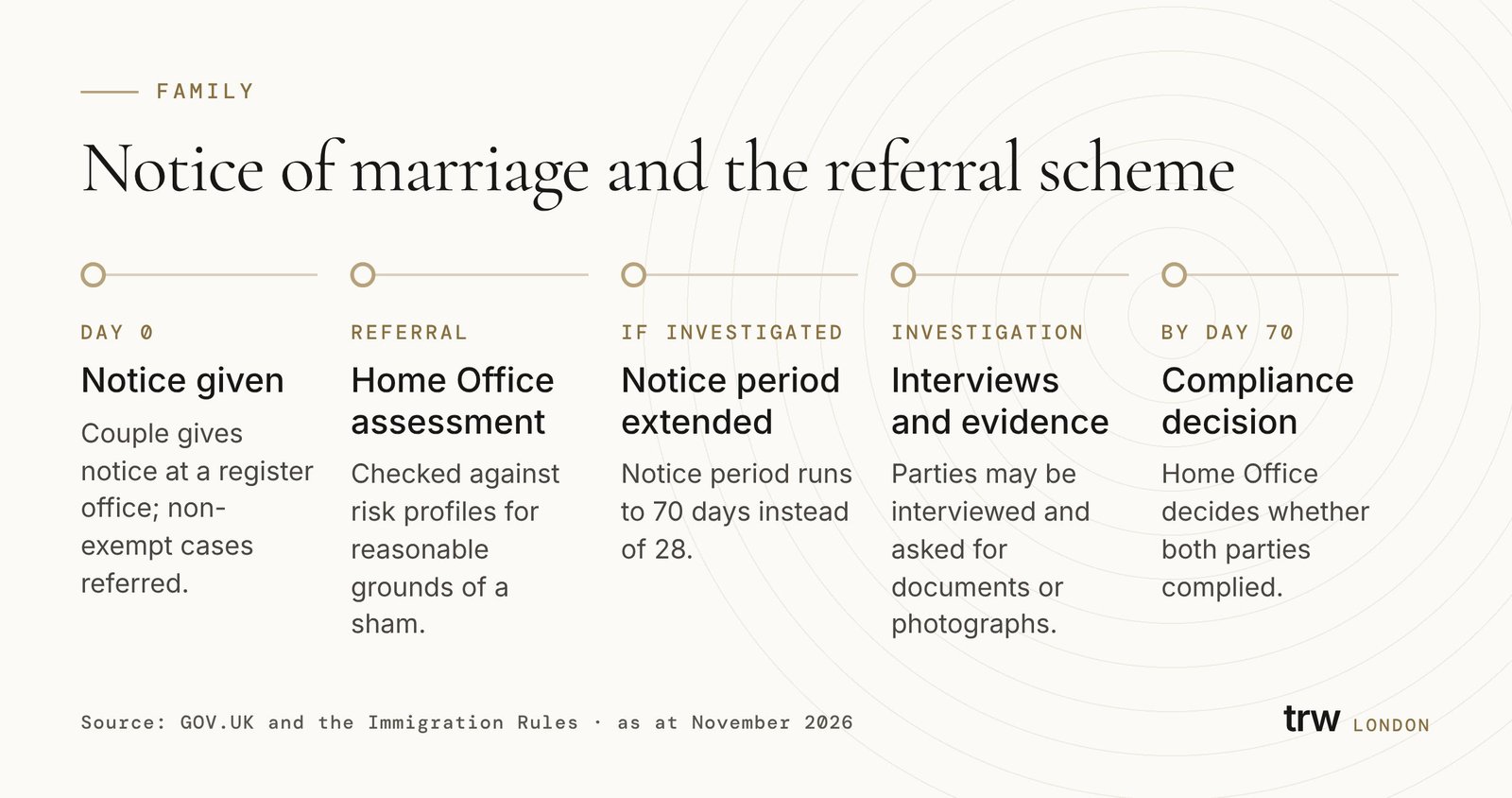
The second setting for a marriage interview is the statutory sham marriage scheme created by Part 4 of the Immigration Act 2014. Since 2 March 2015, couples giving notice of marriage or civil partnership where one party is not exempt are referred to the Home Office. If there are reasonable grounds to suspect a sham, the Home Office may decide to investigate, and the notice period is then extended from 28 days to 70 days.
- Day 0
Notice of marriage
The couple give notice at the register office. Where a party is not exempt, the notice is referred to the Home Office.
- After referral
Decision to investigate
The Home Office assesses the referral against risk profiles and decides whether there are reasonable grounds to suspect a sham.
- If investigated
Notice period becomes 70 days
Both parties are notified and told what they must do, such as making contact or attending an interview.
- During the investigation
Interviews and documents
Parties may be interviewed together or separately, at home, at Home Office premises or remotely, and asked for information, evidence or photographs.
- Before day 70
Compliance decision
The Home Office decides whether both parties complied. If they did, the marriage can go ahead after the 70 days.
According to the statutory guidance, interviews must be "properly probing, but balanced". Typical topics are the background and history of the relationship, the parties' immigration histories, living arrangements, arrangements for the wedding, and future plans. A party may be accompanied by a qualified legal representative and an interpreter. Refusing to answer questions can be treated as a failure to comply.
Sham marriage and suitability
A finding about genuineness can have consequences beyond the immediate application. Under Part Suitability, paragraph SUI 8.1 allows an application to be refused where the decision maker is satisfied that it is more likely than not that the applicant is or has been involved in a sham marriage or civil partnership. SUI 8.2 allows existing permission to be cancelled on the same basis.
For people on the ten-year family route, involvement in a sham marriage during the qualifying period also blocks settlement unless the full 10-year period and a further five years after the issue came to light are completed. A genuine relationship that is badly evidenced is a fixable problem. A sham marriage finding is far harder to undo, so any allegation should be answered promptly and in full.
Building a relationship evidence file
We usually recommend that couples keep a running file from the start of a partner route, rather than gathering papers at the last minute. A good file includes:
- the marriage or civil partnership certificate, and evidence that any previous marriage of either partner has ended;
- tenancy or mortgage documents and council tax bills in both names, or in each name at the same address;
- bank statements showing shared outgoings or transfers between partners;
- GP, dental or HMRC letters to each partner at the shared address;
- if living apart: an explanation, travel records, money transfers and evidence of the reason (job contract, course letter, care needs);
- a short chronology of the relationship: meeting, engagement, wedding, moves and periods apart;
- a small, dated selection of photographs and messages, labelled, to support rather than replace the documents above.

After an adverse finding on the relationship
If a caseworker is not satisfied that the relationship is genuine and subsisting, the application must be refused. What happens next depends on the route. A refusal under Appendix FM is normally treated as the refusal of a human rights claim and carries a right of appeal to the First-tier Tribunal. Dependant partners on points-based routes are usually limited to administrative review, which corrects caseworking errors but does not reassess credibility on new evidence.
An appeal gives the couple something the paper process does not: the chance to give oral evidence and be cross-examined before an independent judge. Credibility findings are often revisited in that setting. Fresh relationship evidence can also be put before the tribunal, even if it post-dates the refusal. Our guide to spouse visa refusals explains how to choose between appealing and reapplying.
Bereaved partners: a lighter touch
One context deserves special mention. Where a partner has died, Appendix Bereaved Partner asks whether the relationship was genuine and subsisting immediately before the death. Home Office settlement guidance tells caseworkers to grant on the basis of the death certificate where the other requirements are met, and not to make detailed enquiries unless doubts were raised earlier or allegations have since been made. Any enquiries must be made with care and tact. See our guide to bereaved partner settlement.
Common mistakes with relationship evidence
Sending everything except what matters
Hundreds of photographs and screenshots, with no tenancy, bills or bank records, invite doubt. Lead with strong evidence.
Unexplained gaps
If you lived apart for a period, say why and show how the relationship continued. Silence lets the caseworker draw their own conclusion.
Inconsistent accounts
Dates of meeting, addresses and family details should match across both partners' forms, earlier applications and any interview.
Ignoring a previous marriage
Any previous relationship of either partner must have broken down permanently, with evidence such as a decree. A missing divorce document can sink an otherwise strong case.
Treating a marriage interview casually
Prepare as you would for any formal interview, ask for an interpreter if you need one, and answer every question. Non-compliance has consequences of its own.
Worked example: a long-distance marriage
Example (hypothetical): a British engineer meets his future wife while working abroad on a 12-month project. They marry after a year together in her country. He returns to London for a new job while she stays to finish her degree, and they apply for her spouse visa six months later.
The genuineness of the relationship is supported by the marriage certificate, so the relationship evidence should concentrate on the period apart. The live question is whether it is subsisting while they live apart. A strong application would explain the separation (his job, her final year of study), show it is temporary (course end date and his tenancy in London), and evidence continued commitment: regular money transfers, flights for visits, and a dated selection of messages. Evidence of the year they lived together abroad, such as a lease or utility bills there, would help to show that the relationship has a track record of cohabitation.

Next steps
If you are preparing a partner application, or have been asked for more relationship evidence or invited to a marriage interview, start by mapping your documents against the evidence tiers above. Where the strong evidence is thin, write a clear explanation and fill the gaps with the strongest acceptable evidence available.
We usually begin with a short review of the relationship file and the questions the caseworker is likely to ask. For related guidance, see spouse visa solicitors, the fiancé visa and what to do after a spouse visa refusal. To discuss your genuine and subsisting relationship evidence, book a consultation.
Frequently asked questions
01Do we have to live together to show a genuine and subsisting relationship?
Not always. Living together over time is strong evidence, but Home Office guidance accepts that couples may live apart for work, study, care or cultural reasons. You then need a reasonable explanation and extra evidence of commitment, such as financial support and visits.
02How much relationship evidence is enough?
Guidance tells caseworkers they should not need numerous documents covering an extended period. A small number of strong documents can be enough. Where the evidence is weaker, more of it and a clear explanation help.
03Are WhatsApp messages and photos useful?
They can help, particularly where a couple has lived apart, but the guidance says applicants are not encouraged to rely on them because they are hard to verify. Use them to support, not replace, official or third-party documents.
04What is a marriage interview?
An interview to explore whether a relationship is genuine. It may be arranged by a caseworker where evidence is insufficient, or as part of a sham marriage investigation after notice of marriage is given. Questions typically cover how the relationship began and developed, living arrangements and future plans.
05Can I bring a lawyer to a marriage interview?
In a sham marriage investigation, the statutory guidance says a party may be accompanied by a qualified legal representative and by an interpreter. Other people may attend only with the investigating officer's consent.
06Does a short relationship before marriage count against us?
Not in itself. Guidance stresses that every relationship is unique and warns against presumptions. But a short or long-distance relationship may need fuller evidence of how it developed.
07Does the test apply to unmarried partners?
Yes, alongside the separate durable relationship requirement of two years in a relationship akin to marriage or civil partnership.
08Is a proxy marriage acceptable?
A proxy marriage can be valid if recognised where it took place, but the couple must still have met in person. Guidance says that if, after enquiries, a caseworker is not satisfied they have met, the application should be refused.
Sources and official materials
- Immigration Rules Appendix FM — E-ECP.2.6 and E-LTRP.1.7 relationship requirements
- Immigration Rules Appendix Relationship with Partner — RWP 6.1 and 6.2 for dependants on work and other routes
- Relationship with a partner: caseworker guidance — Evidence table, direct checks and cultural awareness
- Family life (as a partner or parent) and exceptional circumstances: caseworker guidance — Appendix FM relationship assessment
- Marriage and civil partnership referral and investigation scheme: statutory guidance — Investigations, interviews and the 70-day notice period
- Immigration Act 2014, Part 4 — Statutory basis of the referral and investigation scheme
- Immigration Rules Part Suitability — SUI 8.1 and 8.2: sham marriage or civil partnership
General information only, current as at 19 November 2026. It is not legal advice and does not create a solicitor–client relationship. It reflects the law of England and Wales unless stated otherwise; Scotland and Northern Ireland have separate legal systems, and the law changes frequently. Check current official sources and take advice on the facts of your matter.