TRW & Co · Work and sponsorship
Sponsored worker absence: unpaid leave, unauthorised absence and reporting

Sponsors must report a sponsored worker who is absent without permission for more than 10 consecutive working days, and must normally stop sponsoring a worker absent without pay or on reduced pay for more than four weeks in a calendar year, unless a listed exception applies. Separately, the worker's time outside the UK counts towards settlement limits.
Key pointThe four-week unpaid leave limit is counted in working days against the worker's normal pattern, cumulatively across the calendar year. For a three-day-a-week worker, that is 12 working days.
At a glance
Unauthorised absence
Report within 10 working days after the 10th consecutive day.
Unpaid leave
More than 4 weeks in a calendar year normally ends sponsorship.
Exceptions
Statutory family leave, sick leave, jury service, industrial action and others.
Records
Appendix D requires an absence record for each sponsored worker.
Settlement
No more than 180 days outside the UK in any 12 months for Skilled Worker ILR.
Swipe or scroll →
Sponsored worker absence: the short answer
Sponsored worker absence is governed by two employer rules and one worker rule. An employer must report a sponsored worker who is absent without permission for more than 10 consecutive working days. It must normally stop sponsoring a worker who is absent without pay, or on reduced pay, for more than four weeks in a calendar year, unless a listed exception applies. Separately, the worker's own absences from the UK count towards the limits for settlement.
These rules come from section S4 of Part 2 and section C1 of Part 3 of the Home Office sponsor guidance, and from the Immigration Rules on settlement. This guide explains how each one is counted, which kinds of leave are protected, and what employers and workers should do when an absence is approaching a limit. It states the rules as they stand in November 2026.
Three different absence rules
The word "absence" covers three different questions, and confusing them is the root of most mistakes. The table sets them side by side.
| Rule | What triggers it | Who must act | Consequence if ignored |
|---|---|---|---|
| Unauthorised absence | Absent from work without the employer's permission for more than 10 consecutive working days | Sponsor: report within 10 working days after the 10th day | Breach of sponsor duties; information may be used to cancel the worker's permission |
| Unpaid or reduced-pay absence | More than 4 weeks in total in a calendar year (Scale-up: during the sponsored period) | Sponsor: stop sponsoring, or report an exception or compelling reasons | Breach of sponsor duties; possible cancellation of permission |
| Residence absences | Time spent outside the UK by the worker | Worker, at settlement | Skilled Worker ILR requires no more than 180 days outside the UK in any 12 months |
The first two are employer obligations attached to the sponsor licence. They look at whether the worker is working and being paid. The third looks at where the worker physically was, and matters when they apply for indefinite leave to remain. A worker can be absent from the UK on fully paid annual leave without touching the first two rules at all.

Unauthorised absence: the 10-day rule
Part 3 requires a sponsor to report a worker who has been absent from work without permission for more than 10 consecutive working days. The report must be made no later than 10 working days after the 10th day of absence, and must be made even if the sponsor intends to keep sponsoring the worker.
- Day 1
Unexplained absence starts
The line manager should try to contact the worker and escalate to HR. Record every attempt.
- Days 2 to 9
Contact and welfare checks
Use all known contact details. Consider whether the absence may be sickness or an emergency the worker cannot report.
- Day 10
Threshold reached
If the absence is still unauthorised after 10 consecutive working days, the reporting duty is engaged from this day.
- Within 10 working days
Report via the SMS
State when the absence began, any return date, contact attempts, salary deductions and whether you intend to continue sponsoring.
- After the report
Decide on sponsorship
If the worker has gone, report that you have stopped sponsoring them, with last known address, phone and personal email.
Two points deserve emphasis. First, absence reporting does not require the sponsor to reach a conclusion about why the worker is absent. It requires an accurate account of what the sponsor knows. Second, Part 3 warns that information about non-attendance or disappearance may be used to cancel the worker's permission. If the worker later turns out to have been in hospital, the report and its follow-up should make that clear.
GOV.UK's summary of sponsor responsibilities says sponsors must have systems to track and record attendance and keep contact details up to date. Annex C2 of Part 3 gives, as an example of inadequate systems, internal communications that are not good enough for the sponsor to know a sponsored worker has not reported for work. A sponsor that only discovers an absence weeks later has two problems, not one.
Unpaid leave and reduced pay: the four-week rule
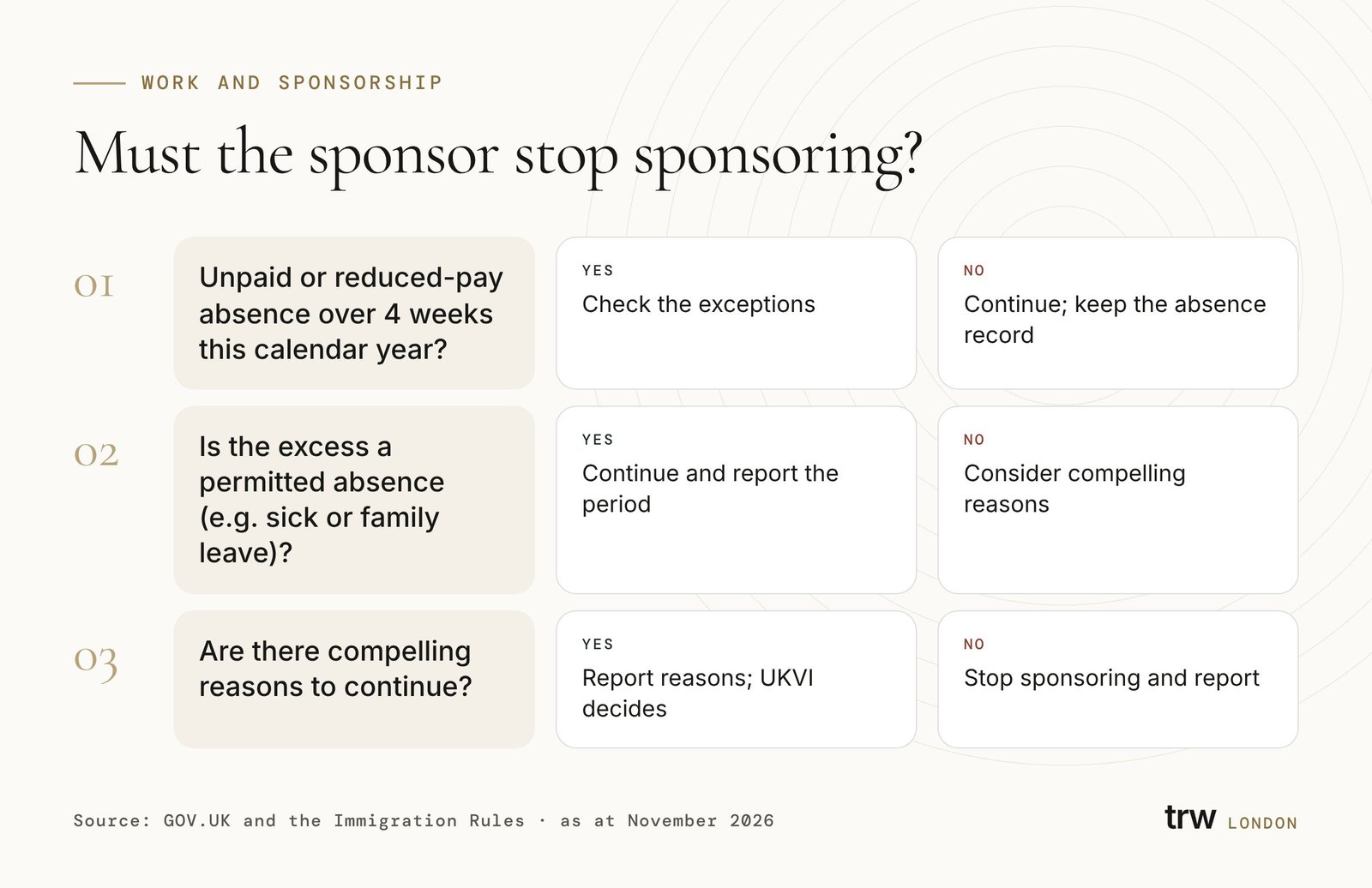
Section S4 of Part 2 says that, unless a valid exception applies, a sponsor must normally stop sponsoring a worker who is absent without pay, or on reduced pay, for more than four weeks in total in any calendar year (1 January to 31 December). For Scale-up Workers the period is the six months for which the sponsor has responsibility instead.
How the four weeks are counted
The four weeks are cumulative: one long period and several short ones are added together. They are measured against the worker's normal working pattern. Part 2 gives the arithmetic: a worker who normally works five days a week reaches four weeks at 20 working days; a worker on three days a week reaches it at 12 working days.
Because the count resets on 1 January, unpaid leave straddling the new year is split between two calendar years. That can help a worker whose leave is long but falls across December and January, but it is not a planning device to be relied on without checking the totals in each year.
What the sponsor must do
Once a worker has been, or will be, absent without pay or on reduced pay for more than four weeks in total, Part 2 gives the sponsor two options. It can stop sponsoring the worker and report that through the SMS. Or, if the absence is for a permitted reason or there are compelling reasons to continue, it can report the absence, including the reason, duration and any salary change, and continue. Shorter unpaid leave does not have to be reported, though Part 2 suggests that reporting it can help with monitoring.
Unpaid leave is counted in working days, across a calendar year, against the worker's own pattern. Most errors come from counting calendar weeks instead.
Absences that do not end sponsorship
Part 2 lists absences that do not, by themselves, require a sponsor to stop sponsoring, even if they are unpaid or on reduced pay:
- Statutory maternity, paternity, parental, shared parental and adoption leave
- Statutory neonatal care leave
- Sick leave
- Assisting with a national or international humanitarian or environmental crisis, where the sponsor agreed to the absence for that purpose
- Taking part in legally organised industrial action
- Jury service
- Attending court as a witness
The exception applies only if the worker would not otherwise have been absent without pay, or on reduced pay, for more than four weeks. In other words, permitted absence is set aside, but ordinary unpaid leave in the same year is still counted. Part 2 says the sponsor should still report the period of absence through the SMS.
For absences that are not on the list, such as a long unpaid sabbatical or extended compassionate leave, the sponsor may report compelling reasons for continuing sponsorship. UKVI considers them and may cancel the worker's permission if not satisfied, in which case sponsorship must stop. Employment-law rights to family leave are covered in our guide to family leave rights.
Before approving a request for unpaid leave from a sponsored worker, check their running total for the calendar year and record the decision. If the request would take them past four weeks and no listed exception applies, discuss the immigration consequences with the worker first; they may prefer paid leave or a shorter period.
Pay during and after a sponsored worker absence
Any salary reduction below the level on the certificate of sponsorship must be reported within 10 working days, whether or not linked to absence. Part 2 recognises some reductions that do not end sponsorship, provided they are reported. One is a temporary reduction in hours, or a phased return to work, for individual health reasons, supported by an occupational health assessment, where the hourly rate does not fall below any hourly rate requirement that applied at the worker's last grant.
For Skilled Workers, the timing of pay also matters. HC 1691 introduced a requirement that the salary be paid in each pay period, subject to permitted variations, rather than only averaged across a year. Employers should therefore look at the pay periods in which a sponsored worker absence occurred, not just the annual total, and check whether the variation is one the Rules permit under Appendix Skilled Worker.
Records matter here. Appendix D requires sponsors to keep a record of each sponsored worker's absences, alongside payslips and evidence of payment. A compliance officer comparing HMRC data with the certificate will see a dip in pay; the absence record is what explains it.
Reduction that can continue (report it)
- Phased return for health reasons with an occupational health assessment
- Unpaid absence within the four-week limit
- Permitted absence, such as statutory family leave or sick leave
- Reduction that still meets the route's salary requirements
Reduction that ends sponsorship
- Unpaid absence over four weeks with no exception or accepted compelling reason
- Revised salary no longer meets the salary, hourly or going rate requirement
- Change not otherwise permitted by the Rules or guidance
Holidays abroad, travel and remote working
Paid annual leave is not a reportable absence. Part 2 confirms that a sponsored worker who takes annual leave and goes home can return to the UK to resume work while their permission is valid. Workers who entered with entry clearance, or who were granted permission to stay for more than six months, can leave and re-enter as often as they wish.
There is an exception. Permission lapses on leaving the Common Travel Area where the worker was granted permission to stay for six months or less, has had their permission shortened so that less than six months remains, or entered under the Creative Worker visa concession. In those cases, a trip abroad ends the permission, and the worker needs a new grant to return.
Remote working raises separate issues. A sponsored worker moving to work entirely from home in the UK with little or no need to attend a workplace must be reported as a change of work location. Extended periods of working from overseas are not addressed in the general absence rules and can affect salary, tax and settlement calculations. We recommend taking advice before agreeing such an arrangement for a sponsored worker.
How absence affects the worker's path to settlement
For the worker, the question that matters most over five years is time outside the UK. GOV.UK's Skilled Worker settlement guidance says applicants must have spent no more than 180 days outside the UK in any 12 months. That limit counts physical absence from the UK, whether the time was paid leave, unpaid leave or business travel.
Employers have a part to play at settlement too. Part 2 says a sponsor must normally certify that a worker applying for settlement is still working for them and is required for the foreseeable future, and, where a minimum salary applies, that it will pay at least that amount. A long unpaid sponsored worker absence close to the application date can make those certifications harder to give.
Settlement policy is changing. The Home Office published its earned settlement response in November 2026, but it is announced policy, not law, and no implementation date has been set. For the current rules, see our guides to ILR absences and ILR for Skilled Workers.
If you are the sponsored worker
Most of the rules above are written for sponsors, but the consequences fall on the worker. If your employer stops sponsoring you, or the Home Office decides your absence was not justified, your permission can be cancelled. Knowing how a sponsored worker absence is treated lets you protect yourself before you agree to time off.
- Keep your own record. Note every day of unpaid leave or reduced pay in the calendar year, and every trip outside the UK with dates. Your employer's record and your own should match.
- Ask before you agree to unpaid leave. If you are close to four weeks of unpaid leave in the calendar year, ask HR how the new request will be counted and whether a listed exception applies.
- Report sickness and emergencies promptly. An absence the employer knows about and has agreed is not unauthorised. If you cannot work because of illness or an emergency abroad, tell your employer as soon as you can and keep evidence.
- Keep contact details current. Your employer must report your last known address, phone and personal email if you disappear from work. Make sure those details are right, and that your UKVI account is up to date before travelling.
- Take advice if sponsorship ends. If your employer tells you it has stopped sponsoring you, get advice quickly about a new sponsor or another route before your permission is cancelled.
Absence reporting is not a disciplinary process, and a report does not mean you have done anything wrong. A well-documented report that records a genuine reason, such as a hospital stay, can protect you if your history is reviewed in a later application.
Worked example: counting a part-time worker's unpaid leave
Example (hypothetical): a Skilled Worker at a London charity works three days a week, so her four-week limit is 12 working days. In February she takes 7 working days of unpaid leave for a family wedding overseas. In September she asks for 6 more unpaid working days to help a relative move house.
Her running total would be 13 working days, one over the limit. Neither absence is on the permitted list. The charity has three choices: agree the second period as paid annual leave instead; shorten it to 5 working days, keeping the total at 12; or approve it and report the absence with compelling reasons through the SMS, accepting that UKVI may disagree.
If she had instead been on sick leave in February, those days would have been set aside as permitted absence, and 6 days in September would have been well within the limit. In either case, the charity should keep the absence record and the decision on file. Her salary for each affected pay period should be checked against the Skilled Worker pay requirements.

Pitfalls in absence reporting
Counting calendar weeks instead of working days
Part 2 measures the four weeks against the worker's normal pattern. For part-time staff, the limit in working days is lower than many HR systems assume.
Treating unpaid leave as unauthorised absence
Approved unpaid leave is not unauthorised absence, so the 10-day report does not apply. But it counts towards the four-week limit and can still require action.
Forgetting reduced pay
Absence on reduced pay counts as well as absence with no pay. Reduced-pay sickness is protected as sick leave; reduced-pay leave for other reasons is not.
Silent payroll changes
Any reduction below the certificate salary must be reported within 10 working days. Absence reporting and salary reporting are separate duties.
Ignoring the worker's settlement position
An absence that is fine for the sponsor may still push the worker over 180 days outside the UK in a 12-month period. Workers should keep their own travel log.
Related guides
Sponsor reporting duties
Every reportable event and how the deadlines run.
Read the guideSettlementILR absences
How time outside the UK is counted for settlement.
Read the guideComplianceEmployer immigration audit
Testing absence records and pay against certificates.
Read the guideWorkSkilled Worker visa
Salary, skill and English requirements for the main route.
Read the guideNext steps
If a sponsored worker absence is approaching ten days without contact, or unpaid leave is approaching four weeks in the calendar year, decide now which report is needed and who will make it. Check the payroll for affected pay periods at the same time.
We advise sponsors on absence reporting, compelling reasons submissions and the settlement position of affected workers. To discuss a case, book a consultation, or see our sponsor compliance page.
Frequently asked questions
01Does paid annual leave count towards the four-week limit?
No. The limit applies to absence without pay or on reduced pay. Paid annual leave abroad does, however, count as time outside the UK for the worker's settlement calculation.
02Is sick leave on statutory sick pay a problem?
Sick leave is a listed permitted absence, so it does not by itself require the sponsor to stop sponsoring. The sponsor should still report a period over four weeks and keep records.
03What if the worker disappears and then comes back?
If the absence passed 10 consecutive working days, the report was still required. Update the Home Office with the return date and whether you will continue sponsoring.
04Can a worker take a sabbatical?
An unpaid sabbatical over four weeks is not a listed exception. The sponsor could report compelling reasons, but UKVI may cancel the worker's permission. Paid or partly paid arrangements need checking against the salary rules.
05Does the four-week rule apply to Scale-up Workers?
For Scale-up Workers the four weeks are measured over the period the sponsor has responsibility for them, rather than a calendar year.
06Do we need to report unpaid leave of two weeks?
Not under the four-week rule, though Part 2 suggests that reporting shorter absences can help monitoring. Any salary reduction below the certificate level must be reported in any event.
07Does parental leave affect the worker's ILR?
The sponsor rule treats statutory parental leave as permitted absence. For settlement, the question is time physically outside the UK and the other ILR requirements; check the current guidance before applying.
Sources and official materials
- Sponsor guidance Part 2: sponsor a worker (section S4) — Four-week rule, permitted absences and salary reductions
- Sponsor guidance Part 3: sponsor duties and compliance (section C1) — Unauthorised absence reporting
- Sponsor guidance Appendix D: keeping records — Absence records and payslips
- Indefinite leave to remain: Skilled Worker — 180-day absence limit for settlement
- HC 1691 explanatory memorandum — Salary to be paid in each pay period
- UK visa sponsorship for employers: your responsibilities — Attendance tracking and HR systems
General information only, current as at 19 November 2026. It is not legal advice and does not create a solicitor–client relationship. It reflects the law of England and Wales unless stated otherwise; Scotland and Northern Ireland have separate legal systems, and the law changes frequently. Check current official sources and take advice on the facts of your matter.