TRW & Co · Asylum, deportation and detention
The UK asylum claim process, step by step
You register an asylum claim in person at a screening interview, at the border or by appointment inside the UK. The Home Office then decides whether the claim can be considered here, interviews you about your fear of return and issues a written decision. There is no fixed timetable, and missed appointments or lost contact can end a claim.
Key pointYour claim does not exist until you attend screening, and it can be withdrawn without a decision if you miss reporting, the interview or the questionnaire deadline.
At a glance
Where to claim
In person at a port or, inside the UK, at an asylum intake unit by appointment.
Booking line
0300 123 4193, Monday to Friday, 9am to 5pm.
What to bring
Identity documents for everyone claiming, plus proof of your UK address.
Fee
GOV.UK lists no fee for registering an asylum claim.
Grant length
30 months for claims from 2 March 2026; 5 years for earlier claims.
Swipe or scroll →
The asylum claim process in short
The asylum claim process in the UK has four core stages: registration at a screening interview, a decision on whether the claim can be considered here, a substantive asylum interview with a caseworker, and a written decision. Some people now have a single combined interview instead. Throughout, the claimant must keep in contact with the Home Office, attend reporting events and send evidence on time, or the claim can be treated as withdrawn.
This guide follows the asylum claim process as set out on GOV.UK and in Part 11 of the Immigration Rules, as at November 2026. It is written for people about to claim, and for family, friends and support workers helping them.
The legal basis for the process
An asylum claim is a claim that removing someone from the UK would breach the UK's obligations under the 1951 Refugee Convention. Since the Nationality and Borders Act 2022, section 14 requires the claim to be made in person at a "designated place": an asylum intake unit, a removal centre, a port, or a place the claimant has been directed to by the Home Office.
Paragraph 327AB of Part 11 of the Immigration Rules mirrors this. An asylum application is recorded as valid only if it is made at a designated place, in person, by someone who is not a British citizen and, for adults, is "particularised", meaning it gives the substance of the fear. A claim that should be treated as further submissions after an earlier refusal is not a new valid application unless it is accepted as a fresh claim under paragraph 353.
Two consequences follow. A letter or email saying "I want asylum" is not a claim. And the date of registration matters: it fixes whether the 30-month or 5-year grant rules apply, and when asylum support can start.
Who can make an asylum application
GOV.UK says you must have left your country and be unable to go back because you fear persecution because of your race, religion, nationality, political opinion, or another characteristic that puts you at risk, such as gender, gender identity or sexual orientation, and you must have failed to get protection from the authorities there. If you are stateless, your own country is the one you usually live in.
You can include your partner and children under 18 as dependants if they are with you in the UK. They usually receive the same length of permission if you succeed, but they do not receive refugee status themselves unless they claim in their own right. Children's own protection needs are considered and they may receive a different outcome.
A dependant is only part of your asylum application once they have been registered at a screening appointment. If they arrive later, you must send a request to add them, with your details, their details, your relationship and any evidence such as a UK birth certificate, by email or post to the address on the GOV.UK guidance.
When an asylum application may not be considered in the UK
GOV.UK warns that a claim might not be considered if you are from an EU country, travelled to the UK through a safe third country, or have a connection to a safe third country where you could claim. A safe third country is generally one you are not a citizen of, where you would not be harmed, and which would not send you on to a country where you would be harmed. If the Home Office cannot arrange removal to such a country, the asylum application is considered in the UK after all.
Children with no adult relative claiming asylum can apply on their own. Those not in the care of social services use the walk-in service at the asylum intake unit; those in care book an appointment through the asylum intake unit appointments line.
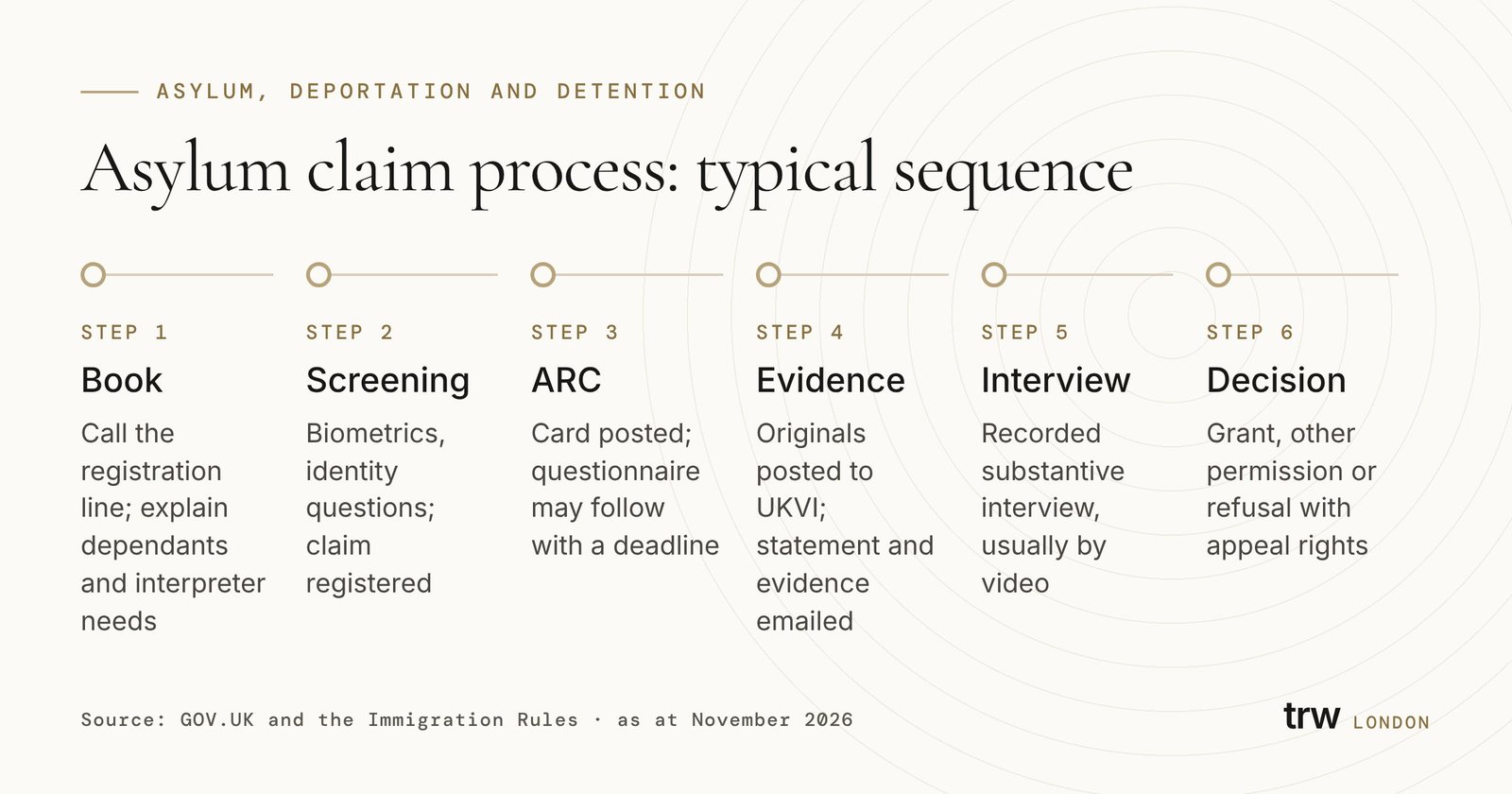
The asylum claim process step by step
- Claim at the border or book a screening. At a port, tell a Border Force officer you want to claim asylum. Inside the UK, call the asylum registration appointment line (0300 123 4193, Monday to Friday, 9am to 5pm). Do not turn up without an appointment.
- Attend the screening interview. You are photographed and fingerprinted, asked who you are and where you are from, and asked why you want asylum. Bring identity documents and proof of your UK address. Your claim is not registered until this appointment.
- Wait for the admissibility decision. The Home Office decides whether your claim can be considered in the UK or whether it may seek to send you to a safe third country.
- Receive your ARC and any questionnaire. An asylum registration card is posted to you unless you are detained. If a questionnaire arrives, complete and return it by the deadline in the covering letter.
- Send your documents and evidence. Post original birth certificate, passport and national ID card, with translations, to UKVI in Bilston, and email evidence of persecution to the Home Office address given on GOV.UK.
- Attend the substantive interview. Usually by video, recorded, with an interpreter. Tell the caseworker everything you want considered.
- Keep reporting and wait for the decision. Attend every reporting event, keep your address up to date, and send any further evidence agreed at interview.
After screening: what the Home Office expects of you
Once the screening interview is over, the asylum claim process moves to a caseworker if the claim can be considered in the UK. Your ARC is how you show who you are, whether you have permission to work, and your entitlement to health and education services. You must take it to every reporting event.
Tell your caseworker about any disability or medical needs. If your details change, contact the Asylum Human Rights Operations central communications hub. If the ARC does not arrive, or is lost, stolen or expired, use the Home Office online form with your Home Office or port reference.

Inside the screening interview
The screening interview registers the asylum application. Its purpose is identity, route and basic reasons, not a full account. According to GOV.UK's screening page, you will be photographed, have your fingerprints taken and be interviewed to check who you are and where you are from. You will be asked why you want asylum and can bring written evidence.
You must say whether you or your dependants take any medication and give relevant medical information. You can ask for a male or female interviewer, although that is not always available, and you can bring a legal representative and an interpreter. Dependants who are claiming with you must come too.
What to bring to screening
- Passports and travel documents for you and each dependant, if you have them.
- Identity documents: identity cards, birth and marriage certificates, school records.
- Proof of your UK address: a bank statement, council tax notice, tenancy agreement or household bill in your name.
- If you are staying with someone, a letter from them under 3 months old confirming you may stay, plus a document showing their name and address.
- Anything else you think will help, including medical letters and a list of medication.
Answers given at the screening interview are compared later with the questionnaire, statement and interview. Short, accurate answers are better than detailed guesses. If something is uncertain, say so; inconsistencies between the screening record and later evidence are a common basis for credibility challenges.
The Single Protection Interview
Nationals of EU and EEA countries, Switzerland, the USA, Canada, Japan, South Korea, Australia and New Zealand may instead be invited to a Single Protection Interview, which combines screening and the asylum interview, and a decision may follow straight after it. The claim is only registered if you attend. HC 259 also introduced "merged registration": one interview covering registration, screening and the basis of claim for claims the Home Office expects to be clearly unfounded, with other claims triaged back into the usual process.
Each stage at a glance
| Stage | What happens | Your main task | Main risk |
|---|---|---|---|
| Booking | Phone call to the registration line | Explain dependants, children, interpreter needs | Attending without an appointment |
| Screening interview | Registration, biometrics, identity and route questions | Bring documents; give accurate basics | Inconsistent dates or names |
| Admissibility | Safe third country check | Provide information on route and connections | Inadmissibility decision |
| ARC and questionnaire | Card posted; questionnaire may follow | Return the questionnaire on time | Implicit withdrawal for non-return |
| Evidence | Originals posted; evidence emailed | Serve a full witness statement | Late, untranslated documents |
| Substantive interview | Recorded interview with caseworker | Explain persecution and fear in full | Missing it without good reason |
| Decision | Grant, other permission or refusal | Diary the appeal deadline | Missing the 14-day window |
A well-run file at each stage of the asylum claim process has three things: a copy of everything sent and received, a dated note of every call or appointment, and a single chronology of the account that is updated whenever a new document arrives. When a decision is challenged later, that file is usually the most important evidence of what was said and when.
Timings, costs and living support
There is no published fixed timetable for the asylum claim process. GOV.UK says a decision is made as soon as possible but may take longer where documents need verifying, more interviews are needed or there are criminal matters. Under paragraph 333A, if no decision has been made within six months and you ask in writing, the Home Office must tell you about the delay and when to expect a decision, though that estimate is not binding.
GOV.UK's asylum pages do not list a fee for registering a claim. You cannot get help with travel costs to the registration appointment. If you have nowhere to live and no money, you can apply for asylum support, which can only start on the day the claim is registered; as at November 2026 the rate is £49.18 per person per week.
Asylum seekers cannot usually work. Permission to work can be sought only where the claim has been outstanding for more than 12 months through no fault of the claimant, and since HC 1691 it is limited to jobs at RQF level 6 or above in Appendix Skilled Occupations. Free help with the process is available from asylum helplines run by charities.
Detention during the asylum claim process
Some people are held in an immigration removal centre while their asylum application is decided. GOV.UK says people are not usually detained if they are children, elderly, a family with children, pregnant, accepted as victims of trafficking, able to provide independent evidence of torture, or have a condition that cannot be managed in detention. Anyone detained should seek advice on bail straight away; see our immigration detention page.
Pitfalls that end claims early
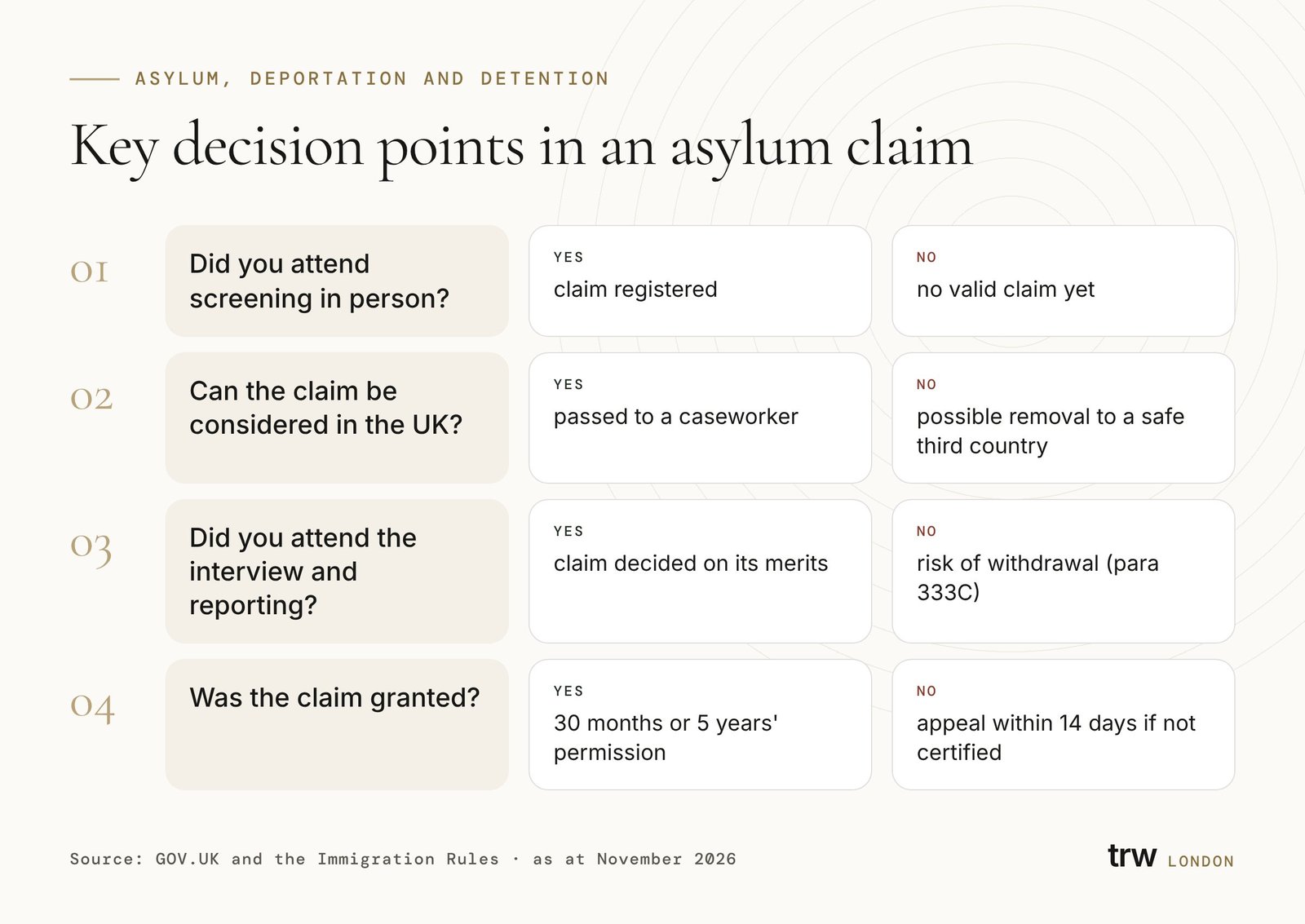
Paragraph 333C of Part 11 lists the ways an asylum application can be treated as withdrawn without any decision on its merits. Most are procedural and avoidable.
Losing contact or not updating your address
If you move, tell the Asylum Human Rights Operations central communications hub. A claim can be treated as withdrawn if you fail to maintain contact or provide up-to-date contact details.
Missing a reporting event
Reporting is a condition of your claim. Missing it can lead to withdrawal and possibly detention, unless you can show within a reasonable time that the failure was due to circumstances beyond your control.
Not returning the questionnaire
Failing to complete an asylum questionnaire when asked is a listed ground for implicit withdrawal. If you cannot complete it, call the number on the covering letter before the deadline.
Missing the interview
GOV.UK says you can only rearrange for reasons outside your control, such as illness (with medical evidence), severe travel disruption or unexpected childcare problems. Tell the Home Office before the interview or within 7 days after it. Without a reason, the claim will usually be withdrawn.
Travelling abroad
Leaving the UK without authorisation before the claim is decided can lead to it being treated as withdrawn.
Not mentioning medical or vulnerability needs
Health problems, pregnancy, trauma and disability affect how interviews are arranged and conducted. Raise them at the screening interview and again with your caseworker, with whatever medical evidence you have.
Giving false information
GOV.UK warns that giving false information can lead to up to 2 years in prison or removal from the UK.
Worked example
Example (hypothetical): a man arrives in London on a visit visa and, two months later, decides it is unsafe to return because of threats linked to his political activity. He calls the registration line, explains that his wife and 10-year-old son are with him, and books a screening appointment. He brings their passports, his son's birth certificate and a council tax bill from his cousin with a letter confirming they can stay.
At screening he gives a short account and his medication details. He then receives an ARC and a questionnaire, which he returns early. Before the interview he posts the original passports to Bilston and emails a full witness statement and party membership evidence. Because he claimed after arriving rather than at the border, the statement explains why: the threats began after he left. His interview is by video, and he sends a medical letter within the deadline agreed at the end of it.
Because his claim was made after 2 March 2026, a grant would give the family a minimum of 30 months' permission, renewable if protection is still needed. If refused, he would have a right of appeal under section 82 of the 2002 Act, to be lodged within 14 days (tribunal guidance).
Recent changes to the process
In force
- Claims and further submissions from 2 March 2026 lead to 30-month grants, not 5 years (HC 1691).
- Further submissions must now be made in person at a Service and Support Centre once appeal rights are exhausted, and can be treated as withdrawn for non-compliance.
- Merged registration interviews and the addition of EEA and Swiss nationals to the "no interview needed" list (HC 259).
- Permission to work limited to RQF 6+ jobs (HC 1691).
Proposed, not yet law
- A single "core protection" status replacing refugee status and humanitarian protection, in the Immigration and Asylum Bill.
- A new Independent Immigration Appeals Authority with one appeal and "claim notices" (Bill).
- Recovery of asylum support costs (Bill).
- No commencement dates have been set.
If you need to add new evidence to a claim that is still pending, GOV.UK explains how to submit new evidence.
Related guides
The substantive interview
How the main interview works and how credibility is assessed.
Read the guideProtectionAsylum support
Housing and weekly payments while the claim is decided.
Read the guideProtectionInadmissibility
Safe third country decisions and how they are challenged.
Read the guideRemediesTribunal appeals
Appealing a refusal to the First-tier Tribunal.
Read the guideNext steps
If you are preparing to claim, gather your documents and write down the key dates of what happened before the screening interview. If you have already been screened, the most valuable work before the substantive interview is a full witness statement prepared with an adviser. Our asylum solicitors in London can help at any stage of the asylum claim process.
For a confidential first meeting, book a consultation with TRW & Co.

Frequently asked questions
01Can I claim asylum by post or online?
No. Section 14 of the Nationality and Borders Act 2022 requires a claim to be made in person at a designated place, such as a port or asylum intake unit.
02Will I be asked about my whole story at screening?
You will be asked why you want asylum, but screening mainly checks identity, route and basic reasons. The detailed account is given at the substantive interview and in your witness statement.
03What is an ARC?
An asylum registration card shows you have applied for asylum. You use it to show who you are, whether you have permission to work, and to access health and education services, and you must take it to reporting events.
04Can I bring my own interpreter to screening?
GOV.UK says you can bring a legal representative and an interpreter to your screening appointment if you need them, and you should tell the booking line if you need an interpreter.
05Can I be detained during the process?
Yes, some claimants are detained, including where the Home Office thinks another country is responsible. GOV.UK says children, families with children, pregnant women and certain vulnerable adults will not usually be detained.
06How do I withdraw an asylum application?
GOV.UK asks you to email the asylum central communications hub as soon as possible, for example because you have been granted another form of permission. Take advice first, because withdrawal has consequences for later claims.
Sources and official materials
- Claim asylum in the UK (GOV.UK) — Screening, documents, interview and decisions.
- Immigration Rules Part 11: asylum — Validity (327AB), delays (333A) and withdrawal (333C).
- Nationality and Borders Act 2022, section 14 — Requirement to claim in person at a designated place.
- HC 259 explanatory memorandum — Merged registration and interview exemptions.
- HC 1691 explanatory memorandum — 30-month grants, further submissions and work rules.
- Asylum support (GOV.UK) — Housing and money while the claim is decided.
General information only, current as at 19 November 2026. It is not legal advice and does not create a solicitor–client relationship. It reflects the law of England and Wales unless stated otherwise; Scotland and Northern Ireland have separate legal systems, and the law changes frequently. Check current official sources and take advice on the facts of your matter.