TRW & Co · Asylum, deportation and detention
The asylum substantive interview: what happens and how to prepare

The substantive interview is where you tell a Home Office caseworker why you need protection. It is usually by video, scheduled for 2 to 3 hours, audio recorded and interpreted. Your answers are tested for detail, consistency and plausibility, so preparation, a prior witness statement and a careful check of the transcript afterwards make a real difference.
Key pointCaseworkers are told not to judge credibility on demeanour; they judge detail, consistency and plausibility, so the work is in preparing a clear, dated account and explaining weak points before they are raised.
At a glance
Legal basis
Paragraphs 339NA to 339NE of Part 11 of the Immigration Rules.
Format
Mostly video calls; audio recorded; interpreter provided free.
Length
Usually scheduled for 2 to 3 hours; follow-up interviews are possible.
Transcript
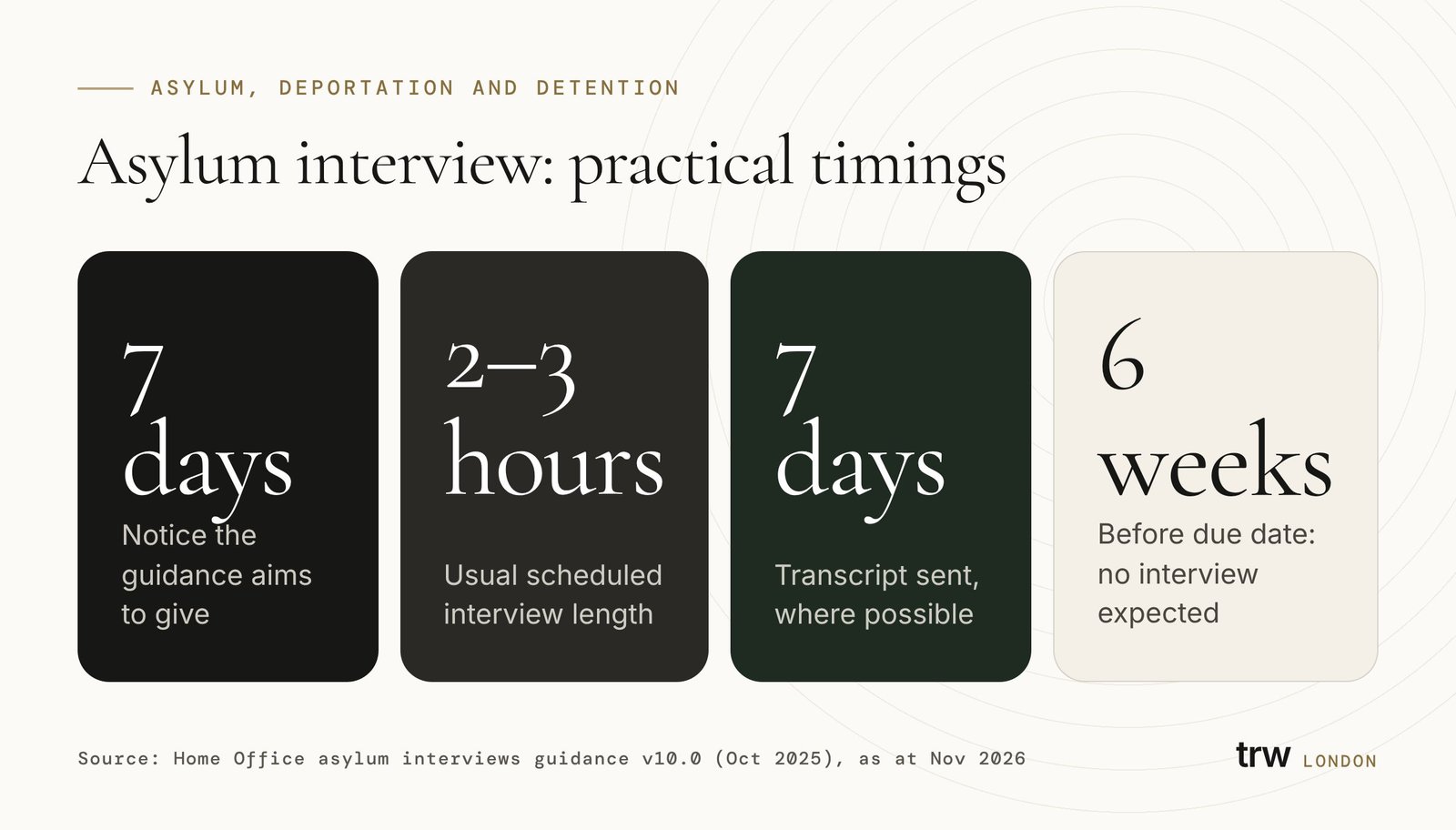
Sent within 7 days where possible; no playback of the recording.
Missing it
Without a reason outside your control, the claim is usually withdrawn.
Swipe or scroll →
The asylum substantive interview in brief
The asylum substantive interview is the main meeting between a person claiming asylum and a Home Office caseworker. It is where you explain how you were persecuted and why you are afraid to return. It usually takes place by video call, is audio recorded, and is conducted with an interpreter if you need one. You receive a transcript afterwards.
The Home Office's own guidance describes the claimant's oral testimony as usually the most important evidence, and often the only evidence, of their individual protection needs. This guide explains the rules that govern the asylum substantive interview as at November 2026, what happens before and during it, how credibility is judged, and what to do afterwards.
The legal basis for the interview
Paragraph 339NA of Part 11 of the Immigration Rules says that before a decision is taken the applicant "shall be given the opportunity of a personal interview" with someone legally competent to conduct it. Paragraphs 339NB to 339NE add safeguards: the interview normally takes place without family members, under conditions of confidentiality; a written report must be made and the applicant must have timely access to it; an interpreter is provided at public expense where necessary; and the interview may be audio recorded.
The interview can be omitted in listed cases, including where a grant can be made on the evidence already available, where the issues raised are irrelevant to protection, where the claimant is unfit to be interviewed because of enduring circumstances beyond their control, where the claimant is an EU, EEA or Swiss national, or where the claim is clearly unfounded.
Detailed practice is set out in the Home Office's asylum interviews caseworker guidance, version 10.0, published on 16 October 2025. Caseworkers must follow it, so it is also a useful checklist for claimants and representatives of what a fair asylum interview looks like.
Before the asylum interview
You will receive an invitation stating when and how the interview will take place and how long it is scheduled for. The caseworker guidance says invitations should be sent at least 7 days in advance where possible, and that interviews are usually scheduled for 2 to 3 hours, although they can be longer or shorter. A follow-up interview can be arranged if more information is needed.
Most asylum interviews take place over video call. If there is a reason you need an in-person interview, such as a hearing or sight impairment, mental health problems, or harm that involved being recorded, tell the Home Office as soon as possible with your reasons.
Preparing
- Send original identity documents. GOV.UK asks for your original birth certificate, passport and national ID card, and those of dependants, to be posted to UKVI before the interview, with translations that show who translated them.
- Email your evidence. Evidence of persecution and anything else that helps should be emailed to the Home Office address on GOV.UK's interview page. Send it before the interview if you can.
- Serve a witness statement. A written statement in your own words, in date order, gives the caseworker your account before the questions start and reduces the risk of important points being missed.
- Re-read your screening record and questionnaire. Note anything that was wrong or incomplete and explain it at the start of the interview or in your statement.
- Ask for the interviewer you need. If you want a male or female interviewer or interpreter, ask before the day. Requests made on the day are considered but may not be possible.
- Arrange childcare. Childcare is not available at interview sites, and parents are not expected to describe persecution in front of their children.
If your interview is by video
The guidance requires the claimant to stay on camera and clearly visible throughout. If the connection is lost, the interview must be paused and resumed only when a clear connection is restored. The interview is video and audio recorded as it happens, but only the audio is kept. The Home Office has also piloted interviews by video from the claimant's own accommodation or an adviser's office, excluding claimants considered high-risk or particularly vulnerable.
Who is in the room
| Person | Role | Key rules |
|---|---|---|
| Interviewing officer | Asks questions and records answers | Must explain the process, offer breaks and check you are fit to continue |
| Home Office interpreter | Interprets between you and the officer | Provided free; you should confirm you understand each other at the start |
| Your legal representative | Observes, raises concerns, comments at the end | Must be a solicitor or IAA-regulated adviser; the interview goes ahead without them |
| Representative's interpreter | Checks interpretation | Allowed; disagreements are normally raised at the end of the interview |
| Friend or supporter | Emotional, medical or spiritual support only | Advance notice; cannot be a family member or an asylum seeker; must not intervene |
| Your children | Usually not interviewed in a family claim | Babies may exceptionally be present if no childcare is available |
GOV.UK is clear that you cannot ask for more time to get a legal representative, and the caseworker guidance says unavailability of an adviser is not an acceptable reason to postpone. If you want a representative there, line them up as soon as the invitation arrives. Under paragraph 30 of Schedule 1 to LASPO 2012, legal aid for asylum does not include attending a Home Office interview unless regulations provide otherwise, so check funding early.
Children's claims are handled by officers trained to interview under-18s, and the Home Office must have regard to the welfare of children under section 55 of the Borders, Citizenship and Immigration Act 2009.
How the interview runs
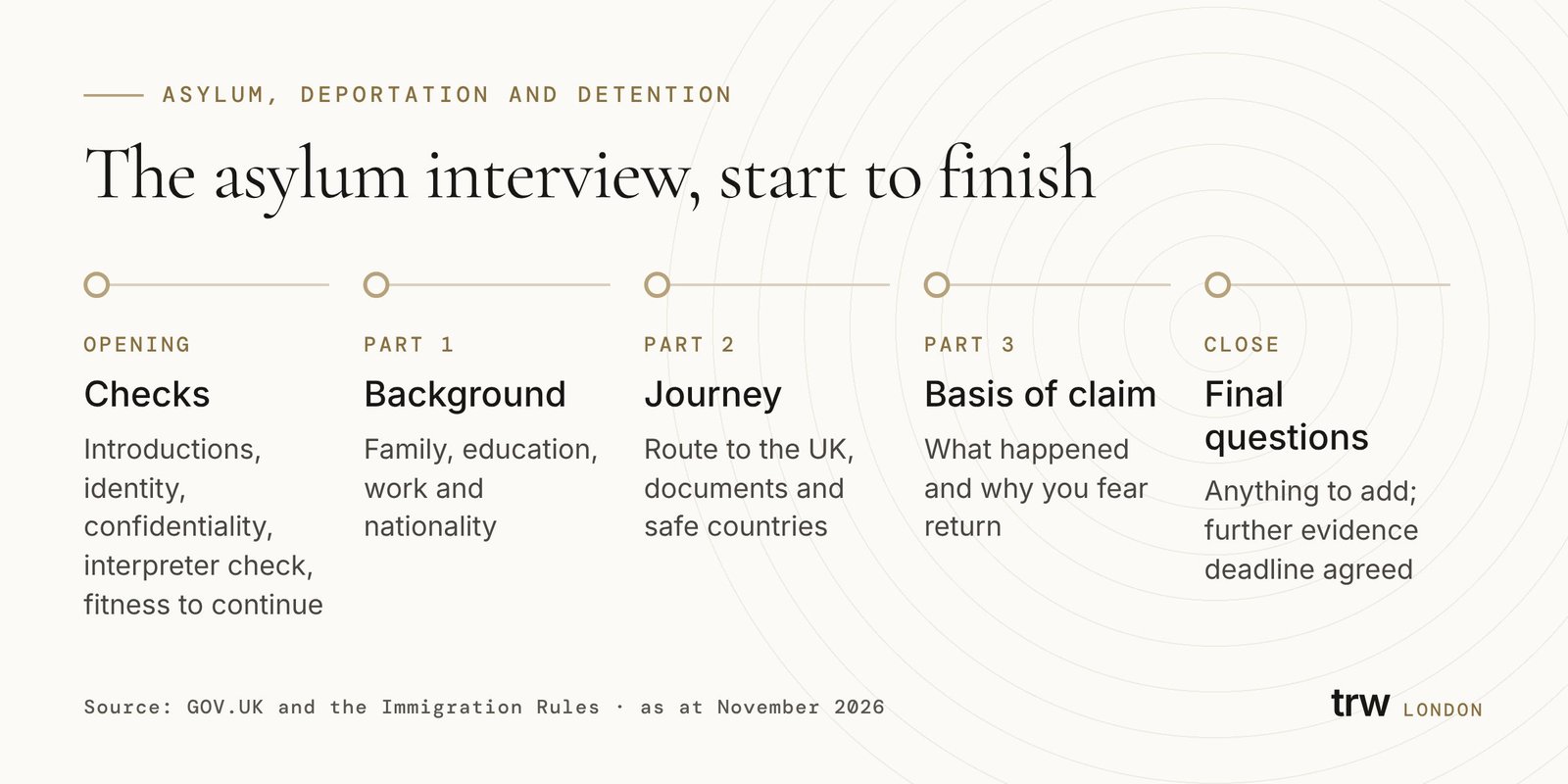
- Opening
Introductions and checks
The officer introduces everyone, confirms your identity and personal details, explains confidentiality, and checks that you understand the interpreter and feel fit to continue.
- Background
Identity and family
Questions about your background, family members (including those overseas), education and work, which help establish nationality and identity.
- Journey
Immigration history and route
How and when you left, the countries you passed through, and any claims elsewhere. Section 8 points such as documents and safe countries are raised here.
- Core
Basis of claim
Open questions about what happened to you and why you fear return, followed by more specific questions to clarify detail.
- Closing
Final questions
You are asked if there is anything to add, any other reasons to stay, whether you understood the questions, and whether you will send further evidence.
During the asylum substantive interview you can ask for a break at any time, and the guidance says taking one will not affect your claim. The officer should check on you after breaks and after sensitive topics. You do not have to answer upsetting questions straight away; you can say you need a moment, or ask to stop.
Survivors of torture and trauma
The asylum interview guidance contains specific advice on interviewing people who have experienced torture or other trauma, and the credibility guidance accepts that trauma can affect memory and disclosure. Officers may suggest that survivors speak to their adviser about medical evidence. Where a medico-legal report is planned, the asylum interview is the moment to say so and to agree time to submit it.
GOV.UK says you must tell the caseworker everything you want them to consider or it can count against you. If something is too difficult to say in the room, tell your representative so it can be put in writing after the interview within the agreed deadline.
How credibility is assessed
Credibility is the centre of most asylum decisions. The Home Office credibility guidance tells caseworkers to focus on the credibility of the claim rather than the claimant, and lists indicators of credibility. They are indicators only, not conditions; credibility can be established even where one is missing, and the evidence must be assessed "in the round".
For claims made since 28 June 2022, section 32 of the Nationality and Borders Act 2022 requires the facts about a claimant's characteristics and fear to be established on the balance of probabilities, with the benefit of the doubt applied where paragraph 339L is met.
| Indicator | What the caseworker looks for | How to prepare |
|---|---|---|
| Sufficiency of detail | Specific, personal detail about key events | Describe who, where, when and what you saw or heard |
| Internal consistency | The account matches across screening, statement and interview | Re-read earlier records and correct errors early |
| External consistency | The account fits country information | Provide or point to reliable country evidence |
| Consistency with other evidence | Documents and witnesses support the account | Explain each document: what it is, how you got it |
| Plausibility | Events are reasonably likely in context | Explain context that makes events understandable |
The guidance also says that a claimant's demeanour must not be used to assess credibility: whether someone is tearful, nervous or calm is irrelevant. It recognises that memory is affected by age, gender, health, trauma, learning difficulties and other factors, and that survivors of torture or sexual violence may find disclosure difficult or delay it.
Against that, section 8 of the 2004 Act requires decision-makers to treat certain behaviour as damaging credibility, such as failing without reasonable explanation to produce an identity document, destroying travel documents, or not claiming in a safe country when there was a reasonable opportunity. The interview is the place to explain these points.
Religion, conversion, sexual orientation and gender
Some claims carry their own credibility guidance. For religious claims, the guidance says it is reasonable to expect knowledge of the core elements of a faith, but credibility must not depend solely on a knowledge test, and questions about conversion should focus on the person's journey and motivation. Caseworkers are not expected to quiz claimants on detailed doctrine.
Claims based on sexual orientation, gender identity or gender-based harm are subject to separate Home Office guidance. The credibility guidance recognises that such harm often takes place in private, may not be considered wrong in the claimant's community, and may be disclosed late. Representatives should prepare these interviews with particular care for privacy and wording.
A clear explanation of a weak point, given early, is worth more than a polished account that leaves it unexplained.
After the interview: transcript and further evidence
After the asylum substantive interview you get a copy of the interview record. For in-person interviews it is usually handed to you at the end; otherwise the transcript should be sent to you and your representative, by email, post or the Home Office portals, within 7 days where possible. The audio recording can be provided on request. You must not record the interview yourself or share the transcript or recording publicly.
Officers may not play back the recording to you, and reading over the transcript happens only in exceptional circumstances. Check the transcript carefully as soon as you receive it and send written corrections and clarifications promptly through your representative.
Further evidence
If the officer asks for more evidence, or you ask for time to provide it, a deadline should be agreed, recorded on the transcript and given to you in writing. The guidance says no negative decision should be made until that period has passed. You can ask in writing for an extension. If nothing arrives in time, the decision is made on the evidence already available.
A decision may follow the interview, subject to country research. The Home Office can also send written questions or invite you to a further interview. Sexually explicit material has no evidential value and must not be submitted.
- Read the transcript the day it arrives and list every error, omission and mistranslation.
- Send corrections in writing within the agreed timescale, with an explanation.
- Send every item of further evidence agreed at interview, translated, before the deadline.
- Keep proof of what was sent and when.
- Keep attending reporting events and keep your address up to date.
Rescheduling, illness and non-attendance
Can I move the interview date?
Only for reasons outside your control, such as an unmovable medical or maternity appointment, severe travel disruption, unexpected childcare problems or illness on the day. Tell the Home Office before the interview or no more than 7 days after it.
What evidence do I need if I am ill?
A letter or certificate from a GP, consultant or other regulated healthcare professional. If the claim is that you are unfit to be interviewed at all, the medical evidence should address that question directly.
I am pregnant. Do I have to attend?
Claimants are not expected to attend in the 6 weeks before their due date, and interviews should not normally be arranged until at least 6 weeks after the birth. Complications can justify more flexibility with medical evidence.
What reasons will not be accepted?
The guidance lists unavailability of your adviser or interpreter, college attendance and, where you have permission to work, work commitments. Interviews also normally go ahead during religious festivals or fasting, with reasonable adjustments.
What happens if I miss it?
Without a reason outside your control, the claim will usually be treated as withdrawn under paragraph 333C. You would then have to claim again.
Eight mistakes to avoid
These are the errors we most often see when reviewing an asylum substantive interview record after a refusal. Each one is avoidable with preparation.
- Guessing dates. Say when you are unsure and explain how you know roughly when something happened.
- Leaving out the hardest part. Anything not mentioned can count against you later; if it cannot be said aloud, it should be put in writing.
- Contradicting the screening record without explanation. Correct earlier errors at the start, not when challenged.
- Not saying you misunderstood a question. Ask for it to be repeated or rephrased; the closing questions specifically invite this.
- Ignoring interpreter problems. Raise dialect or understanding problems immediately and record them.
- Bringing undocumented papers. Be ready to say what each document is, who issued it and how it reached you.
- Missing the further evidence deadline. Diary it the same day and ask for an extension in writing before it expires if needed.
- Not checking the transcript. Errors left uncorrected become part of the record that the decision, and any appeal, relies on.
Worked example
Example (hypothetical): a young woman claims asylum because of a forced marriage and threats from her family. At screening she gave only a short reason and asked for a female interviewer. Before her asylum substantive interview, her representative serves a statement that sets out the events in date order, explains why she did not mention sexual violence at screening, and attaches a GP letter about her sleep and anxiety.
At interview she asks for breaks twice; the officer records them. When asked about the date she left, she says she is unsure and explains how she worked it out, rather than guessing. At the end she says she wants to add a letter from a support worker, and a 10-day deadline is agreed and written down. Her representative sends the letter and transcript corrections within that time. None of this guarantees a grant, but it means the decision is made on a complete and fair record.
Related guides
The asylum claim process
From booking screening to the decision, stage by stage.
Read the guideProtectionAsylum solicitors
How our team prepares statements and evidence.
Read the guideProtectionRefugee status
What a grant gives you after a successful interview.
Read the guideRemediesFresh claims
New evidence after appeal rights are exhausted.
Read the guideNext steps
If you have an invitation to an asylum interview, the time before it is the most valuable time in the case. A representative can help you prepare a statement, identify the points the Home Office is likely to raise, and plan how to deal with anything difficult to say aloud. Our asylum solicitors in London work on interview preparation and post-interview representations.
For a confidential meeting about your asylum substantive interview, book a consultation.
Frequently asked questions
01Is the asylum interview the same as the screening interview?
No. Screening registers the claim and checks identity and route. The substantive interview examines the reasons for the claim in depth. Some nationals receive a single combined interview instead.
02Can I bring documents on the day?
Yes, but it is better to send them in advance. Documents produced at interview are listed on the record with your answers about what they are and how you obtained them, and foreign-language documents need translations within an agreed period.
03What if the interpreter speaks a different dialect?
Say so at the start. The officer must confirm that you understand each other and, if not, find another interpreter or postpone. If you only realise later, raise it in writing straight away with examples.
04Will what I say be shared with my government?
GOV.UK says the information you give is confidential and will not be shared with the authorities in your country. Paragraph 339IA of the Rules prohibits disclosure to the alleged persecutors.
05Can my representative speak during the interview?
Representatives are welcome to attend and are invited to comment at the end. Professional conduct rules apply, and the officer remains in charge of the interview.
06Can I ask to read back my answers?
Read-backs are allowed only in exceptional circumstances and officers must not play back the recording. Use the transcript, which you will receive afterwards, to make written corrections.
07How long after the interview will I get a decision?
There is no fixed period. A decision can follow soon after if no further evidence is awaited, but it may take longer if documents need checking or more questions are needed.
Sources and official materials
- Asylum interviews: caseworker guidance (version 10.0) — How interviews are arranged, conducted and recorded.
- Assessing credibility and refugee status (claims from 28 June 2022) — Credibility indicators and underlying factors.
- Claim asylum: asylum interview (GOV.UK) — Official guidance for claimants.
- Immigration Rules Part 11: asylum — Paragraphs 333C, 339L and 339NA to 339NE.
- Asylum and Immigration (Treatment of Claimants, etc.) Act 2004, section 8 — Behaviour damaging credibility.
- Nationality and Borders Act 2022, section 32 — Standard of proof.
General information only, current as at 19 November 2026. It is not legal advice and does not create a solicitor–client relationship. It reflects the law of England and Wales unless stated otherwise; Scotland and Northern Ireland have separate legal systems, and the law changes frequently. Check current official sources and take advice on the facts of your matter.