
TRW & Co · Private client disputes
Contentious probate time limits in England and Wales

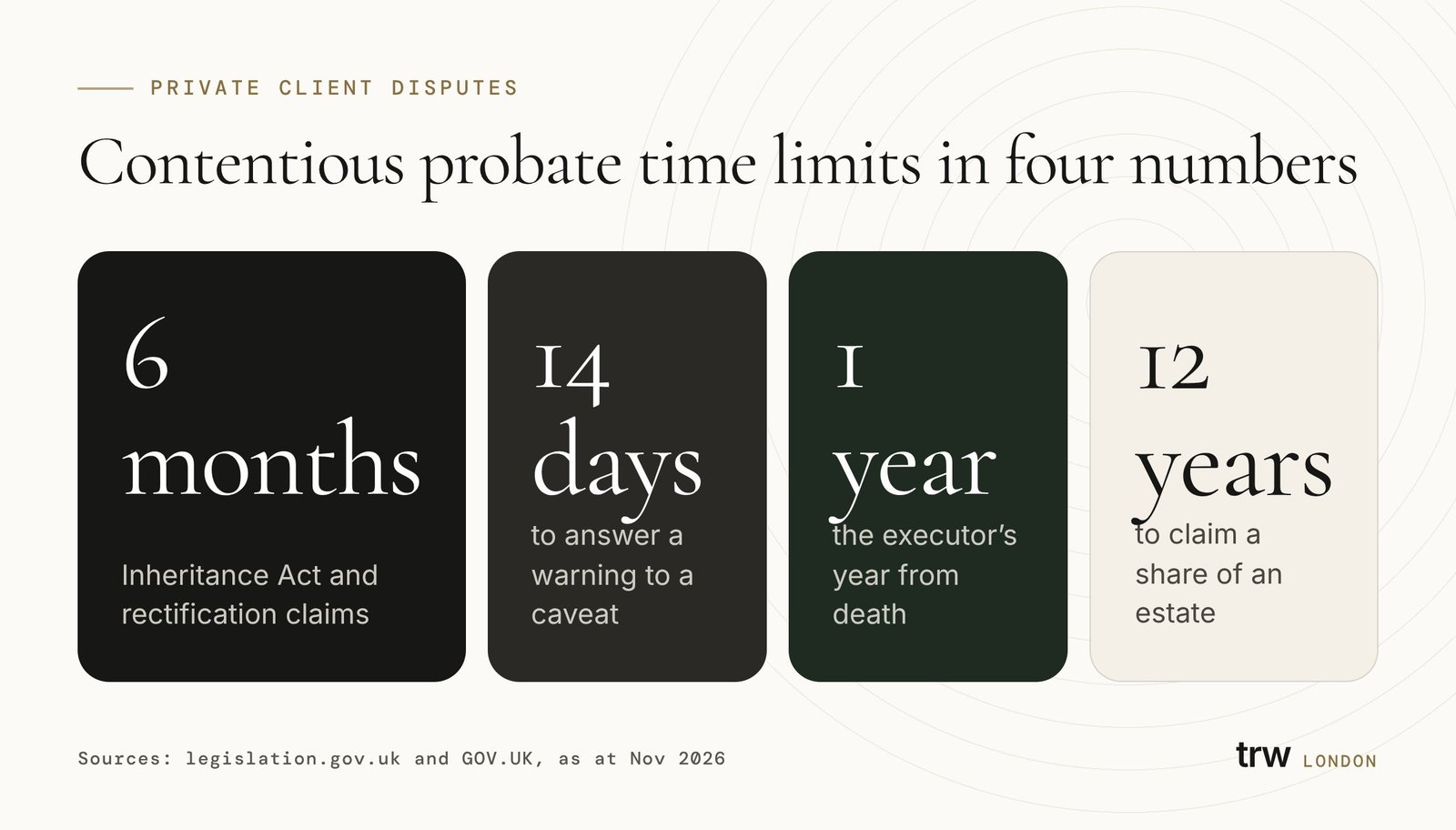
An Inheritance Act claim and a claim to rectify a will must be issued within six months of the first grant of representation, unless the court gives permission. A challenge to a will’s validity has no fixed statutory period, but delay risks distribution and lost evidence. Claims against executors usually run for six or twelve years under the Limitation Act 1980.
Key pointMost of the important deadlines run from the first grant, not the death, so knowing the exact date of that grant is the first job in any estate dispute.
At a glance
Inheritance Act
Six months from the first grant; later only with the court’s permission (s.4).
Rectification
Six months from the first grant for clerical errors or misunderstood instructions (s.20 AJA 1982).
Validity challenges
No fixed statutory period, but act before the estate is distributed.
Caveats
Last six months, cost £4 and must be defended within 14 days of a warning.
Estate shares
Twelve years under s.22 Limitation Act 1980; no limit for fraud or retained property.
Swipe or scroll →
Contentious probate time limits: the short answer
Contentious probate time limits are shorter and less forgiving than most people expect. The headline rule is that an Inheritance Act claim for reasonable financial provision must be issued within six months of the date the first grant of representation is taken out, unless the court gives permission to bring it later. A claim to rectify a will that contains a clerical error runs to the same six-month clock.
The difficulty is that contentious probate time limits start at different moments: the grant, the death, the date a beneficiary became entitled to be paid, or the date a fraud was discovered. A family waiting for documents or hoping a conversation will resolve matters can lose a right simply by letting a date pass. This guide sets out each deadline under the law of England and Wales as at November 2026, and the calculator below turns your dates into a working timetable.
If you already know you want to dispute a will or an estate, our contentious probate solicitors in London page explains how we act. If you are still working out whether you have a claim at all, start with our guide to contesting a will and read on for the dates.
Contentious probate deadline calculator
Interactive tool
Contentious probate time limits calculator
Enter the date of death and the date of the first grant to see the main contentious probate time limits: the six-month, one-year and twelve-year markers. It gives working dates, not legal advice, and does not decide whether a late claim would be allowed.
Without JavaScript: an Inheritance Act claim and a rectification claim must be issued within six months of the first grant unless the court gives permission. Personal representatives are protected if they distribute after those six months. They need not distribute before one year from death. A claim to a share of the estate is generally barred twelve years after the right to receive it accrued, which cannot be earlier than the grant. A caveat lasts six months unless extended.
The calculator counts calendar months by the corresponding date. Treat the last day as a cliff edge, not a target: a court office closure or payment problem on the final day is your risk, not the estate’s.
The Inheritance Act claim deadline: six months from the grant
The Inheritance (Provision for Family and Dependants) Act 1975 lets certain people ask the court for reasonable financial provision from an estate where the will, the intestacy rules or a combination of the two do not make it. Section 4 of the 1975 Act says an application shall not, except with the permission of the court, be made after the end of six months from the date on which representation with respect to the estate is first taken out. That is the Inheritance Act claim deadline, and it is the date most likely to decide a dispute before anyone has looked at its merits.
Three details matter. First, the clock runs from the first grant, whether probate or letters of administration; later replacement grants do not restart it. Second, since 1 October 2014 the Act expressly says that nothing prevents an application being made before representation is first taken out, so a claimant does not have to wait for the executors. Third, the six months is a period for issuing the claim at court, not for writing a letter of claim.
Who may claim before the Inheritance Act claim deadline is set by section 1. The deceased must have died domiciled in England and Wales. Applicants include a spouse or civil partner, a former spouse or civil partner who has not remarried or formed a new civil partnership, a cohabitant who lived with the deceased as a couple for the whole of the two years before the death, a child, a person treated as a child of the family, and anyone who was being wholly or partly maintained by the deceased immediately before death. A surviving spouse or civil partner is judged against a more generous standard than other applicants.
The deadline also protects the executors. Under section 20, personal representatives are not liable for distributing the estate after the six months simply because the court might later allow a late claim. That is why executors often wait until the six-month point before paying out residue, and why the Inheritance Act claim deadline should be treated as the moment the estate can start to leave reach. Our page on Inheritance Act claims explains the merits test in more depth.
Late claims after the Inheritance Act claim deadline
Missing the Inheritance Act claim deadline is serious but not always fatal. Section 4 gives the court a discretion to allow a claim out of time. The most cited modern statement is the Court of Appeal’s decision in Cowan v Foreman [2019] EWCA Civ 1336, where a widow was allowed to bring a claim issued nearly 17 months after the six-month period had expired. The court stressed that the burden is on the applicant, that the discretion must be exercised judicially and that the six-month limit exists to bring a measure of certainty for personal representatives and beneficiaries.
The factors drawn from earlier cases and applied in Cowan include how promptly the applicant acted, whether negotiations began within the six months, whether the estate has already been distributed, whether refusing permission would leave the applicant with no other remedy (for example against a solicitor), and whether the claim has a real rather than fanciful prospect of success. A good reason is not needed for every week of delay; the court looks at the case as a whole. Distribution of the estate is important but not decisive.
Cowan v Foreman also approved written standstill agreements between the parties, but the court said they cannot bind the court. If you agree a standstill, put it in writing, set its duration, include every potential party and apply for permission by consent if proceedings are later issued. An informal email exchange is not a substitute.
The six-month limit is a date for issuing a claim at court, not for opening negotiations.
Is there a time limit to contest a will?
People asking about the time limit to contest a will usually mean a challenge to the will’s validity: that the person lacked testamentary capacity, did not know and approve of the contents, was subject to undue influence, or that the will was forged or not properly signed and witnessed. No section of the Limitation Act 1980 sets a fixed period for a probate claim asking the court to pronounce against a will or to revoke a grant. That does not mean time is irrelevant. Delay makes evidence harder to find, allows the estate to be distributed and can support arguments that a claimant accepted the position.
The practical time limit to contest a will is therefore set by events rather than statute. Before a grant, a caveat can stop probate issuing while the will is investigated. After a grant, the challenge is brought as a probate claim under Part 57 of the Civil Procedure Rules, and every month that passes makes it more likely that property has been sold or money spent. In practice, assume the time limit to contest a will is running from the death.
Rectification is different, and does have a statutory deadline. Under section 20 of the Administration of Justice Act 1982, the court can rectify a will that fails to carry out the testator’s intentions because of a clerical error or a failure to understand instructions. The application must be made within six months of the first grant unless the court gives permission, mirroring the Inheritance Act claim deadline, and personal representatives are again protected if they distribute after that period.
| Claim or step | Time limit | Runs from | Source |
|---|---|---|---|
| Inheritance Act claim | 6 months (later with permission) | First grant of representation | s.4 I(PFD)A 1975 |
| Rectification of a will | 6 months (later with permission) | First grant of representation | s.20 AJA 1982 |
| Challenge to validity (capacity, undue influence, formality, forgery) | No fixed statutory period; delay and distribution are real risks | In practice, the death | CPR Part 57 |
| Caveat | 6 months, can be extended | Date entered | GOV.UK / NCPR 1987 |
| Reply to a warning to a caveat | 14 days | Service of the warning | GOV.UK |
| Claim to a share of personal estate | 12 years | When the right to receive accrued | s.22(a) LA 1980 |
| Arrears of interest on a legacy | 6 years | When the interest became due | s.22(b) LA 1980 |
| Breach of trust (no fraud) | 6 years | When the right of action accrued | s.21(3) LA 1980 |
| Fraud, or estate property kept by the executor | No limitation period | Not applicable | s.21(1) LA 1980 |
Caveats, warnings and the 14-day reply
A caveat is a notice entered at the Probate Registry that stops a grant being issued while it is in force. According to GOV.UK’s guidance on stopping a probate application, it lasts six months at first and can be extended for another six months. The fee is £4 to enter a caveat as at November 2026, and it can be entered online or by post on form PA8A. Since the Non-Contentious Probate (Amendment) Rules 2025 came into force on 3 November 2025, a caveat can no longer be entered in person at a registry.
A caveat is a holding measure, not a claim. The person applying for probate can respond by issuing a warning. GOV.UK explains that the person who entered the caveat then has 14 days, including weekends and bank holidays, to respond by entering an appearance or issuing a summons. If they do nothing, the caveat is removed and the application continues. Entering an appearance turns a paper notice into a live dispute that will normally need to be resolved by agreement or by a probate claim.
GOV.UK warns that entering a caveat can lead to legal action and costs. Use one to buy time for a real investigation of the will file and medical records, not as leverage; the caveat itself does not extend any of the other contentious probate time limits.
Claims against executors: the Limitation Act periods
Once an estate is in administration, disputes often shift from whether the will is valid to how the executors are handling it. Here the Limitation Act 1980 applies. Section 22(a) bars an action for a share of a deceased person’s personal estate twelve years after the date the right to receive the share accrued. Section 22(b) gives six years to recover arrears of interest on a legacy. Section 21(3) gives six years for a claim for breach of trust that is not covered by another provision.
When does the twelve years start? In Re Loftus [2006] EWCA Civ 1124, the Court of Appeal held that the period could not begin before the grant of letters of administration, and Chadwick LJ preferred the view that it runs from when the administrator was in a position to distribute residue, rather than necessarily from the end of the executor’s year. The calculator therefore shows only the earliest date the period could end.
Two rules can remove the deadline altogether. Section 21(1) disapplies limitation for claims by a beneficiary in respect of fraud to which the trustee was a party, and for claims to recover trust property, or its proceeds, still held by the trustee or converted to their own use.
Re Loftus confirmed that a personal representative is a trustee for these purposes, so these contentious probate time limits fall away where an executor has helped themselves. Separately, section 32 postpones the start of a limitation period where there was fraud, deliberate concealment or mistake, until the claimant discovered it or could with reasonable diligence have done so. The court in Loftus also noted that equitable defences such as laches can still apply to a claim with no limitation period.

How contentious probate time limits fit the administration
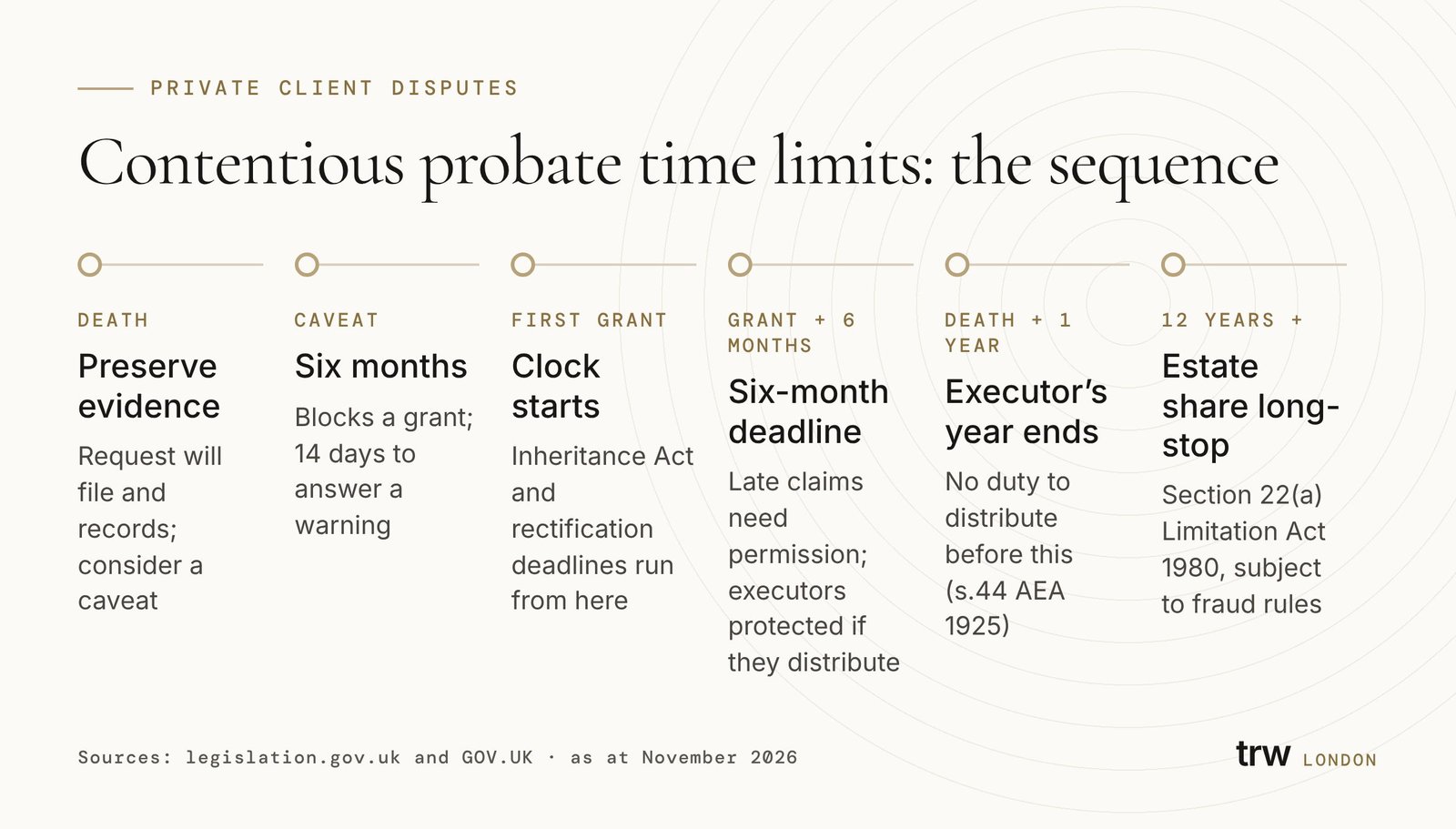
It helps to see contentious probate time limits alongside the normal rhythm of an estate. Personal representatives must collect assets, pay debts and tax, and only then distribute. Section 44 of the Administration of Estates Act 1925 says a personal representative is not bound to distribute before one year from the death, which is the origin of the phrase “executor’s year”. The table of rights on one side and the administration on the other produces a sequence most families can follow:
- Death
Preserve the evidence
Ask for the will file and medical records early; enter a caveat if validity is in doubt.
- Before the grant
Caveat and early claims
An Inheritance Act claim may be issued before any grant; a caveat lasts six months.
- First grant
The six-month clock starts
Inheritance Act and rectification deadlines both run from this date.
- Grant + 6 months
Distribution protection
Executors who distribute after this point are protected under s.20 of the 1975 Act and s.20 of the 1982 Act.
- Death + 1 year
Executor’s year ends
Beneficiaries can press harder for distribution and accounts.
- Grant + 12 years or later
Long-stop for estate shares
Section 22(a) bars most claims to a share of personal estate, subject to fraud and concealment rules.
A claimant who writes before the Inheritance Act claim deadline, sets out the basis of the claim and asks the executors to hold back distribution gives the court a clear record if permission is later needed. Executors who receive such a letter should take advice before distributing, because section 20 protects them only against the possibility of a late claim.
Common pitfalls with contentious probate time limits
Counting from the death instead of the grant
The Inheritance Act claim deadline runs from the first grant. People who count from the death think they have more or less time than they do. If no grant has been taken out, check the probate search service regularly, or enter a standing search, so you know when the clock starts.
Treating a letter of claim as stopping the clock
Only issuing a claim at court satisfies section 4. A written standstill agreement and negotiations within the six months can support a later application for permission, but neither extends the deadline by itself or binds the court.
Assuming no time limit to contest a will means no urgency
There is no fixed statutory time limit to contest a will on validity grounds, but the estate can be distributed and evidence lost. Courts look at delay when deciding costs and remedies, and assets that have left the estate are harder to recover.
Letting a caveat lapse
A caveat lasts six months unless extended. Diarise the extension well before expiry. A lapsed caveat allows a grant to issue, which starts the Inheritance Act claim deadline and the rectification clock.
Missing the 14 days after a warning
The 14 days include weekends and bank holidays. If the caveator does not enter an appearance or issue a summons in time, the caveat is removed. Calendar the date the day the warning arrives.
Each mistake is avoidable with a diary and early advice. The calculator gives you the contentious probate time limits; the harder task is deciding which claim, if any, you have. Our guide to what contentious probate is walks through the main types of claim and includes a short decision tool.
Worked example: two contentious probate time limits at once
Example: a widower dies on 12 February 2026, domiciled in England. His 2024 will leaves his whole estate to his second wife. His adult daughter from his first marriage had been living in a flat he owned and receiving monthly payments from him. His executors obtain probate on 30 June 2026. The daughter has two possible claims, and they run on different clocks.
Her Inheritance Act claim, as a child who was also being maintained, must be issued by 30 December 2026, the end of six months from the first grant, unless the court later gives permission. The executors could distribute after that date without personal liability for having done so. Separately, she believes her father’s memory was failing when he made the 2024 will. That validity challenge has no fixed statutory period, but she should raise it quickly and, ideally, before distribution. If she waits until spring 2027 to decide, her Inheritance Act claim will already need permission and the estate may have been paid out.
A sensible plan is to write to the executors in summer 2026, ask them to hold the estate, request the will file and medical records and propose a written standstill. If that is refused, she should issue before 30 December 2026. The calculator’s default dates reproduce this example.
Reform proposals: will contentious probate time limits change?
On 16 May 2025 the Law Commission published its report on modernising wills law with a draft bill. According to the Law Commission’s announcement, it recommends a single test of testamentary capacity based on the Mental Capacity Act 2005, electronic wills, a power for the court to treat informal records as valid wills where intentions are clear, abolition of the rule that marriage revokes a will, an easier route to prove undue influence, and a minimum will-making age of 16. These are recommendations only. As at November 2026 they have not been enacted, and it is for the government to decide whether to implement them.
None of the contentious probate time limits in this guide has changed as a result. The procedural changes that did take effect were the 2025 amendments to the Non-Contentious Probate Rules and the July 2026 increase in the caveat fee to £4.
Fees and procedure change more often than limitation periods. Check the current GOV.UK fee and caveat pages before you file anything, and keep a note of the date and time each step was taken.
Contesting a will
Grounds, evidence and the route to a probate claim.
Read the guideDisputesInheritance Act claims
Who can claim and how the court assesses provision.
Read the guideEstatesThe probate process
How grants are obtained and estates administered.
Read the guideOur teamContentious probate solicitors
How we act in will and estate disputes in London.
Read the guide
Next steps
Write down the date of death, check whether a grant has been issued and, if it has, the exact date of the first grant. Use the calculator to set the six-month and one-year markers. If you are a potential claimant, put the executors on notice in writing and ask them not to distribute. If you are an executor, keep a record of any notice you receive and take advice before paying out residue. Where the dispute may involve a family member’s mental capacity during life, our Court of Protection team can help with the related records.
We usually start by reviewing the will, the grant and any correspondence, then confirm in writing which deadlines apply and which steps must be taken first. To speak to us about contentious probate time limits, an Inheritance Act claim deadline or the time limit to contest a will, book a consultation.
Frequently asked questions
01Can I bring an Inheritance Act claim before probate is granted?
Yes. Since October 2014, section 4 of the 1975 Act expressly allows a claim before representation is first taken out. That can be useful where executors are delaying the grant or where assets may be dissipated.
02Does a second grant restart the six months?
No. The period runs from the date representation is first taken out. Certain limited grants, such as grants limited to trust property, are disregarded when working out that date; section 20(4) of the Administration of Justice Act 1982 lists them for rectification claims.
03Is a standstill agreement enough to protect a late claim?
It helps but does not bind the court. The Court of Appeal in Cowan v Foreman said written standstills between represented parties are unlikely to be refused, but the claimant still needs the court’s permission once the six months has passed.
04How much does a caveat cost and how long does it last?
It costs £4 as at November 2026 and lasts six months, after which it can be extended. It must be defended within 14 days if the applicant for probate issues a warning.
05What if the executor has kept estate money for themselves?
Section 21(1)(b) of the Limitation Act 1980 means no limitation period applies to recovering trust property, or its proceeds, retained by or converted by the trustee, and a personal representative counts as a trustee for this purpose.
06Does the time limit to contest a will change if I only found out about the will recently?
Validity challenges have no fixed statutory period, so late discovery is relevant mainly to delay and remedies. For Inheritance Act and rectification claims, late knowledge is one of the factors the court weighs when deciding whether to give permission out of time.
07Do these rules apply in Scotland or Northern Ireland?
No. This guide covers England and Wales. Scotland has a different system of legal rights, and Northern Ireland has its own legislation and caveat rules.
Sources and official materials
- Inheritance (Provision for Family and Dependants) Act 1975, s.4 — Six-month time limit and claims before a grant
- Inheritance (Provision for Family and Dependants) Act 1975, s.20 — Protection for personal representatives after six months
- Administration of Justice Act 1982, s.20 — Rectification of wills and its six-month limit
- Limitation Act 1980, ss.21, 22 and 32 — Estate, trust and fraud limitation rules
- Administration of Estates Act 1925, s.44 — The executor’s year
- Cowan v Foreman [2019] EWCA Civ 1336 — Permission for late Inheritance Act claims; standstill agreements
- Re Loftus [2006] EWCA Civ 1124 — When the s.22 period starts; personal representatives as trustees
- GOV.UK: Stopping a probate application — Caveat duration, fee and the 14-day reply to a warning
- Non-Contentious Probate (Amendment) Rules 2025 — Caveat procedure changes from 3 November 2025
- Law Commission: Modernising wills law (May 2025) — Reform recommendations (not in force)
General information only, current as at 23 November 2026. It is not legal advice and does not create a solicitor–client relationship. It reflects the law of England and Wales unless stated otherwise; Scotland and Northern Ireland have separate legal systems, and the law changes frequently. Check current official sources and take advice on the facts of your matter.