
TRW & Co · Property
Party wall notice periods

Work to an existing party wall needs at least two months' notice; a new boundary wall or nearby excavation needs at least one month. The neighbour then has 14 days to consent before a dispute is deemed to arise and surveyors take over. Notices lapse if work has not begun within 12 months.
Key pointEvery party wall deadline runs from the day the notice is served, so proof of the service date matters as much as the notice itself.
At a glance
Party wall work
At least two months' notice under section 3 before work starts.
Boundary walls and digging
At least one month's notice under sections 1 and 6.
Neighbour's response
14 days to consent; silence is a deemed dispute.
Counter-notice
Within one month of a party structure notice.
Lapse
Notices fall away if work has not begun within 12 months.
Award appeal
14 days from service of the award, to the county court.
Swipe or scroll →
Party wall notice periods: the short answer
Party wall notice periods are set by the Party Wall etc. Act 1996, which applies in England and Wales. Work to an existing party wall needs at least two months' notice. A new wall on the boundary line, or an excavation close to a neighbour's building, needs at least one month. In each case the clock runs from the day the notice is served on the adjoining owner, not from the day it is written or posted.
Those periods are the floor, not the whole timetable. Once a notice is served, the neighbour has 14 days to consent. Silence is treated as dissent, and the dispute then goes to surveyors, who settle it in a party wall award. A notice also lapses if the work has not begun within 12 months. Planning for a building project should therefore start from the date of service and work forward through each of these windows.
Interactive tool
Party wall notice periods calculator
Choose the type of notice and the date it was served to see the earliest start date, the 14-day consent deadline and the lapse date. It counts calendar periods under the Act; it does not decide whether your work needs notice or whether service was valid.
Without JavaScript: a party structure notice under section 3 must be served at least two months before work starts; line of junction and excavation notices need at least one month. The adjoining owner has 14 days beginning with the day of service to consent, after which a dispute is deemed to arise (or, for a wall astride the line, the wall must be built on your own land). A counter-notice to a party structure notice is due within one month. Party structure and excavation notices lapse if work has not begun within 12 months.
Which notice your work needs
The Party Wall etc. Act 1996 sets three separate notice regimes. Each has its own trigger, its own period and its own consequences if the neighbour does not agree. Picking the wrong one is a common reason for a notice to be challenged, so the first job is to match each element of the project to the section that covers it. A single project, such as a rear extension with a basement, can need more than one notice.
Section 1 deals with new walls built at the "line of junction", the boundary between two properties where there is no existing wall. Section 2 lists the work an owner may do to an existing party wall or party structure: cutting into it to insert steel beams, raising it, underpinning it, demolishing and rebuilding it, or cutting off projections. Notice of section 2 work is given under section 3, which is why practitioners call it a party structure notice. Section 6 covers excavation and foundations near a neighbour's building, whether or not the wall is shared.
| Work | Section | Minimum notice | If no consent in 14 days |
|---|---|---|---|
| New wall astride the boundary line | s.1(2) | 1 month | Wall must be built wholly on the building owner's land, at their expense (s.1(4)) |
| New wall wholly on the building owner's side | s.1(5) | 1 month | No consent needed; footing rights run from 1 to 12 months after service (s.1(6)) |
| Work to an existing party wall or structure | s.2, notice under s.3 | 2 months | Deemed dispute; surveyors appointed (s.5) |
| Excavation within 3 m of a neighbouring building, below its foundations | s.6(1) | 1 month | Deemed dispute (s.6(7)) |
| Deeper excavation within 6 m, cutting a 45-degree line from the foundations | s.6(2) | 1 month | Deemed dispute (s.6(7)) |
The distances in section 6 are measured horizontally from any part of the neighbour's building or structure. The three-metre rule bites where you will dig below the level of the bottom of their foundations. The six-metre rule applies where your excavation would meet a plane drawn downwards at 45 degrees from the bottom of their foundations. Basement schemes in London terraces often trigger both.
The Party Wall etc. Act 1996 does not reach every job. Minor work such as fixing shelves, plastering or replacing sockets does not normally need notice. If you are unsure whether the work falls within section 2, the safer course is to serve: an unnecessary notice costs little, while a missing one can stop a project. Our residential property team often reviews a scheme drawing before any notice goes out.

How party wall notice periods are counted
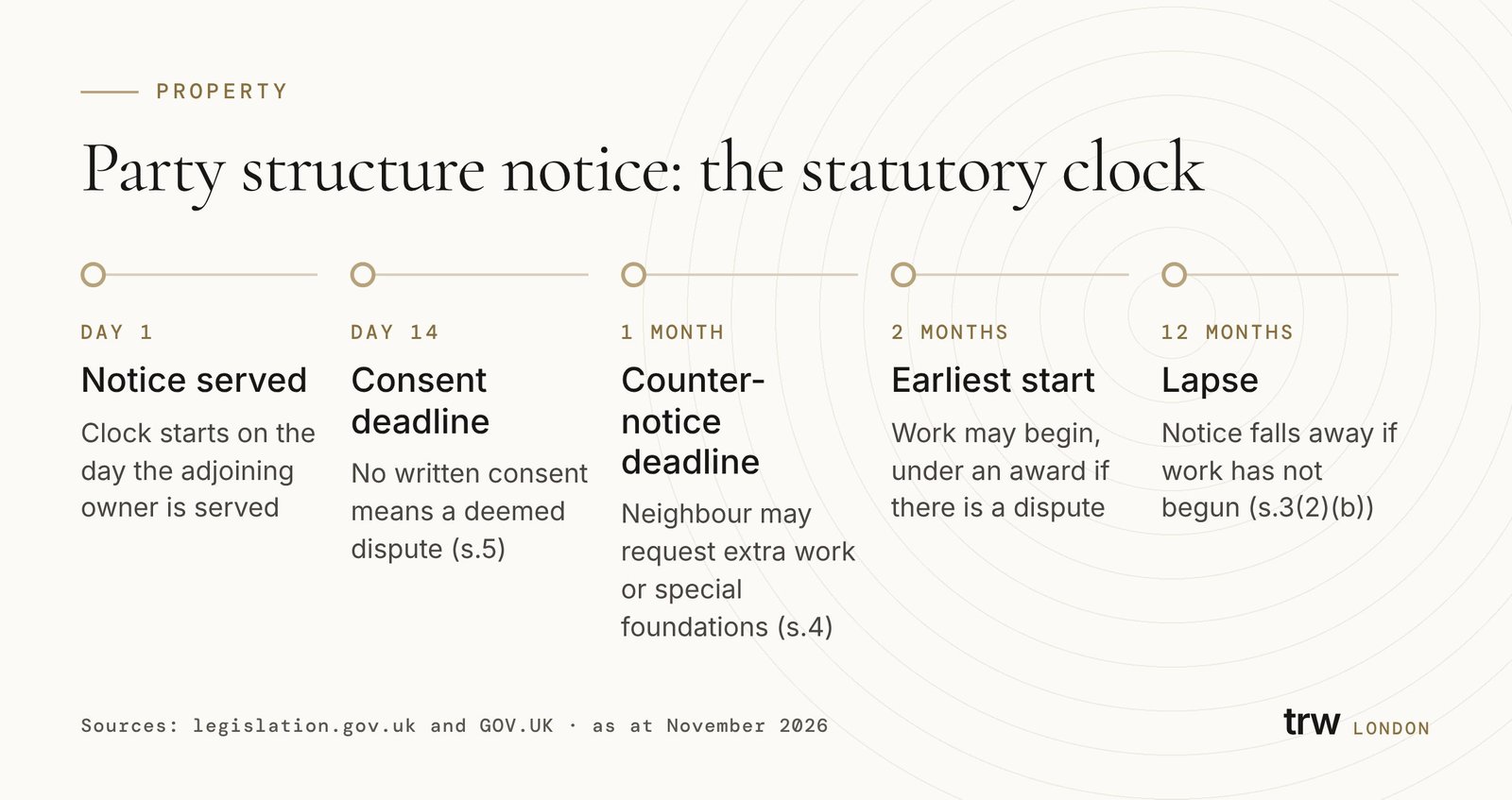
The Party Wall etc. Act 1996 uses two forms of words, and the difference matters. Sections 1, 3 and 6 require a notice to be served "at least" one or two months before work starts. The 14-day, one-month and 12-month windows that follow run for a period "beginning with the day" on which the notice is served, so the day of service counts as day one. A party structure notice served on 23 November allows work to start on 23 January at the earliest, and the 14-day consent window closes at the end of 6 December.
Service itself is governed by section 15. A notice may be handed to the owner, left at or posted to their usual or last-known residence or place of business in the United Kingdom, or, for a company, served at its registered or principal office. Where the owner's name is unknown, it can be addressed to "the owner" and delivered to someone at the premises or fixed to a conspicuous part of them.
Electronic service has been possible since 6 April 2016, under the Party Wall etc. Act 1996 (Electronic Communications) Order 2016, but only where the recipient has said they are willing to accept notices that way and has given an address for the purpose. An email sent without that prior agreement is not good service, and every party wall notice period built on it is open to challenge.
For postal service, section 7 of the Interpretation Act 1978 treats a properly addressed letter as served when it would be delivered in the ordinary course of post, unless the contrary is proved. In practice building owners add a margin of a few days, or deliver by hand and keep a record of the time and the person served. A short covering letter explaining the notice in plain English often helps.
The 14-day window and the deemed dispute
Under section 5, an adjoining owner who receives a party structure notice and does not consent in writing within 14 days, beginning with the day of service, is deemed to have dissented. A dispute is then deemed to have arisen. Section 6(7) applies the same rule to excavation notices. The neighbour does not need to object or give reasons; doing nothing is enough.
A deemed dispute is not a lawsuit. It simply means the work cannot proceed by agreement and must be governed by a party wall award made by surveyors under section 10, and the party wall notice periods give way to the surveyors' timetable. Many dissents are tactical or protective: an adjoining owner with a fragile Victorian rear wall may be entirely supportive of the project but still want a surveyor to record the condition of their property first.
Line of junction notices work differently. If you propose a wall astride the boundary and the neighbour does not consent within 14 days, section 1(4) requires you to build the wall wholly on your own land and at your own expense. You may still place projecting footings under the neighbour's land, subject to compensation for any damage, but only within the period running from one month to 12 months after service.
Under the Party Wall etc. Act 1996, silence is a decision: an adjoining owner who does nothing for 14 days has dissented, and the timetable moves from agreement to surveyors.
Counter-notices, security and the one-month window
A neighbour who receives a party structure notice can respond with a counter-notice under section 4. It may ask for chimney copings, breasts, flues, piers or recesses to be built into the work for the neighbour's convenience, or require any special foundations to be placed deeper or built strong enough to carry a future building of their own. The counter-notice must be served within one month beginning with the day the party structure notice was served, and the building owner then has 14 days to consent before a further dispute arises.
Either owner can also ask for security. Section 12 lets an adjoining owner require the building owner to give security for expenses before starting work, with the amount settled by the surveyors if not agreed. It also lets the building owner, in turn, require security from an adjoining owner who has asked for extra work. If that security is not given within one month of the request, the neighbour's counter-notice request ceases to have effect.
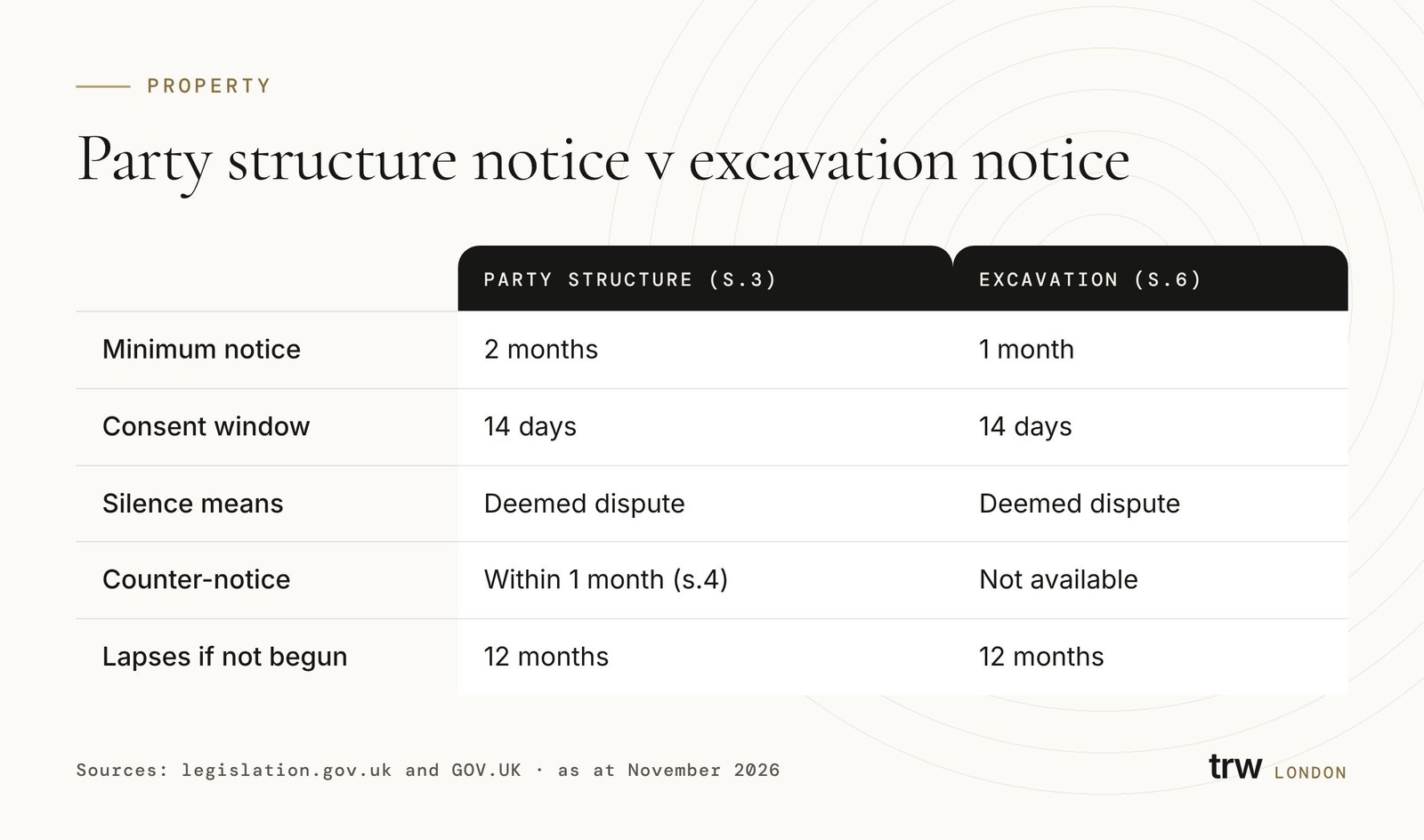
Party structure notice (s.3)
- At least two months before work starts
- 14 days to consent, then a deemed dispute
- Counter-notice due within one month
- Lapses if work has not begun within 12 months
- Covers raising, underpinning, cutting into or rebuilding a party wall
Excavation notice (s.6)
- At least one month before work starts
- 14 days to consent, then a deemed dispute
- No counter-notice: the notice must say whether foundations will be safeguarded, with plans
- Lapses if work has not begun within 12 months
- Covers digging within 3 m or 6 m of a neighbouring building
Surveyors and the party wall award
Once a dispute exists, section 10 gives the owners a choice. They can agree on a single surveyor, often called the agreed surveyor, or each appoint their own, in which case the two surveyors select a third surveyor at once. The third surveyor is called upon only if the two cannot agree. Appointments must be in writing and cannot be rescinded.
The Party Wall etc. Act 1996 has its own default timetable to keep matters moving. If an owner is served with a request to appoint a surveyor and does not do so within 10 days beginning with the day of service, the other owner may appoint one on their behalf. If a surveyor appointed by one party refuses or neglects to act for 10 days after being asked, the other surveyor can proceed alone. These are the most frequently missed party wall notice periods after the initial 14 days.
- Request to appoint. After a deemed dispute, the building owner writes asking the neighbour to appoint a surveyor or concur in an agreed surveyor.
- Ten-day default. If the neighbour does nothing for 10 days, the building owner may appoint a surveyor for them under section 10(4).
- Schedule of condition. The surveyors usually record the condition of the neighbouring property, with photographs, before work starts.
- Party wall award. The surveyors serve an award setting out the work, how and when it may be done, and who pays the costs.
- Fourteen days to appeal. Either owner may appeal the party wall award to the county court within 14 days beginning with the day it is served (section 10(17)).
The party wall award is binding on both owners unless set aside on appeal. It typically describes the work by reference to drawings, sets working hours and methods, provides for access, deals with protection of the neighbour's property, and fixes the surveyors' fees. According to the government's explanatory booklet, the building owner usually pays the costs of drawing up the award where the work is solely for their benefit, though costs can be shared where work is needed because of defects or disrepair.
The 14-day appeal window is short and is strictly applied. An owner who thinks a party wall award is wrong should take advice at once, not after work has started. Appeals are dealt with by the county court, and the usual litigation cost risks apply; our property litigation solicitors can assess whether an appeal is realistic.
Lapse, access and the other time limits
A party structure notice ceases to have effect if the work has not begun within 12 months beginning with the day of service, or if it is not then carried on with due diligence (section 3(2)(b)). Section 6(8) sets the same rule for excavation notices. Projects delayed by planning, finance or contractor availability should diarise the lapse date; a lapsed notice means serving again and restarting every party wall notice period.
Access is a separate clock. Section 8 allows the building owner, their workmen and surveyors to enter the neighbour's land during usual working hours to carry out work under the Act, but outside an emergency they must give at least 14 days' notice of the intended entry. Access for ordinary repairs that fall outside the Act is governed instead by the Access to Neighbouring Land Act 1992, which works through a court order.
| Step | Period | Provision |
|---|---|---|
| Neighbour fails to appoint a surveyor after a request | 10 days | s.10(4) |
| Appointed surveyor fails to act after a request | 10 days | s.10(7) |
| Appeal against a party wall award | 14 days from service of the award | s.10(17) |
| Notice of entry onto neighbouring land (non-emergency) | At least 14 days | s.8(4) |
| Security for additional work requested by the neighbour | 1 month to provide it | s.12(3) |
| Footings under the neighbour's land for a new boundary wall | From 1 to 12 months after service | s.1(6) |
Starting without notice
The Party Wall etc. Act 1996 does not create a criminal offence for failing to serve notice, and the government's booklet notes that it contains no enforcement procedure of its own. That is not a licence to skip the process. An adjoining owner whose wall is being cut into without notice can apply to the court for an injunction to stop the work, and can claim damages for any harm caused. In practice, a court order halting a half-built extension costs far more than a two-month wait.
There is also a structural point. The protections the Party Wall etc. Act 1996 gives a building owner, including the right to carry out section 2 work at all and the right of entry under section 8, depend on following the procedure. Building without notice or a party wall award leaves the owner relying on ordinary property law, under which cutting into a neighbour's side of a party wall may be a trespass. Buyers' conveyancers may also ask whether notices were served and awards made for recent works when the property is sold.
Contractors sometimes start "preparatory" work, such as removing a chimney breast or excavating trial holes, before the notice period has run. If that work engages section 2 or section 6, it is work under the Act and the notice period applies to it too. Check the start date in the building contract against the party wall notice periods in the calculator above.
Common pitfalls
Serving on the wrong person
An "owner" under section 20 includes a freeholder, a tenant holding for more than a year-to-year tenancy, and a buyer who has contracted to purchase. A flat above a shop may have a freeholder and a long leaseholder, each of them an owner. Notice should go to every owner of the adjoining property, or the period does not run against those left out.
Describing the work too vaguely
A party structure notice must state the nature and particulars of the proposed work and the date it will begin. An excavation notice must say whether the foundations will be strengthened or safeguarded and be accompanied by plans and sections. A notice that leaves the neighbour guessing invites challenge.
Counting from the date of posting
The periods run from service. A notice posted on a Friday may not be served until the following week. Build in a margin or serve by hand.
Letting the notice lapse
Twelve months goes quickly when planning or tendering is delayed. If the start slips past the lapse date, a fresh notice and a fresh party structure notice period are needed.
Ignoring the 14-day appeal limit
A party wall award that seems wrong must be appealed within 14 days of service. Complaining to the surveyors after that window has closed rarely changes anything.
Worked example: a terrace with two projects
Example: a homeowner in a Victorian terrace in Hackney plans a loft conversion, with steel beams bearing into the party wall on each side, and a basement under the rear half of the house. The loft work is section 2 work requiring party structure notices to both neighbours. The basement involves digging below the neighbours' foundations within three metres, so section 6 notices are needed too.
Notices are delivered by hand on Monday 23 November 2026. The one-month excavation period would allow digging from 23 December, and the loft steels cannot go in before 23 January 2027. Neighbour A signs a written consent on 1 December. Neighbour B says nothing, so a dispute is deemed to have arisen at the end of 6 December. B also serves a counter-notice on 10 December asking for piers to be built into the wall for a future extension of her own, well inside the one-month window that ends on 22 December.
The homeowner requests that B appoint a surveyor. B names one within the 10 days, and the two surveyors select a third. Because B has dissented, the work on B's side waits for an award. A schedule of condition is completed in mid-December and the party wall award, covering the basement, the steels and B's request, is served on 6 January 2027. Neither owner appeals within the 14 days ending on 19 January. Work starts on 23 January under the party wall award, and both notices remain valid until 22 November 2027 if needed.
Related guides
Party wall notice periods and the party wall award process sit alongside other property and building questions. These guides deal with the issues that most often arise at the same time.
Boundary disputes
Where the legal line runs and how determined boundaries work.
Read the guidePropertyProperty litigation
Injunctions, award appeals and neighbour claims.
Read the guideConstructionConstruction disputes
When the contractor, not the neighbour, is the problem.
Read the guideConstructionBuilding Safety Act
Duties on building work that affect larger projects.
Read the guideNext steps
If you are planning work, list every element that touches a party wall or involves digging near a neighbour, then use the calculator to set the latest date for serving each notice. Allow time for at least one surveyor appointment and a party wall award before your contractor's start date. If you have received a notice, diarise the 14-day and one-month windows and decide early whether to consent, dissent or serve a counter-notice.
We usually start by reviewing the drawings, the notices and any correspondence, then advise on validity, timing and the options if a neighbour or surveyor is not cooperating. Where an injunction or an appeal against a party wall award is in issue, speed matters. To discuss party wall notice periods or a dispute that has already arisen, book a consultation.
Frequently asked questions
01Can my neighbour agree to a shorter notice period?
Yes. The minimum periods protect the adjoining owner, and work may start earlier if they agree in writing. Keep the written agreement with your notices, because it may be asked for on a sale or by a lender.
02Does the Act apply in Scotland or Northern Ireland?
No. The Party Wall etc. Act 1996 applies in England and Wales only, as the government booklet confirms. Other parts of the UK rely on the general law of property and nuisance.
03Is there an official form of notice?
There is no prescribed form, but the notice must contain the information the Act requires: the owner's name and address, the nature and particulars of the work, and the proposed start date. Excavation notices must be accompanied by plans and sections.
04Who pays the surveyors?
Usually the building owner, where the work is solely for their benefit. The surveyors decide costs in the award and can apportion them differently where, for example, work is needed because of a defect in the wall.
05Can a neighbour stop the work entirely?
Not if the procedure is followed. The Act gives the building owner rights to carry out the listed work, subject to the award. A neighbour can, however, seek an injunction where notice was not served or the award is not being followed.
06Does planning permission replace party wall notice?
No. Planning permission and building regulations approval are separate regimes. A project can have planning consent and still need notices under the Party Wall etc. Act 1996.
07What if the neighbour's house is empty or the owner is unknown?
Section 15 allows a notice to be addressed to "the owner" and fixed to a conspicuous part of the premises. Keep photographs and a dated record. Where the owner cannot be found, the building owner can still request appointment of a surveyor and use the 10-day default rule.
Sources and official materials
- Party Wall etc. Act 1996 — The Act: notices, disputes, awards
- Party Wall etc. Act 1996, section 3 — Party structure notices: two months; 12-month lapse
- Party Wall etc. Act 1996, section 6 — Excavation notices: 3 m and 6 m rules
- Party Wall etc. Act 1996, section 10 — Surveyors, awards, 10-day rules and 14-day appeal
- Party Wall etc. Act 1996, section 15 — Service of notices
- The Party Wall etc. Act 1996: explanatory booklet — Government guidance on the procedure and costs
- Party Wall etc. Act 1996 (Electronic Communications) Order 2016 — Electronic service from 6 April 2016
- Interpretation Act 1978, section 7 — Deemed service by post
General information only, current as at 23 November 2026. It is not legal advice and does not create a solicitor–client relationship. It reflects the law of England and Wales unless stated otherwise; Scotland and Northern Ireland have separate legal systems, and the law changes frequently. Check current official sources and take advice on the facts of your matter.