
TRW & Co · Mental capacity
Court of Protection fees and deputyship costs in 2026
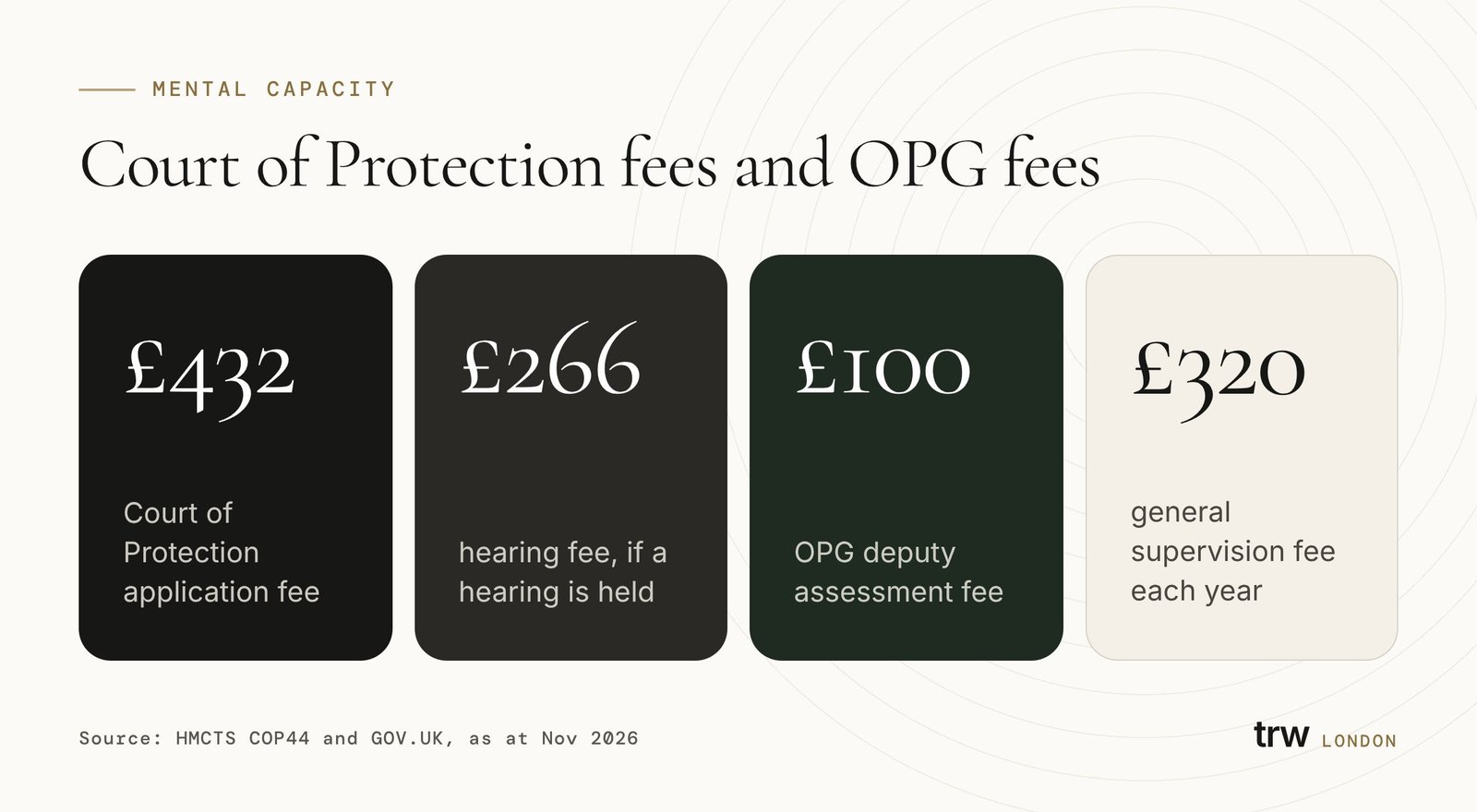
As at November 2026 the Court of Protection application fee is £432, a hearing adds £266 and an appeal costs £272. A new deputy also pays the Office of the Public Guardian a £100 assessment fee and £320 a year for general supervision, or £35 on minimal supervision, plus any security bond. Help with fees can halve or remove the OPG charges.
Key pointThe court fee is a one-off; the OPG supervision fee recurs every year, so the length of the deputyship drives the real cost.
At a glance
Application fee
£432 per application from 13 July 2026; £864 if applying for both types of deputy.
Hearing fee
£266, payable only if the court holds a hearing and makes a final decision.
OPG fees
£100 assessment, then £320 a year general or £35 minimal supervision.
Fee help
OPG remission halves fees below £12,000 income; qualifying benefits give an exemption.
Professional deputies
PD 19B caps: £1,204 to appointment, £2,116 then £1,672 a year, plus VAT.
Swipe or scroll →
Court of Protection fees: the short answer
Court of Protection fees rose in July 2026. As at November 2026, the Court of Protection application fee is £432, the hearing fee is £266, an appeal costs £272 and a copy of a document costs £8, according to the HMCTS COP44 fee guide. Those are only the court’s charges. A new deputy also pays the Office of the Public Guardian a £100 assessment fee and an annual supervision fee of £320, or £35 on minimal supervision, plus the cost of any security bond.
The total deputyship costs therefore depend on the type of deputy, whether the court needs a hearing, how long the deputyship lasts, whether the person qualifies for help with fees, and whether a professional deputy is appointed. The calculator below adds these together for a realistic estimate. The rest of this guide explains each charge, who pays it, and how to reduce it lawfully.
Court of Protection fees and deputyship costs calculator
Interactive tool
Court of Protection fees and deputyship costs calculator
Estimate court and Office of the Public Guardian fees over the first years of a deputyship, with an optional cap for professional deputy charges. It does not include security bond premiums, VAT or legal costs of a contested case.
Without JavaScript: each deputyship application costs £432 (£864 for both types), and a hearing adds £266. The OPG charges a £100 assessment fee and £320 a year for general supervision; some property and affairs deputies later move to minimal supervision at £35 a year. Remission halves the assessment and general supervision fees where income is under £12,000; an exemption removes them. Professional deputies’ fixed costs are capped under PD 19B.
The calculator assumes general supervision in the first year, because every new deputy starts there, and the supervision level you select from year two. Minimal supervision is applied only to property and financial affairs deputyships, since GOV.UK limits it to deputies managing less than £21,000. Where the court appoints a deputy under both types of order, check with the OPG how supervision will be invoiced.
Court of Protection fees from July 2026
Court of Protection fees are set by the Court of Protection Fees Order 2007 and are reviewed periodically. The government announced the July 2026 changes as taking effect on 13 July 2026, and the COP44 guide was updated on 21 July 2026 to show the new figures. The increases are modest in cash terms but they apply to every application, so anyone budgeting from an older leaflet will under-pay.
| Fee | Before 13 July 2026 | From 13 July 2026 | When payable |
|---|---|---|---|
| Application fee (start proceedings or seek permission) | £421 | £432 | When the application is made |
| Appeal fee | £265 | £272 | When filing an appellant’s notice or seeking permission to appeal |
| Hearing fee | £259 | £266 | Where the court holds a hearing and makes a final order, declaration or decision |
| Copy of a document | £5 | £8 | On request for a copy of a filed document |
There is no court fee for an objection to the registration of a lasting or enduring power of attorney where the objector is an attorney or someone entitled to notice. And if the person the application concerns dies within five days of the application or appeal being lodged, the fee is refunded; if they die before a hearing, no hearing fee is payable. Always check the current COP44 before paying, because the figures can change again.
The Court of Protection application fee in practice
The Court of Protection application fee is paid once for each application, not once per applicant. If two family members apply together to be joint property and financial affairs deputies, there is one application and one fee. If the same person applies to be both a property and financial affairs deputy and a personal welfare deputy, GOV.UK says the fee is paid twice, because these are separate applications. Online applications are paid by card; postal applications by cheque to HM Courts and Tribunals Service.
Most deputyship applications are decided on paper without a hearing. If the court decides a hearing is needed, it will tell the applicant when to pay the £266 hearing fee. A hearing is more likely where someone objects, where the evidence of capacity is unclear, or where the application asks for unusual powers such as authority to make large gifts or a statutory will.
Who ultimately bears the Court of Protection application fee depends on the type of application. A property and financial affairs deputy can reclaim the fee from the person’s own funds once appointed. GOV.UK confirms that reclaim route only for property and financial affairs deputies; for personal welfare applications, help with the fee is assessed on the applicant’s own finances. Our guide to deputyship in the Court of Protection explains the full application, including the COP1, COP3 capacity assessment and COP4 declaration that must be filed within three months of notifying connected people, as GOV.UK sets out.
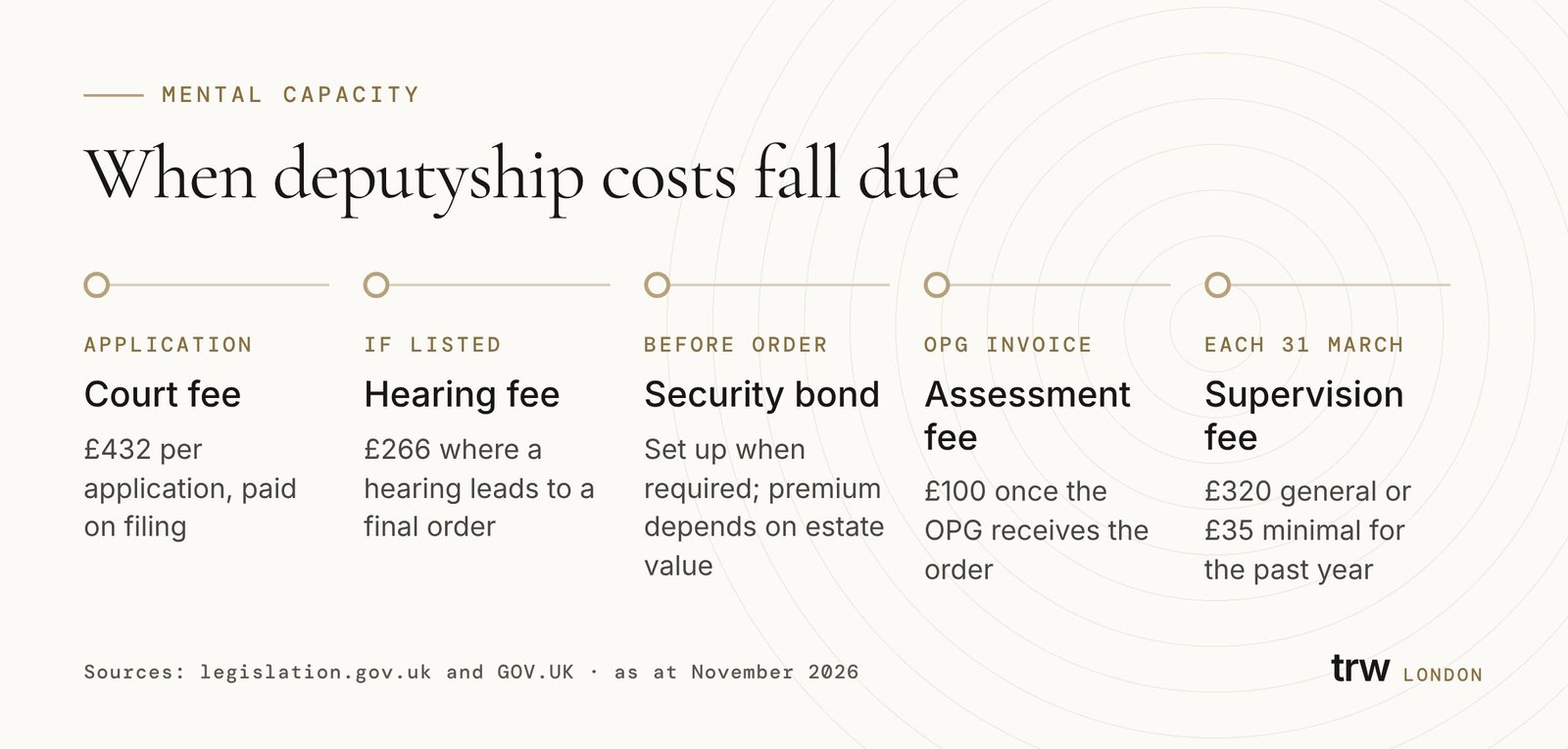
In order, the charges in a straightforward lay deputyship fall due like this:
- Check for an existing power. Search the OPG register for a registered LPA or EPA first. If one covers the decisions, no deputyship, and no Court of Protection fees, may be needed.
- Notify and file. Notify the person and at least three connected people, then file the forms with the £432 application fee within three months.
- Pay any hearing fee. Only if the court lists a hearing, at £266.
- Set up the security bond. If the court requires security, the order is issued once the bond is in place.
- Pay the OPG assessment fee. £100, invoiced when the OPG receives the order, unless remitted or exempt.
- Pay supervision each year. £320 for general supervision, or £35 if moved to minimal, due on 31 March for the year just ended.

Office of the Public Guardian fees and security bonds
Once the court makes a deputyship order, the Office of the Public Guardian (OPG) supervises the deputy. Its fees are set by the Public Guardian (Fees, etc.) Regulations 2007, which list a £100 deputy assessment fee, £320 a year for general supervision and £35 a year for minimal supervision. The assessment fee is invoiced once the OPG receives the order. The annual supervision fee is due on 31 March for the previous year, and if the person dies part-way through the year the fee is apportioned.
Every new deputy starts on general supervision for the first year. According to GOV.UK, a property and financial affairs deputy can move to minimal supervision only if they are managing less than £21,000 and no longer need general supervision. Minimal supervision brings a shorter annual report as well as a lower fee. These OPG charges are recurring deputyship costs, so a deputyship lasting ten years on general supervision costs £3,200 in supervision fees alone at current rates.
Security bonds are the cost most families do not expect. Many property and financial affairs deputies must buy a bond, a form of insurance protecting the person’s money, before the order takes effect. The premium depends on the value of the estate and the level of security the court sets, so no single figure applies; the court may dispense with a bond for small estates or local authority deputies. The premium can be paid from the person’s funds, or paid by the deputy and reclaimed. Ask the provider how and when the premium is charged, because the bond must stay in place for as long as the order requires security.
Where the court requires security, GOV.UK says the deputyship order is sent only after the bond has been set up. Ask for a bond quotation as soon as the court tells you the level of security, or the start of the deputyship will be delayed.
Help with Court of Protection fees: remissions and exemptions
Court fees and OPG fees have separate help schemes, and both are worth checking. For Court of Protection fees, the applicant uses the general Help with Fees scheme and form COP44A. Whose finances count depends on the application: for property and financial affairs deputyship, it is the person who lacks capacity; for personal welfare deputyship, it is the applicant.
For OPG deputy fees, the OPG120 guidance (April 2026) sets out two levels. An exemption removes the assessment and supervision fees entirely where the person receives a qualifying means-tested benefit, such as Pension Credit Guarantee Credit, income-based ESA or JSA, Income Support, Housing Benefit or Universal Credit, and has not received personal injury damages over £16,000 that were disregarded for benefits. A remission halves the assessment fee to £50 and general supervision to £160 where the person’s gross annual income is below £12,000. Minimal supervision can be exempted but not remitted.
Applications for OPG fee help must reach the OPG within six months of the invoice date, with evidence of income for the twelve months before it; bank statements are not accepted as proof of income. Awards can last up to three years, subject to review. Disability Living Allowance, Attendance Allowance and PIP do not by themselves qualify for an exemption.
Professional deputyship costs under Practice Direction 19B
Where a solicitor or other professional is appointed as deputy, their charges are paid from the person’s funds, and the court controls them through Practice Direction 19B. The current version took effect on 1 April 2024. According to the OPG’s guidance on fixed costs, a professional property and financial affairs deputy may take an annual management fee of up to £2,116 plus VAT in the first year and up to £1,672 plus VAT in later years. Where net assets are below £20,300, the annual management fee is capped at 4.5% of net assets instead.
The text of PD 19B also fixes a ceiling of £1,204 plus VAT for work up to and including the order appointing the deputy, £336 plus VAT for the annual report to the OPG and £317 plus VAT for a basic HMRC tax return. Personal welfare deputyship management is capped at 2.5% of net assets up to £703. A professional deputy can instead ask for costs to be assessed by the court, but cannot do so where net assets are below £20,300.
| Work | Fixed costs cap |
|---|---|
| Work up to and including the appointment order | £1,204 |
| Annual management, property and affairs, first year | £2,116 |
| Annual management, property and affairs, later years | £1,672 |
| Annual management where net assets are below £20,300 | 4.5% of net assets |
| Annual management, personal welfare | 2.5% of net assets, maximum £703 |
| Annual report to the OPG | £336 |
| Basic HMRC income tax return | £317 |
These are caps, not entitlements, and they sit on top of Court of Protection fees and OPG fees. Families comparing a professional deputy with a lay deputy should look at both: professional deputyship costs buy expertise, continuity and independence where relatives disagree, while a lay deputy pays only the official fees and bond. Our powers of attorney and Court of Protection team can explain how we charge when we act as deputy or for a deputy.
Who pays legal costs in contested Court of Protection cases
When an application is opposed, legal costs usually dwarf the Court of Protection fees. Part 19 of the Court of Protection Rules 2017 sets the starting points. In property and affairs cases, rule 19.2 provides that the costs are generally paid by the person concerned or charged to their estate. In personal welfare cases, rule 19.3 provides that the general rule is no order as to costs, so each party bears its own.
Rule 19.5 lets the court depart from those rules where the circumstances justify it, considering the conduct of the parties before and during the proceedings, whether it was reasonable to raise or contest an issue, whether a party succeeded in part, and the role of any public body. A relative who pursues an unreasonable objection can be ordered to pay costs personally. For contested matters, see our guide to Court of Protection disputes.
Court of Protection fees are the smallest part of a contested case; the costs rules decide who pays the rest.
How a lasting power of attorney avoids most deputyship costs
The cheapest way to avoid deputyship costs is for the person to make lasting powers of attorney while they still have capacity. The OPG fee to register an LPA is £92 as at November 2026, having risen from £82 on 17 November 2025, with a £46 fee for a repeat application and the same remission and exemption structure as deputy fees. There is no annual supervision fee and usually no security bond. Two LPAs, one for property and financial affairs and one for health and welfare, cost £184 to register.
An LPA is not always possible, because the person must have capacity to make it. Where they have already lost capacity, a deputyship or a single court order is the only formal route for most financial decisions. Our guide to lasting power of attorney vs deputyship compares the two in detail, and our page on lasting powers of attorney explains how to make one.
Worked example: a three-year deputyship
Example: a daughter applies to become property and financial affairs deputy for her mother, who has advanced dementia, no LPA and £250,000 in savings and investments. The application is decided on paper. Using the calculator’s default settings, the Court of Protection application fee is £432 and there is no hearing fee. The OPG charges £100 for assessment and £320 a year for general supervision. Over three years, the official fees total £1,492, before the security bond premium, which the bond provider will quote once the court sets the level of security.
If the family instead asked for a professional deputy because of a disagreement between siblings, the PD 19B caps would add up to £1,204 for the application work, £2,116 for the first year’s management and £1,672 for each later year, all plus VAT, giving up to £6,664 plus VAT over three years before annual reports and tax returns. Tick “Professional deputy” in the calculator to see this figure. If the mother’s gross income were under £12,000, the OPG fees would be halved, and with a qualifying means-tested benefit they would be removed.
Common pitfalls with deputyship costs
Budgeting from an out-of-date fee leaflet
The Court of Protection application fee changed in July 2026, and the LPA fee changed in November 2025. Check the GOV.UK pages on the day you apply, and keep a copy of what you paid.
Paying the OPG fee personally and not reclaiming it
Property and financial affairs deputies can pay official fees from the person’s funds. If you paid personally while waiting for access to accounts, keep receipts and reimburse yourself properly, recording it in the annual report.
Missing the OPG remission deadline
Applications for remission or exemption must reach the OPG within six months of the invoice date. After that, the fee stands, and refunds are not given retrospectively.
Not checking the order when it arrives
If the deputyship order contains a mistake, GOV.UK says it can be corrected free of charge by filing form COP9 within 21 days of receiving it. After that, a fresh application, and potentially another fee, may be needed. Official copies of the order cost £8 each.
Assuming minimal supervision is automatic
Minimal supervision is available only to some property and affairs deputies managing less than £21,000, and only after the first year. Ask the OPG; do not budget at £35 a year until it is confirmed.

Deputyship applications
Forms, evidence and what the court looks for.
Read the guideCapacityLPA vs deputyship
Which route fits, with a decision tool.
Read the guideCapacityCourt of Protection disputes
Objections, challenges and costs risk.
Read the guidePlanningLasting powers of attorney
Making and registering an LPA.
Read the guideNext steps
Check whether the person has a registered LPA or EPA: if so, a deputyship may not be needed. If not, use the calculator to budget for Court of Protection fees and OPG charges, find out whether the person’s income or benefits qualify for help, and ask for an early bond quotation. Where relatives disagree about who should act, consider whether a professional deputy is appropriate before the application is filed.
We usually start by confirming whether a deputyship is the right route, then prepare the application and capacity evidence so the court can decide it on paper. To discuss Court of Protection fees, deputyship costs or an application, book a consultation.
Frequently asked questions
01Can the Court of Protection application fee be paid from the person’s money?
For property and financial affairs deputyship, yes: the deputy can reclaim it from the person’s funds once appointed. For personal welfare applications, help with fees is assessed on the applicant’s own finances.
02Is there a fee to object to an LPA or EPA being registered?
Not where the objector is an attorney or someone entitled to notice of the application, according to the COP44 fee guide. Other applications to the court attract the £432 fee unless help with fees applies.
03Do joint deputies pay two fees?
No. Joint applicants for the same type of deputyship make one application and pay one fee. Separate applications for property and affairs and for personal welfare are charged separately.
04How much does a security bond cost?
It depends on the value of the estate and how much of it the deputy controls, and is quoted by the bond provider. The premium can be paid from the person’s funds.
05What happens to the fees if the person dies?
If they die within five days of the application being lodged, the court fee is refunded, and no hearing fee is payable if they die before a hearing. The OPG supervision fee is apportioned for the part of the year the deputy acted.
06Are Court of Protection fees the same in Wales?
Yes. The Court of Protection covers England and Wales and the same fees apply. Scotland and Northern Ireland have separate systems.
07Can I avoid deputyship costs altogether?
Often, if the person still has capacity to make lasting powers of attorney, which cost £92 each to register. If they have already lost capacity, see our LPA vs deputyship guide for the alternatives.
Sources and official materials
- HMCTS: Court of Protection fees (COP44) — Application, hearing, appeal and copy fees
- GOV.UK: Court and tribunal fees, updates from July 2026 — Previous and new Court of Protection fees
- GOV.UK: Deputies – fees — Application, assessment and supervision fees for deputies
- Public Guardian (Fees, etc.) Regulations 2007, Schedule — Statutory OPG fee amounts
- OPG120: Get help with paying deputy fees (April 2026) — Remissions and exemptions
- OPG: Fixed costs and remuneration of professional deputies — PD 19B annual management caps
- Court of Protection Rules 2017, Part 19 — Costs rules in property and welfare cases
- GOV.UK: Power of attorney fees — LPA and EPA registration fee of £92
General information only, current as at 23 November 2026. It is not legal advice and does not create a solicitor–client relationship. It reflects the law of England and Wales unless stated otherwise; Scotland and Northern Ireland have separate legal systems, and the law changes frequently. Check current official sources and take advice on the facts of your matter.