
TRW & Co · Family
Prenuptial agreement checklist

A prenup is not automatically binding in England and Wales, but the court will give effect to one that both parties entered into freely, with a full understanding of its implications, unless it would be unfair to hold them to it. Independent advice, full disclosure, signing well before the wedding and terms that meet needs are what make it stick.
Key pointThe safeguards that matter most concern how the agreement was made, and they are the hardest to repair after the wedding, so build them in from the start.
At a glance
Legal test
Freely entered into, full appreciation of implications, and fair to enforce (Radmacher, 2010).
Key safeguards
Separate legal advice, financial disclosure, no pressure, early signing.
Limits
Cannot prejudice children or leave a party in real need.
Making it effective
Terms become binding on divorce through a court order, usually by consent.
Reform
Binding qualifying nuptial agreements proposed in 2026; not law as at November 2026.
Swipe or scroll →
Prenuptial agreement checklist: the short answer
A prenuptial agreement checklist is useful because the law of England and Wales does not make a prenup automatically binding. Instead, the court asks whether the agreement was freely entered into by each party with a full appreciation of its implications, and whether it would be fair to hold them to it now. That test comes from the Supreme Court in Radmacher v Granatino [2010] UKSC 42, and it turns largely on how the agreement was made.
In practice, a prenup carries the most weight when each party had independent legal advice, there was full financial disclosure, it was signed well before the wedding without pressure, and its terms still meet both parties' needs and the needs of any children. The government consulted in 2026 on making some nuptial agreements binding; that is a proposal, not law, as at November 2026.
This guide is for couples planning a marriage or civil partnership, and for families whose wealth is passing to the next generation. It explains each item on our checklist and why it matters. For tailored drafting, see our prenuptial agreements solicitors in London and our overview of prenuptial agreements in the UK.
Use the prenuptial agreement checklist
Tick each statement that is true of your agreement, or of the one you are planning. The score shows how closely it matches the factors the courts look for. Run the prenuptial agreement checklist once on the plan and again on the final draft, because the gaps tend to open up in the last weeks. It is a self-assessment, not a guarantee: a judge looks at the whole picture, and one serious defect such as pressure can outweigh many ticks.
Interactive tool
Prenuptial agreement checklist: will a court give it weight?
Twelve questions drawn from Radmacher v Granatino and the 2026 reform proposals. It flags gaps; it cannot tell you whether a particular agreement will be upheld.
Without JavaScript: check that each party had separate legal advice; that both gave full financial disclosure; that you signed well before the wedding and at least 28 days before; that there was no pressure; that terms were negotiated and understood; that the agreement says you intend it to apply; that it meets both parties' needs and any children's; that it has a review clause; and that it identifies protected assets and deals with any foreign assets.
Most people score well on intention and asset schedules, and less well on timing and needs. The prenup safeguards near the top of the list are the hardest to repair later, because they concern how the agreement was made. The fairness items can sometimes be improved by a review or a post-nuptial agreement.
Is a prenup binding in England and Wales?
Is a prenup binding? Not in the way an ordinary commercial contract is. On divorce, the family court has a statutory discretion under section 25 of the Matrimonial Causes Act 1973 to divide assets and order maintenance, having regard to all the circumstances, with first consideration given to the welfare of any child of the family under 18. The parties cannot oust that jurisdiction by agreement. A prenup is one of the circumstances, though it can be the decisive one.
The Supreme Court in Radmacher set the approach: "The court should give effect to a nuptial agreement that is freely entered into by each party with a full appreciation of its implications unless in the circumstances prevailing it would not be fair to hold the parties to their agreement." The court explained that the reason for giving weight to agreements is respect for individual autonomy, and that it would be "paternalistic and patronising" for a court to override them merely because it would have divided things differently.
So the honest answer to the question "is a prenup binding" is: it is highly persuasive if properly made and fair in the circumstances, but the court has the last word. Even where both parties accept it, the terms must be turned into a court order, usually by consent, to be binding on divorce; GOV.UK explains consent orders. Civil partners have equivalent financial remedies under Schedule 5 to the Civil Partnership Act 2004.
Is a prenup binding if it was signed abroad?
Couples with international lives often ask: is a prenup binding in England if it was made under another country's law, where such agreements are routine? The English court applies its own approach, but the Supreme Court said foreign elements can bear on whether the parties intended the agreement to be effective. In Radmacher itself, the agreement was made in Germany with a German law clause. For agreements made today, the court said it will be natural to infer that the parties intended it to take effect.
A prenup is judged twice: once on how it was made, and again on whether it is fair when the marriage ends.
The prenup safeguards courts look for
Radmacher did not lay down fixed rules, but it identified factors that add to or detract from an agreement's weight. The Supreme Court said both parties must enter into it of their own free will, without undue influence or pressure, and informed of its implications, and that the right question is whether there was any material lack of disclosure, information or advice. These are the prenup safeguards that practitioners build into the process, and the first five items on our prenuptial agreement checklist.
| Safeguard | Why it matters | Basis |
|---|---|---|
| Independent legal advice for each party | Shows each understood the implications | Radmacher, paras 68-69 |
| Full and frank financial disclosure | Each needs the information material to the decision | Radmacher, para 69 |
| No duress, fraud, misrepresentation or undue pressure | Vitiating factors negate the agreement's effect | Radmacher, para 71 |
| Signed well before the wedding | Reduces the risk of pressure close to the day | Radmacher, para 72; 2026 proposal (28 days) |
| Intention to be bound | Natural to infer for modern agreements, but state it expressly | Radmacher, para 70 |
| Fair outcome for needs and children | Real need or prejudice to children makes it unfair to enforce | Radmacher, paras 77 and 81 |
The court also looks at the parties themselves: their age and maturity, whether either had been married or in a long relationship before, their emotional state and the pressures they faced, and whether the marriage would have gone ahead without the agreement. A take-it-or-leave-it document presented to a young partner with no advice will be scrutinised far more closely than one negotiated between two experienced professionals.
Prenup safeguards only help if you can prove them years later. Keep a file with each lawyer's letter confirming advice, the disclosure schedules and documents exchanged, the drafts showing what was negotiated, and the dates of each step. If the agreement is ever challenged, that file answers most of the arguments about how it was made, and the prenuptial agreement checklist becomes evidence rather than a list of good intentions.
Under current law, gaps in advice or disclosure are not automatically fatal: the Supreme Court said a party who was fully aware of the implications and indifferent to detail need not be undermined by limited disclosure. But the government's 2026 proposal would make both mandatory for a binding agreement. Do not rely on a waiver if you want the agreement to stand.

Financial disclosure: what to exchange
Disclosure in a prenup is less formal than in divorce proceedings, but it must be enough for the other party to understand what they are agreeing to. Most lawyers attach a schedule of each party's assets, liabilities and income to the agreement, with supporting documents available on request. Undervaluing a business or omitting a trust interest is the commonest way to give the other side a later argument, and it undermines the other prenup safeguards too.
- Property: addresses, ownership, estimated values and mortgages
- Bank, savings and investment accounts, including overseas accounts
- Shares in private companies and partnership interests, with a basis of valuation
- Pensions, with recent valuations
- Trust interests and expected inheritances, with the trust documents where available
- Income: salary, bonus, dividends and carried interest
- Debts, guarantees and other liabilities
- Significant chattels, such as art, jewellery or classic cars
Where assets are hard to value, such as an early-stage company, say so in the agreement and record the basis used. A good prenuptial agreement checklist treats disclosure as a record you may need to produce years later, not as a formality before the wedding.
What a prenup should cover
A prenup can be short or detailed, but it should deal with the issues that will actually arise on separation. The Supreme Court recognised that agreements protecting existing property, or property one party expects to receive from a third party, are not inherently unfair and may have good objective justification, such as obligations towards existing family members.
Non-matrimonial property
Assets owned before the marriage, gifts and inheritances, and how their growth and income are treated.
Family business
Shareholdings, voting control and what happens to dividends and growth during the marriage.
Family home
Whether it is shared, and how the contribution of each party is treated if it is bought jointly.
Maintenance and needs
Lump sums or income for the financially weaker party, perhaps rising with the length of the marriage.
Children and review
Provision if children are born, and a review clause for illness, relocation or a career break.
International elements
Assets and residence in other countries; take advice on the law there as well as in England.
Pensions are often overlooked; see our guide to pensions on divorce. Where wealth is held through a family investment company or trust, the agreement should be consistent with those structures; our page on family investment companies explains the overlap. Working through a prenuptial agreement checklist at the drafting stage, rather than at signing, is the easiest way to make sure none of these is missed.
Timing and process
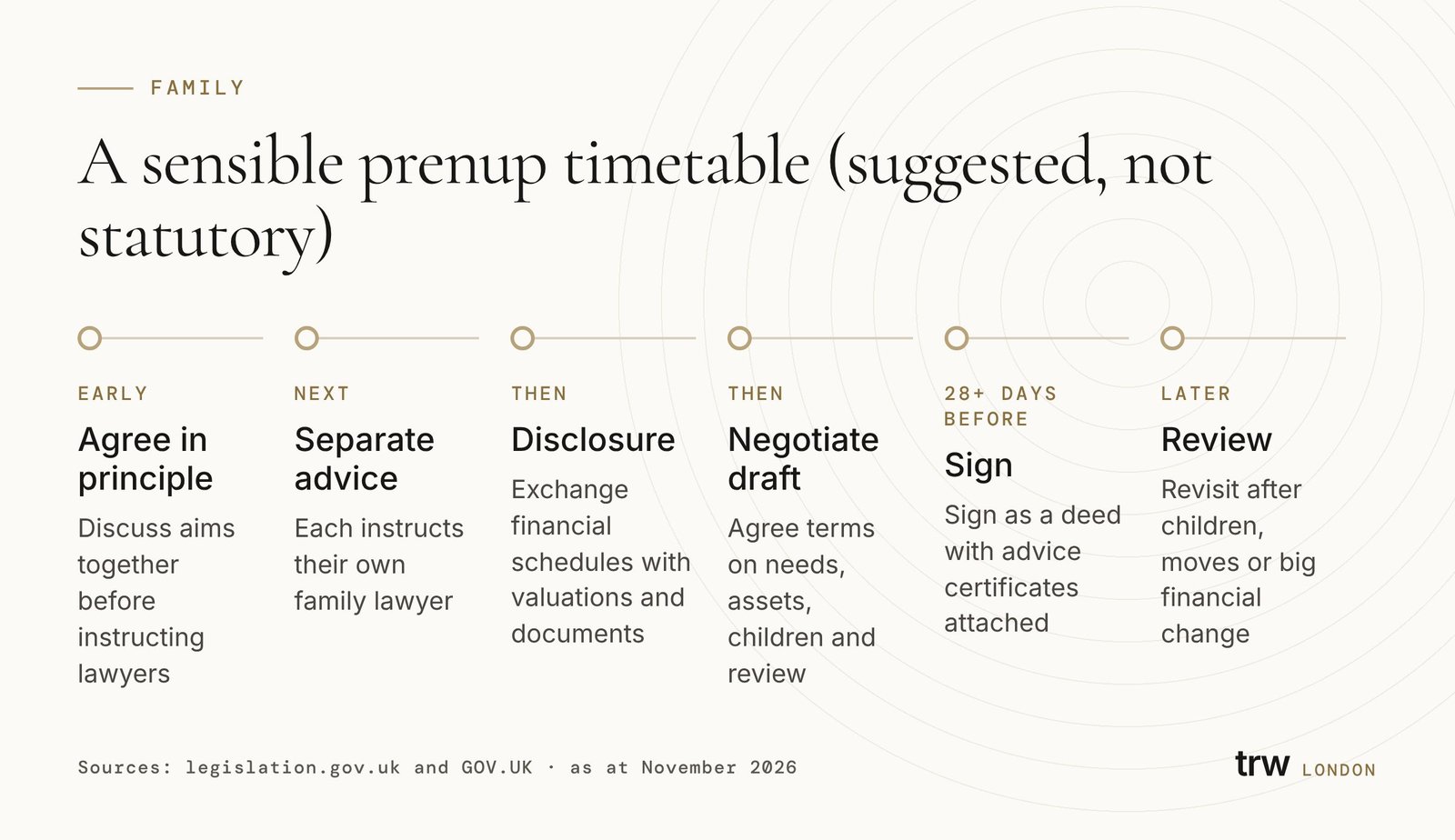
There is no statutory deadline for signing a prenup under current law, but the Supreme Court treated pressure close to the wedding as relevant, and the 1998 Home Office proposals it discussed would have excluded agreements made fewer than 21 days before the marriage. The government's 2026 consultation proposes 28 days for qualifying nuptial agreements. We advise building in much longer.
- Six months or more before
Raise it early
Talk about the reasons for a prenup before venues and invitations make postponement difficult.
- Next
Instruct separate lawyers
Each party chooses their own adviser; one lawyer cannot advise both.
- Weeks later
Exchange disclosure
Schedules of assets, income and liabilities, with documents.
- Then
Negotiate and draft
Agree terms, including needs, children and a review clause.
- At least 28 days before
Sign
Execute the agreement, ideally as a deed, with advice confirmed in writing.
Timing is one of the prenup safeguards that cannot be fixed afterwards. If time runs out, it is better to sign a short agreement in principle and a full post-nuptial agreement after the wedding than to sign a complex document in a rush. Post-nuptial agreements are judged by the same Radmacher test.
When a court will not follow the agreement
Is a prenup binding when life has moved on? Even a well-made prenup can be departed from if, in the circumstances at the time of divorce, it would not be fair to hold the parties to it. The Supreme Court singled out three areas. The welfare of children comes first, and an agreement cannot prejudice their reasonable requirements. Needs and compensation can make enforcement unfair: the court said the parties are unlikely to have intended that one would be left in a "predicament of real need" while the other enjoys a sufficiency or more.
Children arrive who were not envisaged
Provision for children and for the parent caring for them will be made regardless of the agreement. A review clause that anticipates children reduces the room for argument.
One party gave up a career
If one partner's devotion to the family left the other free to accumulate wealth, the court said it is likely to be unfair to let the earner keep everything under the agreement.
Long marriage, changed circumstances
The longer the marriage, the more likely it is that circumstances have changed in ways the agreement did not foresee. Agreements that address existing assets fare better than those trying to predict the future.
Illness or disability
Serious ill health that creates needs the agreement does not meet is a classic reason for the court to top up provision.
Defective process
If there was pressure, no advice or concealed assets, the agreement may carry little weight, and the court will apply the ordinary principles of needs, sharing and compensation.
Where an agreement is departed from, the court usually still gives it some weight, for example by meeting needs at a modest level rather than sharing assets equally. That is why even an imperfect agreement can be worth having, and why the answer to "is a prenup binding" is rarely all or nothing. Our guide to financial settlements on divorce explains the ordinary principles.
Reform: qualifying nuptial agreements
The Law Commission recommended binding "qualifying nuptial agreements" in its 2014 report on matrimonial property, needs and agreements. In June 2026 the Ministry of Justice consulted on them in A fairer end to relationships, which ran from 5 June to 14 August 2026. The government says it plans to include qualifying nuptial agreements in its reforms; as at November 2026 it is analysing responses and no legislation has been introduced.
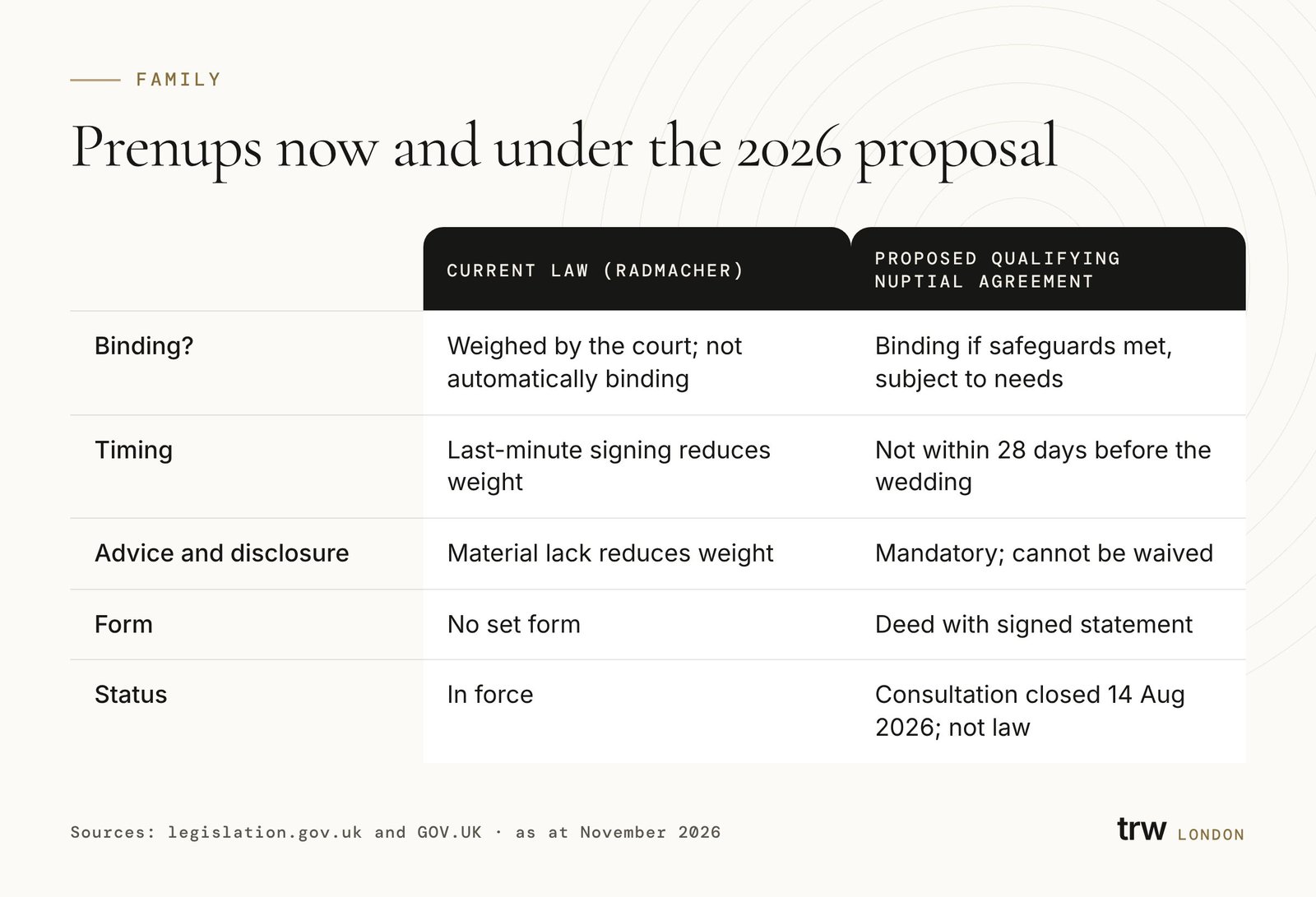
Under the consultation proposal, an agreement would qualify only if it is a valid contract, made by deed with a signed statement that both understand it partially removes the court's discretion, not made within the 28 days before the wedding or civil partnership, and made after each party received disclosure of material financial information and independent legal advice. Those protections could not be waived. Even then, the court could still make orders to meet needs, assessed on a narrower basis, and no agreement could exclude children's needs.
Nothing in the consultation is in force. Agreements signed now are judged under Radmacher. But drafting to the proposed prenup safeguards now (a deed, 28 days, mandatory advice and disclosure) costs little and positions an agreement well if the law changes.
Worked example
Example (hypothetical): Priya, 34, owns 40% of her family's London property company and expects to inherit more. Tom, 36, is a teacher with modest savings. Eight months before the wedding they each instruct a family lawyer, exchange schedules (including a valuation of the company shares) and agree that the shares and any inheritance remain Priya's, that the home they buy together is shared equally, and that Tom receives a lump sum rising with each year of marriage.
They add a review clause on the birth of a child and sign as a deed two months before the wedding, with letters from each lawyer confirming advice. On our prenuptial agreement checklist the agreement ticks all twelve items. If they divorce after ten years with two children, a court is likely to uphold the protection of the company shares but ensure Tom's housing and income needs, and the children's, are met.
Prenuptial agreement solicitors
Drafting and advising on prenups and post-nups.
Read the guideDivorceFinancial settlement on divorce
Needs, sharing and compensation explained.
Read the guideCross-borderInternational divorce
Where to divorce and how agreements travel.
Read the guideUnmarriedCohabitation rights
Cohabitation agreements and the 2026 reform proposals.
Read the guideNext steps
Start early, choose separate lawyers and gather your financial information before the first meeting. Use the prenuptial agreement checklist to test a draft, check that the prenup safeguards are documented, and diarise a review after any major change. If you are already married, a post-nuptial agreement can do the same job.
We usually start by understanding what each of you wants to protect and why, then design the agreement around that, with a process that will stand up to scrutiny. Our family law team also advises on divorce where an agreement is already in place. To discuss a prenup, book a consultation.

Frequently asked questions
01Is a prenup legally binding in the UK?
In England and Wales, not automatically. A court will give effect to a prenup that was freely entered into with a full appreciation of its implications unless it would be unfair to hold the parties to it (Radmacher v Granatino). Scotland and Northern Ireland have their own rules.
02How close to the wedding can we sign?
There is no fixed legal deadline today, but signing close to the wedding invites arguments about pressure. The government's 2026 proposal would require at least 28 days for a binding agreement; we recommend allowing several months.
03Can one lawyer act for both of us?
No. Each party needs independent advice for the agreement to carry full weight, and a lawyer cannot properly advise two people whose interests conflict.
04Does a prenup protect an inheritance?
It can be very effective for inherited and pre-marital assets, which the Supreme Court said are a legitimate subject for agreement. It will not stop the court using those assets to meet genuine needs if nothing else is available.
05What happens if we have children after signing?
The court will always provide for the reasonable requirements of children, whatever the agreement says. A review clause triggered by the birth of a child helps keep the agreement relevant.
06Can a prenup deal with maintenance?
Yes, it can set out lump sums or income. Maintenance is where needs arguments most often arise, so the provision should be realistic for both parties.
07Will the 2026 reforms make my existing prenup binding?
Not automatically. The proposals are at consultation stage, and any new law would set its own requirements and transitional rules. Agreements made now are judged under the current law.
08Do civil partners need a different agreement?
The same principles are applied in practice, and civil partners have equivalent financial remedies under Schedule 5 to the Civil Partnership Act 2004. The 2026 consultation proposes the same qualifying agreement rules for civil partnerships.
Sources and official materials
- Radmacher v Granatino [2010] UKSC 42 — Supreme Court test for the weight of nuptial agreements
- Matrimonial Causes Act 1973, section 25 — Factors the court considers in financial remedy cases
- Ministry of Justice: A fairer end to relationships (consultation, 2026) — Status and dates of the 2026 consultation
- A fairer end to relationships: consultation document — Proposed safeguards for qualifying nuptial agreements
- Law Commission: Matrimonial property, needs and agreements — 2014 recommendations on binding nuptial agreements
- Civil Partnership Act 2004, Schedule 5 — Financial relief on dissolution of a civil partnership
- GOV.UK: Money and property when you divorce or separate — Consent orders and financial orders
General information only, current as at 23 November 2026. It is not legal advice and does not create a solicitor–client relationship. It reflects the law of England and Wales unless stated otherwise; Scotland and Northern Ireland have separate legal systems, and the law changes frequently. Check current official sources and take advice on the facts of your matter.