TRW & Co · Work and sponsorship
The Creative Worker visa: a guide for artists and sponsors

The Creative Worker visa (Temporary Work – Creative Worker) lets artists, performers, models and their entourage work in the UK for a licensed creative sector sponsor. Grants run for up to 12 months, extendable to 24 months with the same sponsor, and do not lead to settlement. Non-visa nationals staying three months or less may use a concession instead of a visa.
Key pointThe grant follows the engagements on the certificates. Get the schedule, the 14-day gaps and the code of practice right, and most of the route falls into place.
At a glance
Length
Up to 12 months; up to 24 months in total with the same sponsor.
Fee
£340 per person, plus the Immigration Health Surcharge where payable.
Sponsor
Temporary Worker licence holder operating in the creative sector.
Concession
Non-visa nationals, up to 3 months, with an ETA and a border stamp.
Settlement
Not a route to settlement.
Swipe or scroll →
Creative worker visa: the short answer
The Creative Worker visa, formally the Temporary Work – Creative Worker route, lets an artist, performer, model or member of their entourage work in the UK for a licensed sponsor in the creative sector. It lasts up to 12 months at a time, can be extended to 24 months with the same sponsor, and does not lead to settlement. Non-visa nationals coming for three months or less may be able to use a concession instead of applying for a visa.
The rules sit in Appendix Temporary Work – Creative Worker to the Immigration Rules and in the Home Office guidance Sponsor a Creative Worker. This guide covers both sides: what the worker needs, and what the sponsoring venue, producer, promoter or agent must do. Figures are as at November 2026.
Who the Creative Worker visa is for
The Rules describe a Creative Worker as someone who can make a unique contribution to the UK's cultural life, for example as an artist, dancer, musician or entertainer, or as a model contributing to the fashion industry. The sponsor guidance lists areas including dance, music, film, theatre, television, circuses, opera and fashion modelling.
Entourage can be sponsored too, provided their work is directly related to the creative worker's. The guidance gives two examples: production crew with proven technical or specialist skills and a previous working relationship with the creative worker; and a non-technical personal assistant to a director or producer of international status in film and television, limited to one per director or producer.
There is one firm boundary. The route must not be used to fill a permanent position, even temporarily. The guidance gives the example of a designer, make-up artist or stylist filling a role the organisation will continue to need after the worker leaves. Applications made on or after 9 April 2025 will be refused where the Home Office has reason to believe the position is permanent, and the sponsor's licence may be at risk.

Eligible roles: codes of practice or a unique contribution
The role must satisfy one of two tests. Where a code of practice in Appendix Creative Workers Codes of Practice covers the occupation, the sponsor must comply with it. The guidance lists seven areas with codes: ballet; dancers in other dance forms; performers in film and television; performers in opera; performers in theatre; workers in film and television; and models in the fashion industry. A sponsor that states on the certificate that it followed a code, when it did not, faces revocation.
Where no code applies, the role must be in the creative industries, in an occupation code listed in Appendix Skilled Occupations, and the worker must make a unique contribution to creative life in the UK. The guidance gives examples of codes that may qualify, including 3411 artists, 3413 actors, entertainers and presenters, 3414 dancers and choreographers, 3415 musicians, 3416 arts officers, producers and directors, and 3422 clothing, fashion and accessories designers.
Evidence of a unique contribution
The sponsor must explain on the certificate how the worker makes a unique contribution and keep the evidence. The guidance suggests four kinds: international status in the field (press, programmes, awards, interviews); an attribute or appearance unlikely to be commonly available in the UK, such as a particular linguistic, musical or vocal skill; continuity, meaning at least a month's work in the past year on a largely identical production outside the UK; or membership of an overseas "unit company" that has performed at least once in its own country, such as an orchestra or circus troupe.
Write the explanation on the certificate as if a caseworker who knows nothing about the art form will read it, because one will. Cite the code of practice followed, or the specific evidence of unique contribution, and keep copies on file under Appendix D.
The sponsor: licence, certificate and responsibility
The creative worker visa is sponsored under a Temporary Worker licence, the licence type for Temporary Work routes. GOV.UK's licence types page lists Creative among the Temporary Worker routes. The licence fee for a Temporary Worker licence is £611, and the sponsor must operate, or intend to operate, in the creative sector. The guidance gives examples such as a national arts body, an events organiser, a producer, a venue, an agent, a promoter, a production company and a media organisation.
In this sector the sponsor is often not the employer. Performers may be engaged through a special purpose vehicle, in which case the guidance expects the sponsor to be a producer, co-producer or general management company. A touring group might be sponsored by the venue, promoter or agent. Whoever sponsors takes on all the sponsor duties, and the Home Office says it will look closely at arrangements where the worker is not a direct employee.
- Check the role. Confirm the code of practice, or the occupation code and unique-contribution evidence, and that the role is not a permanent position.
- Check pay and hours. Where the worker is an employee or a "worker" in employment law, the role must comply with the National Minimum Wage and Working Time Regulations. If the person is genuinely self-employed, say so on the certificate.
- Assign the certificate. Use the SMS to assign a certificate of sponsorship (£55 per certificate, or one fee for a group). It must give start and end dates (maximum 12 months), work addresses including venues, any agent used, the occupation code, pay and how the role is eligible. An A-rated sponsor can certify maintenance.
- Brief the worker. The certificate must be used within three months, and the worker cannot apply more than three months before the start date. Explain whether they need a visa or can use the concession.
- Keep records and report. Report a failure to start, unauthorised absence and significant changes, as with any sponsored worker. See our guide to sponsor reporting duties.
A group certificate can be assigned to members of a unit company, such as a ballet company, orchestra or theatre group, and their entourage. Each member gets their own certificate showing their share of any group fee, but only one certificate fee is paid. If the lead entertainer's application is refused, the Rules say all applications in the group will be refused.
Single, multiple and consecutive engagements
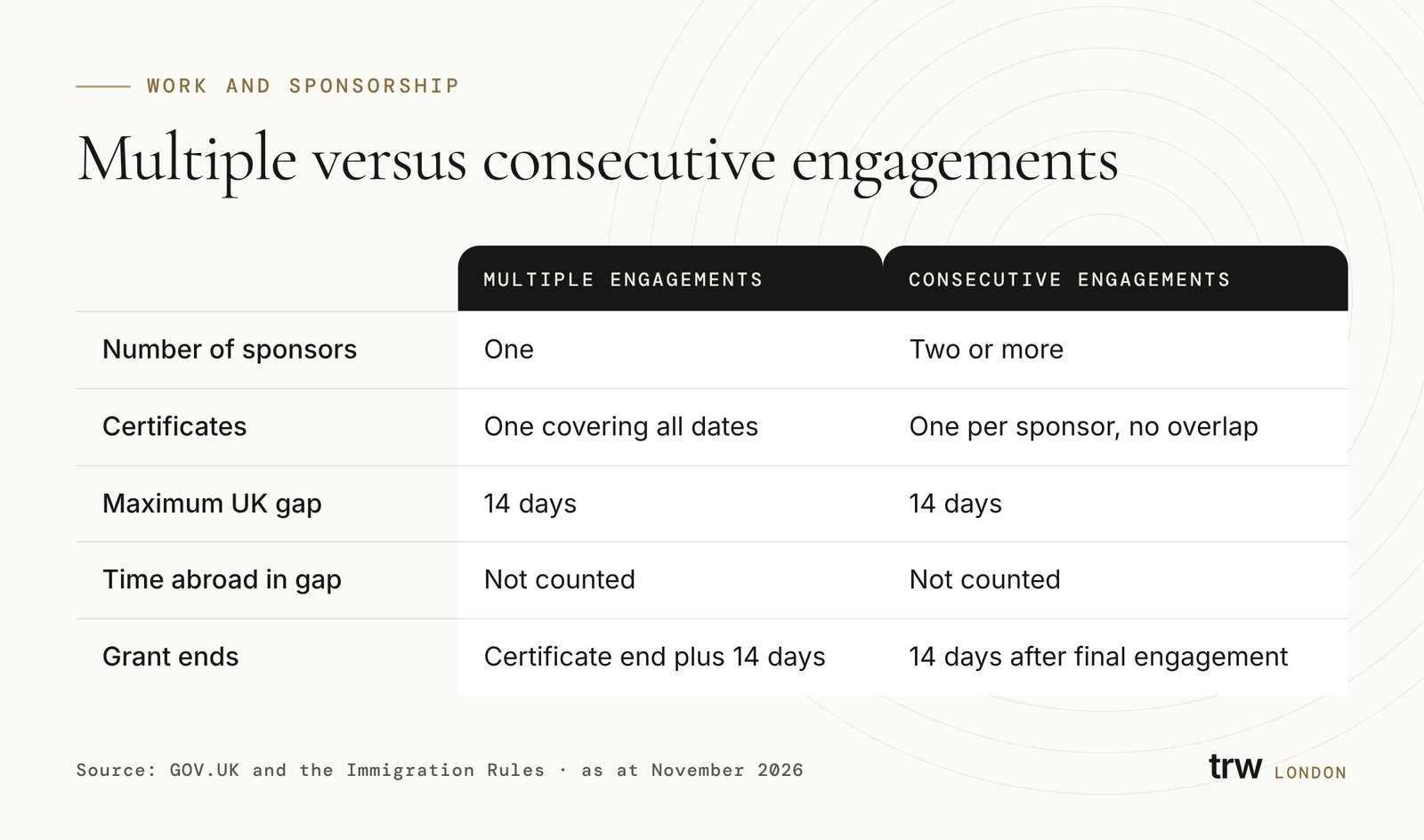
The creative sector rarely works in single blocks of time, and the creative worker visa is designed around that. The guidance distinguishes three patterns.
| Pattern | Sponsors | Certificates | Key rule |
|---|---|---|---|
| Single engagement | One | One | Certificate covers the period of the engagement, including rehearsals |
| Multiple engagements | One | One covering the whole period | No more than 14 days between engagements, excluding time outside the UK |
| Consecutive engagements | Several (venues, producers, promoters) | One from each sponsor | Certificates must not overlap; no gap over 14 days, excluding time outside the UK |
The 14-day gap excludes time the worker spends outside the UK, including the days of departure and return. The guidance gives an example: with an engagement on 1 June, a trip abroad from 8 to 15 June, and no other time abroad, the next UK engagement must be no later than 24 June. Without the trip, it would have to be no later than 16 June.
Rehearsal periods can be included, but the guidance warns sponsors to assign a certificate only for the period genuinely needed. Exaggerating the engagement period to extend a worker's stay can lead to licence action, including revocation.
How long a Creative Worker visa lasts
The length of a creative worker visa grant is always the shortest of several periods. For entry clearance, it is the shorter of: from 14 days before the first engagement to 14 days after the last (consecutive engagements); the period on the certificate plus 14 days either side (otherwise); or 12 months.
Extensions inside the UK are possible only for someone whose current or last permission was as a Creative Worker; people on other routes cannot switch into it and must normally leave and apply from abroad. With the same sponsor, total time can reach 24 months. With a different sponsor, total time as a Creative Worker is capped at 12 months. Workers admitted under the concession cannot extend at all.
If a sponsor wants someone for longer, the guidance points to the Skilled Worker route, which leads to settlement if its skill, salary and English requirements are met, or to Global Talent. The Creative Worker route itself is not a route to settlement.
Worked example (hypothetical)
Example: a contemporary dance company based overseas tours the UK for five weeks, performing at a London venue and then at two regional festivals, each run by a different organiser. The dancers are non-visa nationals, so they could consider the concession, but two members of the touring crew hold nationalities that require visas, and the whole group wants the certainty of a creative worker visa before travelling.
Each of the three UK sponsors in the creative sector assigns its own certificates for its own dates, with no overlap and no UK gap of more than 14 days. The London venue, as the first sponsor, uses group certificates so that only one fee is paid for its engagement. Each dancer's entry clearance will run from up to 14 days before the first engagement to 14 days after the last, well within 12 months. Because a code of practice covers dancers in forms other than ballet, each sponsor must follow it and say so on the certificates, keeping the evidence the code specifies.
A Creative Worker visa is built around engagements, not employment: the grant follows the dates on the certificates, and the certificates must follow the real schedule.
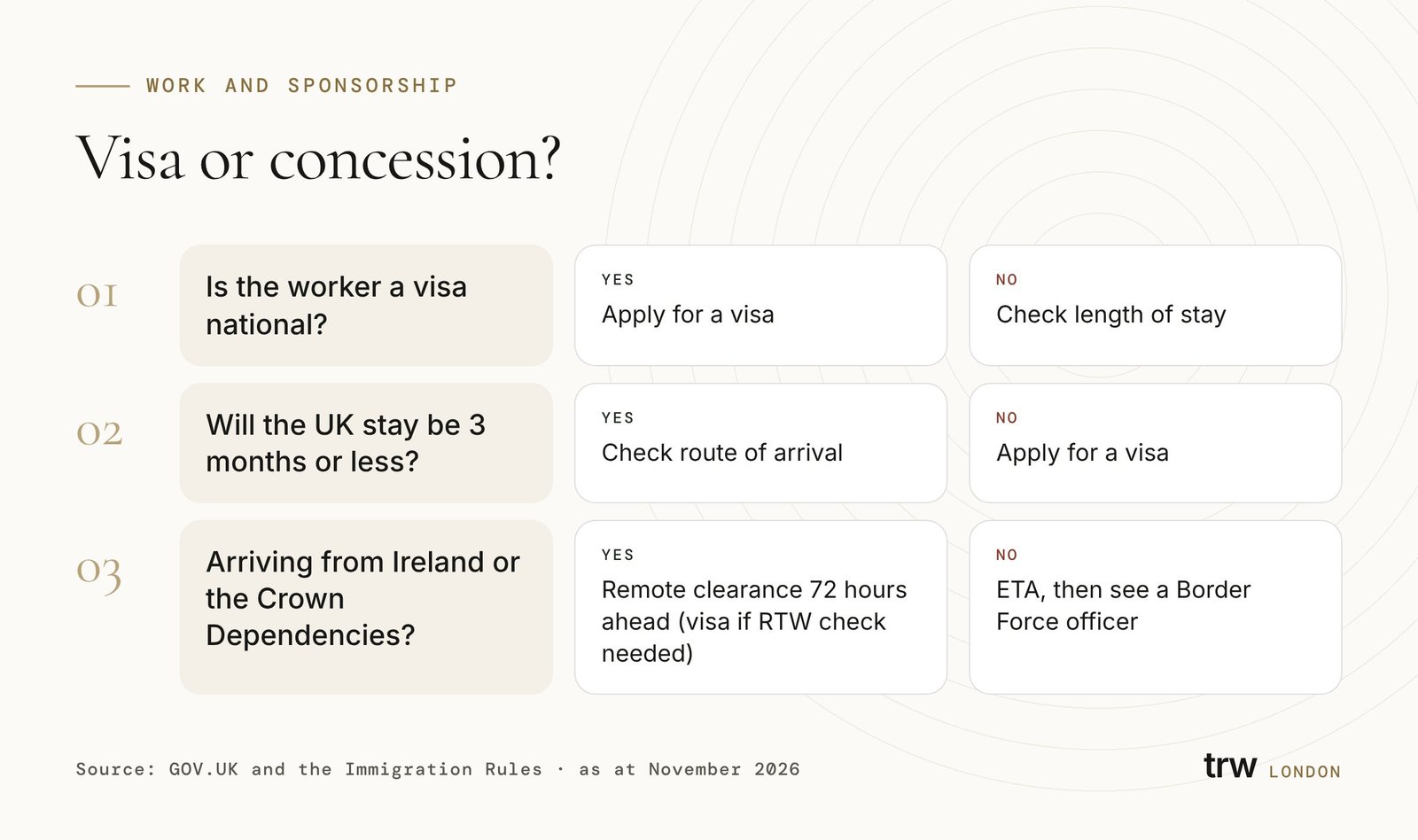
The visa concession for stays of up to three months
A non-visa national coming for three months or less may enter without a visa under the Creative Worker visa concession, if they hold a valid certificate (or certificates), have an Electronic Travel Authorisation where required, and otherwise meet the route's requirements. Visa nationals cannot use it. The concession has strict mechanics, and errors leave the worker without permission to work.
- Get an ETA first. Most non-visa nationals now need an Electronic Travel Authorisation (£20) before travelling, or they may be refused entry.
- See a Border Force officer. Give the certificate number at the border, and evidence of £1,270 in savings held for 28 days unless the sponsor has certified maintenance.
- Do not use the eGates. Nationals of countries such as Australia, Canada, EU states, Japan, New Zealand, Singapore, South Korea, Switzerland and the USA must not use an eGate. Without a stamp, they have no permission to work and must leave the Common Travel Area and re-enter through an officer.
- Copy the stamp. The sponsor must check the passport has been stamped to show permission to work, and keep a copy of that page and the biodata page.
- Use remote clearance from the CTA. Arriving from Ireland, Jersey, Guernsey or the Isle of Man, the worker must apply through the remote clearance service at least 72 hours before arrival. Remote clearance is not available where a right to work check is required for an employment contract; a visa is needed instead.
Permission under the concession lapses as soon as the worker leaves the Common Travel Area. To return for remaining engagements, the worker asks a Border Force officer for a new grant, which will not run beyond the original expiry date. Concession entrants receive a passport stamp or remote clearance, not an eVisa. Our guide to Electronic Travel Authorisations explains the ETA.
Costs and money to show (as at November 2026)
Fees are from the Home Office fee table of 8 October 2026; check it before applying. The Immigration Health Surcharge is £1,035 a year but is not payable on visas of six months or less applied for from outside the UK. Dependants pay the same visa fee and, where applicable, the surcharge.
Funds of £1,270 must be held for 28 consecutive days, with day 28 within 31 days of applying, unless the worker has been in the UK with permission for 12 months, or an A-rated sponsor certifies maintenance up to the end of the first month. Dependants need £285 for a partner, £315 for the first child and £200 for each further child, unless covered in the same way. Applicants must also declare transport, living allowances and other expenses paid to them, and whether the sponsor will recoup them.
Conditions, family members and children
A Creative Worker may work only in the sponsored role, may take supplementary employment within the limits in Part 2 of the sponsor guidance (up to 20 hours a week, outside contracted hours, in the same profession and level or in an Immigration Salary List job), may study subject to ATAS, and has no access to public funds. A partner and children can come as dependants; a dependent partner may work, except as a professional sportsperson or coach.
There is no minimum age. A worker under 18 needs written consent from both parents, a parent with sole responsibility or a legal guardian, covering the application, care and living arrangements and travel. Sponsors must have safeguarding measures in place. For children below school-leaving age taking part in paid performances or paid modelling, the sponsor must ensure a child performance licence is obtained from the local council, applied for at least 21 days before the event, and keep evidence of it.
Other routes for the creative sector
The guidance encourages creative sector sponsors to consider whether another route fits better than the Temporary Work route. Since 8 October 2026, under HC 584, artists, entertainers and musicians coming as visitors may attend rehearsals. For paid one-off work, the Permitted Paid Engagement route may suit an invited professional for up to a month.
Permitted Paid Engagement
Invited professional artists, up to one month, no sponsor.
Read the guideTalentGlobal Talent (arts and culture)
Endorsed leaders and potential leaders; no sponsor; can lead to settlement.
Read the guideWorkSkilled Worker
Longer-term sponsored roles meeting skill, salary and English rules.
Read the guideWorkService Supplier
Some entertainment and modelling work under trade agreements.
Read the guideCreative Worker visa
- Sponsored by a creative sector licence holder
- Up to 12 months, 24 with same sponsor
- Paid work in the sponsored role
- Dependants allowed
- No route to settlement
Visitor (including Permitted Paid Engagement)
- No sponsor
- Permitted activities only; PPE up to one month
- Payment only as the visitor rules permit
- Rehearsals allowed from 8 Oct 2026
- No work for a UK company
Common pitfalls
Using the eGates on arrival
A worker using the concession who passes through an eGate gets no stamp and no permission to work. The sponsor must not let them work, and they must leave the Common Travel Area and re-enter through an officer.
Trying to switch in the UK
Someone in the UK on another route cannot switch into the creative worker visa. They normally need to leave and apply for entry clearance, or use the concession if eligible.
Sponsoring a permanent role
Long-running roles, such as a resident designer or stylist, belong on another route. Using this one risks refusal and licence action.
Gaps over 14 days
Where engagements are spread out, a gap of more than 14 days in the UK breaks the chain. Plan the schedule or use separate visas.
Assigning a certificate while B-rated
A B-rated sponsor cannot assign new certificates, except to continue sponsoring a worker whose last permission it supported.
Next steps
For any creative worker visa, map the schedule first: every engagement, venue, sponsor and gap. Then decide between the Creative Worker visa, the concession and the visitor routes, and confirm that each certificate reflects the real dates.
We advise venues, producers, promoters and agents on licences and certificates, and individual artists on their route. To discuss a production or tour, book a consultation. See also our sponsor licence page.
Frequently asked questions
01Does a creative worker need to speak English?
The Appendix Temporary Work – Creative Worker requirements do not include an English language requirement.
02Can a Creative Worker do other paid work?
Only supplementary employment within the Part 2 limits: up to 20 hours a week, outside sponsored hours, in the same profession and level or in an Immigration Salary List job.
03Can a band be sponsored on one certificate?
A group certificate can cover members of a unit company and their entourage. Each person gets their own certificate, but only one fee is paid.
04Can a Creative Worker switch to Skilled Worker in the UK?
Switching rules depend on the Skilled Worker route. Check the current Appendix Skilled Worker validity requirements and take advice before relying on an in-country switch.
05Does the sponsor have to be the employer?
No. In the creative sector a producer, venue, promoter or agent may sponsor, but it takes on all the sponsor duties for the worker.
06What if the worker leaves the UK during a concession stay?
Permission lapses on leaving the Common Travel Area. The worker can ask for a new grant on return to finish engagements, up to the original expiry date, if the certificate is still valid.
07Can children be sponsored?
Yes. There is no minimum age, but parental consent, safeguarding and, for paid performances or modelling below school-leaving age, a child performance licence are required.
Sources and official materials
- Immigration Rules: Appendix Temporary Work – Creative Worker — Eligibility, length of grant and conditions
- Sponsor a Creative Worker (Home Office guidance) — Eligible roles, engagements, concession and children
- Immigration Rules: Appendix Creative Workers Codes of Practice — Codes for ballet, dance, film, TV, opera, theatre and modelling
- Creative Worker visa (Temporary Work) on GOV.UK — Applicant overview
- Home Office immigration and nationality fees (8 October 2026) — Visa and certificate fees
- HC 584 explanatory memorandum — Visitor rehearsals from 8 October 2026
- Electronic Travel Authorisation — ETA requirement and fee
General information only, current as at 19 November 2026. It is not legal advice and does not create a solicitor–client relationship. It reflects the law of England and Wales unless stated otherwise; Scotland and Northern Ireland have separate legal systems, and the law changes frequently. Check current official sources and take advice on the facts of your matter.