TRW & Co · Talent, founders and investors
Secondment Worker visa: a guide for UK clients and overseas suppliers

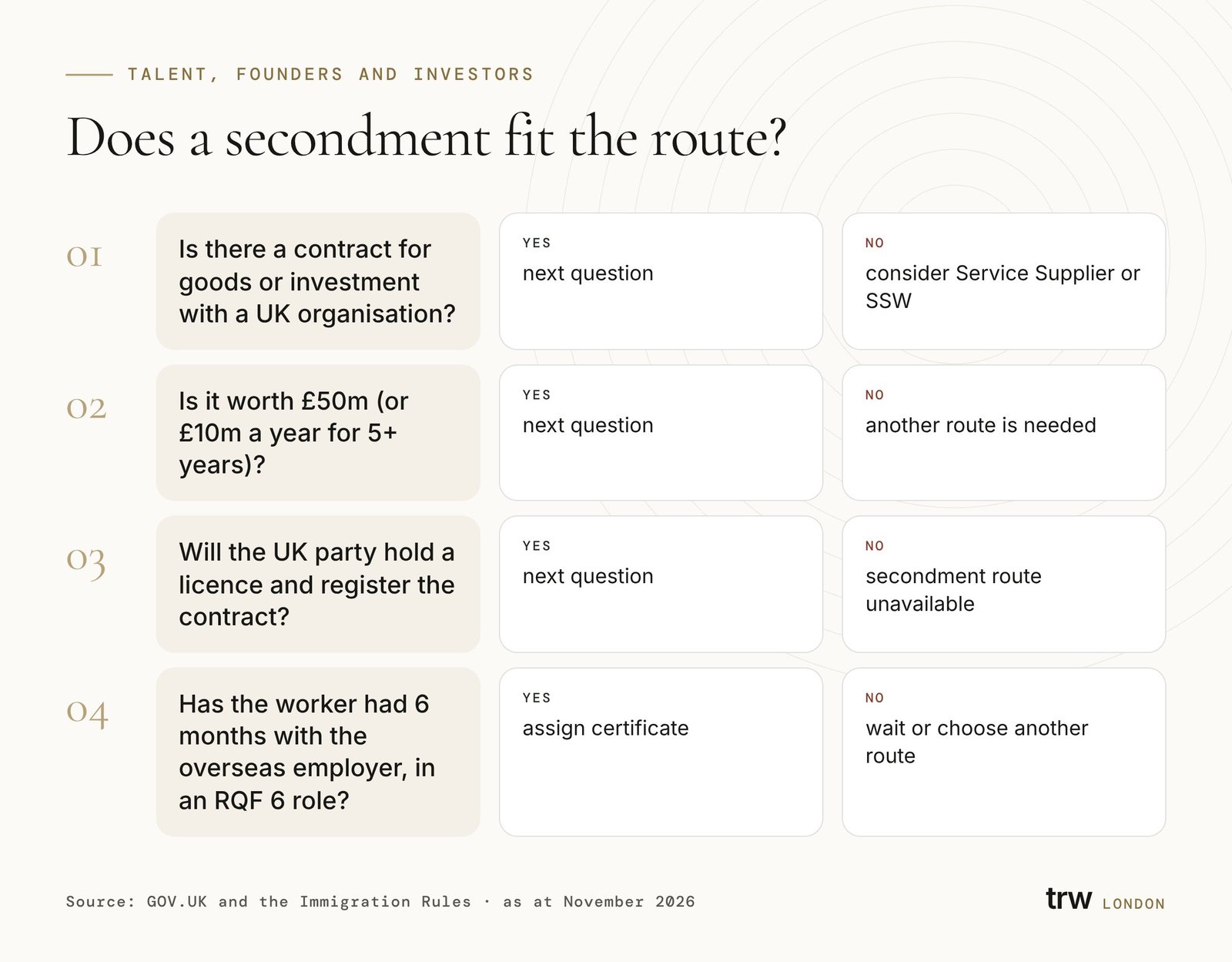
The Secondment Worker visa lets an overseas business send employees to the UK to work on a contract for goods or investment worth at least £50 million with a UK organisation. The UK client sponsors. Workers need six months' prior employment and a graduate-level role. Stays are up to 12 months, extendable to two years.
Key pointThe sponsor is the UK client, not the employer: it takes on sponsor duties for another company's staff, tied to one registered contract.
At a glance
Contract
£50m total, or £10m a year for contracts of 5 years or more.
Worker
6 months with the overseas employer (applications from 8 April 2026); RQF 6 role.
Pay
No salary threshold; National Minimum Wage applies.
Length
Up to 12 months, extendable to a 2-year maximum; GBM cap of 5 years in 6.
Settlement
Not available on this route.
Swipe or scroll →
The secondment worker visa in brief
The secondment worker visa lets an overseas business send an employee to work temporarily for a UK organisation it has a high-value contract with. It is one of the five Global Business Mobility routes, and the only one built around a high-value contract. The unusual feature is who sponsors: not the worker's own employer, but the UK client, which must hold a sponsor licence and must have registered the contract with the Home Office.
As at November 2026, the contract must be worth at least £50 million overall (or £10 million a year for longer contracts), the worker must have worked for the overseas business for at least six months, and the job must be at graduate level. Permission is granted for up to 12 months at a time, with a two-year maximum. The route does not lead to settlement. The worker's visa fee is £340, according to GOV.UK.
How a secondment worker visa arrangement works
The Home Office's guidance on sponsoring a Global Business Mobility worker (version 04/26) describes the route as being for overseas workers on temporary assignments "where the worker is being seconded to the UK as part of a high value contract or investment by their employer overseas". Three parties are involved, and each has a distinct legal role.
Overseas employer
Employs the worker throughout and holds the contract for goods or investment with the UK organisation. It is not the sponsor.
UK sponsor
The UK party to the contract. Holds a Temporary Worker sponsor licence covering the Secondment Worker route, registers the contract and assigns certificates.
The secondee
An existing employee of the overseas business, coming to work on that specific contract in an eligible occupation.
The Home Office
Licenses the sponsor, checks the contract meets the thresholds, and decides the worker's visa application.
This structure suits large procurement and investment relationships: an overseas manufacturer delivering equipment to a UK buyer, for example, or an overseas investor deploying staff into a UK project it is funding. It does not suit staffing arrangements. The guidance says a sponsor can only assign a certificate to a worker coming to fulfil the registered contract "and no others".
The high-value contract requirement
Paragraph GBM2.23 of the sponsor guidance sets the financial test for a high-value contract. The thresholds depend on the length of the contract.
| Contract length | Minimum value | Comment |
|---|---|---|
| Under 5 years | £50 million in total | The total, not the annual value, must reach £50m |
| 5 years or more | £10 million per year | And no less than £50 million overall |
| No specified end date | £50 million over the first 5 years | Value assessed across the first five years |
The contract must be "for goods or investment". The Home Office expects it to be registered through the Sponsor Management System when the licence application is made, and any later contract must be reported, with no certificates assigned under it, until the Home Office has agreed it qualifies (GBM2.24 and 2.25). The guidance says the licence will be revoked if a certificate is assigned in connection with a contract that has not been reported.
A business with a services contract under a trade agreement should look at the Service Supplier route instead. GOV.UK suggests that a business whose contract is below £50 million may be eligible for "another type of visa".
Keep the signed contract, any variations and the evidence of value in the sponsor file. A compliance officer will want to see that the contract, as performed, still meets the threshold and that each secondee is working on it.
The UK sponsor: licence, certificates and duties
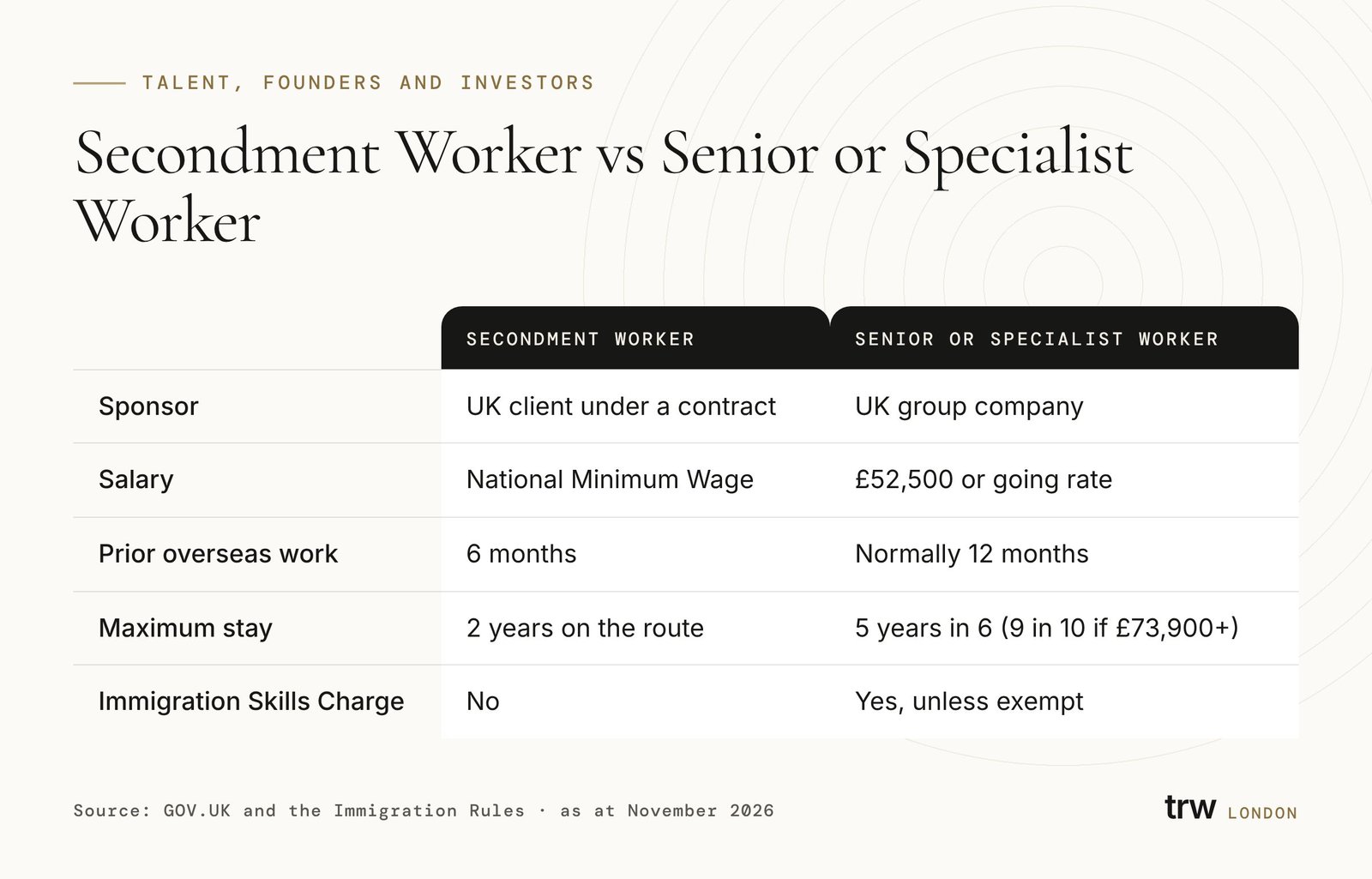
The Secondment Worker route is a Temporary Worker route for licensing purposes (GOV.UK: types of licence). The Temporary Worker licence fee is £611, and a Temporary Worker certificate of sponsorship costs £55, as at November 2026. The Immigration Skills Charge does not apply: the GBM guidance applies it to Senior or Specialist Workers only.
Licensed sponsors take on the full set of duties in Part 3 of the sponsor guidance: record keeping, reporting changes, right to work checks and co-operation with compliance visits. A UK client that has never sponsored before needs suitable key personnel and HR systems before applying, and the licence application must include the contract details. Our sponsor licence team and sponsor compliance team cover both stages.
What the worker must show
To qualify for a secondment worker visa, the worker must score 40 points: 20 for sponsorship and 20 for a job at the appropriate skill level (GBM4.7). Unlike the Senior or Specialist Worker route, there is no general salary threshold or going rate for secondees; GBM7.3 requires pay in line with the National Minimum Wage. The points table does not include an English language requirement for this route.
Overseas work requirement
Statement of Changes HC 1691 cut the period of prior overseas work for secondees from 12 months to six. The guidance applies the shorter period to applications made on or after 8 April 2026. The worker must currently work for the overseas business with the contract, must have worked for it continuously for at least six months immediately before applying, and must have spent at least six months of that time working outside the UK (GBM5.5). Time working for that business's clients counts.
Skill level and occupation code
In most cases the role must be skilled to RQF level 6 (graduate level) or above, and the occupation code must be in Table 2, 2b or 3 of Appendix Skilled Occupations (GBM6.3 and 6.5). The worker need not hold a degree, but the work must be at that level. The guidance warns that choosing a less appropriate code to make a role eligible can lead to refusal and to revocation of the licence.
- Certificate of sponsorship reference from the UK sponsor, linked to the registered contract
- Valid passport
- Job title and four-digit occupation code
- Evidence of £1,270 held for 28 days, unless the sponsor certifies maintenance or the worker has been in the UK for 12 months
- Evidence of six months' work for the overseas employer, if requested (payslips or bank statements)
- Tuberculosis certificate where required, and an ATAS certificate if the role involves sensitive PhD-level research

Length of stay and the GBM cumulative cap
GBM4.47 grants permission for the shortest of four periods: one year after the job start date on the certificate; 14 days after the job end date; the date the worker reaches two years' continuous permission as a secondee; or the date the worker reaches the overall Global Business Mobility cap. An extension adds up to 12 months, giving a two-year maximum on the route.
The cap is a cumulative five years in any six-year period across all GBM routes and the former intra-company routes (GBM4.51). The guidance gives a worked example: a secondee who spends two years on one secondment and two years on another can come back for only one more year before reaching five years in six. Employers that rotate the same specialists through the UK should keep a running tally of each person's GBM time.
- Day 0
Certificate assigned
Worker applies within 3 months, and no more than 3 months before the start date.
- About 3 weeks
Decision
Usual processing time for applications from outside the UK.
- Up to 12 months
First grant ends
Or 14 days after the job end date, if earlier.
- Before expiry
Extension
Same sponsor, same contract; up to 12 more months, decided in about 8 weeks.
- 2 years
Route maximum
The worker must leave or qualify for a different route.
Running a compliant Secondment Worker route programme
Holding a licence for the Secondment Worker route means accepting duties for people who are not your employees. That is the feature UK clients most often underestimate. The sponsor must know where each secondee is working, on what, and for how long, even though the overseas business manages their day-to-day work and pays them.
GOV.UK's sponsor responsibilities page requires sponsors to check that workers have the skills and qualifications for the job, keep records and right to work evidence, track attendance, report non-compliance, and report significant changes, such as a merger or insolvency, within 20 working days through the Sponsor Management System. For a secondment worker visa holder, the practical triggers are usually an early end to the contract, a change of role, or the secondee moving onto work outside the registered high-value contract.
Build those triggers into the commercial documents. A secondment schedule to the main contract can oblige the overseas business to tell the sponsor promptly about absences, role changes and early departures, and to supply payslips on request so the sponsor can show minimum wage compliance. Without that information flow, the sponsor cannot meet its own reporting deadlines.
The consequences of getting this wrong fall on the UK client. Under GOV.UK's licence rating rules, a downgrade to a B-rating stops new certificates and requires a £1,579 action plan, and revocation carries no appeal and a wait of at least 12 months before reapplying. Revocation would also affect any Skilled Worker or other routes on the same licence.
Appoint one named owner for the secondment programme on the UK side, give them access to the Sponsor Management System, and diarise each secondee's certificate end date, visa expiry and cumulative Global Business Mobility time. Level 2 SMS users can no longer be appointed and existing ones are deactivated after 8 March 2027, so plan access through Level 1 users.
Costs and timings
As at November 2026, the main costs are as follows. Check the current Home Office fee table before applying, because fees normally change each April.
| Item | Amount | Who usually pays |
|---|---|---|
| Temporary Worker sponsor licence | £611 | UK sponsor |
| Certificate of sponsorship | £55 | UK sponsor (cannot be passed to the worker) |
| Visa application fee | £340 per applicant | Worker or employer by agreement |
| Immigration health surcharge | £1,035 per year | Worker or employer by agreement |
| Maintenance | £1,270 held, unless sponsor certifies | Worker, or sponsor certifies |
| Immigration Skills Charge | Not payable on this route | Not applicable |
Sponsors must not recover the licence fee, certificate fee or associated administrative costs from the worker. GOV.UK warns that the licence may be revoked if those costs are passed on. The visa fee and surcharge are the worker's liability, although the employers involved can agree to fund them in the secondment terms.
Bringing a secondee to the UK step by step
- Confirm the contract qualifies. Check the high-value contract against the GBM2.23 thresholds and that it is for goods or investment.
- Obtain or extend the licence. The UK party applies for a Temporary Worker licence covering the Secondment Worker route and registers the contract.
- Select the secondee and role. Confirm six months' prior work for the overseas business and an eligible RQF 6 occupation code.
- Assign the certificate. Link it to the registered contract; record start and end dates accurately.
- Worker applies. Online application, fee and surcharge; identity checked by app or at a visa application centre.
- Arrival and right to work. The sponsor checks the eVisa with a share code before work starts and keeps the record.
- Track the assignment. Report changes, monitor the end date and the GBM cumulative cap.
Changes, extensions and family members
A secondee can work only for the sponsor in the role on the certificate and cannot take a second job, though voluntary work and study are allowed. If the job changes to a different occupation code with the same sponsor, the worker must apply to update the visa, and GOV.UK says the new job should not start until the new permission is confirmed.
An extension under GOV.UK's extension rules requires the worker to still be working for the same sponsor on the same contract and not to have reached the maximum stay. A move to a different contract or sponsor falls outside those extension rules, so take advice before agreeing any change to the assignment.
Partners and children can come as dependants. Their permission usually ends on the same date as the worker's, and a child whose parents have different expiry dates gets the earlier date. Each dependant pays the fee and surcharge and must show maintenance unless the sponsor certifies it.
Choosing between Global Business Mobility routes
The five Global Business Mobility routes serve different corporate structures, and the secondment worker visa is the narrowest of them. The secondment route is the only one where the sponsor is a client rather than a group company.
Senior or Specialist Worker
Intra-group transfers; £52,500 or going rate; normally 12 months' prior group service.
Read the guideGBMUK Expansion Worker
Setting up a first UK branch or subsidiary; licence lasts four years.
Read the guideGBMService Supplier
Services contracts covered by a UK trade agreement.
Read the guideAdviceGBM solicitors
How we structure assignments across the routes.
Read the guideNone of the GBM routes leads to settlement. The government's earned settlement response (CP 1707) also lists GBM time among periods that will not count towards settlement; that is announced policy rather than law, and has no implementation date. For an assignment that may become permanent, consider whether a Skilled Worker route through a UK entity would be better from the start.
Compliance pitfalls
Assigning a certificate under an unregistered contract
The guidance says this will lead to revocation. Register each qualifying contract and wait for Home Office agreement before using it.
Using the route to supply labour
A sponsor cannot simply place secondees with other organisations. Work must be on the registered contract, and the third-party working rules apply.
Treating the six months loosely
The six months must be immediately before the application, with the overseas business that holds the contract, and at least six months must be outside the UK.
Ignoring the cumulative cap
Earlier time on any GBM or intra-company route counts towards five years in six. Check history before assigning a certificate.
Paying below the National Minimum Wage
There is no salary threshold, but pay must comply with minimum wage law, and the sponsor must be able to show what the worker is actually paid.
Example (hypothetical): A UK rail operator buys rolling stock from an overseas manufacturer under a four-year, £120 million contract. The operator obtains a Temporary Worker licence, registers the contract, and sponsors six of the manufacturer's commissioning engineers who have each worked for it for at least six months. Each receives 12 months, extended once to two years. When the operator later wants one engineer to stay permanently in a UK role, it needs a different route, because secondment time does not lead to settlement and the engineer must work only on the registered contract.
Next steps
Start with the contract: confirm its value, subject matter and dates. Then decide whether the UK party is willing and able to hold a licence and carry sponsor duties for someone else's employees, which is a commercial question as much as a legal one.
We usually start by reviewing the contract and the proposed secondees' employment history together, then plan licence, certificates and timing. To discuss a secondment, book a consultation.
Frequently asked questions
01Does the overseas employer need a UK sponsor licence?
No. The UK organisation that is party to the contract holds the licence and assigns the certificates.
02Is there an English language requirement?
The points table for this route covers sponsorship and skill level only, so there is no English requirement to score points.
03Can a secondee switch to Skilled Worker?
Possibly, if a UK sponsor offers an eligible job and the requirements are met. See our Skilled Worker team.
04What counts as the contract value?
The value of the contract for goods or investment between the UK sponsor and the overseas business, assessed against the thresholds in paragraph GBM2.23 of the sponsor guidance.
05Is the Immigration Skills Charge payable?
No. The GBM guidance applies the charge to Senior or Specialist Workers only.
06Can the secondee work for another UK company?
No. The worker can work only for the sponsor on the role and contract in the certificate, and cannot take a second job.
07What happened to the 12-month overseas work rule?
HC 1691 reduced it to six months for secondees. The guidance applies this to applications made on or after 8 April 2026.
Sources and official materials
- Secondment Worker visa (GOV.UK) — Eligibility, length of stay, fees and family
- Sponsor a Global Business Mobility worker (v04/26) — Contract thresholds, overseas work, salary and cap
- Immigration Rules Appendix Global Business Mobility routes — Legal requirements
- UK visa sponsorship: types of licence — Temporary Worker licence covers Secondment
- Certificates of sponsorship — Certificate fees
- Explanatory memorandum to HC 1691 — Reduction of overseas work requirement
- Home Office fees, 8 October 2026 — Current fee levels
General information only, current as at 19 November 2026. It is not legal advice and does not create a solicitor–client relationship. It reflects the law of England and Wales unless stated otherwise; Scotland and Northern Ireland have separate legal systems, and the law changes frequently. Check current official sources and take advice on the facts of your matter.