TRW & Co · Work and sponsorship
The Immigration Salary List: current entries, benefits and the end-2026 deadline

The Immigration Salary List (ISL) is a short list of shortage jobs in Appendix Immigration Salary List. A listed job can be sponsored at £33,400 rather than £41,700 (still at the full going rate), carries a lower visa fee, and lets some medium-skilled roles be sponsored at all. Most entries apply only where the certificate is issued before 31 December 2026; two care entries run to 22 July 2028.
Key pointThe removal date is tied to when the certificate of sponsorship is issued, not when the worker applies or starts, so employers relying on the list need certificates issued in 2026.
At a glance
Salary floor
£33,400 instead of £41,700, but never below the full going rate.
Visa fee
£628 (up to 3 years) or £1,235 (over 3 years), inside or outside the UK.
Skill level
Medium-skilled ISL codes can be used for new hires while listed.
Removal date
31 December 2026 for most entries; 22 July 2028 for 6135 and 6136.
Policy direction
The May 2025 White Paper said the ISL "will be abolished".
Swipe or scroll →
What the Immigration Salary List is
The Immigration Salary List is a list of shortage occupation codes, set out in Appendix Immigration Salary List to the Immigration Rules, for which the Skilled Worker route applies more generous terms. A worker sponsored in a listed job can qualify on a salary of £33,400 rather than the usual £41,700, provided they are paid at least the full going rate for the code. They and their family also pay a lower visa fee. Since July 2025, being on the list has also been one of the few ways a medium-skilled job can be sponsored for a new hire.
The list is short (25 entries as at November 2026) and time-limited. All but two entries carry a removal date of 31 December 2026, and an occupation only counts if the certificate of sponsorship is issued before that date. This guide explains what the ISL does, lists every entry, and sets out what employers should do before the deadline.
Where the ISL came from: from shortage occupation list to salary list
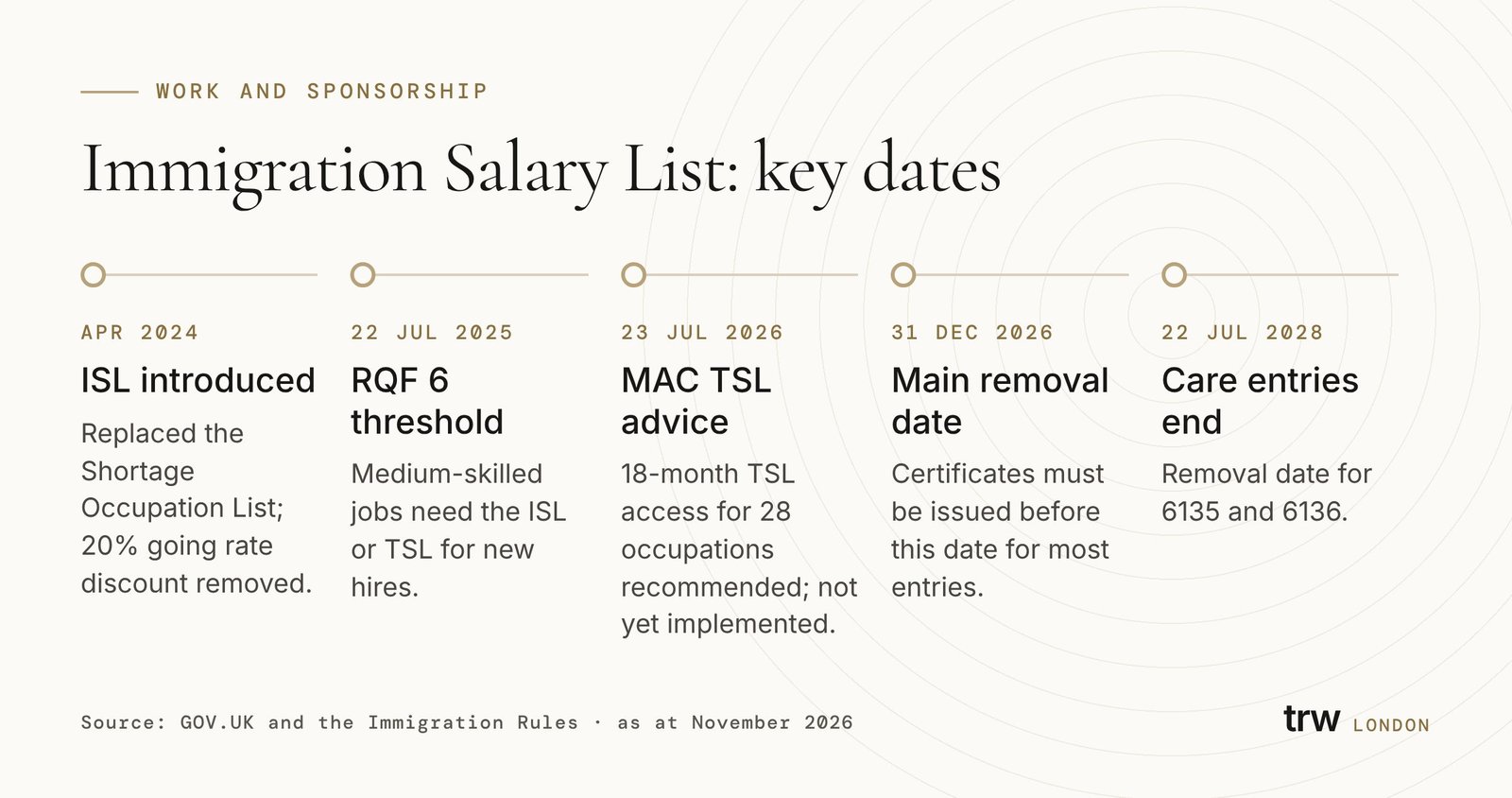
The ISL replaced the former Shortage Occupation List in April 2024. In the January 2024 commissioning letter to the Migration Advisory Committee (MAC), the then Home Secretary said the 20% going rate discount for shortage occupation roles would be removed and the list renamed the Immigration Salary List. The MAC's rapid review of the ISL was published on 23 February 2024, and the Home Secretary replied in March 2024 setting out which recommendations the government would accept.
The commissioning letter also set the principles that still frame the list: roles should be included only where they are skilled, where there is a shortage of suitable resident workers and where immigration is a sensible part of the answer, at least in the short term. It said no sector should be permanently reliant on immigration and roles should not remain on the list forever. The removal dates now in the appendix are the practical expression of that approach.
What an Immigration Salary List job changes
Being on the immigration salary list changes three things and leaves the rest of the route untouched. The comparison below assumes a new applicant and a job in an RQF 6 code.
Standard Skilled Worker job (option A)
- Salary: higher of £41,700 and the going rate
- Visa fee from outside the UK: £819 (up to 3 years) or £1,618
- Visa fee from inside the UK: £943 or £1,865
- Medium-skilled codes not available to new hires
- Immigration skills charge as normal
ISL job (option D)
- Salary: higher of £33,400 and the going rate
- Visa fee: £628 (up to 3 years) or £1,235, inside or outside the UK
- Same reduced fee for partners and children
- Listed medium-skilled codes available to new hires
- Immigration skills charge as normal
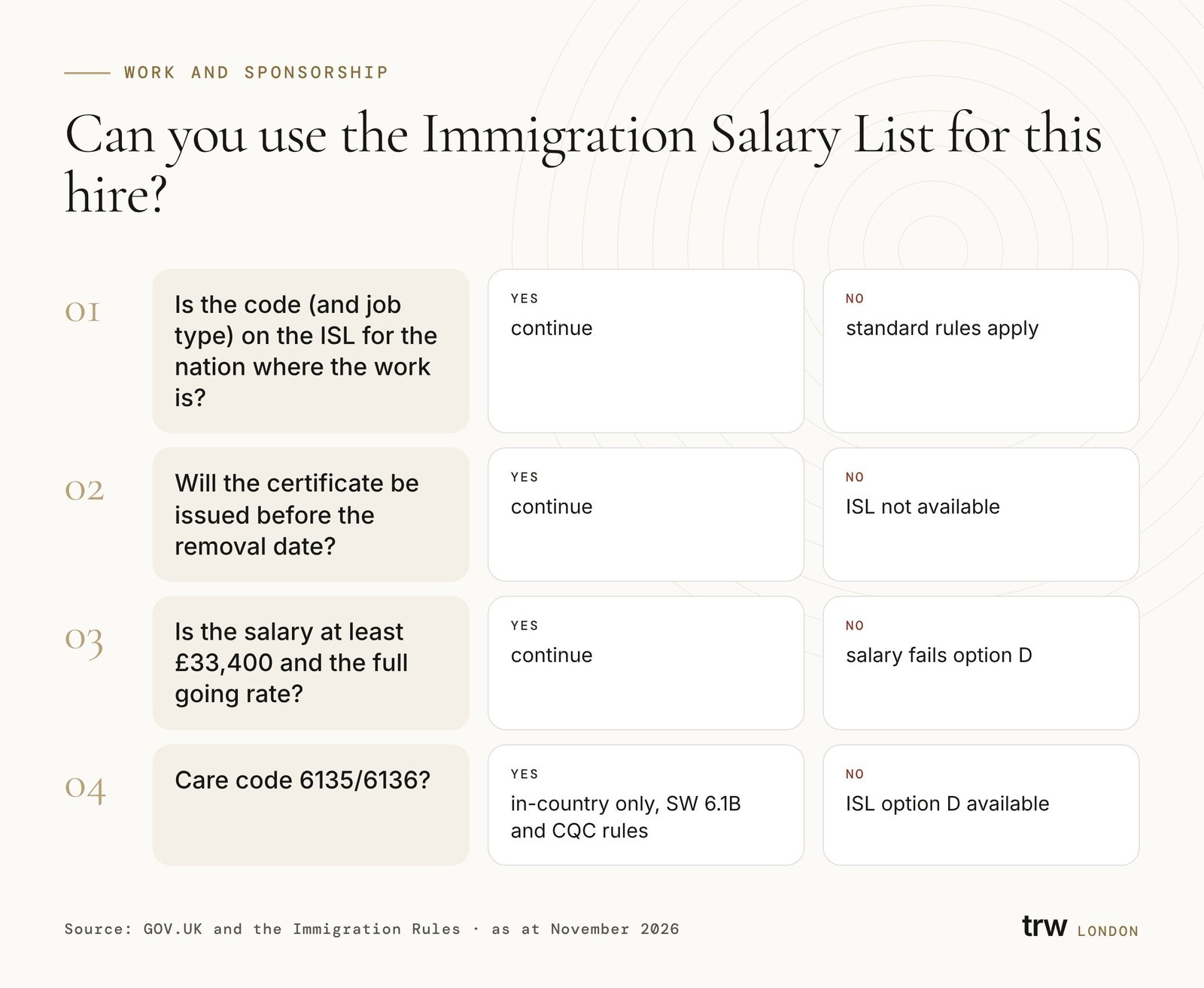
The going rate point is often misunderstood. GOV.UK states that someone sponsored for an ISL job must be paid at least £33,400 and at least the standard going rate for the job (when you can be paid less). The ISL therefore helps only where the going rate for the code is below £41,700. For many of the listed trades, the going rate in Appendix Skilled Occupations is itself £33,400 (the £17.13 hourly floor), so the ISL brings the requirement down from £41,700 to £33,400. For a code with a going rate above £41,700, the ISL changes nothing on salary and only reduces the visa fee.
The current Immigration Salary List, entry by entry
The table reproduces every entry in Appendix Immigration Salary List as published on GOV.UK and checked in November 2026. Some entries cover a whole occupation code; others only named jobs within it. The "Where" column shows whether the entry applies across the UK or in Scotland only. Always check the live appendix before relying on an entry, because the conditions in the full text are detailed.
| SOC 2020 code | Job covered | Where | Removal date |
|---|---|---|---|
| 1212 | Fishing boat masters only | Scotland | 31 Dec 2026 |
| 1232 | Residential, day and domiciliary care managers and proprietors | UK-wide | 31 Dec 2026 |
| 2111 | Chemical scientists: nuclear industry only | Scotland | 31 Dec 2026 |
| 2112 | Biological scientists | UK-wide | 31 Dec 2026 |
| 2115 | Social and humanities scientists: archaeologists only | UK-wide | 31 Dec 2026 |
| 2142 | Graphic and multimedia designers | UK-wide | 31 Dec 2026 |
| 3111 | Laboratory technicians: 3+ years' lawful related experience | UK-wide | 31 Dec 2026 |
| 3212 | Pharmaceutical technicians | UK-wide | 31 Dec 2026 |
| 3411 | Artists | UK-wide | 31 Dec 2026 |
| 3414 | Skilled classical ballet or contemporary dancers (endorsed companies) | UK-wide | 31 Dec 2026 |
| 3415 | Skilled orchestral musicians (ABO member orchestras) | UK-wide | 31 Dec 2026 |
| 3416 | Arts officers, producers and directors | UK-wide | 31 Dec 2026 |
| 5119 | Agriculture and fishing trades n.e.c.: fishing industry only | UK-wide | 31 Dec 2026 |
| 5213 | High integrity pipe welders: 3+ years' lawful experience | UK-wide | 31 Dec 2026 |
| 5235 | Boat and ship builders and repairers | Scotland | 31 Dec 2026 |
| 5312 | Stonemasons and related trades | UK-wide | 31 Dec 2026 |
| 5313 | Bricklayers | UK-wide | 31 Dec 2026 |
| 5314 | Roofers, roof tilers and slaters | UK-wide | 31 Dec 2026 |
| 5316 | Carpenters and joiners | UK-wide | 31 Dec 2026 |
| 5319 | Construction and building trades n.e.c.: retrofitters only | UK-wide | 31 Dec 2026 |
| 6129 | Racing grooms, stallion handlers, stud grooms and hands, work riders | UK-wide | 31 Dec 2026 |
| 6131 | Nursing auxiliaries and assistants (where registered nurse or similar roles exist) | UK-wide | 31 Dec 2026 |
| 6135 | Care workers and home carers (restricted: SW 6.1B, CQC in England) | UK-wide | 22 Jul 2028 |
| 6136 | Senior care workers (restricted: SW 6.1B, CQC in England) | UK-wide | 22 Jul 2028 |
| 9119 | Deckhands on fishing vessels of 9m+: 3+ years' full-time experience | UK-wide | 31 Dec 2026 |
Several entries come with conditions that do real work. The laboratory technician, pipe welder and deckhand entries require 3 years' relevant experience, which must not have been gained through working illegally. The dancer and musician entries require the employing company or orchestra to meet external recognition standards. The nursing auxiliary entry applies only in environments where registered nurse or other registered healthcare professional roles also exist.

Scotland-only entries and the devolved picture
Immigration is reserved, so the same Rules apply across the UK, but the ISL is the one place where a job can be listed for one nation only. GOV.UK reminds applicants to check whether a job is listed for the part of the UK in which they will work. As at November 2026 three entries are Scotland-only.
1212 Fishing boat masters
Only fishing boat masters within the managers and proprietors in forestry, fishing and related services code. Scotland only.
2111 Nuclear chemical scientists
Only chemical scientist jobs in the nuclear industry. Scotland only; the code itself is RQF 6 and eligible elsewhere on standard terms.
5235 Boat and ship builders
All jobs in the code, but only for work located in Scotland.
Everything else
The remaining 22 entries are listed for England, Scotland, Wales and Northern Ireland alike.
The MAC's July 2026 Temporary Shortage List letter recommended no nation-specific additions to that list, finding that the evidence did not show a sufficiently different shortage picture. That advice concerns the TSL, not the ISL, but it suggests that nation-specific shortage treatment is not expanding.
The removal date: what 31 December 2026 actually means
Each ISL entry has a removal date, and the appendix opens with the operative rule: an occupation is only included where an application has been made using a certificate of sponsorship issued by a sponsor to the applicant before the removal date. Three practical consequences follow.
First, the trigger is the certificate, not the visa application or start date. A certificate issued on 30 December 2026 can still be used, within its 3-month validity, for an application made in early 2027. Second, a certificate issued on or after 31 December 2026 cannot rely on an entry with that removal date, however advanced the recruitment. Third, the two care entries (6135 and 6136) have a later removal date of 22 July 2028, but are subject to separate restrictions described below.
What happens after the removal date to workers already sponsored through the immigration salary list is less clear-cut, and depends on the worker's history. Workers granted Skilled Worker permission before 22 July 2025 can use the transitional tables in Appendix Skilled Occupations for medium-skilled codes. Others should take advice well before any extension or change of employment falls due.
The removal date for most entries is 31 December 2026, the same date that applies to the Temporary Shortage List in SW 6.1A. As at 19 November 2026, no Statement of Changes extending either list has been laid. The MAC recommended on 23 July 2026 that 28 occupations receive 18 months of TSL access, but the government has not yet implemented that advice.
The ISL and the Temporary Shortage List compared
The two lists are easily confused because both deal with shortage occupation roles and both mostly end on 31 December 2026. They do different jobs. The ISL lowers the salary floor and the visa fee for the jobs on it. The Temporary Shortage List, set out in SW 6.1A of Appendix Skilled Worker, lets medium-skilled (RQF 3 to 5) codes such as logistics managers, plumbers, floorers, painters and decorators, and energy plant operatives be sponsored at all, but gives no salary discount. A job on the TSL still needs the higher of £41,700 and the going rate, unless another discounted option such as new entrant applies.
Some codes appear on both. Laboratory technicians (3111) are on the TSL and, with a 3-year experience condition, on the ISL. A construction trade such as bricklaying is on the ISL only. The white paper of May 2025 described the TSL as the future gateway for jobs below RQF 6, with access tied to workforce plans; the MAC's Stage 2 letter applied that framework. Our Temporary Shortage List guide covers it in detail.
The ISL changes what you must pay; the TSL changes whether you can sponsor at all.
Policy direction: is the ISL being abolished?
The May 2025 White Paper, Restoring control over the immigration system, said at paragraph 70 that the Immigration Salary List, "which gives people discounts from salary thresholds", will be abolished, and that the MAC would be asked to review salary requirements, including discounts. That is a statement of policy, not law. The ISL remains in the Immigration Rules today, and the mechanism for ending most of it is already there in the 31 December 2026 removal dates.
Employers should therefore plan on the basis that, unless a Statement of Changes says otherwise, the ISL route for most jobs closes for certificates issued from 31 December 2026, and that any replacement is likely to come through the Temporary Shortage List rather than a renewed salary list. We will update this guide if a Statement of Changes is laid.
Care roles, CQC registration and dependants
The care entries are the exception to almost every general point above. Codes 6135 (care workers and home carers) and 6136 (senior care workers) remain on the ISL until 22 July 2028, but SW 6.1B closes them to applicants from outside the UK.
An application in these codes must be for permission to stay, and the applicant must either have legally worked for the sponsor in the role for at least 3 months before the certificate was issued (with the application made before 22 July 2028) or already hold Skilled Worker permission in those codes. In England, the sponsor must be registered with the Care Quality Commission and carrying on a regulated activity. Private households cannot sponsor.
Dependants are restricted too. According to GOV.UK, care workers and senior care workers can bring dependants only if they have been continuously employed in care on the Skilled Worker route since before 11 March 2024, subject to exceptions such as UK-born children. Workers in other medium-skilled codes, including ISL trades, generally cannot bring new dependants unless they have been continuously employed in a medium-skilled Skilled Worker job since before 22 July 2025, with exceptions for UK-born children, sole-parent cases and where both parents are sponsored. Our guide to Skilled Worker dependants sets out the detail.

What employers should do before 31 December 2026
- List roles that depend on the ISL or TSL. Identify every open or planned hire, and every upcoming extension, that relies on a listed code.
- Check the exact entry and nation. Confirm that the job falls within the entry's wording and the work location is in a listed nation.
- Confirm the salary works. The worker must earn at least £33,400 and the full going rate, pro-rated to contracted hours.
- Secure allocation early. Request defined certificates or extra undefined allocation in good time; allocation increases can take up to 12 weeks.
- Issue certificates before the removal date. A certificate issued before 31 December 2026 can be used for an application within its 3-month validity.
- Plan for dependants and extensions. Tell candidates about dependant restrictions and diarise extension dates for workers relying on listed codes.
Worked example: a carpenter hired from overseas
Example (hypothetical): a construction contractor in Manchester holds a Worker licence and wants to hire an experienced carpenter from overseas on 37.5 hours a week at £35,000. Carpenters and joiners (5316) are a medium-skilled code, so a new hire is only possible because the code is on the immigration salary list. The going rate for 5316 in Appendix Skilled Occupations is £33,400.
Under option D the salary must be at least the higher of £33,400 and the going rate, so £35,000 passes. The worker needs B2 English, and pays the ISL visa fee of £628 for a certificate of up to 3 years. The contractor pays the certificate fee and the immigration skills charge as normal. If the worker has a partner and children, they should be told before accepting the offer that new dependants are generally not permitted for a medium-skilled job of this kind, subject to the narrow exceptions.
Timing is the decisive factor. If the contractor requests a defined certificate and issues it on 14 December 2026, the worker can apply in January 2027. If the certificate slips into January, the ISL entry no longer applies, carpenters are not on the Temporary Shortage List, and, unless the Rules change before then, the hire cannot proceed on the Skilled Worker route.
Pitfalls with the Immigration Salary List
Assuming the ISL discounts the going rate
It has not done so since April 2024. A salary below the going rate fails, even if it is above £33,400.
Using a Scotland-only entry for work in England
Three entries apply only in Scotland. The work location on the certificate decides.
Stretching the job description to fit an entry
SW 6.2 allows refusal if the most appropriate code is not on the ISL and the applicant claims ISL points. The entry must fit the real job.
Missing the experience conditions
Several entries need 3 years' lawful experience. Keep evidence of it with the certificate record.
Issuing the certificate on 31 December
The certificate must be issued before the removal date. Do not leave it to the last day of the year.
Next steps
If your recruitment plan relies on a listed job, the deadline is close. We can check each role against the entry wording, confirm salary and code, and help you secure certificates before 31 December 2026, or advise on alternatives if the ISL is not available. See also our guides to the Skilled Worker going rate and to Skilled Worker visas.
To discuss a hire or an extension, book a consultation with TRW.
Frequently asked questions
01Is the Immigration Salary List the same as the Temporary Shortage List?
No. The ISL gives a lower salary floor and visa fee to listed jobs. The Temporary Shortage List, in SW 6.1A of Appendix Skilled Worker, gives medium-skilled jobs access to the route without a salary discount. Both mostly end for certificates issued from 31 December 2026. See our Temporary Shortage List guide.
02Does the ISL let us pay less than the going rate?
No. Since April 2024 the list no longer discounts the going rate. It replaces the £41,700 general threshold with £33,400, but the worker must still be paid at least 100% of the going rate for the code.
03What if the certificate is issued on 31 December 2026?
The rule requires the certificate to be issued before the removal date, so a certificate issued on 31 December 2026 would not qualify for entries with that date. Plan to issue by the end of the previous working day at the latest.
04Can a worker already sponsored in an ISL job extend after the removal date?
Eligibility then depends on other provisions, such as the transitional tables for workers granted permission before 22 July 2025 or before 4 April 2024. Take advice well before the extension falls due.
05Does an ISL job reduce the immigration skills charge?
No. The ISL reduces the worker's visa fee, not the employer's charge, which depends on sponsor size and certificate length.
06Can private households sponsor care workers on the ISL?
No. The ISL entry for 6135 says private households or individuals (other than sole traders sponsoring for their business) cannot sponsor Skilled Worker applicants.
07Will the MAC's 2026 Temporary Shortage List advice change the ISL?
The MAC's July 2026 letter concerns the Temporary Shortage List. As at November 2026, no Statement of Changes implementing it has been laid, and the ISL removal dates are unchanged.
Sources and official materials
- Immigration Rules: Appendix Immigration Salary List — The current list, nations and removal dates
- Immigration Rules: Appendix Skilled Worker — Option D salary rule, TSL in SW 6.1A, care rules in SW 6.1B
- Skilled Worker visa: when you can be paid less — GOV.UK summary of the ISL salary rule
- Skilled Worker visa: how much it costs — Lower ISL visa fees
- Restoring control over the immigration system (White Paper, May 2025) — Para 70: the ISL "will be abolished"
- MAC: Temporary Shortage List stage 2 letter (23 July 2026) — Recommendation of 18-month TSL access for 28 occupations
- MAC commissioned to rapid review new immigration salary list (January 2024) — Origin of the ISL and removal of the 20% discount
General information only, current as at 19 November 2026. It is not legal advice and does not create a solicitor–client relationship. It reflects the law of England and Wales unless stated otherwise; Scotland and Northern Ireland have separate legal systems, and the law changes frequently. Check current official sources and take advice on the facts of your matter.