TRW & Co · Work and sponsorship
The Temporary Shortage List: rules, cut-off and next phase

The temporary shortage list (TSL) keeps some medium-skilled roles, at RQF levels 3 to 5, open to Skilled Worker sponsorship. As at November 2026, it applies only where the certificate of sponsorship is issued before 31 December 2026. It gives no salary or fee discount, and most new TSL hires cannot bring dependants.
Key pointThe TSL cut-off attaches to the date the certificate is issued, so the real deadline for employers is when they can get a valid certificate, not when the worker applies.
At a glance
Rule
Appendix Skilled Worker, paragraph SW 6.1A.
Cut-off
Certificate issued before 31 December 2026 (in force).
Salary
No TSL discount; normally £41,700 or the going rate if higher.
Family
New medium-skilled hires generally cannot bring dependants.
Next phase
MAC recommended 18-month access for 28 occupations; not yet in the Rules.
Swipe or scroll →
The temporary shortage list in short
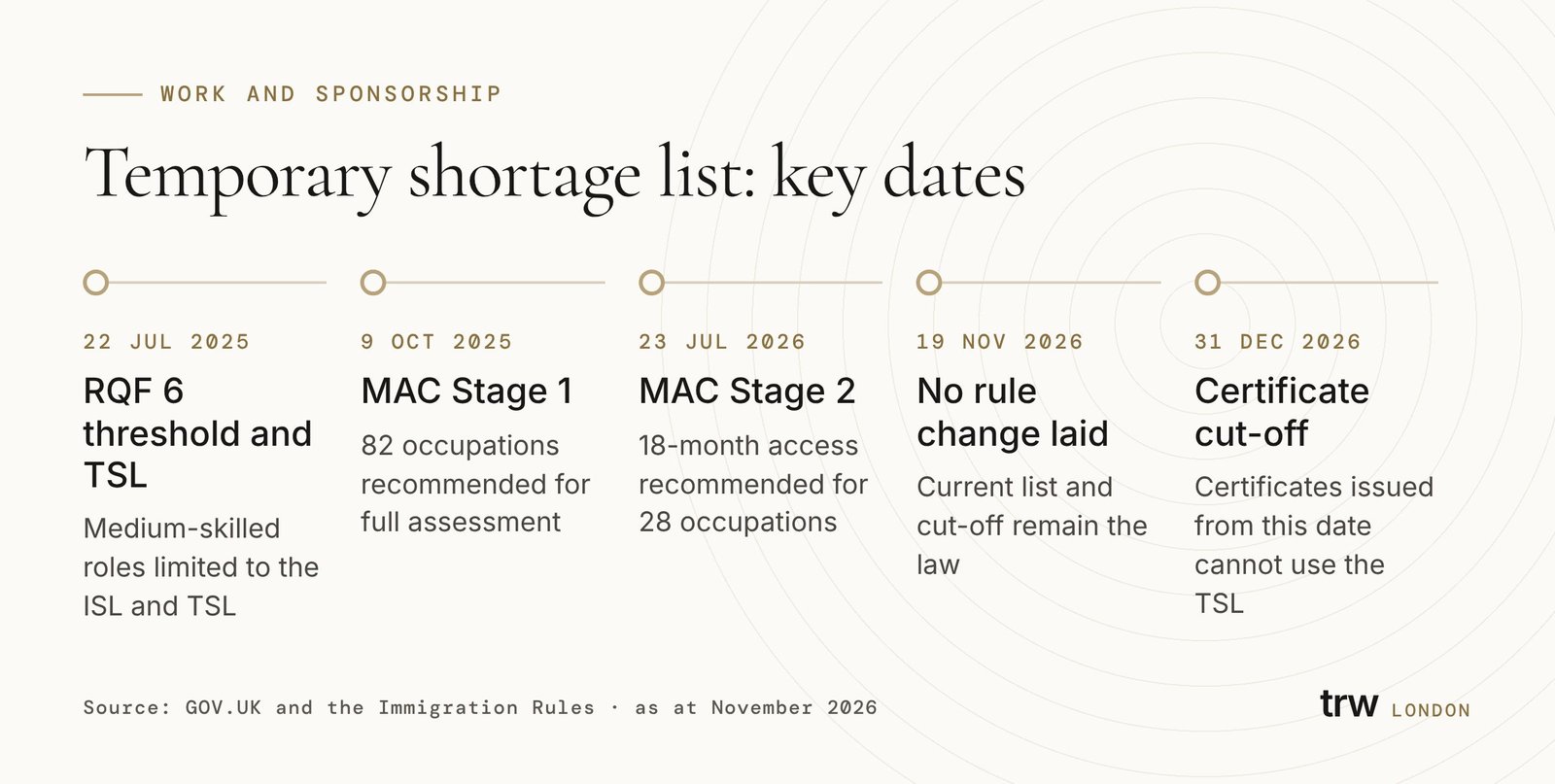
The temporary shortage list is the part of the Skilled Worker rules that still lets a UK employer sponsor certain "medium skilled" jobs, pitched at RQF levels 3 to 5, after the general skill threshold was raised to graduate level (RQF 6) on 22 July 2025. It is found in paragraph SW 6.1A of Appendix Skilled Worker and covers technician, trade, construction, design and finance support occupations.
The list is temporary in a very literal sense. As at November 2026, an occupation on the TSL counts only where the application is made using a certificate of sponsorship issued before 31 December 2026. After that date, unless the Home Office lays new rules, those medium-skilled roles drop out of new sponsorship.
This guide explains what the TSL does and does not do, how the cut-off works, what the Migration Advisory Committee has recommended for the next phase, and what employers should do in the weeks that remain.
Where the TSL sits in the Immigration Rules
Skilled Worker applicants score points for a job "at the appropriate skill level" under SW 6.1. A job qualifies if its SOC 2020 occupation code appears in the higher-skilled tables of Appendix Skilled Occupations, on the Immigration Salary List, or on the temporary shortage list in SW 6.1A. There are narrower transitional gateways for people already on the route before 22 July 2025 and for prison officers.
SW 6.1A has two limbs. The occupation must appear in the list printed in the rule, and the application must be "made using a certificate of sponsorship issued by a sponsor to an applicant before 31 December 2026". Both must be satisfied. A job that is on the list but is sponsored on a certificate issued on 31 December 2026 or later does not qualify.
GOV.UK summarises the effect on its Skilled Worker eligibility page: if your occupation code is listed as medium skilled, you can apply if your job is on the Immigration Salary List or the TSL. The Home Office publication of the temporary shortage list confirms that TSL access covers entry clearance, switching and extensions alike.
The TSL is a gateway for skill level only. Every other Skilled Worker requirement still applies: an A-rated sponsor, a genuine vacancy, the salary rules, B2 English for new applicants and the financial requirement. An employer that relies on the list should test the whole application, not just the occupation code.
Which jobs are on the temporary shortage list
The list in SW 6.1A runs to roughly sixty SOC codes. They cluster in five groups: logistics and consultancy management, science and engineering technicians, IT and data roles, creative and business associate professions, and skilled trades in engineering, electrical work and construction. Several codes are limited to named job types, so the code alone is not enough.
The table below groups some of the listed codes. It is a reading aid, not a substitute for the rule: always check the current text of Appendix Skilled Worker on the day the certificate is assigned.
| Group | Examples of listed SOC 2020 codes | Restriction to note |
|---|---|---|
| Management | 1243 Managers in logistics; 1258 Directors in consultancy services | None in the rule |
| Technicians | 3111 Laboratory technicians; 3112 to 3116 engineering, QA and process technicians; 3120 CAD and architectural technicians | None in the rule |
| IT and data | 3131 IT operations technicians; 3132 IT user support; 3133 Database administrators; 3544 Data analysts | None in the rule |
| Creative and business | 3412 Authors, writers and translators; 3520 Legal associate professionals; 3533 Financial and accounting technicians | 3429 and 3549 cover listed job types only |
| Skilled trades | 5213 Welding; 5241 Electricians; 5315 Plumbers; 5322 Floorers and wall tilers; 5330 Construction supervisors; 8133 Energy plant operatives | 5319 covers listed job types only |
The Home Office's separate TSL publication adds two salary columns for each code. The "standard rate" is the going rate for most applicants; the "lower rate" applies only to workers who got the certificate for their first Skilled Worker visa before 4 April 2024 and have held the visa continuously since. Both are based on a 37.5-hour week and must be pro-rated for other working patterns.
Coding is where many medium-skilled roles fail. SW 6.2 lets a caseworker refuse where the sponsor has chosen a less appropriate code, for example because the most accurate code is ineligible or carries a higher going rate. Job descriptions should match the code's tasks, and the eligible occupations table should be checked alongside the TSL.

What TSL access does not give you
Employers often treat the temporary shortage list as if it were the old shortage occupation list. It is not. Three differences catch people out, and each has a direct cost.
No salary discount
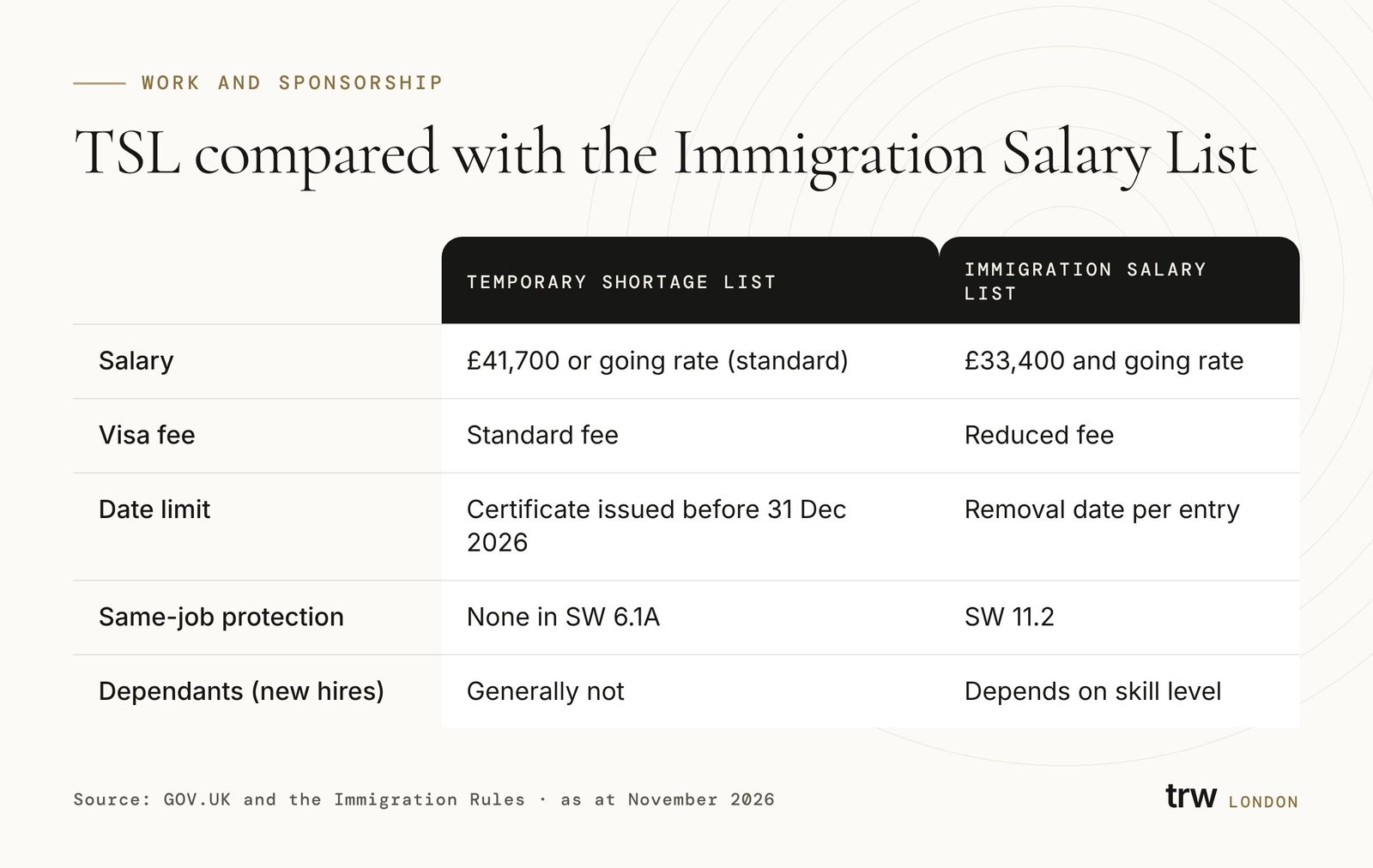
The salary options in the SW 4.2 table give a discount for jobs on the Immigration Salary List (option D: £33,400 and the going rate). There is no TSL option. A worker sponsored in a TSL occupation must normally meet option A, the higher of £41,700 and the going rate, unless they qualify as a new entrant, hold a relevant PhD, or belong to the cohort first sponsored before 4 April 2024. For many technician and trade roles the general threshold, not the going rate, is the binding figure.
No lower visa fee
The reduced Skilled Worker application fee (£628 for up to three years, £1,235 for longer) is tied to the Immigration Salary List. A TSL job pays the standard fee: £819 or £1,618 from outside the UK and £943 or £1,865 from inside, as listed on GOV.UK at November 2026.
No dependants for new hires
Under SW 29.1A and SW 32A.2, a partner or child can only join a Skilled Worker sponsored in a higher-skilled occupation, unless an exception applies. A worker newly sponsored in medium-skilled roles on the TSL generally cannot bring a dependant partner or children. GOV.UK's family page lists the narrow exceptions, such as a child born in the UK.
Immigration Salary List job
- Lower salary option: £33,400 and the going rate
- Reduced visa fee (£628 / £1,235)
- Removal date in Appendix ISL, mostly 31 December 2026
- Protection for workers continuing in the same job (SW 11.2)
Temporary shortage list job
- Standard salary rules: normally £41,700 or the going rate if higher
- Standard visa fee
- Cut-off: certificate issued before 31 December 2026
- No equivalent continuation protection in the text of SW 6.1A
The 31 December 2026 cut-off
The date in SW 6.1A attaches to the certificate, not to the visa application or the start date. A certificate issued on 30 December 2026 for a TSL occupation can, on the wording of the rule, support an application made in early 2027, provided the certificate is still valid. A worker must apply within three months of the certificate being assigned, and the start date on the certificate must be no more than three months after the date of application (SW 5.1(c)).
In practice the window is shorter than it looks. Overseas hires need a "defined" certificate, which GOV.UK says is usually approved within one working day, but can take longer if UKVI makes checks. In-country hires use undefined certificates, and a sponsor that has run out of allocation may wait up to 12 weeks for more, or five working days with the priority service. Christmas closures shorten the run-in further.
Most Immigration Salary List entries carry the same 31 December 2026 removal date, so an employer cannot assume that a job falling off the TSL will be rescued by the ISL. Two care-related ISL entries are dated 22 July 2028. Check both appendices.
The MAC Stage 2 recommendations
The Migration Advisory Committee was asked in July 2025 to decide which RQF 3 to 5 occupations should be on the TSL. Its Stage 1 report on 9 October 2025 recommended that 82 occupations go forward. Stage 2, published on 23 July 2026, assessed those occupations against four criteria: shortage, a credible plan to train and use domestic workers, management of exploitation risk, and overall appropriateness.
In its letter to the Home Secretary, the MAC recommended 18-month access for 28 occupations and said no occupation had a strong enough Jobs Plan to justify three years. Of the 18 occupations it did not recommend, seven were judged not to be in shortage, seven had particularly weak Jobs Plans and two were not considered appropriate. It recommended separate treatment for specific roles within dancers and choreographers and musicians, and no nation-specific additions.
The MAC also proposed a lighter-touch review before the 18-month period ends, and full reviews every three years after that.
The MAC's recommendations are advice, not law. As at 19 November 2026 no Statement of Changes implementing them had been laid; the latest statement on the GOV.UK collection is HC 584 of 3 September 2026. Statements normally take effect at least 21 days after laying, so any replacement list for 1 January 2027 would need to be laid very soon. Plan on the rules as they stand.
Existing TSL workers after the cut-off
For people already on the route, the position depends on when they were first sponsored. A worker who held Skilled Worker permission under the rules before 22 July 2025, and has held it continuously since, can extend or change jobs in a medium-skilled code through SW 6.1(d), whether or not that code is on the TSL. That cohort can also keep family members with them.
Workers first sponsored in a TSL occupation after 22 July 2025 are in a different position. The text of SW 6.1A contains no continuation protection like SW 11.2 for the Immigration Salary List. On the rules as currently drafted, such a worker who needs a new certificate issued on or after 31 December 2026, to extend or to move employer, would not score the skill-level points unless the list is renewed or another gateway applies.
For a post-July 2025 hire in a TSL job, the length of the current certificate may be the most important number in the file.
A Skilled Worker certificate can run for up to five years, and permission is granted until 14 days after its end date (SW 18.1). Where an employer expects to keep a TSL worker beyond 2026, a longer certificate issued before the cut-off may avoid an extension under rules that no longer recognise the role. The trade-off is cost: the Immigration Skills Charge is paid upfront for the whole period.
Common pitfalls with the temporary shortage list
Assuming the TSL brings a lower salary threshold
It does not. Only Immigration Salary List jobs, new entrants, PhD holders and the pre-April 2024 cohort have lower salary options. Re-run the salary maths for every TSL offer against £41,700 and the going rate, pro-rated for the hours actually worked.
Using a code that is limited to named job types
Codes 3429, 3549, 4129 and 5319 are listed only for specified job types. A business support officer may fall within 3549; a general administrator in the same code will not. The job description and the certificate need to show the listed job type.
Promising family relocation
Recruitment packs for TSL roles sometimes still mention family visas. For a worker sponsored after 22 July 2025 in a medium-skilled code, a partner or child usually cannot qualify as a dependant. Correct the offer before the candidate resigns overseas.
Missing the pay-period rule
Since HC 1691 (March 2026), the required salary must be paid in each pay period, not only averaged across the year (SW 14.3B). Variable rotas and unpaid rest weeks need to be set up carefully. The explanatory memorandum explains the change.
Leaving certificates until late December
Defined certificate requests, priority places and internal sign-off all slow down in the holiday period. A certificate issued on 31 December 2026 is too late.
Worked example: a London engineering firm
Example (hypothetical): a medium-sized London engineering consultancy wants to recruit an engineering technician from overseas. The role fits SOC 3113, which is on the temporary shortage list. The candidate is 31 and has no UK study history, so the new entrant discount is not available.
The firm checks the going rate. The Home Office TSL table shows a standard rate of £42,500 for 3113 on a 37.5-hour week, so the required salary is £42,500, not £41,700. The candidate must show B2 English. The firm explains early that the candidate's partner cannot join as a dependant under this route.
Costs fall on both sides. The firm pays the £525 certificate fee and, as a medium or large sponsor, an Immigration Skills Charge of £1,320 for the first 12 months and £660 for each further six months, so £3,960 for a three-year certificate. The candidate pays the £819 visa fee and the Immigration Health Surcharge of £1,035 a year. The firm requests the defined certificate in early December, not after Christmas.

An employer plan for the next six weeks
- Audit your medium-skilled roles. List every planned hire, extension and internal move in an RQF 3 to 5 code, with the date a certificate will be needed.
- Confirm the code and job type. Match each job description to the SOC 2020 code and check SW 6.1A, including any job-type limits.
- Re-cost the offer. Apply option A salary rules unless a discount genuinely applies, and add the certificate fee and ISC for the planned duration.
- Check certificate stock and SMS access. Request defined certificates or extra undefined allocation now; make sure a Level 1 user is available over the holidays.
- Choose certificate length deliberately. For roles you expect to keep, weigh a longer certificate before the cut-off against the upfront ISC cost.
- Diary the cut-off and the rule change watch. Monitor the Statements of Changes collection for any TSL replacement and review the plan as soon as one is laid.
We usually start by reviewing the sponsor's live and planned certificates against the list, because the risk sits with the people who are already employed as much as with new hires. Our sponsor licence team can also help where a business needs a licence before the cut-off.
Related routes and guides
Immigration Salary List
The other list for medium-skilled roles, with a salary and fee discount.
Read the guideWorkGoing rates
How the occupation going rate interacts with the £41,700 threshold.
Read the guideSponsorsCertificates of sponsorship
Defined and undefined certificates, timing and cost.
Read the guideFamilySkilled Worker dependants
Who can bring a partner and children, and the medium-skilled bar.
Read the guideSponsorsImmigration Skills Charge
The upfront charge that drives certificate-length decisions.
Read the guideAdviceSkilled Worker solicitors
Our practice page for employers and workers.
Read the guideNext steps
If your workforce plan for 2027 depends on the temporary shortage list, act before the certificate cut-off rather than waiting to see whether the MAC's recommendations are adopted. Read our broader Skilled Worker visa guide and the summary of the White Paper reforms for context.
To review your TSL roles, certificates and options with a solicitor, book a consultation with TRW & Co.
Frequently asked questions
01Is the temporary shortage list the same as the old shortage occupation list?
No. The old Shortage Occupation List was replaced by the Immigration Salary List. The TSL is a separate, time-limited list that makes certain RQF 3 to 5 jobs eligible at all; it carries no salary or fee discount.
02Can a TSL worker switch to the route from inside the UK?
Yes. The Home Office publication says TSL access applies to entry clearance, switching and extensions, subject to the other switching rules, for example the restrictions on visitors and students who have not completed their course.
03Does the cut-off apply to the visa application date?
No. SW 6.1A looks at whether the certificate of sponsorship was issued before 31 December 2026. The worker must still apply within three months of the certificate being assigned.
04Has the government accepted the MAC's 28-occupation list?
As at 19 November 2026, no Statement of Changes implementing the MAC's Stage 2 recommendations had been laid. Until it is, the existing list and cut-off are the law.
05Are care workers on the TSL?
No. Care workers and senior care workers (6135 and 6136) have their own rules: entry clearance is closed and in-country applications are only possible in limited cases set out in SW 6.1B.
06Can a TSL worker bring their children if one was born in the UK?
A child born in the UK is one of the exceptions to the dependants bar for medium-skilled roles. Other exceptions, such as sole responsibility, apply only to in-country applications. See our dependants guide.
07Will the Immigration Skills Charge be refunded if the worker leaves early?
GOV.UK says a partial refund is available if the worker leaves before the end date on the certificate or moves to another sponsor, and a full refund if the visa is refused or the worker does not start.
Sources and official materials
- Immigration Rules: Appendix Skilled Worker — SW 6.1A list and cut-off; SW 4.2 salary options; SW 29.1A dependants
- Skilled Worker visa: temporary shortage list — Home Office TSL table with standard and lower going rates
- Immigration Rules: Appendix Immigration Salary List — ISL entries and removal dates
- MAC letter on the TSL Stage 2 report (23 July 2026) — Recommendations for 18-month access
- Skilled Worker visa: your job — GOV.UK summary of eligible occupations and salary
- Sponsors: Immigration Skills Charge — ISC rates, refunds and payment
- Statements of changes to the Immigration Rules — Check for any rule implementing the MAC review
General information only, current as at 19 November 2026. It is not legal advice and does not create a solicitor–client relationship. It reflects the law of England and Wales unless stated otherwise; Scotland and Northern Ireland have separate legal systems, and the law changes frequently. Check current official sources and take advice on the facts of your matter.