TRW & Co · Study
Student visa refusal: reasons, remedies and reapplying

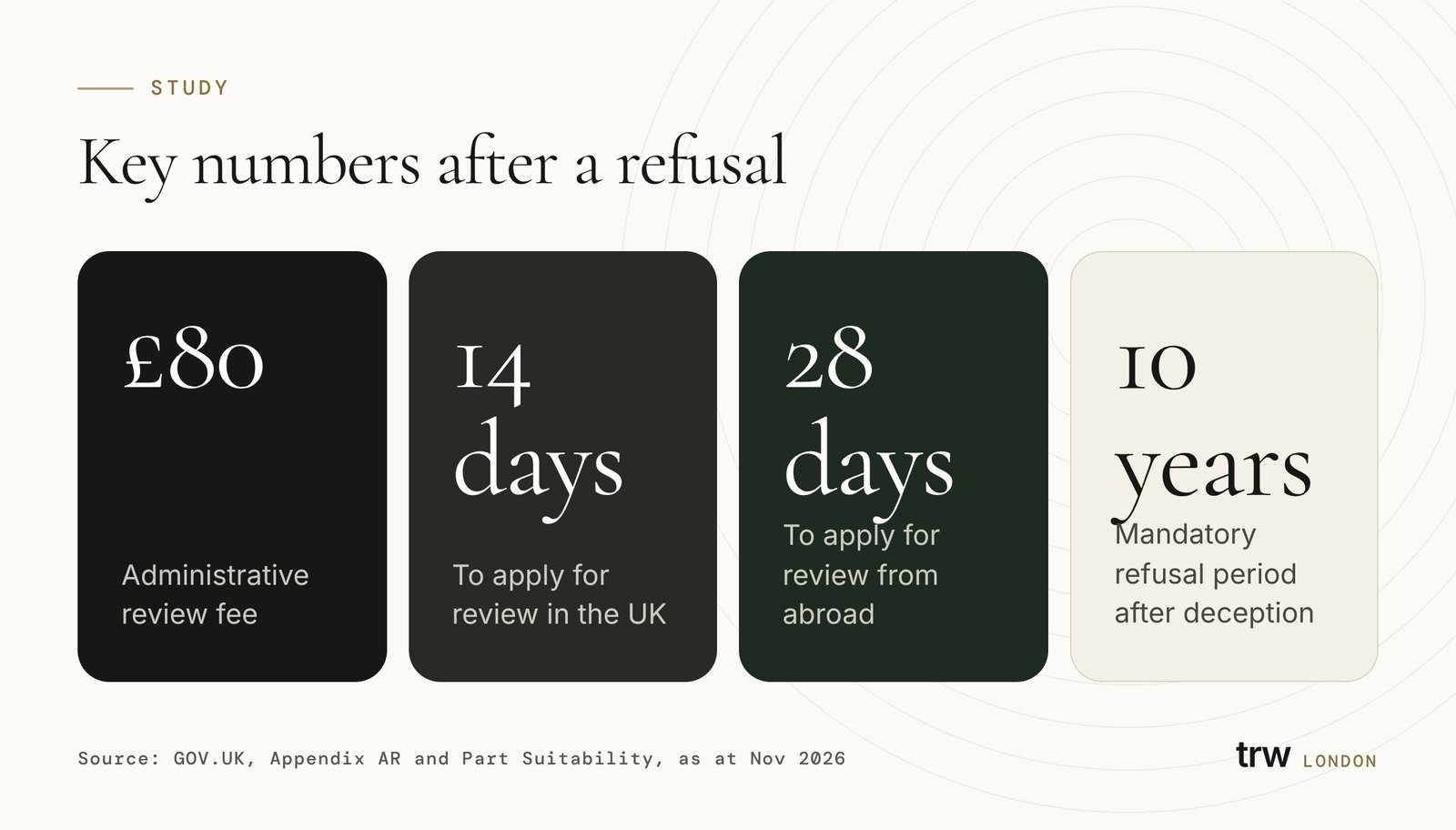
Most Student visas are refused for funds, CAS problems, English, the genuine student test or suitability issues such as deception. There is usually no appeal. You can ask for administrative review (£80; 14 days in the UK, 28 days outside) if the caseworker made an error, or reapply with better evidence. Deception findings can carry a 10-year ban.
Key pointDecide whether the refusal reflects a casework error or a gap in your evidence: review fixes the first, a fresh application fixes the second.
At a glance
Appeal?
No, unless a human rights or protection claim was refused.
Review
£80; 14 days in the UK, 28 days outside, 7 days if detained.
Time
GOV.UK warns reviews can take 12 months or more.
Interviews
Caseworkers must normally interview before refusing on genuineness grounds.
Deception
Mandatory refusal and a possible 10-year re-entry ban.
Swipe or scroll →
Student visa refusal: what to do first
A student visa refusal usually rests on one of a handful of grounds: the money evidence, the CAS, English, the genuine student assessment or a suitability issue such as deception. There is normally no right of appeal. The options are administrative review if the caseworker made an error, a fresh application with better evidence, or, rarely, judicial review. Deadlines are short: 14 days from inside the UK and 28 days from outside.
In the first few days after a refused Student visa, do three things. Diary the review deadline from the date you received the decision. Tell your university's international office, because your CAS and start date may need to change. And read the refusal letter line by line against what you actually submitted, because the choice of remedy depends on whether the caseworker got the rules wrong or you did not prove your case.
Why Student visas are refused
A student visa refusal falls under Appendix Student, Appendix Finance and Appendix English Language, or under Part Suitability, which applies across all routes. Some failures are validity problems, which lead to the application being rejected as invalid rather than refused. The common grounds are:
| Ground | Rule | Typical cause | Usual response |
|---|---|---|---|
| Not a genuine student | ST 5.1 | Weak answers at a credibility interview; unexplained study gap | Fresh application with a clearer study plan, or review if the guidance was not followed |
| Funds not shown | ST 12 and Appendix Finance | Balance dipped below the required level; 28-day period ended too early | Fresh application with correct statements |
| CAS problems | ST 7 and ST 23 | CAS details wrong, expired or withdrawn | New CAS from the sponsor and a fresh application |
| English | Appendix English Language | Wrong test or level; concerns at interview | Correct evidence; review if the evidence was wrongly rejected |
| Deception or false information | SUI 9.1 and SUI 10.1 | False bank statement or certificate; undisclosed refusal | Administrative review with new evidence; specialist advice |
| Failure to attend interview | SUI 14.1 | Missed call or appointment without a reasonable excuse | Review if a reasonable excuse was given; otherwise reapply |
| Visa brake | HC 1691 | Main applicant from Afghanistan, Cameroon, Myanmar or Sudan | No evidential fix while the brake is in force |
Financial grounds are the most avoidable cause of a refused Student visa. GOV.UK requires the funds to be held for at least 28 consecutive days, with the end of that period within 31 days of the application. As at November 2026 the figures are £1,529 a month in London and £1,171 elsewhere for up to 9 months, with an uplift from 30 November 2026. A single day below the required balance is enough to fail.
Since 26 March 2026 the visa brake in HC 1691 requires refusal of Student visa applications by main applicants who are nationals of Afghanistan, Cameroon, Myanmar or Sudan. A student visa refusal on that basis cannot be cured by better evidence or administrative review. The Home Office describes the brake as temporary and kept under review.
The credibility interview
The genuine student rule is applied through the Student and Child Student caseworker guidance (version 15.0, published for staff on 9 October 2026). The caseworker must be satisfied, on the balance of probabilities, that the applicant is a genuine student, taking account of everything in the application and any credibility interview. Under the guidance, a genuineness refusal should normally follow a credibility interview.
The guidance sets an important safeguard. A caseworker "must not refuse an applicant on genuineness grounds without interviewing them", unless the applicant was previously refused on genuine student grounds with no material change or new evidence, or there have been many identical or very similar applications and a sample of applicants has been interviewed. If a refusal letter relies on genuineness and no credibility interview took place, ask whether either exception genuinely applied.
What the interviewer looks at
The guidance lists factors including immigration history; the time since the applicant last studied and the reasons for returning to study; whether the course represents academic progression; the applicant's knowledge of, and research into, the course, institution and living arrangements; the relevance of the course to post-study plans; the credibility of the source of funds; and whether an agent or institution is of concern. A credibility interview may be by telephone, and the caseworker can consider English ability, but must justify that in the refusal letter.
Two limits are worth knowing. Caseworkers must not refuse because an applicant lacks local knowledge, such as bus routes or the geography of the city. And where a statement could be read in different ways, the caseworker must explain why they chose the reading they did. Refusal letters must accurately reflect the interview transcript, which matters on review.

Reading the refusal letter
- Find the date you received it. Review deadlines run from receipt of the decision. Note it and work backwards.
- List every ground. A student visa refusal letter often gives more than one reason. A review that succeeds on one ground but not another still leaves the refusal in place.
- Classify each ground. Ask whether the caseworker misapplied the rules or guidance (a casework error) or whether the evidence was missing or weak (a case to reapply).
- Compare with the file. Check what was actually uploaded, including bank statements, the CAS details and any interview record.
- Check for suitability findings. A deception or false-information finding changes the strategy and has long-term consequences.
- Speak to the sponsor. Ask whether the CAS can be reissued or the start date deferred, and how the sponsor views the refusal.
Choosing a remedy
For most people with a refused Student visa, the real choice is between administrative review and a fresh application. They suit different problems.
Administrative review
- Fee £80; 14 days from inside the UK, 28 days from outside (7 if detained)
- Only for casework errors: rules or published guidance misapplied
- New evidence generally not considered, with limited exceptions
- GOV.UK warns it can take 12 months or more
- Treated as withdrawn if you make a new application
Fresh application
- Full visa fee and health surcharge again, with a new CAS if needed
- Can fix evidence gaps: funds, documents, a fuller study plan
- Must disclose the previous refusal
- Standard decision in about 3 weeks from outside the UK
- A further refusal adds to the immigration history
Timing often decides it. If the course starts in a few weeks and the refusal was caused by an evidence gap, a fresh application is usually the only realistic option. If the caseworker plainly ignored evidence or misapplied the guidance, and the student can wait or defer, review may be worth pursuing. Ask the university about deferral before choosing.

Administrative review after a student visa refusal
Administrative review is governed by Appendix AR. The reviewer decides whether the decision was wrong because the caseworker failed to apply, or incorrectly applied, the Immigration Rules or published guidance (AR 3.1). It is a review of the original application only, not a fresh consideration on any other basis (AR 3.2).
New evidence is only considered in limited cases listed in AR 3.3, including refusals on false-representation or deception grounds, refusals for a previous breach of immigration laws, and a failure to follow the evidential flexibility policy. A financial refusal based on a missing bank statement will therefore usually fail on review, while a refusal that overlooked a statement that was uploaded may succeed.
According to GOV.UK, the Home Office will contact the applicant with an update if no decision is made within 6 months. A person who applied in the UK will not be removed while the review is pending (AR 4.1), and a student who applied in time keeps their existing conditions under section 3C leave. But the review is treated as withdrawn if the applicant leaves the UK, asks for their passport back to travel, or makes another application (AR 4.3 and 4.4). See our administrative review guide for the process.
Reapplying after a refused Student visa
A fresh application starts again: new fee, health surcharge and, if the original has been used or withdrawn, a new CAS. The previous refusal must be disclosed. Failing to mention it can itself amount to deception under Part Suitability, which is far more serious than the original problem.
The new application should answer the student visa refusal directly. If funds were the problem, provide statements that cover a clean 28-day period ending within 31 days of the new application. If genuineness was the problem, or the credibility interview went badly, prepare a clear account of why this course, at this institution, fits the applicant's education and career, and how it will be funded. Where the caseworker guidance allows a further refusal without interview because circumstances have not changed, new evidence matters even more.
Before you reapply after a refused Student visa
- Read every ground in the refusal letter and note how the new application answers it
- Obtain fresh bank statements covering a clean 28-day period ending within 31 days of the new application
- Confirm with the university that the CAS is still valid, or obtain a new one with a realistic start date
- Prepare a short, honest account of your study history, any gaps and your plans after the course
- Disclose the earlier refusal and keep a copy of the decision letter with the new application
- Check every document an agent has prepared, including translations
- If a credibility interview is likely, rehearse explaining the course, the institution and your funding in your own words
Applicants already in the UK face an extra constraint: an in-country Student application must be made before current permission expires, and the new course must start within 28 days of that expiry. If that timing cannot be met after a refusal, the realistic route may be a fresh application from abroad.
Universities may hesitate to issue a new CAS after a refusal. Under the basic compliance assessment, sponsors must keep their visa refusal rate below 5% for assessments applied for on or after 1 June 2026 (student sponsor compliance guidance). Expect the sponsor to ask detailed questions before reissuing, and give it a clear explanation of what has changed.
Appeals and judicial review
Under section 82 of the Nationality, Immigration and Asylum Act 2002, a right of appeal exists only against refusal of a protection claim, refusal of a human rights claim, or revocation of protection status. An ordinary student visa refusal is none of these, so there is no appeal. If a human rights claim was genuinely made and refused, a First-tier Tribunal appeal may be available; our immigration appeals team can advise.
Judicial review is a last resort for decisions that are unlawful in a public-law sense, usually after administrative review has failed. Most immigration judicial reviews go to the Upper Tribunal, where rule 28 of the Tribunal Procedure (Upper Tribunal) Rules 2008 requires the application to be made promptly and no later than 3 months after the decision. A pre-action letter is normally sent first.
Deception findings and re-entry bans
Part Suitability distinguishes two grounds. Under SUI 9.1, an application must be refused where the decision maker is satisfied the applicant used deception, for example by making false representations, providing false documents or failing to disclose relevant facts. Under SUI 10.1, an application may be refused where the applicant or a third party, such as an agent, provided false information, whether or not the applicant knew.
The consequences go beyond the immediate refusal. The mandatory refusal periods in SUI 12.1 include 10 years from the date of refusal where the applicant used deception in an application. Because a deception finding is one of the cases where new evidence is admissible on administrative review (AR 3.3), it is often worth challenging, with evidence showing the document was genuine or that the applicant was not responsible. Our guide to visa refusal for deception covers the standard of proof, and our re-entry ban guide covers the time periods.
An ordinary student visa refusal costs months; a deception finding can cost a decade. Treat any allegation of false documents as the priority.
Worked example
Example (hypothetical): an applicant from outside the UK is offered a master's place at a university outside London and applies 5 weeks before the course starts. The refusal letter gives two grounds: the funds were below the required amount on one day of the 28-day period, and the caseworker was not satisfied the applicant is a genuine student, citing a 4-year gap since the applicant's first degree. The letter records a 20-minute telephone credibility interview.
The funds ground is an evidence failure, not a casework error, and the credibility interview record shows no obvious breach of the guidance, so review cannot fix it. The applicant therefore asks the university to defer the start to the next intake and reissue the CAS. The new application includes bank statements covering a fresh 28-day period, an explanation of the work experience during the gap and how it led to this course, and evidence of research into the programme. It discloses the earlier refusal. Administrative review is not pursued, because a new application would withdraw it in any event.
Pitfalls
Missing the review deadline
The 14 or 28-day limit runs from receipt of the decision. Late applications are accepted only if it would be unjust not to waive the limit and the review was made as soon as reasonably practicable (AR 2.14). Do not rely on that.
Sending new documents with a review
Outside the AR 3.3 exceptions, the reviewer will not look at evidence that was not before the caseworker. Sending it wastes time and can obscure the real error.
Travelling while a review is pending
For in-country reviews, leaving the UK or asking for your passport back to travel withdraws the review. Plan any trip only after the outcome.
Letting an agent prepare the new application unsupervised
Under SUI 10.1 false information supplied by a third party can lead to refusal even if you did not know. Check every document yourself before it is submitted.
Overstaying after a refusal in the UK
Once permission and any section 3C leave end, staying on is unlawful and can affect future applications. Read our guide on overstaying and take advice quickly.
Related guides
Help with a new application
How we prepare Student visa applications after a setback.
Read the guideStudyGetting the funds right
Avoid the most common evidential failure next time.
Read the guideRemediesAdministrative review
How the review works and when it succeeds.
Read the guideRemediesVisa refusal solicitors
Our practice page for refusals across all routes.
Read the guide
Next steps
We usually start by reading the refusal letter alongside the documents that were actually submitted, because the gap between them tells us whether the case needs a review, a better application, or both in sequence. If deception has been alleged, we deal with that first.
If you have received a student visa refusal, book a consultation as soon as you can, ideally well within the 14 or 28-day window. Bring the refusal letter, the application you submitted and your CAS.
Frequently asked questions
01Can I appeal a student visa refusal?
Not usually. Section 82 of the 2002 Act limits appeals to protection and human rights claims. The remedies for an ordinary refusal are administrative review, a fresh application or judicial review.
02Will a refused Student visa affect future UK applications?
You must disclose it on future applications. A refusal for missing evidence is unlikely to be decisive on its own if later applications are strong. A deception finding is far more serious and can lead to mandatory refusals for up to 10 years.
03Can I apply again straight away?
Yes. There is no waiting period after an ordinary refusal. Making a new application withdraws any pending administrative review.
04My refusal says I am not a genuine student, but I was never interviewed. Is that lawful?
The caseworker guidance says applicants must not be refused on genuineness grounds without interview except in two specified situations. If neither applies, that may be a casework error suitable for administrative review.
05Can my university help after a refusal?
Often. It may defer your start date or reissue a CAS, and its international office can confirm the course details. It will also want to understand what went wrong before supporting a new application.
06What if my agent provided a false document without my knowledge?
SUI 10.1 allows refusal even where you did not know, but it is discretionary, and SUI 9.1 requires the caseworker to be satisfied that you used deception. Get advice quickly: new evidence is admissible on review in deception cases.
07Does a credibility interview always happen on the phone?
Not always. The guidance allows telephone interviews and interviews at a set time and place. If you are contacted unexpectedly, you can ask to arrange another time, but refusing without good reason risks a refusal.
Sources and official materials
- Student and Child Student caseworker guidance — Genuine student rule, credibility interviews and refusal letters (v15.0).
- Immigration Rules: Appendix Student — ST 5.1 genuine student requirement and other eligibility rules.
- Immigration Rules: Part Suitability — Deception, false information, interviews and mandatory refusal periods.
- Immigration Rules: Appendix AR — Scope, time limits and evidence on administrative review.
- Ask for a visa administrative review — Fee, deadlines and current processing warning.
- Nationality, Immigration and Asylum Act 2002, section 82 — Limits on statutory appeal rights.
- Tribunal Procedure (Upper Tribunal) Rules 2008, rule 28 — Time limit for judicial review in the Upper Tribunal.
- Explanatory memorandum to HC 1691 — Visa brake for Student applicants of four nationalities.
General information only, current as at 19 November 2026. It is not legal advice and does not create a solicitor–client relationship. It reflects the law of England and Wales unless stated otherwise; Scotland and Northern Ireland have separate legal systems, and the law changes frequently. Check current official sources and take advice on the facts of your matter.