TRW & Co · Work and sponsorship
Skilled Worker visa extension

You can extend a Skilled Worker visa if you stay in the same job, in the same occupation code, with the same sponsor, and meet the salary rules in force when you apply. Apply before your permission expires; section 3C keeps you lawful while you wait. A change of employer or code needs an update application instead.
Key pointSalary is tested afresh on every extension, so the cohort you belong to (pre- or post-April 2024) often decides whether an extension works.
At a glance
Test
Same job, same code, same sponsor.
Fee
£943 (up to 3 years) or £1,865 inside the UK, plus IHS.
English
B1 and no new proof if you held the visa before 8 January 2026.
Timing
Apply before expiry; usual decision within 8 weeks.
Sponsor
Need not be A-rated for an existing worker in the same job.
Swipe or scroll →
Skilled Worker visa extension: the short answer
A Skilled Worker visa extension is an in-country application to stay longer in the same job, in the same occupation code, with the employer that sponsored your current permission. You need a new certificate of sponsorship from that employer, a salary that meets the rules that apply to you on the date you apply, and an application made before your current permission expires. There is no limit on the number of extensions while you remain eligible.
If any of those three elements has changed, the application is not an extension at all. A move to a new employer or a different code is an "update" (a change of employment), and a move from another route is a "switch". The fee and forms look similar, but the requirements and risks differ.
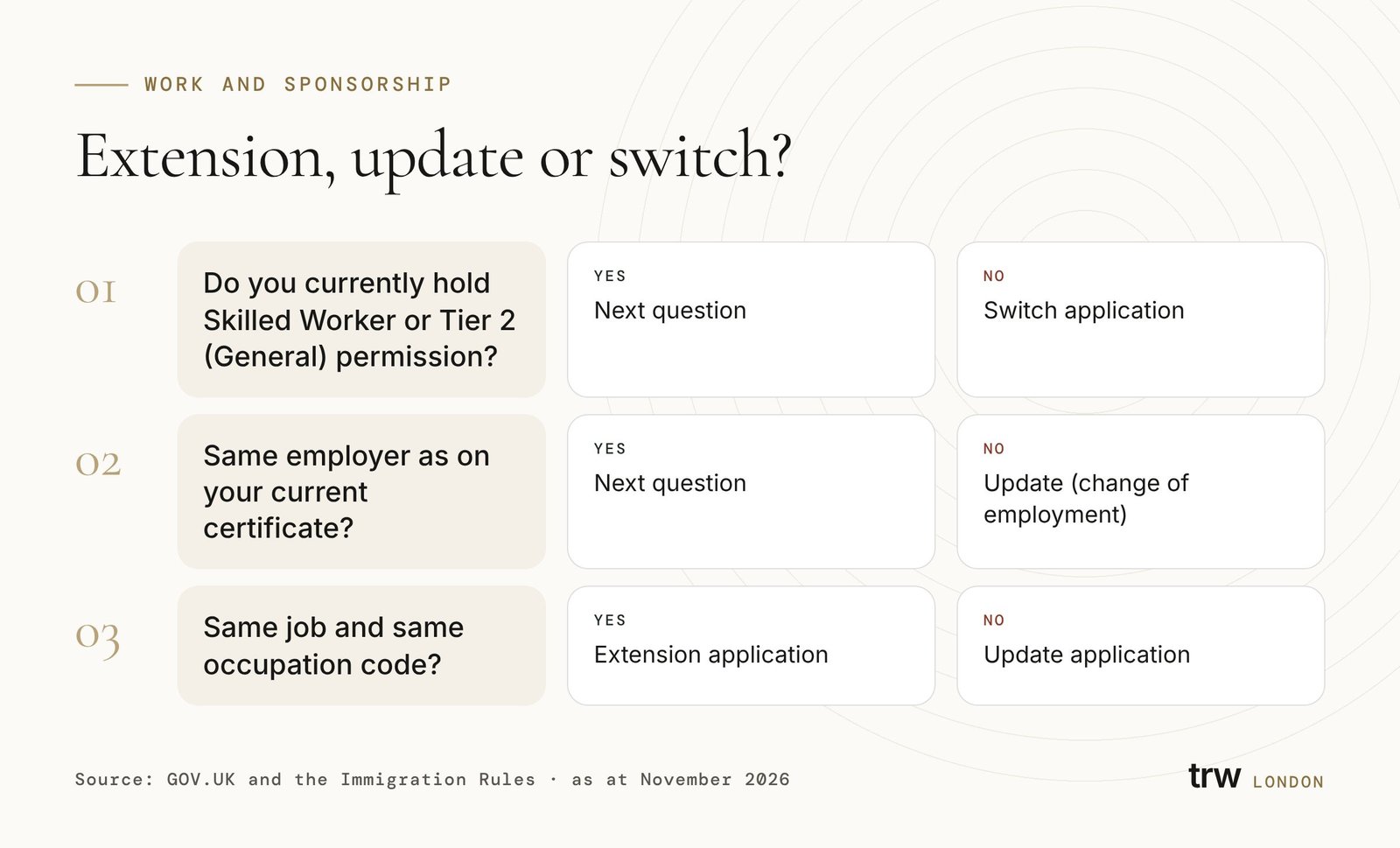
Extension, update or switch?
GOV.UK's extension page says you can usually extend if you have the same job as in your previous permission, the job is in the same occupation code, and you still work for the employer that gave you your current certificate. A promotion that stays within the same code can be handled as an extension. A promotion into a different code cannot.
Extension
- Same employer, same job, same occupation code
- New certificate from the current sponsor
- Sponsor need not be A-rated (SW 5.3 exception)
- Inside-UK fee: £943 or £1,865
Update (change of employment)
- New employer, or same employer and a different code
- New certificate from the new sponsor
- New sponsor must be A-rated
- Same inside-UK fee band; dependants apply separately
The distinction matters most where a worker is near the end of their permission and also about to change role. Filing a Skilled Worker visa extension for a job that has in fact changed code risks a refusal for a job that does not match the certificate. Our guide to change of employment covers the update process.
Who can extend a Skilled Worker visa
To extend a Skilled Worker visa you must already hold Skilled Worker permission, or Tier 2 (General) permission carried forward into the route, and the job must still qualify. The skill-level rules have tightened, so the question is often whether the worker's occupation is still eligible for them.
If the job is listed as "medium skilled", you can extend a Skilled Worker visa only if you got your first certificate of sponsorship before 22 July 2025 and have held Skilled Worker permission continuously since. A worker first sponsored in a medium-skilled code after that date is relying on the Temporary Shortage List or the Immigration Salary List; see our Temporary Shortage List guide on the 31 December 2026 cut-off. Prison officers (code 3314) have their own extension rule: a certificate issued by 31 December 2027, for no more than three years.
Care workers and senior care workers already sponsored in codes 6135 and 6136 can extend under SW 6.1B(b). Where a care worker has been continuously sponsored in care since before 11 March 2024 and stays with the same sponsor, the Care Quality Commission registration requirement does not apply (SW 6.1C).
Salary rules on an extension application
The salary test is applied afresh on every Skilled Worker visa extension, using the thresholds in force on the date you apply. Being granted at last year's rates gives no protection if the rates have moved. The rules depend on which cohort you are in.
| Your situation | Minimum salary | Source |
|---|---|---|
| First certificate before 4 April 2024, continuous permission since | Higher of £31,300 and the lower going rate; discounted floors of £25,000 (or £28,200 for a non-STEM PhD); for applications before 4 April 2030 | GOV.UK; SW 4.2(b)(ii) |
| First certificate on or after 4 April 2024 | Higher of £41,700 and the going rate, unless a discount applies (£33,400 floor) | SW 4.2 option A |
| Job on a national pay scale (health or education) | Higher of £25,000 and the pay-scale rate | SW 13.1, option K |
| Originally Tier 2 (General), certificate on or after 24 November 2016 | Lower rates; allowances such as London weighting can count if you apply before 1 December 2026 | GOV.UK; SW 14.5 |
| Prison officer (3314) | Higher of £31,300 and the lower going rate | SW 4.2(d) |
Two points of detail catch people out on an extension application. First, going rates are pro-rated to the hours on the certificate, based on a 37.5-hour week, and only the first 48 hours a week count. Second, since HC 1691 (March 2026) the salary must actually be paid at the required level in each pay period. An extension application can expose past underpayment as well as future shortfall.
The government's earned settlement response (CP 1707) says the pre-April 2024 cohort will be able to extend "on their current terms until 2035". That is announced policy only. The Rules still say 4 April 2030, and no implementing Statement of Changes has been laid.
Special cases when you extend a Skilled Worker visa
Some workers carry conditions from their first grant into every later extension application. The four most common are summarised below. Each turns on facts the sponsor may not hold, so the worker should raise them early.
New entrant salary rates
If you were granted at 70% of the going rate as a new entrant, your combined time as a Skilled Worker, Graduate and Tier 2 migrant on those terms cannot exceed four years (SW 12.3). An extension beyond that point must meet the full rate.
PhD points
Points for a relevant PhD need not be re-evidenced if they were correctly awarded before, but the sponsor must again explain how the qualification is relevant to the job (SW 9.4).
Job removed from the Immigration Salary List
SW 11.2 lets you keep ISL salary treatment if your job was removed from the list, provided you continue in the same job for the same sponsor as in your last permission.
Health and education pay scales
If your role is paid on a national pay scale, the threshold is the higher of £25,000 and the pay-scale rate for your band, which may have risen since your last grant.
None of these special rules changes the basic test for a Skilled Worker visa extension: same job, same code, same sponsor. They change only how the salary points are scored.
English, funds and documents
If you held the visa before 8 January 2026, GOV.UK confirms you need English at level B1 for an extension and do not need to prove it again. Workers who first entered the route on or after 8 January 2026 will usually already have shown B2.
Most people who extend a Skilled Worker visa do not need to show maintenance funds. Under SW 15.1, an applicant who has been in the UK with permission for 12 months or more meets the financial requirement automatically. GOV.UK adds that you only need to provide the other supporting evidence again if you have been in the UK for less than a year.
- Certificate of sponsorship reference number from your current employer
- Valid passport or other identity document
- Job title, occupation code and annual salary (from the certificate)
- Evidence of funds only if you have been in the UK for under 12 months
- Ecctis or UK PhD evidence only if claiming PhD points for the first time
- ATAS certificate if your sponsor says the role requires one
Timing and section 3C leave
A Skilled Worker visa extension must be applied for before your current permission expires. The certificate start date must be no more than three months after the date of application (SW 5.1(c)), which in practice means you can apply up to three months before the new certificate period begins. Leave will be granted until 14 days after the certificate end date, and a single certificate can run for up to five years (SW 18.1).
An application made in time keeps your existing permission running, on the same conditions, until it is decided, under section 3C of the Immigration Act 1971. That protection also continues while an in-time administrative review is pending. It is lost if the application is withdrawn, and an in-country extension application is treated as withdrawn if you travel outside the UK, Ireland, the Channel Islands or the Isle of Man before a decision.
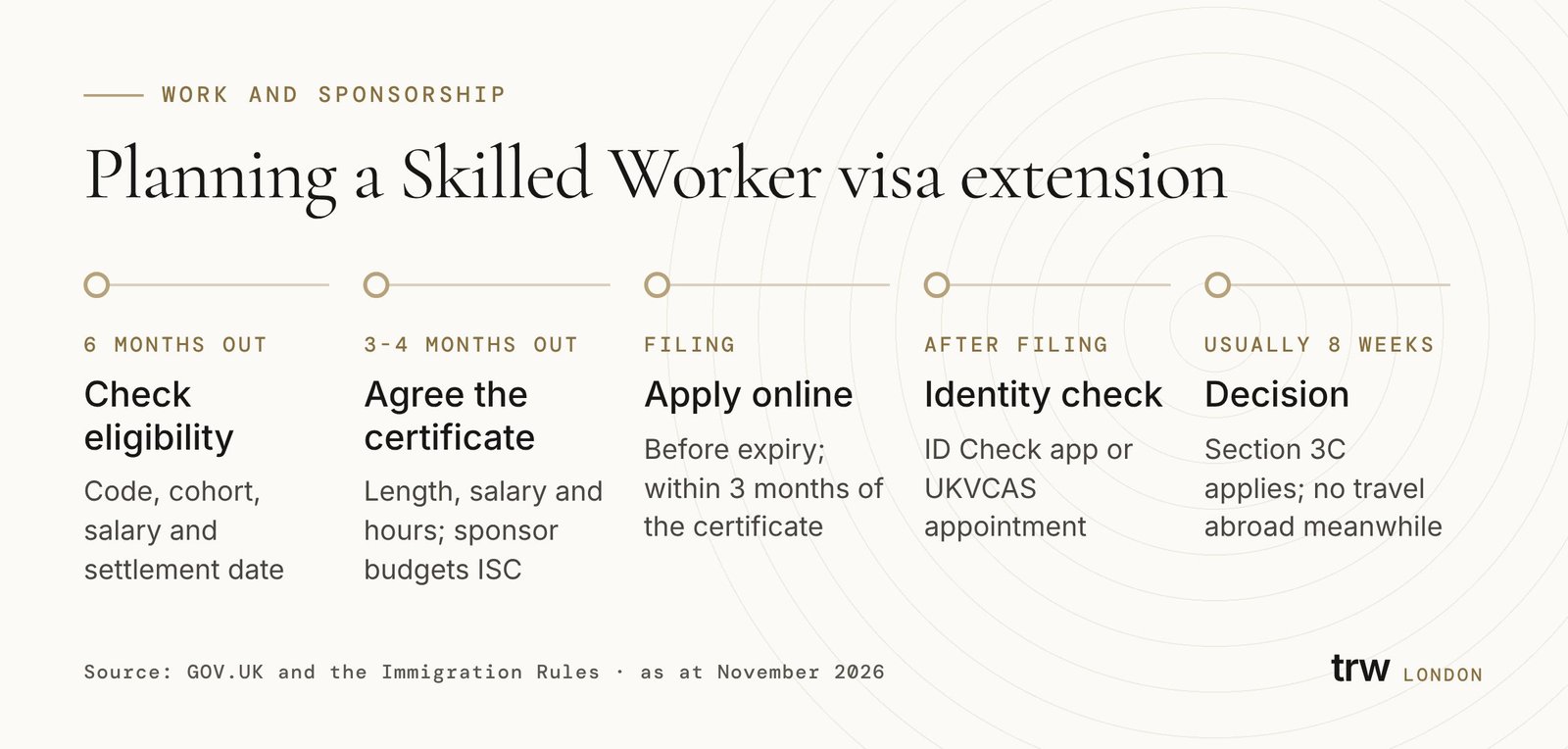
- 6 months before expiry
Diary the deadline
Check the code, cohort and salary rules; confirm whether ILR is closer than you think.
- 3 to 4 months before
Agree terms with the sponsor
Settle the certificate length, salary and hours; the sponsor budgets for the ISC.
- Up to 3 months before the new start date
Certificate assigned and application filed
Apply online; the certificate must be used within three months.
- Shortly after filing
Prove identity
ID Check app or UKVCAS appointment; no fee for biometrics.
- Usually within 8 weeks
Decision
Section 3C keeps you lawful meanwhile; do not travel abroad.
Costs of a Skilled Worker visa extension
On a Skilled Worker visa extension the worker pays the Home Office application fee and the Immigration Health Surcharge. The sponsor pays the certificate fee and, usually, the Immigration Skills Charge. Fees below are as at November 2026; check the current GOV.UK fee page before you apply.
Where the job is on the Immigration Salary List the fee is £628 or £1,235. GOV.UK states the Immigration Skills Charge applies to applications from inside the UK for any length of time, at £480 (small or charitable sponsors) or £1,320 (medium or large) for the first 12 months and £240 or £660 for each further six months. There is no charge where the worker switched from a visa that allowed study and is now extending.
Paying £500 for priority or £1,000 for super priority may shorten the wait where GOV.UK offers it. The employer must not pass the certificate fee or the ISC on to the worker.

What the sponsor has to do
For an extension application the sponsor assigns an undefined certificate, pays the fees and confirms the salary and hours. Under SW 5.3 the sponsor does not need to be A-rated where the worker is continuing in the same job for the same sponsor. GOV.UK's licence rating page confirms that a B-rated sponsor cannot assign new certificates to new workers but can still support existing workers who are extending.
Sponsors should use each extension application as a compliance check: confirm that the role, hours and pay match what is on the certificate, that right to work records are complete and that any changes during the last grant were reported. Our sponsor compliance team can review files before certificates are assigned.
Pitfalls in an extension application
Applying a day late
If permission expires before the application is made, section 3C does not apply and the worker becomes an overstayer. Part Suitability has limited exceptions for short, explained overstaying, but they are not a plan. See our guide to section 3C leave.
Using last year's salary figures
Going rates and thresholds are updated between grants, and every extension application is assessed on the current tables. Check the tables on the date the certificate is assigned and allow for pro-rating if hours have changed.
A quiet change of duties
If the role has drifted into a different occupation code, an extension is the wrong application. Re-code the job honestly and, if needed, apply to update instead.
Forgetting the family
Dependants' permission does not extend automatically. Each partner and child must apply, either with the worker or before their own leave ends; see Skilled Worker dependants.
Pay that dipped in some months
SW 14.3B requires the salary to be paid at least monthly and, for monthly-paid staff, the pay over any three-month period must be at least a quarter of the required annual salary. Unpaid leave, a cut in hours or a deduction scheme can create a shortfall. Review payslips for the whole grant before the certificate is assigned, and correct the position with advice if needed.
Booking holidays while the application is pending
Travel outside the Common Travel Area withdraws an in-country application. Plan travel around the decision or consider priority processing.
Worked example: extending under the lower salary rules
Example (hypothetical), a Skilled Worker visa extension in practice: a structural engineer was first sponsored by a London consultancy on a certificate assigned in January 2024 and has held Skilled Worker permission continuously since. Her three-year grant expires in February 2027. She stays in the same job and code, so this is an extension application.
Because her first certificate predates 4 April 2024, she needs the higher of £31,300 and the lower going rate for her code, not £41,700. She held the visa before 8 January 2026, so B1 English is enough and she need not prove it again. She has lived in the UK for more than 12 months, so no funds are needed.
Her employer assigns a two-year certificate. With two years she will reach five years' qualifying residence and can then consider ILR. She files in December 2026, pays £943 and two years of surcharge, and stays in the UK until the decision.
A well-timed extension is often the bridge to settlement, so set the certificate length with the five-year date in mind.
Extension or settlement?
Skilled Workers can currently apply for indefinite leave to remain after five years, provided absences have not exceeded 180 days in any 12-month period, and they can apply up to 28 days early. The ILR fee is £3,226 per person. If the five-year point falls shortly after the current grant ends, a short Skilled Worker visa extension may be needed to bridge the gap.
From 26 March 2027 Skilled Worker settlement will require English at B2, under rules already laid in HC 1691. Separately, the earned settlement policy announced in November 2026 would lengthen the default qualifying period for many workers, but it is not yet law and has no start date. For people near five years, settling under the current rules sooner may be worth considering; see our ILR for Skilled Workers guide.

Related guides
Change of employment
When a new employer or code means an update, not an extension.
Read the guideFamilySkilled Worker dependants
How partners and children extend alongside you.
Read the guideSettleILR for Skilled Workers
The five-year route and the B2 change from March 2027.
Read the guideWorkGoing rates
How to find and pro-rate the going rate for your code.
Read the guideNext steps
If you need to extend a Skilled Worker visa, start six months out: confirm your cohort, code and salary, agree certificate length with your sponsor, and decide whether settlement is close enough to plan around. The Skilled Worker visa guide and our Skilled Worker practice page have more background.
We usually start by checking the salary history against the pay-period rule, because problems there are easier to fix before the application than after it. To talk through your Skilled Worker visa extension, book a consultation.
Frequently asked questions
01How early can I apply to extend?
The certificate start date must be no more than three months after you apply, so in practice you can apply up to three months before the new certificate period starts. You must apply before your current permission expires.
02Can I work while my extension is pending?
Yes. If you applied in time, section 3C extends your existing permission on the same conditions until the decision, so you can keep working for your sponsor.
03What if my extension is refused?
You can usually apply for administrative review within 14 days for a fee of £80. Section 3C continues while an in-time review is pending.
04Do I need a new English test?
Not if you held the visa before 8 January 2026: you need B1 and do not have to prove it again. Settlement applications from 26 March 2027 will need B2.
05Can my employer extend me if its licence has been downgraded?
A B-rated sponsor cannot assign certificates to new workers, but GOV.UK says existing workers can still extend. The sponsor must follow its action plan.
06Is there a maximum number of extensions?
No. GOV.UK says you can extend as many times as you like while you meet the requirements, subject to any route-specific caps such as the four-year limit for new entrant salary rates.
07Do I need a TB test or criminal record certificate to extend?
Those requirements are aimed at applicants coming from abroad. The criminal record certificate requirement in SW 16.1 applies to entry clearance applications in listed occupations.
Sources and official materials
- Skilled Worker visa: extend your visa — Eligibility, Tier 2 transitional rules and process
- Immigration Rules: Appendix Skilled Worker — SW 4.2 salary options, SW 5.3, SW 14.3B, SW 15.1, SW 18.1
- Skilled Worker visa: first certificate before 4 April 2024 — Lower salary rules until 4 April 2030
- Immigration Act 1971, section 3C — Continuation of leave pending decision
- Skilled Worker visa: how much it costs — Inside-UK fees
- Sponsors: Immigration Skills Charge — ISC on in-country applications
- Indefinite leave to remain for Skilled Workers — Settlement after 5 years
General information only, current as at 19 November 2026. It is not legal advice and does not create a solicitor–client relationship. It reflects the law of England and Wales unless stated otherwise; Scotland and Northern Ireland have separate legal systems, and the law changes frequently. Check current official sources and take advice on the facts of your matter.